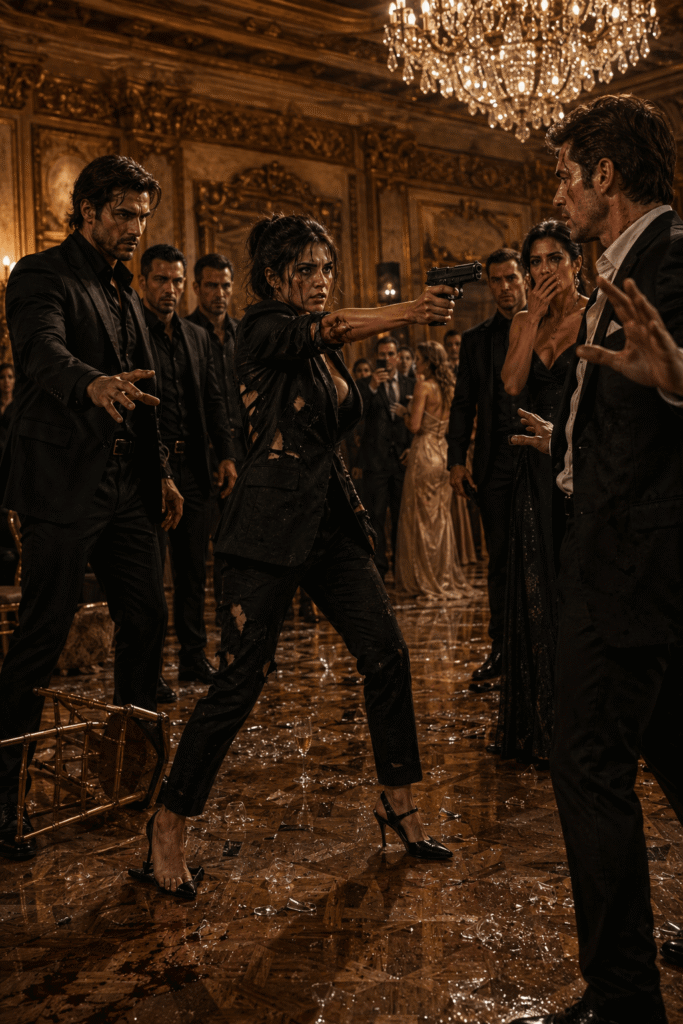
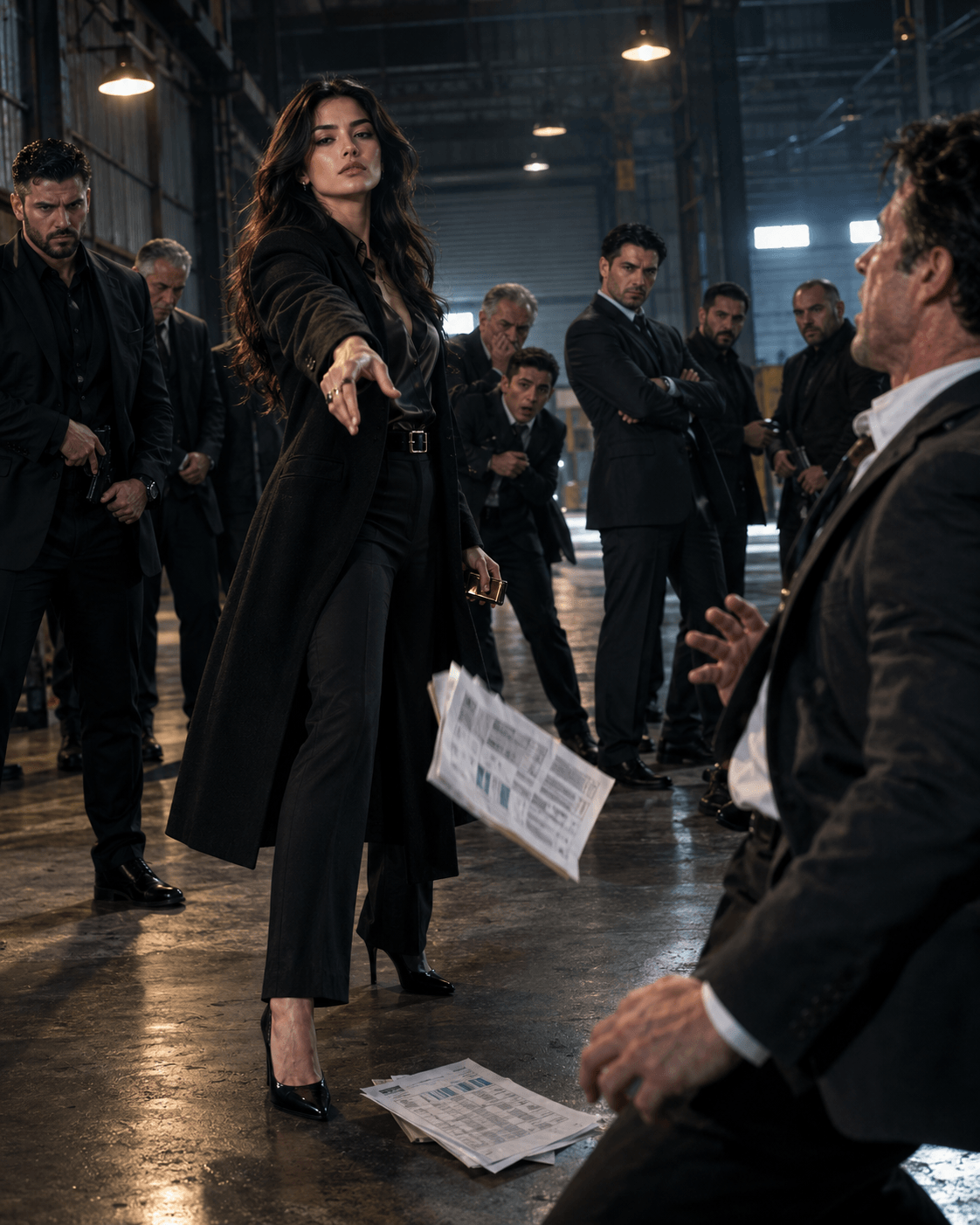
“Do you know why I carry this? My father gave it to me when I was sixteen. He said, ‘Every decision has a cost. Light the fire, or don’t. But never pretend you didn’t choose.'”
Chapter 1
The fire started in the west warehouse at 3:47 a.m., and by the time Marcella Vianello arrived, the sky above Red Hook was the color of a healing bruise.
She parked the black Range Rover herself, ignoring the cluster of made men who moved toward her like iron filings to a magnet. Sal DiBenedetto reached her first, his face smeared with soot, his breath short. “Boss, the sprinklers—”
“Didn’t go off.” She walked past him toward the chain-link fence, her heels grinding broken glass into the asphalt. The heat hit her at twenty yards, a physical wall that made the men behind her flinch. She didn’t. “Which means someone cut the valves before they lit it.”
Sal’s silence was confirmation enough.
Marcella stopped at the edge of the loading dock and watched a hundred thousand dollars’ worth of imported olive oil burn. The glass in the windows had already blown; the frames sagged like wet cardboard. Fire trucks wailed somewhere in the distance, but Red Hook’s narrow streets would slow them. The building would be a skeleton before the water came.
“How many inside?” she asked.
“No one. Night watchman called it in from the gate.”
“Cameras?”
“Dead. Cut the power to the east side first.”
She turned then, and Sal DiBenedetto—fifty-eight years old, forty-one of them in her father’s service—took a step back. Not from fear. From something closer to instinct, the way a man steps back from a ledge.
“Mr. DiBenedetto.” Her voice was quiet. “You’re telling me someone got through our fence, our locks, our cameras, and our men, and no one saw anything.”
“The night shift—”
“The night shift was yours to assign.”
She let that sit. The fire roared behind her, painting the dock in orange light. A half-dozen of her father’s men stood frozen at the fence line, watching. They were all older than her. All of them had known her when she was a girl in braids, trailing through the social club with a coloring book. All of them had laughed—politely, behind their hands—when she’d taken the seat her brother should have inherited.
That was eleven months ago. Some of them had stopped laughing.
“Get the shipping manifests from the office,” she said. “Every item that was in that warehouse, I want it accounted for by noon. If so much as one crate was moved before the fire, I want to know where it went and who signed for it.”
Sal nodded, already backing toward his car. “I’ll handle it.”
“You’ll do it yourself, not delegate it.” Marcella pulled the brass Zippo from her coat pocket, flicked it open, closed it. No flame. Just the worn, silent hinge. “And Sal—we’re going to talk about the valve before the week is out. You and I, alone.”
She didn’t wait for his response. She turned back to the fire, and in the reflection of the flames against the darkened warehouse windows, she could see the men behind her exchange glances. What does she mean by that? What does she know?
Let them wonder. Wondering kept them careful.
The fire chief arrived, then a police captain who owed her family three decades of favors. Marcella handled both with the same flat courtesy, answering questions without revealing information, accepting condolences for losses she hadn’t actually suffered. The insurance would cover the building. The cargo was the question. If Sal had been skimming—and the cut valve suggested he had been, covering his tracks—then the fire was just the cleanup.
At 5:15 a.m., her phone buzzed. A text from her consigliere, Frankie Russo: Need to talk. Not on the phone. The Fork, 6:00.
She didn’t respond. She finished her conversation with the fire chief, waited until the trucks were positioned and the hoses were running, then walked back to the Range Rover. The sky was starting to lighten, a pale gray that caught the soot in the air and made it shimmer.
She drove to The Gilded Fork herself.
The social club sat on a corner off Court Street, its brick facade unremarkable, its windows dark. The back entrance was through a kitchen that hadn’t served food since 1997. Marcella pushed through the aluminum door and found Frankie Russo already seated at the round table in the back room, a cup of espresso going cold in front of him.
He looked up when she entered, and she read the news in his face before he opened his mouth.
“Tell me,” she said.
“Your brother’s been making calls.”
Marcella pulled out the chair across from him and sat. The Zippo was in her hand again, the familiar weight of it. Flick. Close. Flick. Close.
“To who?”
“To whom,” Frankie corrected absently, a habit from his days as a Jesuit before his father’s death pulled him into the family. “And the answer is: Sal. Tommy Grimaldi. Old man Caruso. Anybody who still thinks a woman in that chair is a placeholder.”
“And what does my brother offer them?”
“Same thing he always offers. Tradition. The old ways. A seat at the table where the wine flows and the women stay upstairs.” Frankie’s mouth twisted. “He’s telling them the warehouse fire was a sign. That you can’t protect the business.”
“The fire happened three hours ago.”
“He called them before the flames were out.”
The Zippo stopped moving. Marcella set it on the table with a click—the first sound it had made in years, and it felt like a gunshot.
“Enzo,” she said, “torched my warehouse to make me look weak, and then called my captains to tell them I was weak.”
“Looks that way.”
“And Sal?”
“Sal knew. Maybe not the whole plan, but enough.” Frankie hesitated. “I can’t prove it yet.”
“You won’t have to.” Marcella leaned back in the chair, her eyes on the lighter. “Get me the Castellano file.”
Frankie’s eyebrows rose. “The Castellanos? They’re not in the life.”
“They’re not in your life,” she said. “They’re in mine now.”
Chapter 2
The Castellano family owned fifteen properties across Brooklyn and Queens, all of them legitimate, all of them profitable, and all of them managed by the only surviving grandson: Adrian Castellano, thirty-six, Columbia Business School, currently sitting on more debt than his portfolio could comfortably service.
Marcella had known this for six months. She’d been waiting for the right moment to use it.
She sent the first message through an intermediary—a real estate attorney who owed her a favor and handled the Castellano family’s zoning disputes. The request was simple: a meeting. Private. Neutral ground. Two days after the fire, Adrian Castellano walked into her club like he’d been coming there for years.
He was taller than she’d expected, broader through the shoulders, with the kind of face that belonged on a university campus—open, intelligent, unguarded. But his eyes moved differently. They swept the room once, cataloging, before he even reached the table.
“Ms. Vianello.” He extended his hand. “I’d say it’s a pleasure, but I suspect you didn’t invite me here for the coffee.”
She shook his hand. Firm, brief, professional. “Sit down, Mr. Castellano.”
He sat. She let the silence stretch while she studied him—the expensive watch, the well-cut suit that had been tailored two years and ten pounds ago, the faint crease between his brows that suggested he wasn’t sleeping well.
“I hear you’re having trouble with the Trask Group,” she said.
Something flickered in his eyes. “I’m not sure I’d call it trouble.”
“Then what would you call it? They’re buying up the debt on your office buildings, calling it in early, forcing you to refinance at rates that’ll strangle you within eighteen months.”
Adrian leaned back in his chair, and a ghost of a smile touched his mouth. “You’ve done your research.”
“I always do.”
“So why am I here? You’re not a lender. Last I checked, your family doesn’t do commercial real estate.”
“Last you checked.” Marcella opened the file folder on the table between them. Inside were photographs of four buildings—all Castellano properties, all prime Brooklyn real estate. “I’m not offering you a loan. I’m offering you a partnership.”
“Partnership.” He said the word like it had a bad taste.
“You need capital. I need legitimate fronts for import-export. Your buildings have loading docks, warehouse space, and a reputation that doesn’t follow the Vianello name. We’d be good for each other.”
Adrian picked up one of the photographs. Studied it. Set it down. “You want to move product through my properties.”
“I want to move cargo. Wine, oil, textiles. Legitimate goods with legitimate paperwork.” She paused. “And occasionally, goods with less legitimate paperwork. That’s where your people don’t ask questions and mine handle logistics.”
“Drugs.”
She didn’t confirm or deny. She didn’t need to.
“Why would I say yes to this?” Adrian asked. “I’m a businessman, not a criminal.”
“You’re a businessman with nine million in debt that comes due in six months. The Trask Group wants your grandfather’s portfolio, and they’ll get it—unless you have a better option.” Marcella closed the file folder. “Tell me you have a better option, Mr. Castellano, and I’ll walk out of this room and never contact you again.”
He didn’t tell her that.
Instead, he picked up the folder and leafed through it—slowly, carefully, his eyes moving across the numbers with an almost tactile attention. When he reached the last page, he paused.
“This figure’s wrong.”
Marcella frowned. “Which figure?”
“The projected shipping volume from your Genoa supplier. If you’re moving four containers a month through that operation, your numbers should be closer to three-point-two after customs fees and port delays. This says four-point-eight.” He looked up. “Either your supplier is faking their capacity, or someone’s skimming you on the back end.”
She stared at him for a long moment. Then she took the folder from his hands and looked at the page. The number sat there, unremarkable, exactly what her logistics manager had given her last quarter.
“You’re sure.”
“Photographic memory.” He tapped his temple. “Numbers don’t lie to me. But people do.”
Marcella closed the folder and set it aside. The Zippo was in her hand, the worn hinge moving silently. “This is what I’m offering you, Mr. Castellano. Access to capital. Protection from the Trask Group. And a partner who will never—” She stopped. “A partner who will always tell you the truth about what’s in front of you.”
“Why do I think the truth isn’t something you share easily?”
“I share it when it serves me.” She met his eyes. “And it serves me now.”
The room was quiet. Somewhere in the front of the club, a door opened and closed. Footsteps in the hallway. Adrian leaned forward, forearms on the table.
“I have conditions.”
“I’d be disappointed if you didn’t.”
“I don’t meet with your people. You want to discuss business, we talk face-to-face, no intermediaries. I don’t want to know about the other side of your operation—not the names, not the specifics. If something illegal happens in my buildings, I have plausible deniability. Written into the contract.”
“Anything else?”
“If the Trask Group gets aggressive, I want your people to handle it. Quietly.”
Marcella studied him. “You want protection without the smell of it on your hands.”
“I want to keep my businesses and my conscience. They don’t have to shake hands.”
She almost smiled. The impulse surprised her—she hadn’t felt the urge in months. “You think you can work with me and keep your conscience clean?”
“I think I can work with you and keep it cleaner than the alternative.” He stood, straightening his jacket. “Do we have a deal?”
Marcella remained seated. She looked up at him—this man who’d just walked into her club, questioned her numbers, and made demands of her like an equal. It was either recklessness or confidence. She couldn’t decide which was more interesting.
“One more thing,” she said. “The man who gave me those shipping figures—my logistics manager—he’s been with my family for fifteen years. Started under my father, stayed under my brother. If you’re wrong about the numbers, I’ll know by next week. And if you’re right—” She stood, meeting his gaze. “I’ll handle it.”
“I don’t want to know what that means.”
“No,” she said. “You don’t.”
She walked him to the door herself. When he was gone, she stood alone in the empty club, the Zippo still and silent in her palm.
It had been eleven months since she’d taken this chair. Eleven months of proving herself to men who thought her father’s death should have meant her brother’s rise. Eleven months of deflecting, managing, outmaneuvering. She was tired of being underestimated. Tired of smiling when she wanted to put her fist through a wall.
Adrian Castellano had looked at her and seen a partner—or a threat. She wasn’t sure which yet. But for the first time since her father’s body was pulled from the East River, someone had looked at Marcella Vianello and spoken to the woman holding power, not the girl pretending at it.
That was worth the risk.
For now.
Chapter 3
The first week of the partnership was nothing but paper.
Contracts, revised twice by Adrian’s lawyers and once by Frankie. Shipping schedules reviewed line by line. Access codes for the loading dock at the Castellano property on Van Brunt, transferred through three shell companies before reaching Marcella’s hands. It was tedious, meticulous work—the kind of work her father had hated and her brother had refused to do. Marcella did it all herself.
On the eighth day, Adrian called a meeting at his office in Cobble Hill, a renovated brownstone that smelled like fresh coffee and floor wax. His assistant—a woman in her sixties with sharp eyes and a sharper tongue—showed Marcella to the third-floor conference room without batting an eye. Marcella wondered what Adrian had told her about this arrangement. Probably nothing. He was careful with information.
“New shipment from Genoa arrives Thursday,” she said, spreading the manifest across the conference table. “Three containers. Wine, olive oil, and—”
“Let me guess.” Adrian didn’t look up from the document. “Something that’s been mislabeled.”
“Sundries.”
“Sundries.” He smiled, but it didn’t reach his eyes. “I like that. Very diplomatic.”
“My logistics manager came through with the revised numbers.” She slid another page toward him. “You were right about the skim. Eight percent off the top, every quarter, going back at least two years.”
“What are you going to do about it?”
The question was casual, conversational. But Marcella caught the edge beneath it—the test. He wanted to know who he was getting into bed with. Or more accurately, what kind of woman he was getting into bed with.
“I’ll handle it after the shipment clears,” she said. “No reason to draw attention before the product’s in hand.”
Adrian nodded, his eyes finally lifting to hers. “And my payment?”
“Transferred yesterday. You should have it by now.”
He pulled out his phone, checked something, pocketed it again. The corner of his mouth lifted. “So I do.”
“You doubted me?”
“I doubt everyone.” He pushed back from the table and walked to the window, looking down at the street below. “It’s kept me alive and solvent for thirty-six years.”
“Your family’s never been in the life.”
“My family’s been adjacent to the life for three generations. We owned the buildings where the life happened. We took the rent, looked the other way, and told ourselves we were clean.” He turned to face her. “That’s its own kind of dirty, Ms. Vianello. Don’t mistake it for innocence.”
She stood, gathering the papers. “Then we understand each other.”
“Hardly.” But there was something in his voice that hadn’t been there at their first meeting. Something almost like respect. “But we’re getting there.”
Three days later, the shipment arrived.
Marcella supervised the unloading herself, standing in the shadow of the warehouse as the containers were opened and the cargo inventoried. The wine was excellent—her father’s supplier in Genoa had never disappointed. The olive oil was she, with dates and labels checked against the manifest. And the “sundries”—three crates of them—were moved to a separate loading bay without ceremony.
When the work was done, she walked to the far end of the dock, where the Red Hook channel lapped against the pier. The afternoon sun was pale and watery, casting long shadows across the concrete.
Sal DiBenedetto found her there.
“Boss.” His voice was hesitant, the bravado of the fire gone. “We need to talk.”
She didn’t turn. “About the fire.”
“About a lot of things.” He moved to stand beside her, his bulk blocking the wind. “I’ve been with your father’s people since before you were born. I’ve done things I’m not proud of. But I’ve always been loyal to the family.”
“Which family?”
The question landed like a slap. Sal’s face darkened. “What’s that supposed to mean?”
Marcella finally turned to look at him. “The camera feeds were cut, Sal. The valve was cut. Someone knew exactly when and where to hit, and that someone is someone inside my organization.”
“You think it’s me.”
“I think my brother called you. I think you didn’t tell me. I think that makes you a liar, and the question is whether it also makes you a traitor.” She paused. “Tell me I’m wrong.”
Sal’s mouth opened, then closed. The wind picked up off the water, carrying the smell of salt and diesel. Somewhere behind them, a forklift beeped, backing up with another pallet.
“He called,” Sal said finally. “He wanted to know about the shipment. The one that came in today.”
“What did you tell him?”
“Nothing. I told him nothing, Marcella. I swear on my children.” His voice cracked, raw with something that might have been fear or might have been grief. “But he’s not wrong about the rest of it. The men are talking. They say you’re moving too fast, making deals with outsiders, treating the family business like a—” He stopped.
“Like a what?”
“A corporation. Like you’re some kind of CEO instead of a boss.”
Marcella looked at him for a long moment. Then she reached into her coat and pulled out the Zippo. Flick. Close. Flick. Close. The worn hinge swallowed the sound.
“Mr. DiBenedetto,” she said quietly, “do you know why I carry this?”
He shook his head.
“My father gave it to me when I was sixteen. He said, ‘Every decision has a cost. Light the fire, or don’t. But never pretend you didn’t choose.'” She closed her hand around the lighter. “I choose every day. I chose to take this chair instead of letting my brother burn what our father built. I chose to make a deal with Adrian Castellano because our organization needs legal infrastructure or it dies. And I’m choosing right now to give you one chance to prove you’re not the one who opened that valve.”
Sal’s face had gone pale. “What do you need me to do?”
“Find out who Enzo’s been talking to. Not the obvious ones—the ones he thinks are invisible. His secret connections.” She looked at him. “And Sal—if you warn him I’m coming, I’ll know. And the next time we meet, it won’t be on this dock.”
She left him there, walking back toward the warehouse with even steps, her heels loud against the concrete. Behind her, she could feel his eyes on her back, but she didn’t turn.
In the car, she called Frankie.
“I need everything we have on the Castellano family,” she said. “Not just the businesses. The personal history. The debts, the grudges, the marriages, the funerals. Everything.”
“Why?”
She watched the warehouse shrink in the rearview mirror. “Because Adrian Castellano just did me a favor he didn’t have to do. And in my experience, men only do favors when they’re either angling for something or running from something.”
“And you want to know which.”
“I want to know both.”
The line went quiet for a moment. Then Frankie said, “Marcella—there’s something else. The Genoa supplier called. He says someone’s been asking questions about the shipment that came in today. Someone with a badge.”
Her hand tightened on the steering wheel. “Federal?”
“Unclear. Could be customs, could be FBI. Either way, someone’s poking around where they shouldn’t be.”
Marcella merged onto the BQE, the traffic parting around her like water around a stone. “Then we find out who before they find out anything.” She paused. “And Frankie—the logistics manager. Marco. Put someone on him. Quiet. I want to know where he goes, who he talks to, and what he does with the money he’s been stealing.”
“Understood.”
She hung up and drove the rest of the way to the club in silence. The sun was setting over the harbor, painting the old brick buildings in shades of orange and rust. The city looked like it was burning, and Marcella thought: let it. She’d rebuild from the ashes.
She always did.
Chapter 4
Four days later, Adrian Castellano walked into The Gilded Fork without an appointment.
Marcella was in the back room, reviewing the latest reports from the waterfront—a drop in docking fees, a dispute between two longshoremen that threatened to slow the next shipment. She heard him before she saw him: the front door opening, the brief exchange with the man posted by the entrance, the footsteps in the hall.
He appeared in the doorway, his face unreadable.
“We have a problem,” he said.
She set down her pen. “We have several. Which one are you referring to?”
“The federal kind.” He walked to the table and dropped a single sheet of paper in front of her. It was a letter, printed on official letterhead, addressed to Castellano Properties. “I received this yesterday. The New York Field Office of the FBI would like to schedule a ‘voluntary interview’ regarding my recent business transactions.”
Marcella read the letter twice. “They’re fishing.”
“Maybe. But they’re fishing in my waters, and I don’t like it.” He sat down across from her, unbuttoning his jacket. “Someone’s been asking questions. Not just about me—about my family, my finances, my connection to certain import-export businesses on the Red Hook waterfront.”
“Coincidence.”
“I don’t believe in coincidences.” His eyes held hers. “I need to know if you brought this to my door.”
“I didn’t.”
“Prove it.”
She leaned back, studying him. He looked different than he had at their previous meetings—less polished, more raw. The crease between his brows had deepened, and there was tension in his jaw that suggested he hadn’t slept.
“Someone’s been asking questions about my shipments too,” she said. “Someone with a badge, according to my supplier in Genoa. Which means either the feds are watching both of us separately—or someone’s feeding them information.”
“Who?”
“That’s what I intend to find out.” She picked up the letter, folded it, and slid it into her pocket. “I’ll handle the interview. You don’t go.”
“I wasn’t planning to.”
“Good.” She stood and walked to the small bar in the corner of the room, pouring two glasses of amber liquid from a crystal decanter. “Drink. You look like you need it.”
He accepted the glass, his fingers brushing hers. The contact was brief—accidental—but something crackled in the space between them. Marcella ignored it.
“Your family has unfinished history with the Vianellos,” she said, settling back into her chair. “I know about the dock strike in ’87. I know about the loan your grandfather took from my uncle that was never repaid. I know about the woman—”
“Careful.” His voice was sharp. “That’s old history. It doesn’t have anything to do with now.”
“It has everything to do with now. History is leverage, Mr. Castellano. And I need to know what leverage someone else might have on you before I can protect you.”
Adrian took a long drink, his eyes fixed on something past her shoulder. When he spoke again, his voice was quieter. “My father died ten years ago. Heart attack. But before he died, he was involved with people he shouldn’t have been involved with. People who used his death as an opportunity to clean house.”
“What kind of people?”
“The kind who don’t leave loose ends.” He set down the glass. “I’ve spent ten years making sure my family’s name stays out of the papers. I’ve paid debts that weren’t mine, apologized for things I didn’t do, and smiled at funerals for men I wanted to kill. All so that my mother and my sisters could live without looking over their shoulders.” He met her eyes. “If the feds are digging into my family history, they’re going to find things. Not my crimes—I’ve been careful—but my father’s. And that’s enough to destroy everything I’ve built.”
Marcella felt something shift in her chest. Not sympathy—she’d trained herself out of that—but recognition. He understood what it was to carry a family’s weight. To pay for sins that weren’t yours.
“My father was pulled out of the East River with his hands cut off,” she said flatly. “Eleven months ago. The medical examiner said he drowned, but there was no water in his lungs. He was dead before he hit the river.” She paused. “My brother Enzo is the one who found the body. The one who called the family together. The one who stood in front of our father’s captains and said we needed to be smart, to stay quiet, to let the police handle it.”
Adrian’s expression had gone still. “But you didn’t agree.”
“Enzo was forty years old, had never run a day of our operation, and suddenly he knew exactly how to handle the murder of the most powerful man in Brooklyn?” She shook her head. “I didn’t take the chair because I wanted it. I took it because if I didn’t, my father’s killer would walk free and my family would follow him like sheep.”
“Your brother killed your father.”
“I can’t prove it yet.” The Zippo was in her hand now, moving in that familiar, silent rhythm. “But yes. I believe he did.”
The room was very quiet. In the front of the club, someone laughed—a loud, jarring sound that seemed to come from another world.
Adrian drained his glass and set it down with deliberate care. “Then I suppose we both have someone looking for us in the dark.”
“It seems we do.”
He stood, and for a moment he simply looked at her. The air between them was charged with something that wasn’t quite attraction and wasn’t quite distrust. It felt like standing on the edge of a deep trench, not knowing if the other person would push you or pull you back.
“I’ll handle the FBI,” Marcella said. “You handle the Trask Group. And we both keep our eyes open.”
“And if the information is coming from inside your organization?”
“Then I’ll handle that too.” She stood, moving around the desk to face him. “Mr. Castellano—I don’t lose. Not territory, not shipments, not people. Whatever’s coming, I’ll meet it head-on. The question is whether you’ll be standing beside me when I do.”
He studied her for a long moment. Then, unexpectedly, he smiled—a real smile, the first she’d seen from him. It transformed his face, softening the hard edges.
“You know, Ms. Vianello, I came here expecting to deliver bad news and leave. I didn’t expect to find myself wanting to stay.”
The words hung in the air between them. Marcella felt something flutter in her chest and ruthlessly suppressed it.
“Then stay,” she said. “The vodka’s decent.”
“I wasn’t talking about the vodka.”
Neither was she.
Chapter 5
The FBI agent who showed up at The Gilded Fork three days later was named Patricia Delgado, and she had the exhausted, unimpressed look of someone who’d been doing this job long enough to know exactly how useless it usually was.
Marcella received her in the front room, not the back. Let her see the peeling wallpaper, the scuffed floors, the old men playing cards in the corner who suddenly found reasons to leave. Let her think this was a dying social club, not the nerve center of a criminal empire.
“Ms. Vianello.” Delgado settled into a chair across from her, placing a recorder on the table between them. “Thank you for agreeing to speak with me.”
“I didn’t agree to be recorded.”
Delgado’s hand hovered over the device. “It’s standard procedure.”
“It’s standard procedure when you’re at a police station with a lawyer present. You’re in my club, unannounced, and you haven’t read me my rights. So either you’re not here to arrest me—in which case the recorder is unnecessary—or you are here to arrest me, in which case we have a very different conversation.” Marcella paused, letting the silence stretch. “Which is it, Agent Delgado?”
The agent studied her for a moment, then clicked the recorder off and pocketed it. “Fair enough.”
“Thank you.” Marcella leaned back, crossing her legs. “Now, what can I do for the Federal Bureau of Investigation?”
“I wanted to talk to you about your family’s business operations,” Delgado said. “Specifically, your recent partnership with Castellano Properties.”
Marcella’s expression didn’t change. “I’m not aware of any partnership. Mr. Castellano leases warehouse space. My family has legitimate import interests. The arrangement is purely transactional.”
“Transactions are what interest me.” Delgado pulled a notebook from her bag. “According to our records, your import business has grown substantially in the past eleven months. That’s quite an achievement for someone taking over a family enterprise under what I understand were difficult circumstances.”
“My father died. I took over the business. It’s what he would have wanted.” Marcella let a note of grief edge into her voice—just enough to sound human, not enough to sound weak. “I’m not sure what the FBI finds interesting about a woman running a legitimate import company.”
“We’re interested in patterns,” Delgado said. “Shipping manifests that don’t match port records. Payments that route through offshore accounts. Warehouses that burn down in the middle of the night.”
“The fire at my warehouse was investigated by the NYPD and the fire marshal. Their findings are available to you.”
“We’ve seen them. Arson, undetermined origin.” Delgado looked at her directly. “But here’s what’s strange, Ms. Vianello. The sprinkler system in that warehouse was manually disabled. The camera feeds were cut. And the night watchman—a man who worked for your family for twenty years—disappeared two days after the fire. He hasn’t been seen since.”
Marcella made a mental note to find out who’d handled the night watchman. She hadn’t ordered it. “People leave jobs, Agent. Especially after traumatic events.”
“His wife hasn’t heard from him. His children haven’t heard from him. His passport was found in his apartment, along with his wallet.” Delgado’s voice was flat, reciting facts. “So either he left in a hurry without his belongings, or someone made sure he couldn’t leave at all.”
“I’m sure I don’t know anything about that.”
“I’m sure you’d say that either way.” Delgado closed her notebook. “Let me be honest with you, Ms. Vianello. You’re not the target of my investigation. You’re a thread. Someone’s been feeding us information about your operation—specific information, the kind that only comes from inside. And I’m wondering if you know who that is, and if they might also be the person responsible for the fire.”
Marcella’s Zippo was in her hand, moving through its familiar silent rhythm. She let Delgado see it—a deliberate tell. Let her read it as nervousness, not calculation.
“If someone inside my organization was feeding information to the FBI,” she said slowly, “that would be a serious problem. For them.”
“Is that a threat?”
“It’s a statement of fact. Traitors are bad for business. And I don’t tolerate bad business.” She clicked the Zippo shut. “But I don’t know who you’re talking about. If I find out, I’ll be sure to… handle it internally.”
Delgado stood, adjusting her bag. “We’ll be in touch, Ms. Vianello.”
“I look forward to it.”
When the agent was gone, Marcella sat motionless for a long moment. Then she pulled out her phone and called Frankie.
“Find the night watchman,” she said. “Before the feds do.”
Chapter 6
Adrian called her at midnight.
“Meet me at the Van Brunt property,” he said without preamble. “There’s something you need to see.”
She dressed quickly, pulling on dark slacks and a fitted coat, and drove herself through the empty streets. The warehouse on Van Brunt was quiet, its loading docks empty, but a single light burned in the office above the main floor.
She found Adrian at the window, looking down at the street. He’d removed his jacket and rolled up his sleeves, and there was a bottle of whiskey on the desk beside him, half-empty.
“You look terrible,” she said.
“I’ve had better nights.” He didn’t turn. “There’s a car parked on the corner. Black sedan, two men inside. It’s been there since six o’clock this evening.”
She moved to the window, staying out of the direct sightline. The car was visible, tucked against the curb. “Feds?”
“Or Trask’s people. Or your brother’s. Take your pick.” He turned to face her, and she saw the exhaustion in his eyes. “I can’t tell who’s following me anymore. I can’t tell who’s watching my buildings, my family, my life. Every shadow looks like a threat.”
“Then stop looking at shadows.” She crossed to the desk, poured herself a measure of whiskey, and drank it neat. “You’re a businessman, Mr. Castellano. You’ve dealt with pressure before.”
“Not like this.” He ran a hand through his hair, disheveling it. “My mother called me this morning, asking why there were men outside her building. My sister’s husband is threatening to take her back to Chicago because he doesn’t want to get mixed up in ‘whatever I’m into.’ And my CFO resigned yesterday, effective immediately, with no explanation.” He laughed, a hollow sound. “I’m losing control, Ms. Vianello. And I don’t know how to get it back.”
“You never had control,” Marcella said flatly. “That’s the lesson. The more you cling to the idea of control, the faster it slips through your fingers. You adapt, or you break.”
He stared at her. “Is that supposed to be comforting?”
“It’s supposed to be true.” She set down her glass and moved toward him, stopping close enough that she could smell the whiskey on his breath. “I’m not here to comfort you, Mr. Castellano. I’m here to help you survive. There’s a difference.”
“What do you suggest?”
“First, we identify the threat. The car outside—we find out who they are before sunrise. Second, we stabilize your situation. Your CFO resigning is a problem, but it’s also an opportunity. Hire someone loyal, someone who understands the full picture.” She paused. “Third, we stop reacting and start moving. Right now, we’re playing defense. That ends tonight.”
Adrian studied her face, his expression unreadable. “You have a plan.”
“I always have a plan.” She pulled out her phone, sent a text, and pocketed it. “In about four minutes, two of my men will walk past that car and make a scene—loud enough that the occupants will either leave or expose themselves. If they’re feds, they’ll drive off. If they’re Trask’s people, they’ll stay and try to play it cool. If they’re my brother’s, they’ll panic and do something stupid.”
“And if they’re something else entirely?”
“Then we’ll know that too.” She looked out the window again, her reflection ghostly in the glass. “The key is to control the variables, Mr. Castellano. I can’t know everything. But I can know more than the people who are hunting us.”
The minutes passed in silence. On cue, two figures appeared at the end of the block—Sal and one of the younger soldiers, walking arm-in-arm like drunks staggering home from a bar. As they passed the car, Sal pretended to trip, slamming his hand against the hood and cursing loudly. The younger man joined in, shouting insults at the car’s occupants.
The sedan’s engine started. Then, after a moment’s hesitation, it pulled away from the curb and drove off.
“Feds,” Marcella said, watching it go. “They don’t want to engage unless absolutely necessary.”
“You’re sure?”
“Trask’s people would have gotten out and threatened them. My brother’s people would have shot through the window.” She turned to him. “The FBI is following you, Mr. Castellano. Which means they’re either building a case against you—or they’re using you as bait.”
“Bait for what?”
“For me.” She let the word hang. “Someone’s feeding them information, and they’re hoping that information leads them to something bigger. The question is: who’s the source, and what do they want?”
Adrian moved to the desk, poured himself another drink. “What makes you so sure the source is in your organization?”
“Because the information they’re getting is too specific. They knew about the fire before the fire marshals did. They knew about the shipment from Genoa before it landed. They knew about our partnership before we’d even signed the contracts.” She paused. “Someone close to me is talking. And I need to find out who before they hand the FBI enough rope to hang us both.”
Adrian stared at his glass. Then, slowly, he lifted his eyes to hers. “What if it’s not someone close to you? What if it’s someone close to me?”
The possibility hung in the air between them. She’d considered it, of course—his CFO’s sudden resignation, the timing of the interview request, the fact that he’d come to her with the letter about the FBI before she’d known anything about it. It was possible. But something in her gut said no. He was too scared, too invested, too tangled in this mess to be playing both sides.
“I don’t think it is,” she said. “But I’ll find out.”
“How?”
She smiled—a thin, cold expression that didn’t reach her eyes. “I have my methods.”
Chapter 7
The next morning, Marcella called a meeting of her inner circle.
They gathered in the back room of The Gilded Fork: Frankie, Sal, Tommy Grimaldi, and four other captains whose loyalty she’d spent months cultivating. The air was thick with tension, the unspoken knowledge that something was wrong.
“My father used to say that a family is only as strong as its weakest link,” Marcella began, standing at the head of the table. “I didn’t understand what he meant when I was young. I thought he was talking about physical strength, about the men who could lift the most or throw the hardest punch. But that’s not it at all.”
She moved around the table slowly, letting her eyes rest on each man in turn. “A weak link isn’t the one who can’t fight. It’s the one who can’t be trusted. The one who talks when he should be silent. The one who takes when he should give. The one who thinks he can sell out his family and still smile at the dinner table.”
The room was very quiet. Sal’s face had gone pale. Tommy Grimaldi wouldn’t meet her eyes.
“I’ve been patient,” Marcella continued. “I know there are men in this room who doubted me. Who thought that because I’m a woman, I couldn’t hold this chair. Who thought that because I’m young, I couldn’t understand the weight of it.” She stopped at the head of the table again. “Let me be clear. I understand exactly what I’m holding. And I understand exactly what happens to the man who tries to take it from me.”
She looked at Sal. “Mr. DiBenedetto. You’ve been with this family for forty-one years. You served my father faithfully. You were the first to swear loyalty to me when I took this seat.” Her voice was soft, almost gentle. “Why did you lie to me?”
Sal’s mouth opened. “Marcella, I didn’t—”
“You said you told my brother nothing. But I know for a fact that you met with him two days ago at his apartment in Queens. You spoke for forty minutes. You told him about the shipments, about the Castellano partnership, about my meeting with the FBI.” She paused. “And then you came back here and smiled at me like you’d done nothing wrong.”
The other men shifted in their seats. Tommy Grimaldi inched away from Sal, as if distance could protect him from what was coming.
“I can explain,” Sal said, his voice cracking. “He called me, said he wanted to make peace, said he was worried about the family—”
“And you believed him.”
“He’s your brother, Marcella. He’s a Vianello.”
“He’s a traitor.” Marcella’s voice hardened. “He killed my father. He burned my warehouse. And he’s been feeding information to the FBI for months, trying to destroy everything my family built.” She leaned forward, both hands flat on the table. “And you helped him.”
Sal’s face crumpled. For a terrible moment, she thought he might cry. “I didn’t know about the warehouse. I didn’t know about the FBI. I just thought—I thought if I could keep him calm, keep him talking, I could find out what he was planning. Protect the family.”
“By lying to me.”
“By protecting you!” The words burst out of him. “I was trying to protect you, Marcella. The way I protected your father. The way I’ve always protected this family.”
Marcella studied him for a long moment. Then she straightened, her expression unreadable. “I believe you.”
The room exhaled. But she wasn’t finished.
“I believe that you thought you were helping. That you thought you could handle my brother without involving me.” She walked around the table to where he sat, stopping beside his chair. “But here’s the problem, Mr. DiBenedetto. You don’t get to decide that. You don’t get to decide what I need to know, or when I need to know it, or how I should handle threats to my family. That’s my job now. And every time you try to do it for me, you undermine me.”
She let the words sink in. “I don’t need your protection. I need your loyalty. Unquestioning, uncompromising, absolute. Can you give me that?”
Sal looked up at her, his eyes red-rimmed. “Yes. I can.”
“Then prove it.” She pulled the Zippo from her pocket and set it on the table in front of him. “My brother is planning a move against me. I need to know what it is, when it’s coming, and who’s involved. You’re going to find out—not by protecting him, but by betraying him. Feed him false information. Gain his trust. And when he’s ready to strike, you come to me first.” She paused. “Can you do that, Sal? Can you lie to him the way you lied to me?”
The room was silent. Sal stared at the lighter on the table—the worn brass, the familiar weight of it. Then, slowly, he nodded. “Yes.”
“Yes, what?”
“Yes, boss.”
Marcella picked up the Zippo and returned it to her pocket. “Good. Then we have work to do.”
She dismissed the others with a word, but held Frankie back. When they were alone, she sank into the chair at the head of the table and closed her eyes.
“Was it true?” Frankie asked quietly. “About Sal meeting with Enzo?”
“Every word.” She opened her eyes. “But I didn’t know the details until this morning. The FBI visit made me push harder on our surveillance. He’s been meeting with Enzo for weeks—not just about the family, but about the business. Properties, routes, personnel. My brother’s building a shadow organization, and he’s using my people to do it.”
“Then why give Sal a chance? Why not deal with him now?”
“Because I need him.” Marcella stood, moving to the window that looked out on the street. “Sal’s been with this family longer than anyone. If I kill him, I lose the old guard. But if I turn him—if I make him believe he can earn back my trust—he becomes the most valuable weapon I have. He knows Enzo’s patterns, his contacts, his weaknesses. And he’ll hand them all to me, thinking he’s protecting me while he does it.”
Frankie was quiet for a moment. “You’re playing a dangerous game.”
“I’m winning a dangerous game.” She turned to face him. “There’s a difference.”
Chapter 8
Three weeks passed, and Marcella didn’t see Adrian Castellano once.
She told herself it was better this way. The less contact they had, the less chance the FBI or Enzo’s people would find a connection. The partnership continued through intermediaries—shipping documents, payment transfers, the occasional terse email. It was efficient. Professional. Exactly what it should be.
But late at night, when she was alone in her apartment, she found herself thinking about the way he’d looked at her in the warehouse office. The way his voice had cracked when he’d talked about losing control. The way something had shifted between them in that moment—not quite alliance, not quite attraction, but something that felt like the beginning of both.
She pushed the thoughts away. There was no room in her life for distraction. Enzo was making moves—she could feel it, the same way she’d felt the weather change as a child before a storm. The men were restless. The feds were circling. And the shipment from Genoa—the one that was supposed to arrive three weeks ago—had been delayed twice, routed through customs in a way that suggested someone was poking at it, looking for holes.
She was in the middle of reviewing the latest shipping manifests when her phone buzzed. A text from Frankie: We found Marco. He’s in Jersey City. Alive. But he’s got company.
Marco. The logistics manager who’d been skimming. The one whose numbers Adrian had caught in their first meeting. She’d ordered surveillance on him weeks ago, then forgotten about him in the chaos of everything else.
What kind of company? she texted back.
Federal company. Two suits, parked outside his building since yesterday morning. Looks like he’s about to flip.
Marcella closed her eyes. If Marco talked to the FBI, he could provide enough detail to connect the shipping operation directly to her—payment records, route information, the names of suppliers and contacts. It wouldn’t be enough to convict her, but it would be enough to seize assets, freeze accounts, and cripple the legitimate front she’d been building with Adrian.
Can you get to him? she texted.
Not without the suits noticing. And if he’s already talking, it might be too late anyway.
She thought for a long moment. Then she dialed Adrian’s number.
He answered on the second ring. “This is unexpected.”
“I need a favor.”
“Another one?”
“One that benefits us both.” She explained the situation quickly, her voice flat and businesslike. “Marco has information that could hurt our partnership. The feds are probably cutting a deal with him right now. I need to know what he’s told them before I can respond.”
“What do you want me to do?”
“You have contacts in the federal prosecutor’s office. Business associates, donors, people who owe you favors. I need to know if Marco’s been granted immunity, and if so, what he’s giving them in exchange.”
The line was silent for a moment. Then Adrian said, “I can make some calls. But this isn’t the kind of thing I can do quickly.”
“I need it by tomorrow.”
“That’s not realistic.”
“Then make it realistic.” She paused. “This is important, Adrian. If Marco flips, we both go down.”
“I understand.” His voice had shifted—the humor gone, replaced by something serious. “I’ll do what I can. But I need something from you in return.”
“What?”
“Tonight. A meeting, face-to-face. There are things we need to discuss that can’t be discussed over the phone.”
Marcella considered refusing. She’d been avoiding him deliberately, and she knew why. But he was right—there were things that needed to be said in person. And if she was being honest with herself, she wanted to see him. Not because she missed him—she barely knew him—but because something about his presence steadied her. Made her feel like she wasn’t carrying the world entirely alone.
“Fine,” she said. “Eight o’clock. The usual place.”
“The Fork?”
“No. Somewhere neutral. There’s a diner on Fourth Avenue—Pete’s. Meet me there.”
She hung up before he could respond.
The diner was nearly empty when she arrived, a relic of old Brooklyn with cracked vinyl booths and a fluorescent sign that flickered in the window. Adrian was already there, sitting in a back booth with a cup of coffee in front of him. He looked tired, his shirt wrinkled, his jaw shadowed with stubble.
“You look like you’ve been sleeping in your car,” she said, sliding into the booth across from him.
“I’ve been sleeping in my office. The car’s too visible.” He pushed a second cup of coffee toward her. “I ordered for you. Black, right?”
“You remembered.”
“I remember everything.” The ghost of a smile touched his lips. “It’s both a blessing and a curse.”
They sat in silence for a moment, the weight of unspoken things between them. Then Adrian leaned forward.
“The FBI pulled my financial records three days ago,” he said quietly. “Not officially—no warrant yet—but I have a source at the bank who flagged it. They’re looking at the transfers between your accounts and mine, tracking the money trail. If they find enough to establish a pattern, they’ll have probable cause for a full investigation.”
“Then we need to make the money trail disappear.”
“I’ve already started. But it’s not just the money. They’re talking to my employees, my tenants, even my family’s old business associates. Anyone who might have seen or heard something that connects me to you.” He paused. “I’m starting to wonder if this partnership was a mistake.”
Marcella felt something cold settle in her stomach. “You want out.”
“I want to survive. And right now, every day I stay connected to you makes that less likely.”
“Then walk away.” Her voice was flat, betraying nothing. “If you think the FBI will stop looking at you just because you break our agreement, you’re deluding yourself. They’ll keep digging, and without my resources, you’ll have no one to help you when they find something.”
“Help me?” He laughed—a bitter, exhausted sound. “You’re the reason they’re looking at me at all.”
“No. I’m the reason they haven’t already arrested you.” She leaned forward, her eyes locked on his. “Before our partnership, you were drowning in debt, bleeding assets, and alone. Now you have capital, protection, and someone who actually gives a damn whether you live or die. That’s not a liability, Adrian. That’s leverage.”
He stared at her, his expression unreadable. For a long moment, neither of them spoke. Then he said, “Why do you care? Really. Why me?”
The question caught her off guard. She’d asked herself the same thing, late at night, and hadn’t found an answer that satisfied her.
“Because you’re useful,” she said finally. “Because you’re honest. Because when you look at me, you see someone who’s still learning, still figuring it out—and you don’t treat that like weakness. You treat it like information.” She paused. “And because you caught the discrepancy in my shipping numbers that no one else noticed. That tells me you’re smart enough to be dangerous, and loyal enough to point out a problem instead of exploiting it. I don’t find that combination often.”
Something shifted in his face. The tension in his jaw softened, and for a moment he looked almost vulnerable.
“I don’t know if I’m loyal,” he said quietly. “I’ve never had anyone to be loyal to before. Not really. My family’s loyal to each other, but that’s blood, not choice. This—” He gestured between them. “This is different.”
“Different how?”
“I chose this. Chose you.” He met her eyes. “And that scares me more than the FBI, more than your brother, more than the Trask Group combined.”
The air between them felt thick, charged. Marcella was acutely aware of the space between their hands on the table, the inches of cracked Formica that separated them. She could close that distance. She could reach across and touch him, and something would change—irrevocably, dangerously.
She didn’t move.
“Then we’re both scared,” she said. “That’s not a bad thing. Fear keeps you sharp. Keeps you alive.” She picked up her coffee, drinking it without tasting it. “What do you want, Adrian? Right now, in this moment—what do you actually want?”
He was quiet for a long time. Then, slowly, he said, “I want to stop running. I want to build something that lasts—not just survive, but actually build. My grandfather did that once. He built an empire out of nothing, and then my father tore it down with his mistakes. I’ve spent my whole adult life trying to rebuild what was lost. And now—” He stopped, looking at her. “Now I’m not sure I want to rebuild the same thing. I think maybe I want to build something new.”
“Something with me.”
“Something with you.” He said it without hesitation, without qualification. “If you’ll have me.”
The words hung in the air between them—a declaration, a question, a risk. Marcella felt something crack open in her chest, something she’d been holding closed since the day her father’s body was pulled from the river.
“I don’t know how to do this,” she admitted. “Partnership, alliance, trust—I know how to do those things. But this…” She gestured between them again. “This is unfamiliar territory.”
“Then we’ll learn together.” He reached across the table, his fingers brushing hers—deliberate this time, intentional. “I’m not asking for promises, Marcella. I’m asking for a chance. To figure out what this is, and what it could become.”
She looked at his hand on hers, the warmth of his skin against her own. It had been so long since anyone had touched her without fear, without agenda, without the invisible calculation of what she could do for them.
“One chance,” she said quietly. “And if you betray me, I’ll kill you myself.”
He almost smiled. “I’d expect nothing less.”
Chapter 9
The next morning, Marcella woke to a text from Frankie: Marco’s made his move. He’s talking to the Feds. Full cooperation, full disclosure. We need to act fast.
She read the message twice, then climbed out of bed and dressed with methodical precision. The fear she’d felt the night before—the softness, the vulnerability—was gone, replaced by the cold clarity that came with crisis.
By noon, she’d gathered her inner circle at the club. The men filed in silently, taking their usual seats around the table, their faces grim. They’d heard by now—the news traveled fast in their world—and they were waiting to see how she’d respond.
“Marco Benevento has been providing information to the FBI,” she said without preamble. “He’s named names, provided documents, and offered testimony against this family in exchange for immunity. As of this morning, he’s in federal custody.”
The room exploded into chaos. Men shouting, demanding to know how this happened, who else was involved, what the FBI knew. Marcella let them rage for a full minute before raising a hand.
“Enough.” Her voice cut through the noise like a blade. “Marco’s betrayal is a problem, but it’s not a catastrophe. He was a logistics manager—middle management. He knows our shipping routes and our front companies, but he doesn’t know our people. He doesn’t know our leadership structure. He doesn’t know anything that can’t be replaced.”
“What about the feds?” Tommy Grimaldi demanded. “If they’re building a case, we need to shut it down.”
“We will. But first, I need to know exactly what Marco gave them.” She looked at Frankie. “Our source at the prosecutor’s office—what have they told you?”
Frankie shifted in his seat. “Marco’s been in custody for approximately eighteen hours. He’s meeting with prosecutors now, laying out everything he knows. According to our source, he’s provided banking records, shipping manifests, and the names of three front companies connected to our import operation.”
“Three out of how many?”
“Eleven.”
Marcella nodded. “So he’s given them a piece, not the whole. Good. That gives us time.” She turned back to the table. “Here’s what’s going to happen. The three front companies Marco identified will be shut down, their assets transferred through channels the FBI can’t trace. Our shipping routes will be reorganized—new suppliers, new ports of entry, new documentation. And Marco himself will be dealt with.”
“How?” Sal asked. “He’s in federal custody. There’s no way to reach him.”
“There’s always a way.” Marcella’s voice was flat, final. “But Marco’s not the priority right now. The priority is containing the damage. And that means finding out who else might be working with the FBI.”
The room went quiet. She let the weight of the accusation settle over them, watching each face for signs of guilt.
“I’m not accusing anyone in this room,” she said. “But Marco didn’t act alone. Someone fed him information, encouraged him, or at the very least knew what he was doing and didn’t tell me. That person is still out there. And when I find them—” She paused. “They’ll wish they’d gone to the FBI themselves. Federal custody would have been kinder.”
She dismissed the meeting and retreated to her office at the back of the club. The room was small, cluttered with files and photographs—her father’s old space, which she’d claimed and never redecorated. She sat in the worn leather chair and closed her eyes.
A knock at the door. Frankie entered without waiting for permission.
“Adrian Castellano is on the phone,” he said. “He wants to know if you’ve seen the news.”
Marcella opened her eyes. “What news?”
Frankie handed her a tablet, open to a local news site. The headline read: “Warehouse Fire in Red Hook Linked to Organized Crime, Sources Say.”
She read the article quickly, her jaw tightening. The story cited unnamed sources in the FBI who claimed the fire that destroyed her warehouse was “part of an ongoing investigation into organized crime activity in the Brooklyn waterfront.” It mentioned the Vianello family by name—carefully, with words like “allegedly” and “reportedly”—but it didn’t name her directly.
Not yet.
“Take the phone,” she said. “Tell him I’ll call him back.”
Frankie hesitated. “He’s been waiting for twenty minutes. He sounds worried.”
“He should be worried.” She stood, moving to the window. “This changes everything. The FBI isn’t just fishing anymore—they’re going public. Someone’s feeding them information specifically designed to hurt us, and they’re timing the release to cause maximum damage.” She paused. “Who benefits from this?”
“Your brother.”
“Exactly.” She turned to face Frankie. “Enzo’s been waiting for a moment like this. The fire was his move. Marco flipping was his move. And now the news story—that’s his move too. He’s creating chaos, hoping I’ll make a mistake he can exploit.”
“Then don’t make a mistake.”
“That’s the plan.” She moved to the door. “Get me everything we have on Marco. Every contact, every meeting, every phone call he made in the months before he flipped. If my brother turned him, there’s a paper trail. Find it.”
Frankie nodded and left.
Alone again, Marcella pulled out her phone and called Adrian.
“I’ve seen the news,” she said when he answered. “We need to meet.”
“I was about to say the same thing.” His voice was tense, controlled. “My office, tonight. After dark.”
“Fine.” She paused. “Adrian—we need to be more careful than ever. The walls are closing in.”
“I know.” There was a beat of silence. “Are you okay?”
The question caught her off guard. No one asked her that—not her people, not her family, not anyone. They asked about strategy, about operations, about the next move. Never about her.
“I’m fine,” she said automatically. Then, softer: “I’ll be fine.”
“I’ll see you tonight.”
She ended the call and sat back in her father’s chair, the brass Zippo moving through its silent rhythm in her hand. The news story was bad. But it was also an opportunity—a chance to see who panicked, who scrambled to protect themselves, who reached out to Enzo looking for an exit strategy.
In chaos, loyalties revealed themselves. And Marcella was very, very good at reading the signs.
Chapter 10
Adrian’s office was dark when she arrived, the street outside quiet. He met her at the back entrance, guiding her through a service corridor to a private elevator that opened directly into his third-floor suite. The windows looked out over Cobble Hill, the brownstones below bathed in the amber glow of streetlights.
“You look tired,” he said, locking the door behind them.
“You look worse.” She moved to the window, her reflection ghostly in the glass. “The news story is bad. My men are scared. And scared men do stupid things.”
“Like what?”
“Like reaching out to my brother. Like making deals with the FBI. Like turning on each other to save themselves.” She turned to face him. “I need to know where you stand, Adrian. Before this gets worse.”
He moved toward her, stopping a few feet away. “I thought we already had this conversation.”
“That was before the news story. Before Marco flipped. Before the FBI started asking questions about our partnership specifically.” She paused. “You could walk away right now. Take your businesses, distance yourself, claim ignorance. The FBI might believe you—you’re a legitimate businessman with a clean record. If you cooperate, they’ll offer you a deal. Full immunity, maybe. All you’d have to do is testify against me.”
The words hung between them. She watched his face, searching for any sign of temptation.
“You think I’d do that?” His voice was low, controlled.
“I think you’d be a fool not to consider it.” She moved toward him, closing the distance. “I’m not offering you safety, Adrian. I’m offering you danger. And I need to know if you’re willing to accept that danger, knowing it might destroy everything you’ve built.”
He stared at her for a long moment. Then, without breaking eye contact, he reached out and took her hand. His fingers were warm, steady.
“I’ve spent my entire life being careful,” he said quietly. “Careful with money, careful with people, careful with every decision. And what did it get me? Debt, isolation, and a family that’s too scared to live their lives.” He squeezed her hand. “You’re the first person who’s ever asked me to be brave. The first person who’s ever made me want to be.”
Marcella felt her pulse quicken. “Bravery gets people killed in my world.”
“Then I’ll die knowing I lived.” He stepped closer, his free hand rising to her face, his thumb brushing her cheek with surprising gentleness. “I’m not walking away, Marcella. Not from this partnership. Not from you.”
She looked up at him, searching for the lie. She’d become expert at reading people—micro-expressions, tells, the subtle shifts in body language that revealed deception. But all she saw in Adrian’s face was sincerity. Raw, unguarded, terrifying sincerity.
“You don’t know what you’re signing up for,” she whispered.
“Then show me.”
The kiss, when it came, was not gentle. It was desperate, hungry—the release of weeks of tension, of stolen glances and unspoken promises. His hands tangled in her hair, pulling her closer, and she gripped his shoulders like he was the only solid thing in a world that had suddenly begun to spin.
They stumbled backward, and she felt the edge of his desk against her thighs. He lifted her onto it, his body pressing between her knees, his mouth never leaving hers. She could taste whiskey on his breath, and underneath it, something sweeter—something that might have been hope.
“Wait,” she gasped, pulling back. “Wait.”
He froze immediately, his forehead resting against hers. “Did I—”
“No. It’s not that.” She placed a hand on his chest, feeling the rapid beat of his heart. “I need you to understand something. If we do this—if we cross this line—there’s no going back. I don’t do casual. I don’t do temporary. I don’t do half-measures.”
“I know.” His voice was rough. “I’m not asking for casual.”
“Then what are you asking for?”
He pulled back slightly, meeting her eyes. “I’m asking for a chance. A real chance. To see what this could be—not just partnership, not just alliance. Something more.”
“Something more,” she repeated. The words felt strange in her mouth, like a language she’d forgotten how to speak.
“Something more,” he confirmed. “If you want it too.”
She looked at him—really looked—and for the first time in months, she allowed herself to want something without calculating the cost. Allowed herself to imagine a future that wasn’t just survival, wasn’t just power, wasn’t just proving herself to men who would never accept her.
“Yes,” she said. “I want it too.”
He kissed her again, slower this time, more deliberate. She felt the tension drain from her shoulders, felt herself softening in ways she’d forgotten she was capable of. His hands moved from her face to her shoulders, down her arms, settling at her waist. Gentle. Patient. As if he had all the time in the world.
But they didn’t have all the time in the world. They had enemies closing in from every side. And she was about to remind him of that when her phone buzzed.
She ignored it. Then it buzzed again. And again.
“Answer it,” Adrian said, stepping back. “It might be important.”
It was a text from Frankie: Found Marco’s contact. The one who pushed him to flip. It’s not who you think. Call me.
Marcella read the message twice, then showed it to Adrian. “I have to go.”
He nodded, already straightening his clothes. “I understand.”
She slid off the desk, her legs unsteady. “I’ll call you when I know more.”
“Marcella.” He caught her hand as she turned toward the door. “Be careful.”
The words were simple, but the weight behind them was not. She squeezed his hand once, then let go.
“Always.”
Chapter 11
Frankie was waiting for her at a safehouse in Gowanus, a rundown apartment above an auto body shop that her father had used for decades. The smell of oil and rust permeated everything, and the windows were covered with old newspapers.
“Tell me,” she said, closing the door behind her.
Frankie looked up from a laptop, his face pale in the blue glow of the screen. “Marco’s contact—the one who convinced him to cooperate with the FBI—it wasn’t your brother. At least, not directly.”
“Then who?”
Frankie turned the laptop toward her. On the screen was a series of emails, forwarded through multiple servers. “These are from a lawyer. A man named Daniel Okafor. He specializes in federal immunity negotiations. He’s been meeting with Marco for months.”
“I know that name.” Marcella’s brow furrowed. “He represented that Colombo capo last year. The one who flipped.”
“Exactly. He’s a government facilitator. But here’s the thing—he’s not working for the government this time.” Frankie pulled up another screen. “Okafor’s been receiving payments from a shell company registered in the Cayman Islands. The same shell company that’s been paying off your brother’s debts for the past six months.”
Marcella stared at the screen. “Enzo hired a lawyer to push Marco into flipping?”
“It looks that way. But the payments don’t come from Enzo directly. They come from another source—a legitimate business with ties to your family.” Frankie paused. “A business owned by the Castellano family.”
The world tilted. Marcella grabbed the back of a chair to steady herself. “Adrian.”
“I don’t think he knows.” Frankie’s voice was careful. “The payments were made by an intermediary—a trustee of the Castellano family trust, someone with access to their accounts. But Adrian’s name isn’t on anything. Not directly.”
“Then who?”
Frankie pulled up a third screen. “His mother. Maria Castellano. She’s been making payments to Okafor through the family trust for months, using funds Adrian doesn’t know about.”
Marcella felt something cold settle in her chest. “His mother is working with my brother.”
“It’s more complicated than that.” Frankie leaned back. “Maria Castellano has a history with your family. Her husband—Adrian’s father—was killed by your uncle in 2009. The official story was a heart attack, but we both know the truth. She’s been looking for revenge ever since.”
“Revenge against my family.”
“Against your father specifically. But he’s dead now, so she’s targeting you.” Frankie paused. “She’s been feeding information to your brother, funding his operations, and now pushing Marco to flip. All to destroy you and everything your father built.”
Marcella’s mind raced. The implications were staggering—not just for her, but for Adrian. He’d been working alongside her, building something new, while his own mother conspired to tear it all down.
“Does Adrian know?” she asked.
“I don’t think so. But I can’t be sure.”
She thought of the way he’d looked at her earlier tonight—the vulnerability, the sincerity. The way he’d said he wasn’t walking away. If he’d been playing her this whole time, it was the most convincing performance she’d ever seen.
But she didn’t think it was a performance. She thought Adrian Castellano was exactly what he appeared to be: a man trying to escape the sins of his family, only to discover that those sins had followed him into the one place he’d thought he could build something new.
“I need to talk to him,” she said. “Before this goes any further.”
“Marcella—” Frankie’s voice was cautious. “You need to consider the possibility that he’s involved. That everything he’s told you has been part of a longer game.”
“I’ve considered it.” She met his eyes. “And I don’t believe it.”
“You don’t believe it, or you don’t want to believe it?”
The question hung in the air. She didn’t answer.
Chapter 12
She found Adrian at his apartment in Brooklyn Heights, a fourth-floor walkup that overlooked the Promenade. He answered the door in a t-shirt and jeans, his hair still damp from a shower. The confusion on his face quickly turned to concern when he saw her expression.
“What’s wrong?”
“We need to talk.” She pushed past him into the apartment, her eyes sweeping the space—bookshelves crammed with novels and history texts, a piano in the corner that looked like it hadn’t been played in years, photographs on the mantle of a family she was only beginning to understand.
“Marcella, you’re scaring me.” He closed the door, following her into the living room. “What happened?”
She turned to face him. “Your mother has been funding my brother’s operations for months. She hired the lawyer who convinced Marco to flip. She’s been working with Enzo to destroy me.”
The color drained from Adrian’s face. “What?”
“The payments are coming from the Castellano family trust. Funds you don’t have access to, money that’s been sitting there since your grandfather’s death. Your mother’s been using it to finance a war against my family.” She paused. “A war that I didn’t know existed until tonight.”
Adrian sank onto the couch, his head in his hands. “I had no idea.”
“I believe you.”
He looked up, his eyes red-rimmed. “Do you?”
“I’m here, aren’t I?” She moved to sit beside him, keeping a careful distance. “If I thought you were involved, you’d be dead already.”
The words were harsh, but something in her tone—something almost gentle—seemed to reach him. He took a shaky breath.
“My mother never forgave my father for dying,” he said quietly. “She blamed your family for everything—the debts, the collapse of the business, the years of struggle that followed. When your father was killed, I thought… I hoped she’d finally let it go. That the feud would die with him.” He looked at her. “I didn’t know she was still fighting.”
“Your mother lost her husband. Grief does strange things to people.”
“Grief doesn’t excuse this.” His voice hardened. “She’s been using family money—money that belongs to all of us—to fund a vendetta. Putting my sisters at risk, putting me at risk, all for revenge.” He stood abruptly, pacing the room. “I have to confront her. Make her stop.”
“That’s not the priority right now.” Marcella’s voice was calm, measured. “The priority is containing the damage. If your mother’s been funding Enzo, she knows his plans. She knows his contacts, his resources, his timetable. We can use that.”
“You want to use my mother as an asset?”
“I want to stop your mother from destroying everything we’ve built.” She met his eyes. “And I want to know whose side she’ll choose when it comes down to it—her son’s or her revenge.”
Adrian stopped pacing, staring at her. “You think she’d choose the revenge?”
“I think she’s been choosing the revenge for over a decade. One conversation isn’t going to change that.”
He was quiet for a long moment. Then, slowly, he said, “What do you need from me?”
“For now? Nothing. I need you to keep doing what you’ve been doing—running your businesses, managing our partnership, acting like nothing’s wrong.” She stood. “But I also need you to know that this changes things. Your mother is involved with my brother. If it comes down to a choice—her or me—you need to decide now where you stand.”
“It’s not a choice.”
“Everything’s a choice, Adrian.”
He walked toward her, stopping close enough that she could feel the warmth of his body. “Then I choose you. Not because it’s easy, not because it’s safe, but because you’re the only person who’s ever looked at me and seen something worth fighting for.” He paused. “My mother made her choices a long time ago. I’m making mine now.”
Marcella searched his face, looking for the lie. She found none.
“Then we fight together,” she said. “But if you betray me—”
“You’ll kill me yourself. I know.” A ghost of a smile touched his lips. “You’ve mentioned it once or twice.”
“It bears repeating.”
The tension between them shifted, softening into something else. He reached for her hand, and this time she let him take it.
“I’m sorry,” he said quietly. “For whatever my mother’s done. For whatever your family and mine have done to each other over the years. It ends now. With us.”
She looked at their joined hands—his clean, unmarked, a businessman’s hands; hers bearing the faint calluses of a life that had never been entirely legitimate. Two worlds, colliding.
“With us,” she repeated. The words felt like a promise. Or maybe a prayer.
Chapter 13
The next three days were a blur of activity.
Marcella moved her pieces across the board with surgical precision. The three front companies Marco had identified were quietly dissolved, their assets transferred through a chain of shell corporations that even the FBI would struggle to untangle. New shipping routes were established through Baltimore and Philadelphia, bypassing the ports the feds were watching. And a meeting was arranged with the Genoa supplier, who agreed to restructure their payment system to avoid the paper trail that had nearly destroyed them.
Through it all, Adrian remained by her side—not physically, but through a constant stream of texts, calls, and unexpected visits. He brought her coffee at the club, reviewed shipping documents with an accountant’s eye, and sat in on meetings with her captains, his presence a silent statement of solidarity.
The men noticed. Some of them approved—Adrian Castellano was a respected name, and his involvement gave their operations a veneer of legitimacy. Others were more skeptical. Tommy Grimaldi made a comment about “outsiders” that Marcella shut down with a single look.
But the tension was building. She could feel it in the air, in the way her men avoided her eyes, in the whispered conversations that stopped when she entered a room. Something was coming. And she needed to be ready.
On the fourth day, Sal DiBenedetto came to her with the information she’d been waiting for.
“Enzo’s making his move,” he said, his voice low. They were in the back room of the club, alone except for Frankie. “He’s called a meeting of the captains—not just ours, but the ones from other boroughs. He’s telling them you’re weak, that you’ve lost control of the operation, that it’s time for new leadership.”
“Where’s the meeting?”
“Tomorrow night. A warehouse in Long Island City. Neutral territory, supposedly.” Sal paused. “He’s expecting me to be there. To speak on his behalf.”
Marcella studied him. “And what will you say?”
“Whatever you want me to say.” There was no hesitation in his voice. “I’ve been feeding him false information for weeks, just like you asked. He trusts me. He thinks I’m his man on the inside.”
“Then this is our opportunity.” She turned to Frankie. “We need to know everything about this meeting. The location, the security, who’s attending, what Enzo plans to propose. Can you get me that?”
Frankie nodded. “I’ll reach out to our sources.”
“Do it.” She turned back to Sal. “You’ve done well. But the hardest part is still ahead. If Enzo suspects anything—if he so much as doubts your loyalty for a second—you’ll be dead before you can explain yourself.”
“I know the risks.” Sal’s face was grim. “I’ve been in this life long enough to understand what’s at stake.”
“Then go. Prepare for tomorrow night. And Sal—” She paused. “If this works, if we take down Enzo and secure my position, I won’t forget what you’ve done.”
He nodded once, then left without another word.
When they were alone, Frankie looked at her with an expression she couldn’t read. “You’re really going to do this. Confront Enzo in front of the captains.”
“I’m going to end this. The way my father should have, before it destroyed him.”
“Your father loved Enzo. Even after everything, he couldn’t bring himself to—”
“My father is dead.” Marcella’s voice was flat. “And Enzo killed him. Whatever love my father had for his son, it died in the East River with him.” She met Frankie’s eyes. “I don’t have that weakness.”
Frankie was silent for a moment. Then: “What about Adrian? Shouldn’t he know what’s happening?”
“He knows enough.” She moved to the window, looking out at the street. “This is family business. Not his.”
“He’s part of this now, whether you like it or not. His mother is funding Enzo’s operation. His family’s money is in play. He has a right to know what’s coming.”
She didn’t answer. She’d been careful to keep Adrian at arm’s length from the operational details—not because she didn’t trust him, but because she wanted to protect him. If things went wrong tomorrow night, if Enzo somehow emerged victorious, Adrian would need deniability. He’d need to be able to walk away clean.
But Frankie was right. He was already involved. Already compromised. Already tied to her in ways that couldn’t be undone.
“I’ll tell him,” she said finally. “After it’s done.”
Chapter 14
The meeting with Adrian that night was brief and tense.
She found him at the Van Brunt warehouse, reviewing the latest shipping manifests in the small office above the loading dock. He looked up when she entered, and something in her expression must have warned him, because he set down his pen immediately.
“What’s happening?”
“My brother’s making his move tomorrow night. A meeting of the captains in Long Island City. He’s going to try to take control of the family.”
Adrian absorbed this information silently. Then: “What do you need from me?”
“Nothing. I need you to stay away from it. If things go wrong, I need you to be able to claim ignorance.”
“Claim ignorance?” He stood, moving toward her. “You think I’m going to hide while you walk into a trap?”
“It’s not a trap. I’ve been preparing for this for months. Sal’s been feeding Enzo false information, positioning us exactly where we need to be.” She paused. “But there’s always a chance something goes wrong. And if it does, I need you to be safe.”
“I don’t care about safe.” He reached for her hands, holding them tightly. “I care about you.”
The words hit her harder than she expected. She looked at him—really looked—and saw the fear behind his eyes. Not fear of her brother, or the FBI, or the coming violence. Fear of losing her.
“I can’t bring you into this,” she said quietly. “Not yet. It’s family business.”
“I thought we were partners.”
“We are. But this is different.” She squeezed his hands. “Trust me. Please.”
He stared at her for a long moment. Then, slowly, he nodded. “I trust you. But if something happens—if you need me—”
“You’ll know.” She released his hands and stepped back. “I should go. There’s a lot to prepare.”
“Marcella.” His voice stopped her at the door. “Come back to me.”
She didn’t turn. “Always.”
The warehouse in Long Island City was a cavernous space, dimly lit and cold. The captains began arriving at nine o’clock, their cars pulling up to the loading dock in waves, their drivers staying behind as the men made their way inside. Marcella watched from a nearby rooftop, her coat pulled tight against the November wind.
Frankie stood beside her, a pair of binoculars pressed to his eyes. “I count twelve so far. Your brother’s not here yet.”
“He’ll be last. It’s a power play—make everyone wait for him.”
“Sal’s inside. He’s been there since eight, circulating, making sure everyone knows he’s Enzo’s man.” Frankie lowered the binoculars. “You’re sure about this?”
“I’m sure.” But even as she said it, she felt the familiar flutter of uncertainty in her stomach. Twelve captains. If even half of them sided with Enzo, she’d be outnumbered. And outnumbered in this world meant dead.
“Enzo’s car just pulled up,” Frankie said. “It’s time.”
Marcella took a deep breath. Then she pulled out her phone and sent a single text: Now.
Below, the warehouse doors burst open. Her men poured in from every entrance—the loading dock, the side doors, even the roof access. Twenty-five soldiers, all loyal, all armed, all moving with the precision that came from months of preparation.
The captains inside barely had time to react before they were surrounded. Marcella walked in through the main entrance, Frankie at her side, her heels echoing against the concrete floor.
The room went silent.
Enzo was standing at the center of the warehouse, surrounded by his own men, his face contorted in shock. “What the hell is this?”
“This is me taking back what’s mine.” Marcella’s voice carried across the space, flat and cold. “You called a meeting to challenge my authority. I decided to attend.”
Enzo’s shock quickly turned to anger. “You have no authority. You’re a woman playing at being a boss. Father would be ashamed.”
“Father is dead.” She walked toward him, her steps measured. “And we both know who’s responsible for that.”
The accusation landed like a slap. The captains shifted uneasily, their eyes darting between brother and sister.
“You’re insane,” Enzo spat. “I would never—”
“You cut a deal with the Trask Group six months before Father died. You promised them control of our shipping routes in exchange for their support in taking over the family. When Father found out, he confronted you. And you killed him.”
“You have no proof.”
“I have proof.” She pulled a folded document from her coat and tossed it at his feet. “Bank records. Wire transfers. Phone records. Everything.”
Enzo stared at the document, his face going pale. “Those are forged.”
“They’re not. And even if they were, it wouldn’t matter. The captains are here. They’ll make their own judgment.” She turned to the gathered men. “My brother killed my father. My brother burned my warehouse. My brother has been conspiring with outsiders to destroy everything our family has built. What do we do with a traitor?”
The silence stretched. Then, slowly, Sal DiBenedetto stepped forward. “We kill him.”
One by one, the other captains nodded. The weight of their judgment pressed down on Enzo, and for the first time, Marcella saw real fear in his eyes.
“You can’t do this,” he said, his voice cracking. “I’m your brother. I’m a Vianello.”
“You stopped being a Vianello the day you murdered our father.” Marcella pulled out the brass Zippo and flicked it open. “But I’ll give you a choice. You can walk out of here and disappear—leave the city, leave the country, never show your face again. Or you can stay and face the consequences.”
“And what’s to stop me from coming back? From seeking revenge?”
“Nothing.” She met his eyes. “Except the knowledge that if you ever show your face again, I’ll kill you myself. No trial, no warning, no mercy.”
Enzo stared at her, his face a mask of hatred. Then, slowly, he turned and walked toward the door. The crowd parted for him, men stepping back as he passed.
At the threshold, he paused. “This isn’t over, Marcella.”
“Yes,” she said quietly. “It is.”
The door closed behind him, and the warehouse erupted into chaos.
Chapter 15
The warehouse emptied slowly, the captains filing out in small groups, their faces a mixture of shock and grudging respect. Marcella remained at the center of the room, watching them go, her expression unreadable. The brass Zippo was in her hand, moving through its silent rhythm.
Sal approached her when the last of them had gone. “That was a risk,” he said quietly. “Letting Enzo walk.”
“He won’t be a problem.” Marcella’s voice was flat. “By morning, he’ll be in Montreal with whatever money he can scrape together. In six months, he’ll be broke. In a year, he’ll be dead—either from his own stupidity or someone else’s ambition.” She paused. “He’s not a threat anymore. He’s a cautionary tale.”
“Or he’s a wounded animal, and wounded animals are dangerous.”
She turned to face him. “Then we’ll deal with him when he comes back. But he won’t come back. Not for a long time.” She flicked the Zippo shut. “Go home, Sal. Get some rest. Tomorrow, we start rebuilding.”
Frankie appeared at her elbow as Sal walked away. “That was well done,” he said. “You gave him enough rope to hang himself without getting blood on your hands. The captains will talk about this for years—how Marcella Vianello faced down her brother’s challenge and let him live.”
“Mercy is a weapon,” she said. “My father never understood that. He thought power came from fear alone.”
“And what does power come from?”
She didn’t answer. Instead, she pulled out her phone and checked it—no messages from Adrian. She’d expected him to call, to demand to know what had happened. But he’d respected her request for distance. Or he was waiting for her to come to him.
Both possibilities felt like a weight on her chest.
“There’s one more thing,” Frankie said. “Maria Castellano. Now that we’ve dealt with Enzo, she’s still out there. Still funding operations against you. Still nursing her grudge.”
“I know.” Marcella pocketed the Zippo. “And I’ll deal with her too. But not tonight.”
“Marcella—”
“Not tonight, Frankie.” Her voice was sharp. “I’ve done enough for one night. The rest can wait.”
She left the warehouse without looking back, climbing into the waiting car and directing the driver to Brooklyn Heights. She needed to see Adrian. Needed to feel something other than the cold, empty satisfaction of a war won.
The apartment was dark when she arrived, but the door was unlocked. She pushed it open and found Adrian sitting in the living room, a glass of whiskey in his hand, staring out the window at the harbor lights.
“It’s done,” she said, closing the door behind her. “Enzo’s gone.”
He didn’t turn. “I heard. The news is already spreading through half of Brooklyn.” He took a drink. “You let him live.”
“Is that a problem?”
“It’s unexpected.” He finally looked at her, and she saw something complicated in his eyes—relief, maybe, or concern, or something else entirely. “I thought you’d kill him.”
“I thought about it.” She moved into the room, stopping at the edge of the sofa. “But killing him would have made him a martyr. Some of the captains would have resented it—they’ve known Enzo since he was a child. Letting him live, letting him run… it shows strength without cruelty.” She paused. “And it gives him enough time to make his own mistakes. To prove to everyone that I was right about him.”
“You’re playing a long game.”
“I’m always playing a long game, Mr. Castellano.” The formal title slipped out—a habit, a shield. She corrected herself: “Adrian.”
He stood, setting down his glass. “You called me by my name.”
“I did.”
“That’s the first time you’ve done that without being asked.”
She looked at him, really looked, and felt the last of her walls beginning to crumble. “I’m trying,” she said quietly. “This—everything between us—it’s new for me. I don’t know how to do it.”
“Neither do I.” He reached for her, pulling her into his arms. “But I think we’re figuring it out.”
She let herself be held, let herself rest against him, feeling the steady beat of his heart. It had been so long since she’d allowed herself this kind of vulnerability. So long since she’d trusted anyone enough to let them see her without her armor.
“Your mother,” she said finally. “She’s still out there. Still working against me.”
“I know.” His voice was rough. “I’ll deal with her. I’ve been putting it off, but—”
“Let me help you.”
He pulled back, looking down at her. “You want to help me confront my mother?”
“I want us to do it together. As partners.” She met his eyes. “Whatever she’s done, she’s still your mother. You shouldn’t have to face her alone.”
Something shifted in his face—gratitude, maybe, or love, or both. “You’re remarkable,” he said softly. “Do you know that?”
“I’ve been called worse things.” But she smiled, and the expression felt strange on her face—genuine, unguarded, happy.
He kissed her then, and she let herself sink into it, let herself forget—for just a moment—the enemies still circling, the threats still looming, the war that was far from over. For just a moment, she was simply a woman in the arms of a man who wanted her. Not her power, not her position, not her family name. Just her.
Chapter 16
They confronted Maria Castellano three days later, in the parlor of her townhouse in Park Slope.
She was a small woman, immaculately dressed, with silver hair pulled back in a severe bun. Her eyes—the same deep brown as Adrian’s—flickered with something like surprise when Marcella entered behind her son.
“I wondered when you’d come,” Maria said, her voice cool. “Please, sit.”
“I’d rather stand.” Marcella remained by the door, her posture rigid. “I think you know why we’re here.”
Maria’s gaze moved to Adrian. “You brought her into my home?”
“I brought her because we need to talk.” Adrian’s voice was strained. “I know about the payments, Mother. The lawyer. The connection to Enzo Vianello.”
Maria’s expression didn’t change. “I’m not sure what you think you know.”
“I know you’ve been funding a war against Marcella’s family for months. I know you hired the lawyer who convinced her logistics manager to flip. I know you’ve been working with her brother to destroy her.” He paused. “I know everything.”
The silence stretched. Then Maria let out a small, bitter laugh. “Everything? You know nothing, Adrian. You never have.”
“Then explain it to me.”
“Your father was murdered.” Maria’s voice sharpened. “Murdered by Marcella’s family, by her uncle, by the same people who’ve been bleeding this city dry for decades. And you—my son—you chose to align yourself with them. To do business with them. To sleep with them.” She looked at Marcella with undisguised contempt. “Did you think I would simply stand by and watch?”
“I thought you’d moved on,” Adrian said quietly. “I thought the feud died with Father.”
“The feud will never die. Not until every Vianello is in the ground.”
Marcella stepped forward then, drawing Maria’s attention. “Your husband was killed by my uncle,” she said, her voice flat. “My uncle is dead. He died six years ago, in prison, of cancer. The men who ordered the hit—my grandfather’s generation—are all dead too. I had nothing to do with your husband’s death. I was a child when it happened.”
“That doesn’t absolve you.”
“I’m not asking for absolution.” Marcella moved closer, her eyes locked on Maria’s. “I’m telling you that your war is with ghosts. And while you’ve been fighting it, you’ve been funding men like my brother—men who would just as soon kill your son as look at him. Enzo doesn’t care about your revenge, Mrs. Castellano. He cares about power. And if helping you meant sacrificing Adrian, he wouldn’t hesitate.”
Something flickered in Maria’s eyes—uncertainty, perhaps, or fear. But she masked it quickly. “You’re lying.”
“Am I?” Marcella pulled out her phone, scrolling through a series of text messages. “These are communications between Enzo and one of his lieutenants, intercepted by my people. In this one, he discusses a plan to kidnap Adrian and use him as leverage against you. In this one, he talks about eliminating Adrian entirely once the Vianello business is secure.” She held up the phone. “Your ally was planning to kill your son, Mrs. Castellano. And you were paying for the privilege.”
Maria’s face went pale. She stared at the phone, her carefully constructed composure crumbling. “That’s… that can’t be…”
“It’s real.” Adrian’s voice was quiet. “I’ve seen the originals.”
The room fell silent. Maria sank into a chair, her hands trembling. For a moment, she looked every one of her seventy-two years—small, fragile, broken.
“Why?” she whispered. “Why would you show me this?”
“Because you’re my mother,” Adrian said. “And despite everything, I still love you. I don’t want to see you destroyed by your own hatred.” He moved to kneel beside her chair. “Please, Mother. Let it go. Let the past stay in the past.”
Maria looked at him, her eyes glistening. Then she looked at Marcella, and something shifted in her expression—not forgiveness, exactly, but maybe a truce. “You’re not what I expected,” she said.
“I never am.” Marcella pocketed her phone. “I’ll leave you two alone. But before I go, I want to be clear about something.” She paused. “The payments stop. The lawyer stops. The alliance with my brother stops. If I find out you’re still working against me—still funding operations against my family—I will not be merciful. Do you understand?”
Maria met her eyes. For a long moment, no one spoke.
Then, slowly, Maria nodded. “I understand.”
Marcella turned and walked out of the room, leaving mother and son alone. She didn’t look back.
Chapter 17
One month later, the dust had finally settled.
Enzo had disappeared, as Marcella predicted. He was spotted briefly in Montreal, then in a small town outside Toronto, then not at all. His organization had crumbled, its members scattering to other families or retiring from the life altogether. The captains who had wavered in their loyalty now fell over themselves to demonstrate their commitment to Marcella’s leadership.
The FBI investigation, meanwhile, had stalled. Marco Benevento’s testimony was compelling, but without the supporting evidence he’d promised—much of which had mysteriously vanished—the case against the Vianello family was built on sand. The agents who had been following Adrian were reassigned. The questions stopped.
And Maria Castellano kept her word.
The payments ceased. The lawyer was dismissed. And slowly, tentatively, she began to rebuild her relationship with her son—not as an ally, but as a mother. It would take time, Adrian admitted. But it was a start.
“I never thanked you,” Adrian said one night, as they lay together in his apartment, the city lights casting long shadows across the ceiling. “For what you did with my mother. For giving her a way out.”
“She gave herself a way out,” Marcella replied. “I just showed her the door.”
“You showed her mercy when you could have destroyed her.”
“Mercy is a weapon.” She turned her head to look at him. “Did you not believe me when I said that?”
“I believed you. I just didn’t understand.” He reached for her hand, lacing his fingers through hers. “You could have killed Enzo. You could have killed my mother. You could have wiped out everyone who ever threatened you. But you didn’t.”
“Killing is easy. Keeping people alive—that’s harder.” She smiled faintly. “It forces them to live with what they’ve done.”
“Is that why you kept me alive? The first time we met, when I questioned your numbers?”
“That was different.”
“How?”
She was quiet for a moment. Then: “You weren’t a threat. You were a possibility.”
Adrian propped himself up on one elbow, looking down at her. “A possibility of what?”
“A different kind of life. A different kind of power.” She met his eyes. “I’ve spent my entire adult life fighting. First for my father’s approval, then for his seat, then for survival. I never had time to think about what came after. What I wanted beyond just winning the next battle.” She paused. “You made me think about that.”
“And what do you want?”
She reached up, touching his face. “This. You. A future that isn’t just violence and retribution.” She paused. “I want to build something, Adrian. Something that lasts. Like your grandfather did, but better. Stronger. Ours.”
“Ours.” He repeated the word like a prayer. “I like the sound of that.”
He kissed her then, slow and deep, and she let herself sink into the warmth of it. The fear was still there—she didn’t think it would ever fully go away—but it was quieter now. Drowned out by something louder, something that felt almost like hope.
Six months later, the Vianello family held a celebration at The Gilded Fork.
The occasion was the opening of the new corporate headquarters—a legitimate business office in downtown Brooklyn, staffed by men and women who knew nothing of the organization’s other activities. Adrian Castellano stood at Marcella’s side as she cut the ribbon, his presence a statement to everyone watching: this was a partnership, not a takeover.
That evening, in the back room of the club, Marcella gathered her inner circle for the first time since the confrontation with Enzo. The men filed in, taking their usual seats, their faces relaxed for the first time in months.
“I want to thank you,” Marcella said, standing at the head of the table. “For your loyalty. For your patience. For trusting me when it would have been easier to doubt.”
Frankie raised a glass. “To the boss.”
“To the boss,” the others echoed.
Adrian, sitting at the far end of the table, caught her eye and smiled. It was a small gesture—a private moment in a room full of men—but it warmed her.
“We’re entering a new phase,” Marcella continued. “The legitimate businesses are growing. The shipping operation is running smoothly. And for the first time in years, we’re not looking over our shoulders.” She paused. “I know change is hard. I know some of you still think a woman can’t lead this family. But I hope the past year has shown you otherwise.”
Sal DiBenedetto cleared his throat. “You’ve shown us plenty, boss. We were wrong to doubt you.”
A murmur of agreement passed through the room. Marcella acknowledged it with a small nod.
“Then let’s move forward,” she said. “Together.”
The meeting dissolved into conversation and drinks, the tension of the past months finally beginning to ease. Marcella moved through the room, exchanging words with each of her captains, reinforcing bonds that had been tested and found strong.
When she finally found a moment alone, Adrian appeared at her side. “You were brilliant in there,” he said quietly.
“I was competent. There’s a difference.”
“To the men in this room, it’s the same thing.” He handed her a glass of wine. “They believe in you now. Not just fear you, not just tolerate you. Actually believe.”
She took a sip, considering his words. “And what do you believe?”
He turned to face her, his expression serious. “I believe you’re the most remarkable person I’ve ever met. I believe you’ve built something extraordinary from the ashes of your family’s mistakes. And I believe—” He paused, taking her free hand. “I believe I’m in love with you.”
The words hung in the air between them. Marcella felt her heart stutter, then start again.
“I’m not easy to love,” she said quietly.
“I know.” He squeezed her hand. “I love you anyway.”
She looked at him—this man who had walked into her life with questions and stayed to find answers. This man who had chosen her, not despite her power but because of it. This man who had become her partner, her equal, her refuge in a world that offered no safety.
“I love you too,” she said. “Whatever that means in a life like ours.”
“It means we face it together.” He pulled her closer, his forehead resting against hers. “All of it. The good, the bad, the dangerous. Together.”
She closed her eyes, letting herself believe it. Letting herself trust. Letting herself imagine a future that wasn’t just survival, but something more.
When she opened her eyes, the room had gone quiet. Her men were watching—not with judgment, but with something like approval. Frankie raised his glass again, a silent toast.
Marcella Vianello, boss of the Vianello family, smiled.
The letter arrived on a Tuesday, in a plain envelope with no return address.
Marcella opened it at her desk in the new office, the Manhattan skyline visible through the window behind her. Inside was a single sheet of paper, handwritten.
I’m watching. I’m waiting. And when you least expect it, I’ll be back.
—Enzo
She read the letter twice, then set it down. The brass Zippo was in her hand, moving through its silent rhythm. Flick. Close. Flick. Close.
A knock at the door. Adrian entered, his tie loosened, his jacket slung over one shoulder. “Ready for lunch?”
She looked up at him, and something in her expression must have warned him, because he stopped mid-stride. “What’s wrong?”
She pushed the letter across the desk. He read it, his face darkening.
“He’s still out there,” Adrian said. “Still watching.”
“He’s a ghost.” Marcella stood, moving to the window. “And ghosts can’t hurt us.”
“He could come back. He could—”
“Let him try.” She turned to face him. “I’ve faced worse than my brother. I’ve survived worse. And I didn’t do it alone.” She reached for his hand. “We’ll face whatever comes together. Like we always do.”
He looked at her for a long moment. Then, slowly, he nodded. “Together.”
She squeezed his hand, then let go, turning back to the window. The city stretched out before her—Brooklyn, Manhattan, the rivers that connected them. Her city. Her empire. Her future.
Enzo was out there somewhere, nursing his grudges, planning his revenge. The FBI was still watching, waiting for her to make a mistake. The other families were circling, testing her strength, looking for weakness.
Let them come.
Marcella Vianello was ready.
She picked up the Zippo, flicked it open, and for the first time in years, lit the flame.