
“That’s not foundation,” she said. “That’s a structure. A room. Or something like one.”
She came home to restore her father’s estate. She found a hidden vault, a stepfather’s crimes, and a truth that would either bury her — or set her free.
The excavator was already on the lawn when Vera pulled through the gate.
She stopped the car hard enough that her father’s compass slid off the passenger seat and hit the floor mat with a dull clink. Through the windshield, the machine sat like a yellow beetle against the grey sky, its arm curled over a trench that hadn’t been there three weeks ago when she’d last reviewed the site plans.
Three weeks. She’d been gone three weeks, wrapping up a hotel restoration in Charleston, and in that time someone had decided to dig.
Vera got out. The air smelled of turned earth and salt — the cove was just below the bluff, hidden by a line of wind-bent cedars. She could hear the water. She always heard the water here, even when it was calm. It was the first thing she’d ever drawn as a child: the cove from the east window of the library, rendered in crayon with the sea a violent purple because she hadn’t yet learned the word for grey-blue.
The trench was eight feet deep and twenty long, running parallel to the foundation’s north wall. Fresh lumber was stacked beside it. A permit notice was tacked to a stake — she read it twice, then a third time.
Emergency structural remediation, authorized by property owner.
Property owner. Her stepfather’s name was on the line beneath, in the same font the family had used on wedding invitations.
“Ms. Aldridge.”
She turned. Ben Okafor, the site foreman she’d hired herself, was walking toward her from the direction of the carriage house. He was wiping his hands on a rag that had once been white. His expression was the one people wore when they’d been hoping to avoid exactly this conversation.
“Ben.” She kept her voice level. “What am I looking at?”
He stopped a few feet away, close enough that he didn’t have to raise his voice but far enough that he could read her face. Smart man. “Mr. Thorne authorized it. Said it was urgent — water infiltration along the north foundation. He brought in his own crew.”
“His own crew.” Vera looked at the excavator, at the trench, at the permit she was still holding. “I’m the architect of record. Any structural work has to go through me.”
“I told him that.” Ben’s jaw tightened. “He said you’d sign off once you saw the report.”
“What report?”
“The one he said you already had.”
Vera’s phone buzzed in her pocket. She didn’t look at it. She was too busy cataloguing: the trench’s angle, the depth, the way the excavated soil had been hauled to the wrong side of the property — the side facing the road, not the side facing the water. If this were drainage work, the spoils would be staged near the cove. They weren’t.
“Ben.” She kept her voice quiet. “Where’s the soil going?”
He didn’t answer immediately. That was an answer.
“Ms. Aldridge—”
“Where, Ben.”
“Trucks come at night.” He said it fast, like ripping off a bandage. “I don’t know where they go. I wasn’t supposed to notice.”
Vera looked at the trench again. The north foundation. The north wall of the old cellar, specifically — the part of the house her father had always told her was “settled wrong, but not worth fixing.” She’d asked him about it once, when she was twelve and had just learned about load-bearing walls. He’d said the cellar was older than the rest of the house, that it had been there before the Aldridges, and that some things you didn’t disturb because they were holding up more than just the roof.
She’d thought he was being poetic. He was always being poetic.
“Ms. Aldridge.” Ben’s voice had dropped. “There’s something else.”
Her phone buzzed again. This time she pulled it out. A text from Gerald: Welcome home, sweetheart. Stop by the house for dinner. We need to talk about the permits.
She read it twice, then turned the screen face-down against her palm.
“Tell me,” she said.
Ben glanced at the house — the big, shingled, salt-weathered house that had been in her family for four generations and in Gerald Thorne’s name for the last six years. “The crew he brought in,” he said. “They’re not contractors. I checked. There’s no license number on their equipment, no company decals, nothing. They’re — I think they’re private.”
“Private.”
“Security. Or something like it. They don’t talk to my guys. They don’t talk to anyone. They just dig.”
Vera’s hand closed around the compass in her pocket. The brass was warm from her body heat, the needle stuck at northeast, same as always. Her father had given it to her on her sixteenth birthday, the same day he’d first brought her to a job site — a barn conversion in Vermont, nothing grand, but he’d let her hold the plans and he’d said, You see what’s underneath, Vera. That’s the whole job. Anyone can dress a facade.
She’d spent twenty years learning to see what was underneath.
She was looking at it now.
“Ben,” she said. “I need you to do something for me.”
“Name it.”
“Get me the excavation logs. Whatever your guys have recorded — depth, soil composition, anything they’ve pulled out that isn’t just dirt. Don’t tell anyone you’re doing it.”
Ben nodded slowly. “And if Mr. Thorne asks?”
“Tell him I’m reviewing the structural report.” She smiled, and it didn’t reach her eyes. “Tell him I want to be thorough.”
She didn’t go to the house for dinner.
Instead, she drove into Marrow Bay and parked outside the town clerk’s office, which was closed, and sat in her car with the engine off and the windows down, listening to the gulls argue over something on the pier. The permit she’d taken from the site was spread on the passenger seat. She’d photographed it, emailed it to herself, and then folded it carefully into the glove compartment, behind the registration.
The permit was valid. That was the thing. Someone — Gerald, presumably — had filed the proper paperwork, paid the proper fees, gotten the proper signatures. The work was authorized. The property owner had the right to remediate structural issues.
But Vera had designed the remediation plan for the north foundation two years ago. She’d done the soil samples herself. There was no water infiltration. The foundation was dry as bone.
She pulled out her phone and called the number on the permit — the town building department’s after-hours line. It rang four times before a recorded voice told her to leave a message.
She didn’t.
Instead, she sat in the dark and thought about the last time she’d been inside Thornfield. Six years ago, the night of her father’s funeral. She’d stood in the library with a glass of whiskey she hadn’t drunk and listened to Gerald tell her that the estate was in debt, that the family needed to “consolidate,” that she should focus on her career in the city and let him handle things.
She’d been twenty-four. Grieving. She’d signed what he put in front of her because she couldn’t read the words through the fog.
She’d spent six years rebuilding her career from scratch — no Aldridge name, no family connections, just her own two hands and her own two eyes. She’d learned to read contracts the way she read blueprints: looking for what was missing.
She was reading now.
Her phone buzzed. Ben: Got the logs. You’re not going to like it.
She typed back: Send them.
A pause. Then: Can’t. Too risky. Meet me at the boathouse. Midnight.
Vera looked at the house — Thornfield, lit up like a stage set, every window blazing. She could see Gerald’s silhouette in the library window, phone pressed to his ear.
She started the car.
The boathouse was a half-mile down the bluff, accessible only by a path that had been washed out twice in the last decade and never properly repaired. Vera picked her way down in the dark, phone flashlight off, relying on memory and the pale glow of the moon on the water. The compass was in her hand now, thumb rubbing the stuck needle.
Ben was already there, sitting on the dock with his feet dangling over the black water. He didn’t turn when she approached.
“You came alone,” he said.
“You told me to.”
“I know.” He finally looked at her. “I just — I wanted to make sure you weren’t followed.”
Vera sat down beside him. The dock creaked. “What did you find?”
Ben pulled a folded sheaf of papers from his jacket. “Soil logs,” he said. “From the first week of excavation. I had my guy take samples every two feet.”
He handed her the papers. Vera unfolded them, angling them toward the moon.
The first few pages were ordinary. Topsoil, clay, glacial till. The kind of strata you’d expect on a coastal bluff.
Then she got to the eighth page, and the words stopped making sense.
Depth: 14 ft. Material: Concrete, reinforced. Anomaly: Void detected beneath.
She read it again. Void. Beneath the concrete. At fourteen feet.
“That’s not foundation,” she said.
“No.”
“That’s—”
“A structure,” Ben said. “A room. Or something like one.”
Vera’s mind was already racing — the cellar, the north wall, her father’s voice: Some things you don’t disturb because they’re holding up more than just the roof. She’d thought he was being poetic.
“What else?” she asked.
Ben hesitated. “There’s a second page. From yesterday.”
He handed it to her. She read it in the dark.
Depth: 20 ft. Material: Steel door, sealed. Anomaly: Inscription on frame.
Vera’s throat tightened. “What inscription?”
“I don’t know.” Ben’s voice was barely above a whisper. “My guy couldn’t read it. But he said it looked like a name.”
Vera folded the papers and put them in her jacket. Her hand was steady. Her voice, when she spoke, was not.
“Ben,” she said. “I need you to pull your crew off the site. Tomorrow. All of them.”
“He’ll just bring in more of his people.”
“I know.” She stood up, brushing sand from her jeans. “That’s the point.”
She started back up the path, but Ben’s voice stopped her.
“Ms. Aldridge.” He paused. “What’s down there?”
Vera looked at the dark water, the dark house, the dark sky. “I don’t know yet,” she said. “But my father did.”
CHAPTER 2: THE DINNER
Gerald Thorne had a way of making you feel like you’d arrived late to a party you hadn’t been invited to.
Vera felt it the moment she stepped into the Thornfield dining room the next evening — the long mahogany table set for four, the crystal decanters catching the chandelier light, the smell of something rich and French. Gerald sat at the head, as always. Her mother, Caroline, sat at his right, thinner than the last time Vera had seen her, her smile too bright.
“Vera, darling.” Caroline rose, arms outstretched. “You look exhausted. Are you eating?”
“I’m fine, Mom.”
“Of course she’s fine.” Gerald didn’t rise. He gestured to the chair across from him — her father’s chair, Vera noted. The one no one had sat in for six years. “She’s been busy. Haven’t you, sweetheart?”
Vera sat. The chair was cold. “I’ve been working.”
“On the Charleston hotel, yes. I heard it’s beautiful.” Gerald poured wine into a glass she hadn’t asked for. “You always did have your father’s eye.”
It was the kind of compliment that was also a knife. Vera let it slide.
“I saw the site this morning,” she said. “The north excavation.”
Gerald’s expression didn’t change. “Ah. Yes. I was going to call you about that.”
“You were going to call me about emergency structural remediation that I didn’t authorize?”
“Now, now.” He set down the decanter. “Let’s not be dramatic. The foundation was compromised. I had a report done—”
“I’ve seen the report.” Vera kept her voice even. “The one that doesn’t exist.”
Caroline’s smile flickered. “Vera, darling, I’m sure Gerald had the best intentions—”
“The permit lists emergency remediation. But the soil logs show a void at fourteen feet.” Vera looked at Gerald. “That’s not a foundation issue. That’s an excavation.”
The silence lasted exactly three seconds. Vera counted.
Gerald picked up his wine glass. “You’ve been talking to your foreman.”
“I’ve been doing my job.”
“Your job.” He said it like it was a hobby. “Your job, as I recall, is to restore the estate to its former glory. Not to interrogate the property owner about routine maintenance.”
“I’m the architect of record. Any structural work goes through me.”
“Was.” Gerald took a sip of wine. “You were the architect of record. I had the paperwork amended. You’ve been gone three weeks, sweetheart. Things move.”
Vera’s hand found the compass in her pocket. The brass was cold now. She’d taken it out of her jacket and put it in her jeans, needing the weight of it.
“You can’t amend the architect of record without my signature,” she said.
“I can if the original contract has a clause allowing the property owner to make temporary substitutions in cases of urgent need.” Gerald smiled. “Page fourteen. You signed it six years ago.”
Vera remembered. She remembered signing everything he put in front of her, that night after the funeral, too grief-stricken to read the fine print. She’d been so sure he was trying to help.
“Let me be clear,” she said. “I don’t care what clause you’re hiding behind. If you’re digging under that house without my authorization, I’ll take it to the state.”
Gerald’s smile didn’t waver. “You’ll take what to the state? A void? A rumour? Your own foreman’s speculation?” He leaned back. “I have permits, Vera. I have engineers. I have the property owner’s signature. What do you have?”
Vera stood up. “I have my father’s name.”
The words landed like a slap. Caroline flinched. Gerald’s eyes went cold.
“Your father,” he said quietly, “left this estate in debt. I saved it. I’ve spent six years keeping this family afloat while you played architect in other people’s cities. So don’t come into my house and tell me what your father would have wanted.”
My house. There it was.
Vera looked at her mother — at the way Caroline’s hands were folded in her lap, knuckles white, eyes fixed on the tablecloth. She’d seen that posture before. She’d seen it every time Gerald raised his voice, every time her father drank too much, every time the family pretended everything was fine.
“Mom,” Vera said. “Come with me.”
Caroline looked up. Her eyes were wet. “Vera—”
“She’s not going anywhere.” Gerald’s voice was soft. “Are you, Caroline?”
Caroline didn’t answer. She just looked at Vera with an expression that said I’m sorry and don’t make me choose and I’ve already chosen all at once.
Vera nodded slowly. She understood.
“Fine,” she said. She pulled the compass from her pocket and set it on the table — a deliberate move, the brass catching the chandelier light. “I’ll be at the boathouse. I’ll be there until I find out what’s under that foundation. And when I do—”
She didn’t finish the sentence. She didn’t need to.
Gerald’s hand moved to his tie. He loosened the knot. One quarter-turn.
Vera saw it. She’d seen it at fourteen, when he’d told her he hadn’t touched her mother’s trust fund. She’d seen it at twenty-two, when he’d told her the estate was fine, that her father’s health was fine, that everything was fine.
She picked up the compass. She walked out.
Behind her, she heard Gerald say, “Now, now, Caroline. She’ll come around.”
CHAPTER 3: THE VAULT
Three days later, Vera found the first letter.
She’d spent the intervening time doing what her father had taught her: reading the building. Not the surface — the bones. She’d pulled the original blueprints from the town archive, the ones filed when the house was built in 1892. She’d compared them to the renovation plans from the 1950s, the 1970s, the 2000s. She’d traced the north wall’s evolution from stone to brick to concrete.
And then she’d walked the cellar.
It was her third trip down. The cellar was damp and low-ceilinged, smelling of old mortar and something colder — a mineral smell, like wet stone. She’d brought a flashlight and a tape measure and a notepad.
The north wall was wrong.
It looked ordinary at first — rough concrete, the kind poured in a hurry sometime in the mid-century. But when Vera ran her hands along it, she felt it: a seam. A hairline crack that wasn’t a crack. A deliberately scored line, eight inches from the floor, running the length of the wall.
She followed it. At the eastern end, it turned a corner — and stopped at a section of wall that was subtly, almost imperceptibly, newer.
Vera measured. She sketched. She sat on the cellar floor and thought about her father, who had brought her down here when she was ten and told her the cellar was “the heart of the house, Vera. Everything else is just dressing.”
She’d asked him what the heart pumped.
He’d said, Secrets.
She found the seam’s point of weakness — a depression in the mortar, hidden behind a rusted pipe — and pressed.
Nothing happened.
She pressed harder.
A click. A groan. The wall shifted.
Vera stepped back. The section of concrete swung inward, revealing a staircase — narrow, steep, going down into darkness.
She stood at the top for a long moment. Her heart was hammering. Her hands were steady.
You see what’s underneath, her father said.
She went down.
The vault was small. Ten feet by twelve. Concrete walls, concrete floor, concrete ceiling. No windows, no vents. A single bulb hung from the ceiling, unlit. Vera found the switch by touch and flicked it on.
The light was harsh, yellow, revealing everything at once.
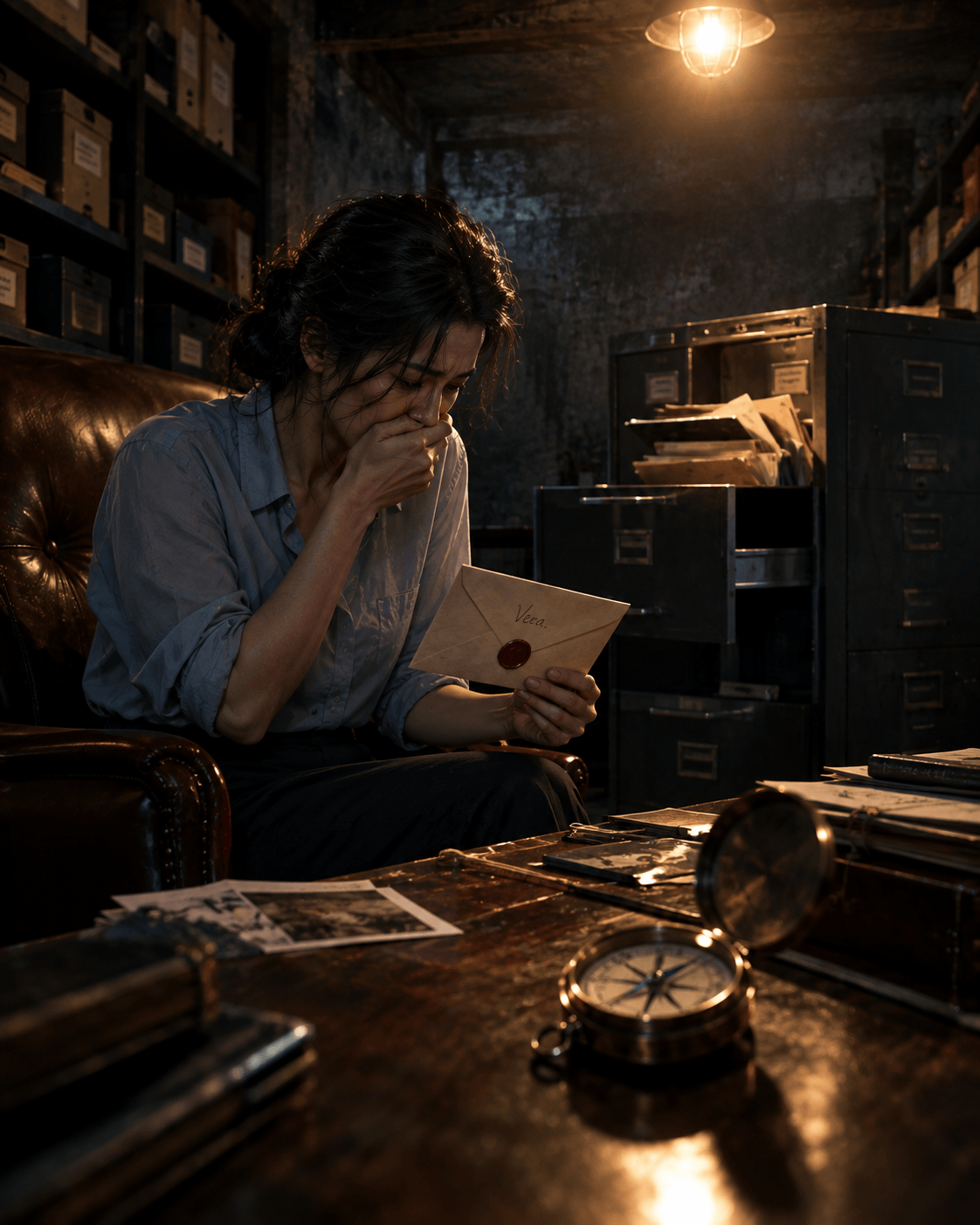
A desk. A chair. A filing cabinet. Shelves lined with boxes. And on the desk, a single envelope, sealed with wax, her name written on the front in her father’s handwriting.
She opened it.
Vera,
If you’re reading this, you’ve found the vault. I’m sorry I never showed it to you myself. I was going to, the week I died. But then I didn’t, and now you’re reading this instead of hearing it from me, which is worse.
Here’s what you need to know:
The vault was built by your great-grandfather in 1922. He used it to hide things during Prohibition — not liquor, but paper. Contracts. Ledgers. Evidence. The Aldridges have always been good at keeping secrets, and this is where they kept the dangerous ones.
Your stepfather knows the vault exists. He doesn’t know how to open it. He’s been trying for six years.
The work he’s doing now — the excavation, the permits — it’s not remediation. It’s an attempt to reach the vault from above. He’s going to fail. The vault is reinforced. But he’s going to keep trying, because he thinks there’s something down here that can destroy him.
There is.
Vera sat down in her father’s chair. The leather creaked. The envelope was trembling in her hand.
In the filing cabinet, you’ll find everything he’s done since he married your mother. The embezzlement. The forged signatures. The deals he made with people who should never have been allowed near this family.
I knew. I knew for years. I was going to expose him, but then I got sick, and I ran out of time.
So I built a trap instead.
Here’s how it works:
The excavation he’s running is illegal. He’s filed false permits, falsified soil reports, hired unlicensed contractors. All of it is documented in the cabinet — the originals, not copies. He doesn’t know they exist. He thinks he’s been careful.
When the authorities come — and they will, because I’ve made sure someone will call them — they’ll trace the permits back to him. But they’ll also trace them back to you, because your name is still on the architect-of-record paperwork from six years ago.
Unless you do exactly what I’m about to tell you.
Vera read the next paragraph twice. Then she read it again.
Then she put the letter down and laughed — a raw, broken sound that echoed off the concrete walls.
Here’s the trap: The permits are in your name. The excavation is illegal. But the vault — this vault, the one you’re sitting in — is not on any blueprint. It doesn’t exist. There’s no record of it anywhere.
So when the authorities arrive, you’ll tell them the truth: you discovered an undocumented structure beneath the estate, you investigated, and you found evidence of illegal excavation authorized by Gerald Thorne. You’ll present them with the original permits he filed — the ones with his signature, not yours. You’ll show them the soil logs, the contractor records, the financial transactions.
You’ll be the whistleblower, not the accomplice.
And Gerald will go to prison.
Vera looked at the filing cabinet. Then at the shelves — the boxes, labeled in her father’s handwriting. 1987-1992. 1993-1998. 1999-2004.
Then she looked at the last page of the letter.
One more thing.
I know I wasn’t a perfect father. I know I drank too much. I know I let your mother marry him because I was too tired to fight. I know I let you leave because I didn’t know how to ask you to stay.
I’m not asking you to forgive me. I’m asking you to finish what I started.
The vault is yours now. So is the house. So is everything.
Make him pay.
Love, Dad.
Vera sat in the vault for a long time. The bulb hummed. The compass sat on the desk beside the letter, its needle still stuck at northeast.
Finally, she stood up. She opened the filing cabinet.
The first folder was labeled THORNE, GERALD — 2017-2019.
She pulled it out. Started reading.
Halfway down the third page, she found the first forgery. Her signature, replicated perfectly, on a document she’d never seen.
Vera’s hand didn’t shake. Her voice, when she spoke aloud, was calm.
“Let me be clear,” she said to the empty vault. “You picked the wrong architect.”
She picked up her phone. Dialed a number she hadn’t called in six years — the state’s attorney’s office, white-collar crimes division.
“Hi,” she said. “My name is Vera Aldridge. I’d like to report an ongoing illegal excavation at the Thornfield estate. And I have evidence of fraud.”
CHAPTER 4: THE INVESTIGATION
The state’s attorney’s office in Hartford was a grey building on a grey street, and Vera sat in a grey conference room for three hours before anyone came to talk to her.
She’d brought the files. All of them. The original permits with Gerald’s signature, the falsified soil reports, the contractor records showing payments to shell companies, the financial transactions linking those shell companies to Gerald’s personal accounts. Her father had been thorough. Her father had been relentless. Her father had spent the last years of his life building a case that he’d never been able to deliver himself.
Vera delivered it for him.
The assistant state’s attorney was a woman named Priya Raghavan, mid-forties, sharp-eyed, with the kind of calm that made Vera think of bomb disposal experts. She read through the files for forty minutes without speaking. Then she looked up.
“Ms. Aldridge,” she said. “Do you understand what you’ve brought me?”
“I do.”
“These documents implicate your stepfather in approximately fourteen felonies. Fraud, forgery, illegal excavation, environmental violations, and what looks like an attempt to defraud the estate’s creditors.” Priya paused. “Your name is on several of these documents.”
“I know.” Vera kept her voice steady. “I signed them without reading them. I was twenty-four and grieving. I’m not asking for immunity. I’m asking for the chance to cooperate.”
Priya studied her for a long moment. “You understand that cooperation means testifying against him. In open court. In front of your family.”
“I understand.”
“And you understand that your mother will likely be called as a witness.”
Vera’s jaw tightened. She’d thought about that. She’d thought about it all night. “My mother has been a victim of his manipulation for six years. If testifying helps her see him for what he is—”
“That’s not your decision to make.”
“No.” Vera met her eyes. “But it’s my decision to stop protecting him. I’ve been doing that since I was fourteen. I’m done.”
Priya nodded slowly. She closed the folder. “We’ll need to move quickly. If he realizes you’ve come to us, he’ll destroy evidence, liquidate assets, possibly leave the country. Do you have a safe place to stay?”
“I have the estate.”
“The estate is the crime scene.”
“Then I’ll stay in the boathouse.” Vera smiled thinly. “It’s cold, but it’s mine.”
Priya didn’t smile back. “We’ll need you to wear a wire.”
Vera had expected that. She’d prepared for it. But hearing it aloud made something in her chest tighten — a cold, hard knot that felt like fear and resolve in equal measure.
“For how long?”
“Until we have enough to arrest him. Two weeks, maybe three. We’ll coordinate with local law enforcement. You’ll have backup on standby at all times.”
“And if he figures it out?”
Priya’s expression didn’t change. “Then you run. And we arrest him anyway.”
CHAPTER 5: THE WIRE
Gerald called her the next morning.
Vera was standing in the boathouse, watching the sun rise over the cove. She’d barely slept. The wire was taped beneath her shirt, a small, cold disc pressed against her sternum. She’d practiced not touching it. She’d practiced breathing normally.
“Vera.” Gerald’s voice was warm, conciliatory. The voice he used when he wanted something. “I’ve been thinking about our conversation. I may have been hasty.”
“May have.”
“Now, now. Let’s not start this way. Come to the house. Have breakfast with your mother and me. We’ll talk about the permits. I’ll show you the engineering reports. You’ll see there’s nothing to worry about.”
Vera looked at the compass in her hand. The needle was still stuck. You see what’s underneath.
“All right,” she said. “I’ll be there in an hour.”
She hung up. Then she texted Priya: Meeting confirmed. House. 1 hour.
Priya’s response was immediate: We’ll be listening. Be careful.
Breakfast was laid out in the morning room — the small, sunny room with the bay window overlooking the rose garden. Vera’s mother was there, pale and quiet, pushing scrambled eggs around her plate. Gerald sat at the head of the table, reading the Wall Street Journal.
“Vera.” He folded the paper. “Sit. Eat.”
She sat. She didn’t eat.
“I wanted to apologize,” Gerald said. “For the other night. I was defensive. The estate has been under a lot of pressure, and I took it out on you.”
“You were defensive because you’re hiding something.”
Gerald’s smile flickered. “I’m hiding stress, sweetheart. The estate is bleeding money. The trust your father left is nearly depleted. I’ve been trying to keep this family afloat for six years, and I’m tired.”
“The trust is nearly depleted because you’ve been siphoning from it.”
The words landed like a stone in still water. Caroline’s fork clinked against her plate. Gerald’s hand moved to his tie — then stopped.
“That’s a serious accusation,” he said quietly.
“It’s not an accusation. It’s a fact. I have the records.”
Gerald set down his coffee cup. “What records?”
“The ones my father kept.” Vera watched his face. “The ones in the vault.”
For a single, unguarded moment, Gerald’s expression cracked. Fear. Real fear. Then it was gone, smoothed over by the mask he’d worn for six years.
“The vault,” he repeated. “Your father told you about that?”
“He left me instructions.”
“Instructions.” Gerald’s voice was very soft now. “And what do these instructions say?”
Vera leaned forward. The wire pressed against her chest. “They say you’re a thief. They say you’ve been embezzling from the estate since the day you married my mother. They say you forged my signature on documents that make me legally liable for your crimes.”
Gerald stood up. He walked to the window. He stood there for a long moment, his back to her, his shoulders rigid.
“You don’t have the vault,” he said.
“I do.”
“You can’t. The entrance is sealed. I’ve been trying to reach it for years—”
“You’ve been trying to reach it. You never found it.” Vera stood up too. “Because my father built it so that only an architect could find it. Only someone who understood the bones of the house. Only me.”
Gerald turned. His face was pale, his eyes cold. “What do you want?”
“I want you to leave. I want you to sign over the estate to my mother. I want you to never set foot in Thornfield again.”
“And if I refuse?”
“Then I go to the state’s attorney.” Vera smiled. “Which I’ve already done.”
The silence lasted exactly five seconds. Vera counted.
Then Gerald laughed. It was a horrible sound — hollow, desperate, furious.
“You think you’ve won,” he said. “You think you’ve outmaneuvered me. But you don’t understand what you’re dealing with, sweetheart. I have spent my entire adult life building this family’s fortune. I have connections. I have lawyers. I have—”
“The wire is still on,” Vera said. “Everything you just said is being recorded.”
Gerald’s face went white.
“You—”
“I told you. I’m done protecting you.” Vera picked up the compass from the table. “You have until the end of the day to leave. Otherwise, the state’s attorney will come for you. And I’ll be there to watch.”
She walked out of the morning room without looking back.
Behind her, she heard her mother’s voice — small, trembling. “Gerald? Gerald, what did she mean? Gerald—”
Then the sound of a chair falling.
Vera kept walking.
CHAPTER 6: THE COMPLICATION
The arrest happened faster than anyone expected.
Priya called Vera that evening: Gerald had tried to flee. He’d packed a bag, withdrawn fifty thousand dollars from a hidden account, and driven toward the Canadian border. State troopers picked him up outside Albany.
“His lawyer is already trying to negotiate,” Priya said. “But with the wire recording and the documents, we have enough. He’s not going anywhere.”
Vera sat on the boathouse floor, her back against the wall, the phone pressed to her ear. She felt hollow. She felt light.
“What happens now?” she asked.
“Now we document everything. The vault, the excavation, the financial records. You’ll need to give a formal statement. And your mother—”
“I know.” Vera closed her eyes. “My mother.”
Caroline had called her three times that day. Vera hadn’t answered. She didn’t know what to say.
“She’s not implicated,” Priya said. “As far as we can tell, she had no knowledge of the financial crimes. But she’ll need to testify.”
“I’ll talk to her.”
“Good.” Priya paused. “One more thing. The excavation. We found something.”
Vera’s eyes opened. “What?”
“Their equipment broke through the concrete slab above the vault. They didn’t reach the vault itself — your father’s reinforcement held — but they reached the space above it. There was a second chamber. Smaller. Filled with documents.”
Vera sat up. “What kind of documents?”
“Your father’s.” Priya’s voice was careful. “Letters. Journals. Photographs. And a second vault — smaller, inside the first. We haven’t opened it yet. We wanted you to be there.”
CHAPTER 7: THE SECOND VAULT
The excavation site was swarming with state investigators when Vera arrived. Ben was there, standing beside his crew, watching the forensic team work. He caught her eye and nodded — a small, private gesture of solidarity.
Priya met her at the edge of the trench. “It’s this way.”
She led Vera down a temporary ladder into the excavation pit. The walls were shored up with steel plates, the floor covered with wooden pallets. At the bottom, a narrow passage led toward the north foundation — toward the vault.
Vera had to duck. The passage was rough, unfinished, carved out by Gerald’s illicit crew. But it opened into a small chamber — one her father had built, one she’d never seen.
Her father had been a man of secrets, and this was his greatest one.
The chamber was lined with cedar. The air smelled of old paper and something faintly sweet — pipe tobacco, maybe, or dried flowers. Shelves lined the walls, filled with boxes and folders and a single wooden chest in the center of the room.
Vera knelt beside the chest. It was unlocked. She opened it.
Inside: a leather journal, a bundle of letters tied with twine, and a small, wrapped package.
She opened the journal first.
January 3, 2016
I’m dying. The doctors won’t say it, but I can feel it — the way the light looks thinner every morning, the way my hands shake when I try to write. I’ve been trying to write this for weeks, but every time I start, I think of Vera. I think of all the things I didn’t say. I think of how I let her leave.
I know she thinks I didn’t fight for her. She’s right. I didn’t. I was too tired and too sick and too ashamed of the man I’d become. But I’m fighting now.
This vault is my last act. My last chance to protect her.
If she finds it — when she finds it — I want her to know: I saw her. I always saw her. The way she looks at buildings, the way she reads what’s underneath. She’s the best of me. She’s everything I should have been.
And Gerald — Gerald is the worst. He’s everything I let myself become. He’s the man I might have been if I’d never had Vera to remind me what mattered.
I built this place to trap him. But I also built it to free her.
Vera, if you’re reading this: you’re free. You were always free. You just didn’t know it.
I love you. I’m sorry I never said it enough.
Dad.
Vera closed the journal. Her hands were steady. Her eyes were not.
She opened the letters next. There were dozens — all addressed to her, all dated over the last six years. The first was from 2017:
Vera,
I’m writing this from the hospital. It’s nothing serious — just a check-up — but I wanted to write to you. I wanted to tell you that I’m sorry for the way things ended. I’m sorry I let your mother marry him. I’m sorry I didn’t stop you from leaving.
I want to tell you about the vault. I want to tell you about Gerald. But I can’t yet — it’s not safe. He’s watching me. He’s watching everything.
So instead, I’ll tell you this: I believe in you. I always have. Whatever you’re doing, wherever you are, I hope you’re happy. I hope you’re building something beautiful.
I hope you’re free.
Dad.
The last letter was dated three days before he died.
Vera,
I’m running out of time. I can feel it. But I’ve finished the vault. I’ve finished everything. All that’s left is you.
I know you’ll find it. I built it for you — not just the vault, but the clues. The seam in the wall. The blueprints. The compass. I knew you’d never fix it. I knew you’d keep it. I knew you’d come home.
I’m sorry I wasn’t a better father. I’m sorry I let you go. But I’m not sorry I built this. I’m not sorry I trapped him. Because that’s what you do for the people you love — you build things that outlast you. You build things that protect them when you can’t.
You’re the architect, Vera. You always were.
Build something beautiful.
Dad.
Vera sat in the vault for a long time. The investigators moved around her, cataloguing, photographing, documenting. Priya came and went. Ben brought her coffee. She didn’t drink it.
She just sat there, holding the letters, and let herself feel everything she’d been holding back for six years.
Grief. Rage. Love. All of it.
When she finally stood up, her legs were numb. Her eyes were dry. She felt something she hadn’t felt in years: whole.
CHAPTER 8: THE TERMS
Caroline came to the boathouse three days later.
She looked older than Vera remembered — smaller, somehow, as if six years of Gerald’s presence had compressed her. She stood in the doorway, hands clasped, eyes uncertain.
“Can I come in?”
Vera stepped aside.
The boathouse was small — a single room with a cot, a table, a chair. Vera had cleaned it up over the last few days, but it was still rough. Caroline sat on the edge of the cot and looked around.
“You’re living here,” she said.
“I’m staying here. Until the estate is sorted out.”
“The estate.” Caroline’s voice was hollow. “The lawyers say it’s mine now. Or it will be, once the courts finish with Gerald.”
“Good.”
“I don’t want it.” Caroline looked at her. “I never wanted any of this. I just wanted—” She stopped. Swallowed. “I wanted to be safe.”
Vera sat down across from her. “I know.”
“You don’t.” Caroline’s voice cracked. “You don’t know what it was like. After your father got sick. After the drinking got worse. Gerald was — he was there. He was kind. He made me feel like I wasn’t drowning.”
“And then he took everything.”
“He didn’t take anything. I gave it to him.” Caroline’s hands were trembling. “I signed the papers. I let him handle the money. I let him push you out. I did that. Not him. Me.”
Vera reached out. She took her mother’s hands.
“Mom,” she said. “Look at me.”
Caroline looked up.
“I don’t blame you.”
“You should.”
“Maybe.” Vera squeezed her hands. “But I don’t. You were in survival mode. You did what you had to do to get through. I don’t agree with it, and I’m not going to pretend I’m not angry. But I don’t blame you.”
Caroline’s face crumpled. She started to cry — deep, ugly, shaking sobs that seemed to come from somewhere far below her ribs. Vera held her. She didn’t say anything. There was nothing to say.
When the crying stopped, Caroline pulled back. Her face was blotchy, her eyes red.
“What happens now?” she asked.
“Now we rebuild.” Vera picked up the compass from the table. “Dad left me the vault. He left me the house. He left me everything I need to make sure Gerald never hurts anyone again.”
“And me?”
Vera looked at her mother. “You’re my mother. You’re always welcome here. But if you want to stay, there are terms.”
Caroline nodded. “Name them.”
“One: you go to therapy. Real therapy. Not the kind where you talk about your feelings for an hour and pretend everything’s fine. The kind where you actually deal with what happened.”
Caroline flinched. But she nodded.
“Two: you don’t talk to Gerald. No visits, no calls, no letters. He’s not your husband anymore. He’s a criminal. You need to accept that.”
Another flinch. Another nod.
“Three: you let me handle the estate. You don’t sign anything without me or a lawyer reviewing it first. Ever.”
Caroline’s voice was small. “You don’t trust me.”
“I don’t trust anyone with your money right now. Including you.” Vera’s voice softened. “But I trust you to learn. I trust you to get better. I trust you to be my mother again.”
Caroline was quiet for a long moment. Then she nodded.
“Okay,” she said. “Okay.”
Vera pulled her into another hug. This one was longer. Warmer.
Outside, the sun was setting over the cove. The water was calm. The compass in Vera’s pocket was still stuck, but for the first time in years, she didn’t mind.
She knew where she was going.
CHAPTER 9: THE SABOTAGE
The complication came three weeks later.
Vera was in the library — her father’s library, now hers — reviewing the estate’s finances with a forensic accountant. The investigation had turned up more than anyone expected: not just Gerald’s crimes, but a network of shell companies, offshore accounts, and bribed officials stretching back a decade.
It was exhausting work. Necessary, but exhausting.
She was on her third cup of coffee when the doorbell rang.
She ignored it. The staff knew not to disturb her.
The doorbell rang again. Then again. Then a voice — loud, familiar, unwelcome.
“Vera! Vera, I know you’re in there! Open the door!”
Vera set down her coffee. She walked to the front hall. Through the leaded glass, she saw a woman — tall, blonde, dressed in a pale pink suit that cost more than most people’s monthly rent.
Helena Vance.
Gerald’s lawyer. And, before that, his mistress.
Vera opened the door.
Helena smiled — a bright, brittle smile that didn’t reach her eyes. “Vera. You look well.”
“You’re not welcome here.”
“I’m not here for a social call.” Helena stepped forward, forcing Vera to either block her or step back. Vera stepped back. Helena walked in.
“I’m here about the estate,” Helena said. “There’s a clause in your father’s will that you may not be aware of.”
Vera’s hand found the compass in her pocket. “My father’s will was read six years ago. There are no surprises.”
“There are always surprises.” Helena pulled a document from her purse. “This is a codicil. Signed by your father two months before he died. It stipulates that if the estate is ever found to be involved in illegal activity — any illegal activity — the property reverts to the control of a court-appointed trustee.”
Vera took the document. Read it. Read it again.
The signature was her father’s. She knew it as well as her own.
“This is a forgery,” she said.
“Is it?” Helena’s smile widened. “Then you won’t mind if we have it authenticated. But I should warn you — I’ve already filed it with the probate court. If it’s upheld, you’ll lose control of the estate. The excavation, the vault, the evidence — all of it will be sealed. Your stepfather’s trial will be delayed for years. Maybe indefinitely.”
Vera stared at the document. Her mind was racing — the signature, the timing, the language. It was almost perfect. Almost.
Then she saw it: a small inconsistency in the notary stamp. The date was wrong — two days off.
“This is forged,” she said. “The notary stamp is from a day when my father was in the hospital. He couldn’t have signed this.”
Helena’s smile flickered. “You can’t prove that.”
“I can.” Vera pulled out her phone. “My father kept a journal. Every day of his last year. Including the days he was in the hospital.” She held up the phone. “I have photos of every page. Including the one from the day this was supposedly signed. He was in Hartford General. He was unconscious.”
Helena’s face went pale.
“Now,” Vera said. “Let me be clear. You have two options. One: you leave now, withdraw the codicil, and tell the court it was a mistake. Two: I file charges against you for forgery, fraud, and conspiracy to obstruct justice. And I win.”
Helena stared at her. For a long moment, neither of them spoke.
Then Helena laughed — a cold, brittle sound. “You really are your father’s daughter.”
“I’ll take that as a compliment.”
Helena turned and walked out. The door slammed behind her.
Vera stood in the hall for a long moment. Her heart was pounding. Her hands were steady.
She pulled out her phone and called Priya.
“Helena Vance just tried to serve me with a forged codicil,” she said. “I need you to add forgery to the charges against Gerald. And I need you to start an investigation into Helena’s involvement.”
Priya’s voice was grim. “We’re on it.”
Vera hung up. She walked back to the library. The forensic accountant was still there, waiting.
“Everything okay?” he asked.
Vera sat down. She picked up the compass. The needle was still stuck at northeast.
“Everything’s fine,” she said. “Where were we?”
CHAPTER 10: THE TRIAL
The courtroom was smaller than Vera expected. She’d imagined something grand — marble columns, vaulted ceilings, the kind of architecture that made you feel the weight of justice. Instead, it was a beige room with fluorescent lights and plastic chairs, and the only thing that felt heavy was the air.
She sat in the front row, beside her mother. Caroline had dressed carefully that morning — a navy suit, her hair pinned back, her hands folded in her lap. She looked like the woman Vera remembered from childhood, before the drinking and the silence and the slow erosion of everything she’d been.
She looked like herself.
Gerald sat at the defendant’s table, flanked by two lawyers Vera didn’t recognize. He’d aged in the months since his arrest — his hair thinner, his face gaunter, the smooth, paternal mask replaced by something harder. He didn’t look at Vera. He didn’t look at Caroline. He stared straight ahead, as if the courtroom were a stage and he were waiting for his cue.
The prosecutor was Priya’s colleague, a man named Daniel Cho. He was calm and methodical and utterly relentless. Vera watched him dismantle Gerald’s defense in the first hour: the forged permits, the shell companies, the falsified soil reports, the payments to unlicensed contractors. Each piece of evidence was a brick, and Daniel laid them one by one until the wall was too high for Gerald to climb.
Then it was Caroline’s turn.
Vera reached over and squeezed her mother’s hand. Caroline squeezed back. Then she stood up and walked to the witness stand.
She testified for two hours. She testified about the night Gerald proposed — how charming he’d been, how attentive, how he’d made her feel seen. She testified about the first time she noticed money missing from the trust account — how Gerald had explained it away, how she’d believed him because she’d wanted to. She testified about the night Vera left — how Gerald had told her it was for the best, how he’d said Vera needed to “find herself,” how she’d let him convince her not to call.
She testified about the night Vera came home — the dinner, the excavation, the moment she’d realized her husband was a stranger.
When the defense attorney cross-examined her, he tried to trip her up. He asked her about her drinking. He asked her about her “emotional instability.” He asked her whether she’d ever signed documents without reading them.
Caroline answered every question with the same quiet dignity.
“Yes,” she said. “I did. Because I was afraid. Because I didn’t want to lose the only person who’d ever made me feel safe. And I was wrong. I was wrong about everything.”
The defense attorney sat down.
Vera exhaled.
CHAPTER 11: GERALD’S TESTIMONY
Gerald took the stand on the third day.
He was calm. He was polished. He was the same man Vera had known for eighteen years — the one who could make you feel like you were the unreasonable one, the one who could twist any truth into something unrecognizable.
He testified that the excavation was legitimate. He testified that the permits were properly filed. He testified that the documents in the vault were “misinterpreted” and “taken out of context.”
Then Daniel Cho asked him about the forged codicil.
Gerald’s eyes flickered — just for a moment, just for a breath. Then the mask was back.
“I have no knowledge of any codicil,” he said. “Helena Vance acted independently. She was my attorney, but she had no authority to file documents on my behalf.”
“She was also your mistress,” Daniel said. “Wasn’t she?”
Gerald’s jaw tightened. “That’s irrelevant.”
“Is it?” Daniel held up a piece of paper. “This is a hotel receipt from 2019. Two nights. A suite at the Plaza. The room was booked under your name, but the credit card belonged to Helena Vance. Would you like to explain that?”
Gerald didn’t answer.
“Would you like to explain why Ms. Vance visited you in jail three times in the last six months? Why she filed a forged codicil claiming to represent your interests? Why she tried to intimidate your stepdaughter into giving up her claim to the estate?”
Gerald’s face was red now. His hands were gripping the arms of the chair.
“I loved your father,” he said, looking at Vera. “I loved this family. I did everything for this family.”
“You embezzled from this family,” Daniel said. “You forged documents. You buried illegal excavation beneath your own home. You tried to frame your stepdaughter for your crimes.”
“I was protecting her!” Gerald’s voice cracked. “I was protecting all of you! You don’t understand what it’s like — the pressure, the expectations. Your father was dying, Vera. He was drinking himself to death, and someone had to hold things together. Someone had to make the hard decisions.”
“So you decided to steal from the estate?”
“I decided to save it!” Gerald’s voice was shaking now. “The trust was depleted. The house was falling apart. I had to make money somehow. I had to—”
“You had to dig an illegal tunnel beneath a historic property? You had to forge your stepdaughter’s signature on documents that made her legally liable? You had to lie to your wife for six years?”
Gerald was silent.
Vera stood up.
The judge looked at her. “Ms. Aldridge?”
“I’d like to address the court,” Vera said.
The judge nodded.
Vera walked to the front of the courtroom. She stood in front of Gerald, close enough to see the sweat on his forehead, the tremor in his hands.
“You keep saying you loved my father,” she said. “But you didn’t. You feared him. You envied him. He had everything you wanted — the name, the estate, the respect. And when he got sick, you saw your chance.”
Gerald’s eyes met hers. For the first time, Vera saw something real in them: not remorse, but recognition. He knew she was right.
“Let me be clear,” Vera said. “You didn’t save this family. You almost destroyed it. You took my mother’s trust and my father’s legacy and my own future, and you used them to build a life for yourself. And when I came home — when I started asking questions — you tried to bury me too.”
She turned to the judge. “This man is not a victim. He’s a predator. And I’m asking the court to treat him like one.”
She walked back to her seat.
Gerald watched her go. His hands were shaking.
CHAPTER 12: THE VERDICT
The jury deliberated for two days.
Vera spent those two days at Thornfield, walking the grounds, touching the walls, listening to the house. She’d spent so much time in the vault, in the excavation pit, in the courtroom — she’d forgotten what it felt like to just be here, in the place her father had loved.
She walked the cove at sunrise. She sat in the library at noon. She stood in the cellar at dusk, her hand on the wall that had opened for her and no one else.
On the third morning, Priya called.
“Guilty,” she said. “On all counts.”
Vera closed her eyes.
“The sentencing is in three weeks,” Priya said. “Given the severity — the fraud, the forgery, the illegal excavation, the attempt to obstruct justice — he’s looking at fifteen to twenty years.”
“Good.”
“Your mother will need to testify at sentencing. Victim impact statement.”
“I know.”
“And you—”
“I’ll be there.” Vera opened her eyes. The sun was rising over the cove. “I’ll be there for all of it.”
CHAPTER 13: THE COST
The estate was saved. The trial was over. Gerald was going to prison.
But the cost was higher than Vera expected.
The legal fees had drained what was left of the family’s liquid assets. The house needed repairs — not just the excavation damage, but years of deferred maintenance. The trust was empty. The staff had been let go.
Vera sat in her father’s library with the estate’s financial records spread across the desk. The numbers were bleak. Thornfield was hers now, free and clear — but it was also a burden she wasn’t sure she could carry.
She could sell it. She could walk away, go back to Charleston, go back to her career, pretend the last six years had never happened.
She looked at the compass on the desk. The needle was still stuck.
You see what’s underneath, her father said.
She saw. That was the problem.
She picked up her phone and called her old firm in Charleston.
“I’m not coming back,” she said. “I’m staying in Marrow Bay.”
There was a pause. Then her boss — a woman named Diane who had mentored Vera for a decade — said, “Are you sure?”
“I’m sure.”
“What will you do?”
Vera looked at the library — the books, the blueprints, the light coming through the windows. She looked at the compass. She looked at the house.
“I’m going to restore it,” she said. “And I’m going to open my own practice. Right here.”
The first thing she did was hire Ben.
“You want me to be your foreman?” He looked skeptical. “Full time?”
“I want you to be my partner.” Vera slid a contract across the table. “We restore Thornfield together. Then we restore Marrow Bay. The town’s full of old buildings that need someone who sees what’s underneath.”
Ben looked at the contract. Then at her. Then at the compass on the desk between them.
“Your father would’ve liked this,” he said.
Vera smiled. “I know.”
CHAPTER 14: THE FOUND FAMILY
The second thing she did was reopen the house.
Not as a museum, not as a monument — as a home. She moved her office into the library. She turned the carriage house into a workshop. She hired back the staff who had been loyal to her father — Mrs. Kowalski, the housekeeper who had taught her to bake; Tom, the groundskeeper who had shown her where the cove’s best tide pools were; Rosa, the cook who had made her birthday cakes every year until she left.
They came back one by one, drawn by the promise of something new.
“You’re really staying,” Mrs. Kowalski said on her first day back. She was standing in the kitchen, her hands on her hips, looking around at the renovation plans. “You’re really going to fix this place.”
“I’m going to try.”
Mrs. Kowalski nodded. Then she pulled Vera into a hug — a fierce, maternal hug that smelled of lavender and yeast.
“Your father would be so proud,” she said. “He talked about you all the time. Even at the end. Even when he couldn’t remember much else, he remembered you.”
Vera hugged her back. She didn’t let go for a long time.
CHAPTER 15: THE SENTENCING
Gerald was sentenced on a Tuesday.
Vera sat in the same courtroom, in the same plastic chair, with the same fluorescent lights buzzing overhead. Caroline sat beside her, holding her hand.
Daniel Cho read the victim impact statements. First Caroline’s — a quiet, devastating account of six years of manipulation and control. Then Vera’s — a clear, surgical dismantling of everything Gerald had claimed to be.
Then the judge spoke.
“Mr. Thorne,” she said. “You have been convicted of fourteen felonies, including fraud, forgery, and obstruction of justice. You have shown no remorse. You have blamed everyone but yourself. You have used your position of trust to exploit the very family you claimed to protect.”
Gerald stared straight ahead.
“I sentence you to twenty years in federal prison. You will serve a minimum of fifteen before parole eligibility. You will pay restitution to the estate of Elias Aldridge in the amount of four million dollars. You will have no contact with Caroline Thorne or Vera Aldridge for the duration of your sentence.”
The gavel fell.
Gerald was led away in handcuffs. He didn’t look back.
Vera watched him go. She felt nothing — not triumph, not relief, not sadness. Just a quiet, steady certainty that the world was finally right.
Caroline was crying. Vera put her arm around her.
“It’s over,” Vera said.
Caroline nodded. “It’s over.”
CHAPTER 16: THE COMPASS
The night after the sentencing, Vera went down to the vault.
She hadn’t been back since the investigators had catalogued everything. The room was empty now — the files removed, the boxes archived, the desk and chair left behind. The bulb still hummed overhead. The walls were still concrete, still cold, still holding secrets.
She sat in her father’s chair. She put the compass on the desk.
“I did it,” she said to the empty room. “I finished it.”
The vault didn’t answer. But Vera didn’t need it to.
She thought about her father — not the man he’d been at the end, sick and tired and defeated, but the man he’d been before. The man who had taught her to read buildings. The man who had believed in her. The man who had built this vault not to trap Gerald, but to free her.
She thought about the letters. The journals. The years of silence.
She thought about the compass — the needle stuck at northeast, pointing toward something she couldn’t see.
She picked it up. She turned it over in her hands.
Then she took it to a jeweler in town.
“Can you fix it?” she asked.
The jeweler — an old man named Harold who had known her father — examined the compass. He turned it over, opened the back, peered at the mechanism.
“The needle’s stuck,” he said. “But it’s not broken. It’s just — stubborn. Like someone didn’t want it to move.”
Vera laughed. “That sounds about right.”
Harold looked at her. “You want me to fix it?”
Vera thought about it. She thought about the needle pointing northeast, toward the cove, toward the vault, toward everything her father had built.
“No,” she said. “Leave it.”
Harold raised an eyebrow. “You sure?”
“I’m sure.” Vera took the compass back. “Some things are supposed to stay where they are.”
She put it in her pocket. It was warm from her body heat.
CHAPTER 17: THE FOUNDATION
Six months later, Thornfield was still standing.
Not restored — not yet. The north wall was still under repair, the excavation pit filled and graded and seeded with grass. The vault was sealed again, this time with Vera’s own hands, this time with a new lock and a new purpose: a time capsule, filled with letters and photographs and blueprints, for whoever found it next.
But the house itself was alive again. The windows were open. The rooms smelled of lemon polish and fresh flowers. The kitchen was full of Mrs. Kowalski’s bread, and the library was full of Vera’s blueprints, and the cove was full of light.
Caroline was in therapy. She went twice a week, every week, and she was starting to talk about the things she’d spent six years avoiding. She was starting to sleep through the night. She was starting to laugh.
Vera was building her practice. She’d taken on three projects in Marrow Bay — a church restoration, a library renovation, a private home on the bluff. She was busy. She was tired. She was happy.
She was home.
On a Sunday in June, she stood on the bluff above the cove, looking out at the water. The compass was in her pocket. The sun was warm on her face.
Ben walked up beside her. He was holding two cups of coffee. He handed her one.
“You did it,” he said.
“We did it.”
They stood in silence for a while, watching the water. The tide was coming in. The gulls were circling. Somewhere below, a boat was heading out toward the open sea.
“What happens now?” Ben asked.
Vera smiled. She took a sip of coffee. She looked at the house — her house, her father’s house, the house that had held secrets and lies and, underneath all of it, love.
“Now we build something beautiful,” she said.
She pulled the compass from her pocket. The needle was still stuck at northeast — pointing toward the cove, toward the vault, toward everything that had come before.
She didn’t need it to move.
She knew where she was going.