“You think I don’t know who you are?”
The question came from the woman behind the desk, and it wasn’t a question at all.
Mateo Ferrer stood just inside the doorway of the upstairs office, two of her men flanking him close enough that he could smell the gun oil on their hands. The office was cold for a coastal city. The air conditioning ran too high, or maybe that was just the building itself—old stone walls that had soaked up a century of damp and blood and kept it circulating.
The woman behind the desk was younger than he’d been told. That was the first miscalculation. The photographs in his file showed a girl in her early twenties, soft-faced, caught in the flash of a society gala three years ago. The woman in front of him now was not that girl.
Lucía Almeida leaned back in a chair too large for her, one hand resting on the armrest, the other on a stack of shipping manifests. Her hair was pulled back hard from her face. No jewelry except a thin silver chain at her throat. She wore a black silk blouse buttoned to the collarbone, sleeves rolled to her elbows, and she was watching him the way a butcher watches a carcass—not with interest, but with calculation of where to make the first cut.
“I think,” Mateo said, keeping his voice even, “that you were expecting me.”
A small crease at the corner of her mouth. Not a smile. “I was expecting a man named Joaquín Reyes. A security consultant from Cártama Norte. But Joaquín Reyes has been dead for eight months. I saw his body pulled out of the harbor myself. So.” She tilted her head. “Who the fuck did they send?”
Mateo’s hand moved—instinct, nothing more—and the two men at his sides shifted. He stopped himself. Raised both palms, slowly.
“My name is Mateo Ferrer. The rest of what you were told is true. I was sent to assess your operation and recommend… corrections. The name was a cover. A precaution.”
“A precaution against what?”
“Against exactly this conversation going badly.”
He had been in this business long enough to know when a lie was being weighed, and he watched Lucía Almeida weigh his now. Her face gave nothing away. But her right hand had moved from the armrest to her lap, and he saw the edge of something silver—a knife, small, the blade already open. He hadn’t heard it open. That was the most dangerous detail in the room.
She wanted a piece of him, but she wanted to see him notice it first. To see if he flinched.
He didn’t.
“Your uncle hired me,” Mateo said. “Three weeks ago, when the shipment from Veracruz went missing. He’s concerned about… internal security. He wanted an outside set of eyes.”
“Did he.” Her tone made it clear the statement wasn’t worth responding to. “And you came alone.”
“I work alone.”
“That’s either very brave or very stupid.” She closed the knife—a flick of her wrist, the blade folding into the handle with a soft click—and set it on the desk beside the manifests. “My uncle didn’t hire you. My uncle hasn’t made a decision in this organization without my approval since the day I came back. And I didn’t hire you.” She leaned forward now, both hands flat on the desk. “So I’ll ask again. Who sent you?”
The air in the room changed. Mateo felt it in his chest—a barometric drop, the kind that preceded a coastal storm. He had walked into offices of men twice her age, men with armies and alliances and decades of blood on their hands, and none of them had done this to him. None of them had made him feel, within thirty seconds, like a boy caught lying to his priest.
He could kill her. That was the thought running under everything else. She was three meters away, small, unarmed except for the folded knife. Her men were close, but he was faster. The window behind her overlooked the harbor, a two-story drop to the stone quay below. It could be done.
But Mateo hadn’t come to kill her. That was the problem. That was always the problem. He’d come for information—to assess the woman everyone in Cártama was suddenly whispering about, the prodigal daughter returned to claim her dead father’s empire—and he’d known within seconds that the whispers were wrong. She wasn’t a daughter. She was a butcher who had decided to wear silk.
“Your brother,” he said quietly, and watched her entire body go still. “Tomás Almeida. He contacted me six weeks ago from Veracruz. He thought someone in your organization was skimming, and he wanted a name before he came back to Cártama. He hired me to find it.”
The silence that followed lasted four seconds.
Then Lucía Almeida picked up her knife, opened it again, and began to run her thumb along the edge of the blade. Slow, deliberate. Not cutting. Just feeling.
“You’re lying,” she said, and her voice had dropped to something almost conversational. “Tomás was already dead when you say he contacted you. So you’re either an idiot, or you thought you could use a dead man as cover because his name would shake me.” She raised her eyes to his. “Which is it?”
Mateo’s hand went to his wrist—to the cracked face of his watch, the hands frozen at 11:47. He felt the broken glass beneath his thumb. A habit he’d never managed to break. It meant he was about to lie.
“Both,” he said. “I’m an idiot. But I’m not lying about the rest.”
It was the truth, and she could see it. For the first time, something shifted in her face—not warmth, but recognition. The slight narrowing of her eyes as she recalibrated.
“Tomás is dead,” she repeated. “So whatever he supposedly hired you to do is void. You can walk out of this room now, and I’ll forget the name you used. Or you can stay, and I’ll find out what you’re really after.” She shrugged, a small, elegant movement. “Your choice.”
She had already turned back to her manifests, dismissing him, when Mateo said the words he’d been holding since he walked in.
“I found the name he was looking for.”
Lucía’s hands stilled.
“The skimmer,” he said. “The man inside your operation. I found him. And he’s not a man.”
The office was silent. Then, slowly, Lucía Almeida lifted her head.
“Then sit down, Ferrer,” she said. “And tell me who’s bleeding me.”
The name he gave her was Rafael Echeverría.
Lucía’s face didn’t change when she heard it, but Mateo watched her right hand move to the silver knife on her desk. Her thumb found the nick in the blade—a small, worn notch near the hilt—and pressed against it. He would learn later what that meant. For now, he only knew that something behind her eyes had gone very still.
“Rafa,” she said, as if tasting the name. “You’re telling me Rafael Echeverría has been skimming from the Almeida organization.”
“I’m telling you I have proof. Shipping manifests from Veracruz, altered at the port before they reached your accountants. A second set of books in a warehouse in La Quema. He’s been bleeding you for at least eighteen months, maybe longer.” Mateo shifted his weight, acutely aware of the two men still flanking him. “You asked who’s bleeding you. I’m answering.”
Lucía was quiet for a long moment. Then she looked past him, to the man on his left. “Diego. Give us the room.”
“Jefa—”
“Now.”
The man named Diego hesitated, then nodded. He and the other guard filed out, closing the heavy door behind them with a soft click that somehow felt louder than a slam.
They were alone.
Lucía rose from her chair and walked to the window behind her desk. The harbor sprawled below, cranes and container ships and the gray-green water of the bay. The afternoon light caught the silver chain at her throat. She stood with her back to him, arms crossed, and Mateo found himself watching the line of her shoulders, the way she held herself like someone who had learned young that relaxation was a weapon she couldn’t afford to give away.
“Rafael Echeverría has worked for my family for twenty-three years,” she said. “He worked for my father. He taught my brother how to shoot. He stood at my mother’s funeral and held the umbrella over my head when it rained. And now you walk into my office with a fake name and a broken watch and tell me he’s been robbing me for a year and a half.” She turned to face him. “Do you understand why I might find that difficult to believe?”
Mateo understood more than she knew. He understood that the men closest to you were always the ones holding the knife when it finally slid home. He understood that loyalty was a currency most people spent the moment it became inconvenient. And he understood, with a clarity that surprised him, that Lucía Almeida had already known—some part of her had known—and was testing not his evidence but his nerve.
“I understand,” he said. “But the evidence doesn’t care what you believe.”
That earned him a small, humorless smile. “Evidence can be manufactured. Men can be bought. You’re a mercenary, Ferrer. You know the price of both better than most.”
“And you know the price of ignoring the truth.” He took a step forward—one step, no more—and watched her body tense, not in fear but in alertness. “Your brother died before he could come back to Cártama. The shipment that went missing was under Echeverría’s control. You came back from wherever you were hiding and took power six months ago, and since then, three of your shipments have been hit. Three. All under the same man’s supervision. Coincidence?”
Lucía’s eyes narrowed. “I wasn’t hiding.”
“That’s what you took from that?”
“It’s what you implied.” She moved back to her desk but didn’t sit. Instead, she opened a drawer and pulled out a slim black folder, which she set on the desk between them. “You’ve done your homework on me. Good. But you don’t know me, Mateo Ferrer. You don’t know where I was, or why I left, or what I came back to. And if you’re going to work for me, you’ll learn to keep your assumptions to yourself.”
The shift was so subtle he almost missed it. Almost.
“Work for you,” he repeated.
“You said my brother hired you. Tomás is dead, so the debt is mine. You’re either working for the person who inherited his debts, or you’re working for my enemies. Which one is it?”
Mateo should have expected this. She’d done what any good leader would do—turned his own premise against him, forced him to declare himself. The problem was, he didn’t know the answer. He’d come to Cártama for money and information, not allegiance. He didn’t work for anyone, not permanently. That was the whole point of being a fixer. You moved in, solved the problem, and moved on before anyone could claim you.
But something about the way she watched him—unblinking, unafraid—made the usual calculation feel like a lie.
“I want to see the proof before I decide anything,” Lucía said, when he didn’t answer. “Take me to the warehouse in La Quema. Show me the second set of books. If what you’re saying is true, then we’ll talk about what you want in return. If it’s not…” She let the sentence hang, then sat down and pulled the black folder toward her. “Well. I don’t think we’ll need to discuss that contingency.”
She was dismissing him. Not with cruelty, but with the calm certainty of a woman who didn’t waste time on threats she might not have to carry out. It was, Mateo thought, the most dangerous thing she’d done all afternoon.
“Tonight,” he said. “The warehouse is only accessible after the docks close. Nine o’clock.”
“Then you’ll meet me at the port gate at nine.” She opened the folder and began reading, no longer looking at him. “Diego will show you out. Try not to make him nervous—he shoots first and asks questions at the funeral.”
It was a joke, and not a joke. Mateo found himself almost smiling.
He turned toward the door, then paused. “One more thing.”
Lucía looked up.
“Echeverría isn’t just skimming. He’s building something. Money moves through the second set of books and out through a shell company in Cártama Norte. Whoever’s on the other end of that shell company knows your operation from the inside. If you want my help, you need to know that you’re not just dealing with a thief.” He held her gaze. “You’re dealing with a coup.”
The silence that followed was thick as harbor fog.
Then Lucía Almeida closed the folder and folded her hands on top of it. “Nine o’clock, Ferrer. Don’t be late.”
The port of Cártama at night was a different animal.
By day, it was all industry—container ships, customs agents, the constant grind of cranes loading cargo onto trucks that rumbled through the narrow streets of La Quema. By night, when the legitimate work ended and the gates swung shut, the district belonged to the men and women who did their business in shadows.
Mateo arrived at the north gate at 8:52. He wore a dark jacket against the coastal chill, and he’d left his car three blocks away, in a lot where no one would think to look. Old habits. He’d spent the afternoon reviewing what he knew about Lucía Almeida, which wasn’t enough.
The file on her was thin, which was strange for a woman who had supposedly inherited an empire. Six months ago, she’d walked into the Almeida compound and announced she was taking control. No buildup, no warning. Her father had died three years earlier, leaving the organization in the hands of her uncle, Esteban, who by all accounts had been content to let it rot. Then Lucía returned—from where, no one seemed to know—and within a week, Esteban had stepped aside. No blood, no fight. That was the part that didn’t make sense. Men like Esteban Almeida didn’t give up power quietly.
Unless they’d been given a reason.
Mateo had spent enough time in this world to know that the quiet transitions were the ones you had to watch. The loud ones—the shootouts, the coups—they were simple. But when power changed hands without a single body dropping, it meant someone had made a calculation. And calculations could shift.
A black SUV pulled up to the gate at 8:59, and the passenger window rolled down.
Lucía sat behind the wheel, alone. She’d changed into dark jeans and a gray jacket, her hair still pulled back. The silver knife was in her lap, closed.
“Get in,” she said.
Mateo walked around to the passenger side and climbed in. The interior smelled like leather and something floral—jasmine, maybe. It was such a small, human detail that it caught him off guard.
“You came alone,” he said.
“Did you expect an escort?”
“I expected you to be smarter than to meet a mercenary alone at night in a dock district.”
Lucía pulled away from the gate and turned down a dark street lined with warehouses. “I’m not alone,” she said. “I have you.”
It took him a second to realize she was joking. Maybe. Her face gave nothing away.
The warehouse was on the south end of La Quema, a hulking structure of corrugated metal and peeling paint. A single security light flickered over the loading bay, casting a weak orange glow. Lucía parked across the street and killed the engine.
“How did you get the key?” she asked.
“I picked the lock. The second set of books is in an office on the second floor, behind a false panel in the back wall. Echeverría isn’t creative, but he’s careful.”
“Careful enough to hide a second set of books in a warehouse he controls, but not careful enough to hide it from a stranger with lock picks?”
Mateo shrugged. “Careful people make mistakes when they think no one’s looking.”
They crossed the street together, and Mateo was suddenly aware of how quiet the port was—no traffic, no voices, just the distant sound of water against concrete. The air smelled like salt and diesel and something rotting. La Quema, the locals called it. The burning. The name had history.
He unlocked the side door with a pick set, his hands working on autopilot while his eyes scanned the shadows. Lucía waited behind him, still, patient. A woman who knew how to be silent.
The warehouse interior was cavernous, stacked with wooden crates and shipping pallets. Mateo led them to a metal staircase at the back, up to a small office overlooking the main floor. The door was locked; he picked it too, the old mechanism giving way with a soft scrape.
Inside, the office was sparse—a desk, a filing cabinet, a wall of shipping schedules. Mateo went straight to the back wall and pressed on a panel near the floor. It swung open to reveal a narrow alcove, and inside, a black ledger.
“Here,” he said, and pulled it out.
Lucía took the ledger from him and opened it on the desk. Her face, lit only by the faint orange light from outside, was unreadable. She flipped through pages, her thumb tracing the columns of numbers, the names of ships, the amounts that didn’t match the official records. Minutes passed. Mateo watched her work, noting the way her eyes moved—quick, sharp, missing nothing. She didn’t ask him to explain. She didn’t need to. She understood the books as well as he did, maybe better.
Then she closed the ledger and looked up.
“This is Echeverría’s handwriting,” she said quietly.
“Then you believe me.”
“I believed you this afternoon, Ferrer. I just needed to see if you were lying about the proof.” She tucked the ledger under her arm and turned toward the door. “Let’s go. I need to think about how to handle this.”
They were halfway down the metal staircase when Mateo heard it—the faint scrape of a boot on concrete.
He grabbed Lucía’s arm and pulled her back, his other hand already reaching for the gun at his hip. Below them, in the darkness of the warehouse floor, something moved.
“Company,” he breathed.
Lucía didn’t ask questions. She dropped into a crouch beside him, pulling a pistol from the small of her back with a smoothness that told him she’d done this before. The silver knife, he noticed, was still in her jacket pocket, but her hand hovered near it.
“How many?” she whispered.
“At least three. Maybe more.” He scanned the shadows, picking out shapes—two near the loading bay, one by the crates to the east. They moved like men who knew the space. “They knew we’d be here.”
Lucía’s jaw tightened. “Then someone told them.”
She looked at him then, and in the faint light, he saw the question in her eyes. Was it you?
“Not me,” he said. “If I’d wanted to set you up, I wouldn’t have handed you the ledger first.”
That got him the ghost of a nod. “Then we have a problem.”
The first shot came from the left.
It shattered the window above their heads, raining glass down the staircase, and then the warehouse erupted in gunfire.
Mateo moved on instinct—hand on Lucía’s back, pushing her down the stairs, returning fire at the shadow near the crates. His gun kicked in his hand, the noise deafening in the enclosed space. He heard a grunt, then the thud of a body hitting concrete. One down.
“We’re outnumbered,” he said, grabbing her hand. “This way.”
He pulled her toward the west side of the warehouse, where he’d scouted an emergency exit earlier that day. Old habits. Always know the exits. The second and third men were firing now, bullets chewing through the wooden crates around them. Mateo felt a hot whistle past his ear, too close.
Lucía was fast. She kept pace with him, firing over her shoulder, her shots controlled and precise where his were instinctive. He saw one of her rounds hit the second man in the shoulder, spinning him into a stack of pallets.
Then they were through the emergency exit and out into the alley, gasping in the cool night air.
“SUV,” Lucía said, already running. “Keys are in the ignition.”
They reached the car just as the third man burst through the exit behind them. Mateo dove into the passenger seat as Lucía gunned the engine, and they peeled away from the curb in a scream of tires.
In the rearview mirror, the man stood in the alley, watching them go.
He didn’t follow.
Lucía drove for ten minutes, taking side streets and doubling back twice before she finally pulled into an underground parking garage near the center of Cártama. She killed the engine and sat there, hands still on the wheel, breathing slowly.
“Someone knew we were going to that warehouse,” she said. “The only people who knew were you and me.”
Mateo shook his head. “And whoever you told.”
“I didn’t tell anyone.”
“Then someone’s following you.”
Lucía turned to look at him. In the dim light of the garage, he could see the streak of blood on her cheek—a scratch from the breaking glass—and the cold fury in her eyes.
“This morning, I didn’t know you existed,” she said. “Now I’ve got a ledger proving my brother’s godfather is plotting against me, and someone tried to kill me in my own district. So tell me, Ferrer—why should I trust that you’re not part of this?”
Mateo looked at her. At the blood on her face. At the knife she still hadn’t let go of.
“Because if I wanted you dead,” he said quietly, “I would have let them finish the job.”
It was the wrong thing to say. He knew it immediately.
But Lucía Almeida didn’t flinch. Instead, she smiled—a thin, dangerous thing—and put the car back in gear.
“Then it seems we both have a problem,” she said. “Welcome to Cártama.”
The apartment she took him to was not what he expected.
Mateo had assumed—based on the compound, the SUV, the way she carried herself—that Lucía Almeida lived in some fortified mansion, surrounded by guards and gates and the trappings of power. Instead, she drove to a narrow street in the old quarter of Cártama, parked in a private garage beneath a building that looked like it had been standing since the city was a colonial outpost, and led him up three flights of narrow stairs to a door with three locks.
The apartment inside was small. Sparsely furnished. A single sofa, a wooden table, a galley kitchen. The windows overlooked the harbor, but the glass was old and warped, turning the lights of the port into smears of gold on dark water. No security cameras. No guards. Just her, her gun, and the knife she still hadn’t put down.
“Guest room’s through there,” Lucía said, nodding toward a short hallway. “Bathroom’s at the end. Don’t touch anything else.”
She said it without looking at him, already moving toward the kitchen. Mateo stood just inside the door, feeling the weight of the night settle around them. The chase, the gunfire, the drive through the city—it had all happened fast, too fast to process. Now, in the quiet of her apartment, the adrenaline was fading, and what remained was something sharper.
Trust. She’d brought him to her home. Or a version of it.
“You sleep with a gun under your pillow?” he asked, trying to break the tension.
Lucía opened a cabinet and pulled down a bottle of tequila. “I sleep with two. One under the pillow, one on the nightstand.” She poured herself a glass, didn’t offer him one. “The guest room has its own. You look like a man who checks.”
It wasn’t a question. Mateo almost smiled.
“How long have you lived here?” he asked.
She took a sip of the tequila, then turned to face him, leaning against the counter. “Why do you want to know?”
“Because I’m trying to figure out where you came from. The file I was given said you disappeared three years ago. Now you’re back, and you’re running the organization from a three-room apartment in the old quarter. It doesn’t fit.”
“Maybe I don’t like fitting.”
“Maybe.” He held her gaze. “Or maybe you’re not sure who to trust, so you sleep where no one knows to look.”
The flicker in her eyes told him he’d hit something. But she didn’t confirm it, didn’t deny it. Just took another sip of tequila and set the glass down on the counter.
“Get some rest, Ferrer. Tomorrow, we work.”
She disappeared into what must have been her bedroom, closing the door with a soft click. A moment later, he heard the bolt slide home.
Mateo stood in the quiet apartment for a long time, listening to the city outside. Then he went to the guest room, checked the windows, checked under the pillow, and lay down on the narrow bed with his gun on the nightstand and his eyes on the door.
He didn’t sleep.
The next morning, Lucía was already dressed when he emerged from the guest room. Dark trousers, a white blouse, her hair pulled back. The scratch on her cheek had scabbed over, a thin line of rust against her brown skin. She was standing at the window, a cup of coffee in her hand, watching the harbor.
“There’s coffee in the kitchen,” she said without turning around. “Then we’re leaving.”
“Where?”
“The Almeida compound. My uncle wants to see me. Well—he wants to see both of us.”
Mateo poured himself coffee from the pot on the stove and took a sip. Strong, bitter, no sugar. It suited her.
“Why does your uncle want to see me?”
“Because I told him about the ledger. And about the ambush.” She turned from the window, and her face was calm, but her eyes were hard. “He wants to know who I’ve brought into our business.”
Mateo set the mug down. “And what do you want?”
Lucía crossed the room, stopping a few feet from him. Close enough that he could smell jasmine again, faint beneath the coffee and the salt air. “I want to know who ordered the men in that warehouse. I want to know how they knew where we’d be. And I want to know if my uncle is the one who sent them.” Her voice was low, deliberate. “You said you found the skimmer. You said it’s bigger than money. So help me prove it. Help me find out who’s trying to take what’s mine.”
It was the first time she’d said it so directly—what’s mine. The claim of ownership. The line she’d drawn.
“If I do this,” Mateo said carefully, “I want something in return.”
“What?”
He’d thought about this on the drive, in the quiet of the apartment. About what he wanted, what he’d come for, what he was willing to risk. “Your brother promised me access. Names, records, connections—things that would help me with my own work. If I help you find your traitor, I want that access.”
Lucía considered him for a long moment. “That’s it? Access to my files?”
“To your network. The people who move through the ports, the officials on your payroll, the families who owe you favors. I want to know how this city works, and I want to be able to move through it without getting a knife in my back.”
“And in exchange, you give me Echeverría.”
“And the men who shot at us. And whoever else is behind it.” He paused. “Do we have a deal?”
Lucía’s thumb moved to her jacket pocket, where he knew the silver knife sat. He watched her press against it—that small, unconscious gesture—and wondered what it meant. A decision? A reminder? A prayer?
Then she nodded. “We have a deal. But understand something, Ferrer.” She stepped closer, and her voice dropped to a murmur. “If you betray me, I won’t kill you quickly. I’ll make sure every door in this city closes to you. You’ll be a ghost without a grave. Do you understand?”
Mateo’s pulse quickened. “I understand.”
“Good.” She turned away, grabbing her keys from the counter. “Then let’s go meet my uncle.”
The Almeida compound was a converted customs house on the eastern edge of the harbor, all old stone and iron gates and a view of the water that would have been beautiful if it weren’t for the men with rifles stationed at every corner.
Lucía drove through the main gate, her window down for the guard, who nodded and waved them through. The courtyard inside was cobblestone, lined with black SUVs and a single white sedan that looked out of place. At the far end, a set of double doors led into the main house.
“Try not to look so impressed,” Lucía said as she parked. “My uncle likes to think this place still commands respect.”
“Does it?”
“It commands compliance. Not the same thing.”
They walked inside, and Mateo felt the weight of the building settle over him—high ceilings, dark wood, portraits of dead men on the walls. It smelled like old money and cigar smoke and something floral, the same jasmine he’d noticed in Lucía’s car. Maybe it was her scent, trailing through the halls.
Esteban Almeida was waiting in a large study at the back of the house, a room filled with books and maps and the head of a boar mounted above the fireplace. He was a heavy man, gray-haired, with a face that had once been handsome and was now just tired. But his eyes were alert, sharp, watching Mateo with the same calculation Lucía had shown the day before.
“Mateo Ferrer,” he said, not rising from his chair. “The man who found my nephew’s killer.”
“I found the man who hired the men who killed him. Or so I believe.” Mateo kept his voice even. “The proof is in the ledger your niece now has.”
Esteban’s gaze shifted to Lucía. “You’ve seen this ledger?”
“I’ve seen it. It’s Rafa’s handwriting. And before you ask—yes, I’m sure.” She sat down in a chair opposite her uncle, crossing her legs. “The question is what to do about it.”
“The question,” Esteban said, “is whether we can afford to move against Echeverría at all. He controls the port unions. He has relationships with customs. If we push him, we risk losing half our operations.”
“If we don’t push him, we risk losing everything.” Lucía’s voice was calm, but there was steel beneath it. “Rafa isn’t just skimming. He’s building a network. He wants to replace us.”
Esteban’s face darkened. “You don’t know that.”
“I know the money in that ledger doesn’t end at his pocket. I know the men who shot at us last night knew exactly where to find us. And I know—” She leaned forward, “—that if we wait for him to make his move, we’ll be too late to stop him.”
The room went quiet. Mateo stood near the door, watching the two of them, feeling the weight of the history between them. This was a family, not just an organization. And families had their own wounds.
Finally, Esteban sighed and rubbed a hand over his face. “What do you propose?”
“A meeting. Rafa, you, me. We lay out what we know and give him a choice: walk away with what he’s already stolen, or stay and face the consequences.” Lucía paused. “But before that, I want to know who’s feeding him information. Someone in our house told him about the warehouse. Someone in our house tried to have us killed.”
Esteban’s eyes flicked to Mateo. “And what’s his role in all this?”
“He’s my insurance,” Lucía said simply. “If Rafa has people inside our walls, I want someone who isn’t connected to any of them. Someone who can see what we can’t.” She stood, smoothing her blouse. “I trust Ferrer to do what he’s been hired to do. That’s enough for now.”
“You trust him?” Esteban’s voice was sharp. “A stranger? A mercenary?”
“I trust his self-interest. He wants access to our network. He can’t get that if we’re dead.” She looked at Mateo, and there was something almost like amusement in her eyes. “Isn’t that right, Ferrer?”
“Self-interest is the only thing anyone can truly rely on,” Mateo said.
Esteban stared at him for a long moment, then nodded slowly. “Fine. But he doesn’t leave this compound without a guard. And if he does anything that smells like betrayal, he goes into the harbor with Rafa’s men.”
“Fair enough,” Lucía said, as if discussing the weather. “Now—where’s Diego? I need him to pull the port schedules for the last month.”
“He’s in the security office.” Esteban reached for a cigar on the desk beside him. “I’ll arrange the meeting with Rafa. Thursday, noon, at the old fish market. Neutral ground.”
Lucía nodded and turned to leave, gesturing for Mateo to follow. They were halfway to the door when Esteban’s voice stopped them.
“Lucía.”
She paused but didn’t turn around.
“Your father would be proud of you.”
There was a beat of silence. Then Lucía continued walking, her heels clicking on the polished floor, and said nothing at all.
They found Diego in the security office, a windowless room on the ground floor filled with monitors and filing cabinets. He was a broad-shouldered man with a shaved head and a permanent scowl, and when Mateo walked in behind Lucía, the scowl deepened.
“Jefa.”
“Diego. I need the port schedules for the last month, and I need you to pull the security footage from the night of the Veracruz shipment. The cameras near the west gate.”
Diego nodded slowly, his eyes still on Mateo. “Who’s this?”
“Mateo Ferrer. He’s working with us.”
“Working with us or working for us?”
Lucía’s expression didn’t change, but Mateo saw her fingers twitch toward her pocket. “Diego. Do you remember what I told you when I came back? About how I would run things?”
Diego’s jaw tightened. “You said you’d trust people until they gave you a reason not to.”
“And you’ve given me no reason not to trust you. Don’t start now.” She held his gaze until he looked away. “Pull the schedules. Bring them to my office in an hour.”
She left without waiting for a response, and Mateo followed her up the stairs to a small office on the second floor. This one was different from the study at the compound—more functional, with a plain desk and a filing cabinet and a window that faced the harbor. Lucía sat down heavily in the chair and exhaled.
“He doesn’t like me,” Mateo said.
“Diego doesn’t like anyone he hasn’t known for ten years. He’ll warm up.” She opened a drawer and pulled out a map of the port district, spreading it across the desk. “Or he won’t. Either way, he does his job.”
Mateo sat down across from her. “Your uncle doesn’t want to move against Echeverría. You know that, right?”
“I know.” Lucía didn’t look up from the map. “He’s afraid. Rafa has been part of this family longer than I’ve been alive. Moving against him feels like betrayal, even if it’s self-defense.”
“And you? Do you feel like it’s betrayal?”
She was quiet for a moment, her thumb tracing a line on the map—the route from the west gate to the warehouse, Mateo realized. The route they’d taken last night.
“Rafa was at my mother’s funeral,” she said quietly. “He carried the coffin with my father and my uncle. He taught Tomás how to shoot. But he also took money from our shipments and fed information to our enemies. He had my brother killed.” She looked up, and her eyes were like winter. “So no. I don’t feel like it’s betrayal. I feel like it’s justice.”
Mateo nodded slowly. “The meeting Thursday. You’re not planning to negotiate, are you?”
“What gave you that idea?”
“Because you asked for the port schedules. And the security footage. You’re not just going to talk to him. You’re going to bury him.”
Lucía smiled—that thin, dangerous smile he was beginning to recognize. “I’m going to give him a choice. Just like I told my uncle. If he takes it, he walks away. If he doesn’t—” She shrugged. “That’s on him.”
“And if he doesn’t walk away?”
“Then he dies.” She said it so simply, so matter-of-factly, that it took Mateo a moment to register the words. “And you’re going to help me.”
Mateo leaned back in his chair, studying her. This was the moment he’d been waiting for—the moment she showed him exactly who she was. Not the daughter, not the niece, not the woman in the apartment with the jasmine perfume. The boss.
“Help you do what?” he asked, though he already knew.
“Find the proof that ties Rafa to the hit on my brother. And then…” She stood, smoothing the map flat. “Make sure the whole city sees what happens to people who cross the Almeida family.”
She turned away from him, walking to the window, and Mateo watched her go. She was small, standing there against the glass, the harbor spread out behind her like a backdrop. But she filled the room. She filled the whole damn city, if he was honest with himself.
“I’ll need access to the port security office,” he said. “And the union records. If Echeverría’s been moving money through the docks, there’ll be a paper trail.”
“You’ll have what you need.” She didn’t turn around. “But Mateo—”
It was the first time she’d used his first name. The sound of it stopped him.
“If you’re lying to me,” she said quietly, “if you’re part of this—I’ll know. And what I said this morning still stands.”
“I know,” he said. “Ghost without a grave.”
Lucía turned, and for just a second, her face softened. It was so fleeting he almost missed it—a crack in the armor, a glimpse of something human underneath.
“Good,” she said. “Then let’s get to work.”
The days that followed blurred into a rhythm Mateo hadn’t expected.
He worked out of a small desk in the security office at the compound, surrounded by monitors and filing cabinets and the constant hum of Diego’s suspicion. Lucía had given him access to the port schedules, the union records, and a stack of shipping manifests that went back three years. The paper trail was there—faint, almost invisible, but present. Shell companies. Altered timestamps. A pattern of shipments that arrived in Cártama heavier than they left Veracruz.
Echeverría was good. But he wasn’t perfect.
By the third day, Mateo had traced the shell company to a defunct fishing cooperative in Cártama Norte, a front that existed only on paper and in the name of a man who had died six years ago. The money flowed through it like water through a sieve—in from the Almeida shipments, out to accounts in three different countries, and back to the men who guarded the ports and looked the other way.
It was elegant, in its way. A quiet coup, built not on violence but on bureaucracy.
Lucía came by the office every evening, after her meetings and her calls and whatever else occupied the hours of a cartel boss. She’d sit across from him, going over what he’d found, asking questions in that low, deliberate voice. She never rushed. She never repeated herself. And she always, always noticed the details.
“This company,” she said on the fourth night, pointing to a name on the ledger he’d copied. “It doesn’t exist. But the account it’s linked to—that’s real. It was opened by my father’s lawyer, a man named Hidalgo. He disappeared two years ago.”
“You think Echeverría killed him?”
“I think Rafa doesn’t leave loose ends.” She leaned back, rubbing her eyes. “How long until we have enough?”
“For the meeting? Enough to scare him. Enough to make him think we know more than we do.” Mateo paused. “Enough to make him run. That’s what you want, isn’t it? To see where he goes, who he contacts.”
Lucía looked at him with something like approval. “You’re learning.”
“I’m good at reading people.”
“Are you?” She tilted her head. “Then tell me something about myself I don’t already know.”
It was a challenge, but not a hostile one. There was something almost playful in her tone, the first hint of it he’d seen. Mateo set down his pen and considered her.
“You don’t trust anyone in this compound,” he said slowly. “Not really. You trust Diego because he was your brother’s man, not yours. You trust your uncle because you have to. But you brought me to your apartment, and that’s the first time you’ve brought anyone there. So either you’re testing me, or you’re more scared than you want anyone to know.”
The words hung in the air between them.
Lucía’s face was unreadable. Then, slowly, she reached into her pocket and pulled out the silver knife. She opened it, the blade catching the fluorescent light, and set it on the desk between them.
“My brother gave me this when I was twelve,” she said. “He told me it was for protection. He said the world would try to hurt me, and I should always have a way to hurt it back.” She ran her thumb over the nick in the blade. “He put that notch there himself, the night before he left for Veracruz. He said it was so I’d remember that even the sharpest things can be broken.”
Mateo didn’t speak. He watched her, the way her shoulders had dropped slightly, the way her voice had gone soft at the edges.
“He was supposed to come back,” she said. “He promised. And I believed him, because he’d never broken a promise to me before. Not once.” She closed the knife with a click. “Now he’s dead, and I’m sitting in an office with a man I don’t know, trying to find out who killed him. So yes, Mateo. I’m more scared than I want anyone to know.”
It was the most honest thing she’d said to him since they’d met. And it cracked something open in his chest—something he’d been trying to keep closed.
“I’ll find him,” Mateo said quietly. “Whoever did it. I’ll find him.”
Lucía looked up, and for a long moment, they just watched each other. The fluorescent lights hummed overhead. Somewhere in the compound, a door opened and closed.
“You sound very sure,” she said.
“I am.”
“Why?”
Mateo’s hand moved to his wrist, to the broken watch. He felt the cracked crystal beneath his thumb—the familiar, comforting weight of it.
“Because I’ve spent my whole life cleaning up other people’s messes,” he said. “And this is the first time I’ve had a reason to finish one.”
The meeting with Echeverría was set for Thursday at noon.
But on Wednesday night, everything changed.
Mateo was in the security office, alone, when Diego appeared in the doorway. The big man’s face was grim, and he was holding a manila envelope.
“Where’s the jefa?” he asked.
“Her office. What is it?”
Diego didn’t answer. He just turned and walked away, toward the stairs, and Mateo followed.
They found Lucía in her office, standing at the window with her back to the door. She was wearing dark blue, the color of the sea at dusk, and her hair was down for once, spilling over her shoulders in soft waves. She turned when they entered, and whatever she saw on Diego’s face made her go still.
“What happened?”
Diego set the envelope on her desk. “This came for you. Left at the front gate about twenty minutes ago. No one saw who dropped it.”
Lucía opened the envelope and pulled out a single photograph. Mateo couldn’t see the image from where he stood, but he watched her face as she looked at it—the way the blood drained from her lips, the way her free hand went to the knife in her pocket.
She didn’t speak. She just turned the photograph around so they could see.
It was a picture of Tomás Almeida. Not alive. The image was grainy, poorly lit, but the meaning was clear: a body on a concrete floor, a face that had once been handsome now slack and gray. And on the back of the photograph, written in red ink, a single word:
THURSDAY.
Mateo felt his stomach turn. “That’s a threat.”
“It’s a message,” Lucía said, her voice flat. “He’s telling me he’s not afraid of Thursday. He’s telling me he’s already won.” She set the photograph down carefully, almost gently, as if it were a living thing she might hurt. “Where did you say this was found?”
“Front gate,” Diego repeated. “Inside the perimeter. Whoever left it knew our patrol schedule.”
Lucía was quiet for a long moment. Then she turned to Mateo.
“Your shell company. The fishing cooperative. What was the name of the man who owned it?”
“Sebastián Ríos. He’s been dead for six years.”
“Sebastián Ríos,” she repeated slowly. “That was the name of the man who used to run the docks before Rafa took over. Before my father promoted him.” She picked up the photograph again, staring at it as if it might offer more answers. “Rafa didn’t just take over the docks. He erased the man who had them.”
“Then he did it with your father’s blessing,” Mateo said.
Lucía’s jaw tightened. “My father made mistakes. Trusting Rafa was one of them.” She set the photograph down and straightened. “Tomorrow, I’m going to correct that.”
“What do you need from me?” Diego asked.
“Nothing yet. Go home, get some rest. I’ll need you sharp tomorrow.” She waited until he’d left, closing the door behind him, then turned to Mateo. “I want you there. At the old fish market. But not as my guest.”
“Then as what?”
“As a ghost. Someone Rafa doesn’t see. Someone who can watch from the outside and tell me what I’m missing.” She moved toward him, her eyes intent. “Can you do that?”
Mateo nodded. “I’ve spent years being invisible. It’s what I’m good at.”
“Good.” She stopped in front of him, close enough that he could see the faint line of the scratch on her cheek, nearly healed now. “Because tomorrow, I’m going to give Rafa a choice. And whatever he chooses, I need to know who else is in the room. Who flinches. Who looks away.” Her voice dropped. “Who’s been lying to me all along.”
“Your uncle,” Mateo said quietly.
Lucía didn’t confirm it. But she didn’t deny it either.
“Tomorrow,” she said, “we’ll find out.”
She turned away, back to the window, and Mateo knew he’d been dismissed. But he didn’t leave. Not immediately. He stood there in the doorway, watching her silhouette against the dark harbor, and felt something shift in him—something he couldn’t name.
He was in too deep. He knew it. He’d known it since the warehouse, maybe earlier. This wasn’t just a job anymore. It was something else, something that made him want to stay in this godforsaken city and see it through to the end.
And that terrified him more than any gun ever had.
“Get some rest, Mateo,” Lucía said without turning around. “Tomorrow, we find out who wants us dead.”
The old fish market was a cavernous, abandoned building on the northern edge of the port, its high ceilings crisscrossed with rusted beams and the faint smell of brine and rot still clinging to the concrete floors. Once, it had been the heart of Cártama’s fishing trade. Now it was a monument to everything the city had lost—and a favorite meeting spot for the families who ran what remained.
Mateo arrived early, slipping through a broken window on the eastern side and climbing to a maintenance catwalk that ran the length of the main hall. From there, he could see everything: the long table set up in the center of the room, the metal chairs arranged around it, the men with guns standing at every exit.
He’d dressed in dark clothing, his face hidden behind a cap pulled low. No one looked up. No one noticed the shadow among the beams.
At exactly noon, the main doors opened, and the players began to arrive.
First came Esteban Almeida, flanked by two guards. He looked older in the harsh light, his gray hair thinner, his face drawn. Behind him walked Diego, who scanned the room with the practiced wariness of a man who had survived too many meetings like this.
Then came Lucía.
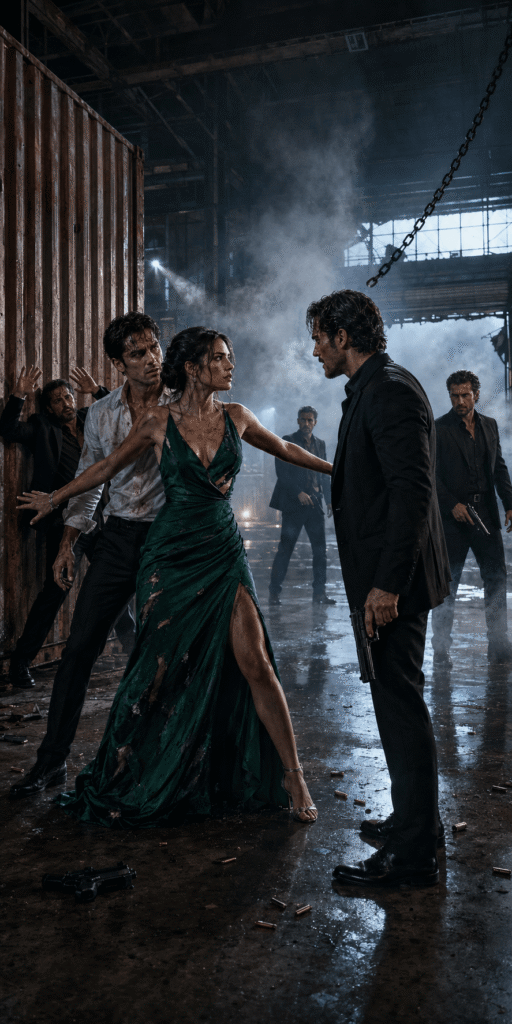
She wore black—a fitted jacket, tailored trousers, her hair pulled back like armor. The only color on her was the silver chain at her throat and the small knife she carried openly now, clipped to her belt. She walked with the easy grace of a woman who owned the room, and Mateo watched the way the men at the exits straightened as she passed, their eyes following her with a mix of respect and fear.
And then came Rafael Echeverría.
He was older than Mateo had expected—late fifties, with a weathered face and salt-and-pepper hair and the kind of build that came from years of physical work on the docks. But his eyes were hard, and his smile was the smile of a man who had already won.
“Lucía,” he said, his voice echoing in the empty space. “You look well.”
“Rafa.” She didn’t smile back. “Thank you for coming.”
“You made it clear I didn’t have a choice.” He pulled out a chair and sat down heavily, his guards spreading out behind him. “So. Let’s talk.”
Lucía remained standing, her hands resting on the back of the chair across from him. “You know why we’re here. The ledger. The shipments. The photograph.”
“The photograph?” Echeverría’s face showed a flicker of confusion, quickly masked. “I don’t know what you’re talking about.”
“The photograph of my brother’s body, delivered to my compound last night. The one with your message on the back.” Her voice was cold, measured. “Did you think I wouldn’t recognize the room he was killed in? It’s the back office of the old Ríos warehouse. The same warehouse where your second set of books is hidden.”
Echeverría’s smile faded. “Lucía, I don’t know who told you these things, but—”
“I’m not here for your denials, Rafa.” She pulled out the chair and sat down, placing the black ledger on the table between them. “I’m here to give you a choice. Walk away. Take what you’ve already stolen, leave Cártama tonight, and I won’t come after you. But if you stay—if you keep moving against my family—I will bury you.”
The room went very quiet.
Echeverría stared at her for a long moment. Then he laughed—a short, ugly sound that bounced off the concrete walls.
“Bury me? You? A little girl who ran away and came back thinking she could play boss?” He leaned forward, his voice dropping to a sneer. “Your father built this organization. Your uncle held it together. You’re just a placeholder until someone better comes along. Everyone knows it.”
Mateo’s hands tightened on the catwalk railing. Below, Lucía didn’t flinch.
“Is that what you think?” she asked softly.
“I know it. You’ve been back six months, and what have you done? You’ve lost three shipments. You’ve alienated half your own men. You’ve brought a stranger into our business and given him access to our records.” Echeverría shook his head. “You’re not a boss. You’re a liability.”
The words hung in the air like smoke.
Lucía looked at him for a long moment, her expression unreadable. Then she reached into her jacket and pulled out a folded sheet of paper.
“This,” she said, “is a list of every account linked to the shell company you’ve been using to move money out of the Almeida organization. It includes the names of the customs officials you’ve bribed, the union representatives you’ve bought, and the three men who shot at me in La Quema last Tuesday.”
She slid the paper across the table.
“It also includes the account number for the payment you made to the men who killed my brother.”
Echeverría didn’t move. But something in his face changed—a tightening around the eyes, a flicker of something that might have been fear.
“You’re bluffing,” he said.
“Am I?” Lucía leaned back in her chair, and for the first time, she smiled. It was the smile Mateo had seen in the warehouse—thin and dangerous, like the edge of a blade. “Then walk away, Rafa. Go home. Call your men. See how many of them answer.”
From the catwalk, Mateo watched as Echeverría pulled out his phone, his jaw tight. He dialed a number, waited, then tried another. Then another. Each time, the same result: nothing.
“The ports are closed to you,” Lucía said quietly. “Your union contacts have been detained by customs, pending an investigation into the altered manifests. Your accounts are frozen. And the men you sent to kill me are currently sitting in a holding cell in Cártama Norte, telling the police everything they know.” She stood, smoothing the front of her jacket. “You should have taken my offer when you had the chance, Rafa.”
Echeverría rose slowly from his chair, his face pale with rage. “You little bitch,” he hissed. “You think you can take what’s mine? You think—”
He lunged.
It happened fast—faster than Mateo could track from the catwalk. Echeverría reached for the gun at his hip, his hand moving with the practiced speed of a man who had killed before. But Lucía was faster.
The silver knife was in her hand before Mateo even saw her move, and then it was pressed against Echeverría’s throat, the nick in the blade catching the light.
“Go ahead,” she whispered, her voice barely audible even from above. “Give me a reason.”
The room was frozen—every man with his hand on his weapon, every eye fixed on the tableau before them. Esteban had risen from his chair, his face white. Diego had drawn his gun. But no one moved. No one dared.
Echeverría’s hand hovered over his holster, trembling. The knife pressed deeper, a thin line of blood appearing at his collar.
“I’ll kill you,” he breathed. “I’ll kill you for this.”
Lucía’s smile didn’t waver. “No, you won’t. Because if you do, every man in this room will see exactly what you are—a traitor who couldn’t even beat a girl with a knife.” She stepped closer, her eyes never leaving his. “And what do you think happens to traitors in this city, Rafa?”
The silence stretched on, thick and suffocating.
Then, slowly, Echeverría lowered his hand.
“Good choice.” Lucía stepped back, closing the knife with a flick of her wrist. “You have until sunset to leave Cártama. If you’re still here tomorrow, I won’t give you a second chance.”
She turned and walked toward the door, her heels clicking against the concrete. The men at the exits parted for her, their eyes wide. Esteban followed, his face unreadable. And Mateo watched from above, his heart pounding, as Lucía Almeida walked out of the old fish market without looking back.
She hadn’t needed him. She hadn’t needed anyone.
But as the room emptied and the last of Echeverría’s men filed out, Mateo saw something that made his blood run cold. One of the men at the far exit—a young man with a scar across his jaw—lingered behind, pulling out his phone. He spoke into it briefly, then slipped out through a side door.
And in the empty market, alone now, Mateo realized what he’d just witnessed.
Echeverría wasn’t the only one Lucía needed to worry about.
Someone else was pulling the strings.
Mateo followed the scar-faced man.
He descended from the catwalk as quickly as he dared, moving through the shadows of the old fish market until he reached the side door. The man had gone east, toward the docks, his phone still pressed to his ear. Mateo kept his distance, using the rusted cargo containers and abandoned fishing equipment as cover.
The man didn’t look back. He was in a hurry, his shoulders hunched, his steps quick and uneven. Whoever he was reporting to, the news wasn’t good.
At the edge of the dock, the man stopped. A car was waiting—a black sedan with tinted windows, idling in the shadow of a decommissioned trawler. The man climbed into the passenger seat, and the car pulled away, heading north toward Cártama Norte.
Mateo memorized the plate number, then turned and walked back toward the market, his mind racing. Echeverría had been handled—Lucía’s trap had worked perfectly, and Rafa was finished. But someone else had been watching. Someone else had wanted to know how the meeting went.
And that someone had a man inside Echeverría’s crew.
He found Lucía back at the compound, in the security office with Diego and two other men Mateo didn’t recognize. She was still in her black suit, but her jacket was off now, and he could see the tension in her shoulders, the way she held herself like a coiled spring.
When she saw him, she dismissed the others with a nod. Diego gave Mateo a long, hard look before leaving, the door closing behind him with a solid thunk.
“What did you see?” Lucía asked.
Mateo told her about the scar-faced man, the phone call, the black sedan. He gave her the plate number and the direction the car had gone. She listened without interrupting, her face unreadable, her thumb moving absently over the nick in her knife.
“The scar on his jaw,” she said when he finished. “Which side?”
“Right side. It looked old.”
Lucía nodded slowly. “That’s Marco Reyes. He’s been with Rafa for years, but he’s not loyal. He’s a hired gun—he goes where the money is.” She set the knife down on the desk. “Whoever was on the other end of that phone call has more money than Rafa. Or more power.”
“Or both.”
She looked at him sharply. “What did you hear?”
“Nothing. But the way he moved, the way he talked—it wasn’t like a soldier reporting to a commander. It was like a man afraid of disappointing someone.” Mateo leaned against the doorframe. “Who’s afraid of Echeverría? After what you just did to him?”
Lucía was quiet for a moment. Then she stood and walked to the map of the port that was still spread across her desk. She traced the route from the fish market to Cártama Norte, her finger following the line of the coast.
“There’s only one man in this city who could make a man like Marco Reyes afraid,” she said quietly. “And he’s been dead for three years.”
Mateo frowned. “Your father?”
“My father’s partner. The man who built the Veracruz route before Rafa took it over. His name was Enrique Salazar.” She looked up, her eyes dark. “He was supposed to have died in a fire, six months before my father. The police identified his body through dental records. But the identification was… convenient.”
“Convenient how?”
“The fire was in a warehouse in Cártama Norte. The building collapsed. The body they found was burned beyond recognition, but the dental records matched Salazar’s. Only problem was, Salazar hadn’t been to a dentist in fifteen years. He was terrified of them.” Lucía’s voice was bitter. “Someone wanted us to believe he was dead.”
“And now you think he’s back.”
“I think he never left.” She walked back to her chair and sat down heavily. “Salazar was the one who taught Rafa everything. How to run the ports, how to move money, how to build a network. If Rafa was skimming, he was skimming for Salazar. And if Salazar is still alive—”
“Then Echeverría was just a pawn,” Mateo finished. “And you just cut off the hand, not the head.”
The silence between them was heavy. Outside, the harbor lights flickered on, one by one, yellow and white against the darkening water.
Lucía rubbed her temples, a gesture of exhaustion she’d never shown him before. “I was so focused on Rafa. I thought if I could just prove he was behind the shipments, behind Tomás…” She trailed off. “I should have seen it.”
“You couldn’t have known,” Mateo said.
“Don’t.” Her voice was sharp. “Don’t comfort me. I don’t need it.”
“I wasn’t—” He stopped himself. “I know you don’t.”
She looked at him then, and something in her face shifted. The hard edge softened, just slightly. “Sit down, Mateo.”
He sat.
“I brought you here because I needed someone outside my organization. Someone who could see what I couldn’t.” She paused. “You’ve done that. You found Echeverría. You found the shell company. And now you’re telling me there’s something bigger. So what do you want to do about it?”
The question caught him off guard. “You’re asking me?”
“I’m asking my insurance.” The ghost of a smile flickered at her mouth. “You said you’d help me find who killed my brother. That’s still the job. So—what do you want to do about it?”
Mateo thought about it. About the black sedan, the plate number, the direction it had gone. About Salazar, the man who had supposedly died in a fire. About the photograph of Tomás Almeida’s body, delivered to the compound with a single word on the back.
“We follow the money,” he said. “Echeverría’s accounts are frozen, but the shell company is still active. Salazar’s network still has resources. If we can trace the payments, we can find out where they’re coming from.”
“I’ve already put men on the customs officials and the union reps. They’ll talk.”
“Not to me, they won’t.” Mateo leaned forward. “But they’ll talk to someone who knows the docks. Someone they’ve seen before. Diego.”
Lucía considered this. “Diego is loyal. He’d do it.”
“Then use him. Send him to the bars in La Quema, the places where the dock workers drink. Have him ask about Salazar—not by name, but about rumors. Men coming back from the dead. Money flowing through the old channels.” He paused. “And in the meantime, I’ll work on the plate number. If I can trace the car, I can find out who Marco Reyes was talking to.”
Lucía nodded slowly. “And what about my uncle?”
The question hung in the air. Mateo had been waiting for it.
“What about him?”
“He’s been quiet since the meeting. Too quiet.” She stood and walked to the window, looking out at the harbor. “Before I came back, he was running things. He had every opportunity to stop Rafa, to notice the missing shipments. But he didn’t. Either he was part of it, or he was too afraid to act. Either way, I can’t trust him.”
“Then don’t.” Mateo stood as well, moving to stand beside her. The view was the same one from her office—the port, the cranes, the dark water. But something about it felt different now, standing shoulder to shoulder with her. “You don’t need to trust anyone. You just need to know who’s useful.”
Lucía turned her head to look at him, and for a long moment, neither of them spoke. She was so close he could see the faint dusting of freckles across her nose, the way her pulse beat at the base of her throat.
“Is that what I am to you?” she asked quietly. “Useful?”
Mateo’s chest tightened. “No.”
“Then what?”
It was the same question she’d asked before, but it carried a different weight now. Not a test. Not a challenge. Something else—something that made his heart hammer against his ribs.
“I don’t know yet,” he admitted. “But I’m not going anywhere.”
Lucía held his gaze for another moment. Then she turned back to the window, and the moment passed.
“Good,” she said. “Because I need you here.”
The next three days were a blur of waiting.
Diego worked the bars in La Quema, talking to dock workers and union men, buying drinks and listening. He came back with fragments—rumors of a man called El Fantasma, the Ghost, who had been seen in Cártama Norte. Men who had worked for Salazar years ago, men who had gone quiet after his supposed death, were suddenly active again. Whispering. Recruiting.
Mateo traced the black sedan’s plate number to a leasing company in the capital, which led to a shell corporation, which led to a property in Cártama Norte—a sprawling, walled estate on a hill overlooking the old naval yards. The estate had been purchased six months ago by a company that didn’t exist.
It was the day before they were supposed to move on the property when the message came.
Lucía was in her office when her phone buzzed—a number she didn’t recognize. She answered it on speaker, and the voice on the other end was cold and familiar.
“You should have stayed away, Lucía.”
Mateo, sitting across from her, went still. He recognized the voice from the fish market. From the phone call. It was Marco Reyes.
“Where’s Salazar?” Lucía said, her voice calm.
The man on the phone laughed. “Salazar is dead, girl. You know that. Burned in a fire.”
“Then why are you calling me?”
There was a pause. Then Reyes’s voice changed, dropping the mockery. “Because you cut off my source of income. Echeverría’s gone, and the accounts are frozen. The Ghost doesn’t like losing money. He wants to meet.”
“The Ghost,” Lucía repeated flatly. “So he does exist.”
“He’s been running this city for three years, girl. You just haven’t noticed.” Another pause. “He’ll meet you tomorrow night. The old naval yards, the dry dock on the north side. Come alone. If you bring anyone, he’ll know.”
The line went dead.
Lucía stared at the phone for a long moment, then looked up at Mateo.
“He doesn’t know you exist,” she said quietly. “Not yet. That’s our advantage.”
“You’re not actually going alone.”
“No.” She stood, moving to the safe behind her desk. “I’m going to do what I should have done from the start. I’m going to walk into that dry dock, and I’m going to end this.”
“And me?”
Lucía turned, and in her hand was a small black handgun, which she checked and holstered at her hip. “You’re going to be my ghost, Mateo. Just like the fish market. But this time, when I give the signal, I need you to be ready to kill.”
She said it so matter-of-factly that it took him a second to process.
“What signal?”
“You’ll know it.” She smiled—that thin, dangerous smile. “I promise.”
That night, Mateo couldn’t sleep.
He lay in the narrow bed in the guest room of Lucía’s apartment, staring at the ceiling, running through every possible outcome of the meeting at the dry dock. Reyes would have men. Salazar—or whoever the Ghost was—would be prepared. And Lucía was walking into it willingly, because that was what she did. She walked into danger and dared it to touch her.
He heard movement in the other room. The soft creak of floorboards, the faint clink of glass.
Mateo rose and pulled on his shirt. He found Lucía in the living room, sitting on the old sofa with a glass of tequila in her hand, staring out the window at the harbor. She’d changed into a loose shirt and worn jeans, her hair down, her feet bare. The knife was on the cushion beside her, closed.
“Can’t sleep either?” she asked without looking at him.
“Never could before a job.” He sat down at the other end of the sofa, keeping a careful distance. “You?”
“Same.” She took a sip of the tequila. “I used to think it was fear. Now I think it’s anticipation.”
“Anticipation of what?”
She was quiet for a moment. Then she set the glass down and turned to face him, tucking her feet under her. “When I was eighteen, my father sent me away. He said I was too young to be part of the family business. Too soft. So I left Cártama, and I spent four years in the capital, pretending I wasn’t an Almeida. Going to university. Dating boys who didn’t know how to hold a gun.” She smiled bitterly. “It was the best thing that ever happened to me.”
“Because you learned who you were?”
“Because I learned what I didn’t want to be.” She picked up the knife, turning it over in her hands. “I didn’t want to be someone who ran away. I didn’t want to be someone who let other people decide my fate. When my father died, I almost didn’t come back. But then Tomás called me, and he told me things were falling apart. He told me he needed me.”
Mateo listened, saying nothing. This was the most she’d ever told him about herself, and he knew it wasn’t idle conversation. It was a gift, offered in the dark, in the quiet, between two people who might not survive tomorrow.
“I came back because he asked me to,” she said. “And then he died, and I stayed because there was no one else. Not because I wanted the power, not because I was ruthless or ambitious. Because I was the only one left who remembered what this family was supposed to be.”
“What was it supposed to be?” Mateo asked.
Lucía looked at him, and there was something raw in her eyes. “Something worth dying for.”
The words hung between them.
Mateo’s hand moved to his wrist, to the broken watch. He felt the cracked crystal under his thumb, the familiar pain of it. Eleven-forty-seven. The moment everything had changed for him, frozen forever in shattered glass.
“My father was a man named Ignacio Ferrer,” he said quietly. “He was a fixer, like me. He worked for men like Salazar, men who paid him to solve problems. One night, he was called to a meeting at a warehouse in the capital. He never came home.”
Lucía’s gaze didn’t waver. “What happened?”
“I don’t know. The police said it was a robbery. They found his car in a ditch, his body a mile away. He’d been shot three times.” Mateo swallowed. “He was wearing this watch when they found him. It stopped at 11:47. The moment he died.”
“Why do you still wear it?”
“Because I want to remember what I’m doing this for.” He looked down at the watch, at the frozen hands. “I’m not just a mercenary, Lucía. I’m looking for the man who killed my father. And I think he might be the same man you’re about to meet tomorrow.”
The silence that followed was heavy, but not uncomfortable. It was the silence of two people who had just shown each other their scars and found them matching.
“Mateo,” Lucía said softly. “If we survive tomorrow… I want you to tell me everything.”
“I will.”
She reached out and took his hand—the one still resting on the watch. Her fingers were warm against his, her grip surprisingly strong.
“Promise me,” she said.
“I promise.”
They sat there for a long time, hands intertwined, watching the lights of the harbor flicker in the darkness. Neither of them spoke again. They didn’t need to.
Outside, the city held its breath.
The old naval yards were a graveyard of rusted ships and abandoned dry docks, a place where the city’s maritime history had been left to rot. The north dry dock was the largest, a massive concrete basin half-filled with black water, its walls streaked with rust and salt. A single light burned at the far end, casting long shadows across the cracked ground.
Lucía arrived alone.
She walked through the gate with her head high, her hand resting on the knife at her belt. The night was cold, the air thick with the smell of salt and decay. Somewhere in the distance, a bell buoy clanged against the tide.
Marco Reyes was waiting for her at the edge of the dry dock, flanked by four men with automatic rifles. He had the same scar across his jaw, the same cruel smile.
“The little boss,” he said. “Right on time.”
“Where’s your master?” Lucía asked. Her voice carried across the empty space, calm and steady.
“He’s watching.” Reyes gestured toward the shadows beyond the light. “But before he comes out, I have a question. What makes you think you can walk in here alone and walk out alive?”
Lucía stopped a few feet from him, her eyes scanning the darkness. “Who said I was alone?”
Reyes’s smile flickered. For just a second, he looked uncertain.
And then, from the shadows, the Ghost stepped forward.
He was older than Lucía expected—mid-fifties, with silver hair and a face carved by years of sun and violence. Enrique Salazar. Not dead. Not burned. Very much alive.
“Lucía Almeida,” he said, his voice smooth as oil. “You look just like your mother.”
“Don’t talk about my mother,” Lucía said quietly.
Salazar smiled. “Fair enough. But you should know—I didn’t want this. Any of it. Your father and I built something together, and when he died, I tried to keep it going. But your brother… Tomás was reckless. He was going to destroy everything.”
“So you had him killed.”
“I had him removed. There’s a difference.” Salazar took a step closer, his eyes glinting in the dim light. “And now you’re here, making the same mistakes. You should have stayed away, Lucía. You should have let the city forget you.”
“Like it forgot you?” Lucía tilted her head. “You faked your death, Enrique. You let your own family mourn you. And for what? Money? Power?”
“For survival.” Salazar’s voice hardened. “The same thing you’re fighting for now. The same thing we’re all fighting for.” He stopped a few feet from her, close enough to touch. “So I’m going to give you a choice. Walk away. Leave Cártama. Let me run things the way your father would have wanted. And I’ll let you live.”
Lucía stared at him for a long moment. Then she laughed—a low, humorless sound.
“You think I came here to negotiate?”
“No,” Salazar said. “I think you came here to die.”
He raised his hand, and the men behind him lifted their rifles.
But before he could give the order, Lucía moved.
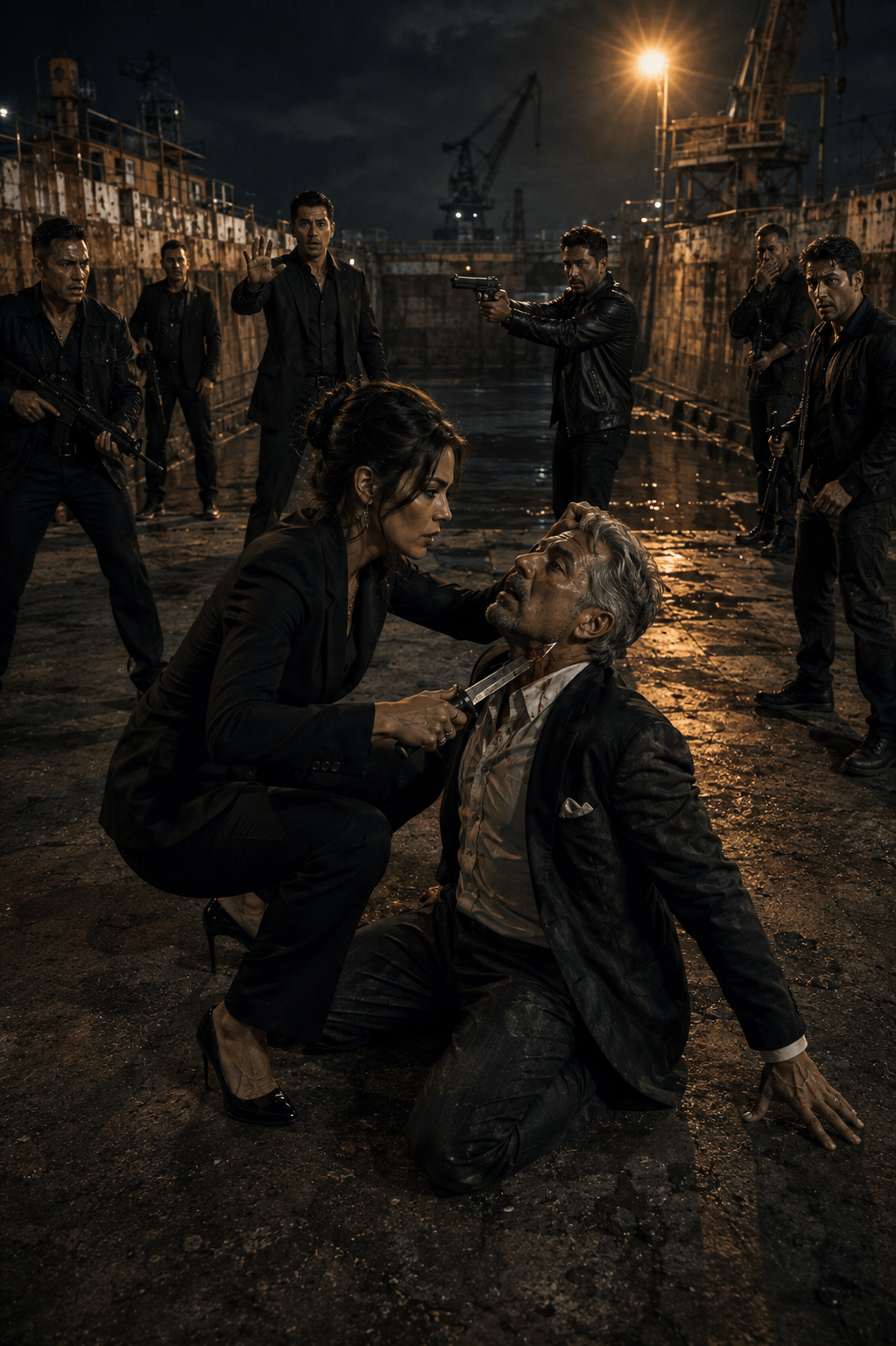
The knife was in her hand, and then it was pressed against Salazar’s throat, the same knife, the same nick, the same deadly precision. The men froze, their fingers on their triggers but their eyes wide with shock.
“Drop your weapons,” Lucía said, her voice carrying like a whip crack. “All of you.”
No one moved.
“I said drop them!”
From the darkness behind Salazar, a figure emerged—Mateo, his gun drawn, moving with the silent efficiency of a man who had been waiting in the shadows for hours. He had Reyes in his sights before the scar-faced man could even turn.
“I’d listen to her,” Mateo said quietly.
Reyes went pale. “You—”
“Me.”
Salazar, his throat pressed against the blade, let out a choked laugh. “You brought backup. I’m impressed.”
“I’m not here to impress you, Enrique.” Lucía’s voice was ice. “I’m here to end this.”
She pressed the knife harder, and a thin line of blood welled up at Salazar’s collar.
“Now tell your men to drop their weapons, or I’ll open your throat right here.”
For a long, terrible moment, no one moved. The rifles stayed raised, the shadows stayed still, and the only sound was the distant clang of the buoy and the ragged breath of the man with a knife at his throat.
Then, slowly, Salazar raised his hand.
“Drop them,” he said.
The men lowered their rifles.
And in that moment, Mateo saw something shift in Lucía’s face—not relief, not triumph. Something harder. Something final.
He had seen her ruthless before. He had seen her powerful. But he had never seen her like this.
This was the woman her father had sent away because she was too soft. This was the girl who had come back and taken what was hers. This was Lucía Almeida, the undisputed boss of the Almeida cartel, holding a knife to the throat of the man who had killed her brother.
And Mateo realized, with a clarity that felt like a bullet to the chest, that he would follow her into hell if she asked him to.
The standoff at the dry dock lasted eleven minutes.
Later, Mateo would remember every second of it—the way the sodium light flickered over Salazar’s face, the way the rifles lowered one by one, the way Lucía’s hand never trembled on the knife. But what he would remember most was the sound of her voice when she finally spoke the words that ended it.
“On your knees.”
Salazar didn’t move. The knife pressed deeper. A thin rivulet of blood ran down his neck, dark against his collar.
“I said,” Lucía repeated, her voice soft as a prayer, “on your knees.”
The old man’s legs buckled. He went down hard on the cracked concrete, his face a mask of rage and humiliation. His men stood frozen, rifles lowered, watching their leader kneel before a woman half his age.
Marco Reyes made a sound—a strangled noise of protest—and Mateo pressed the barrel of his gun harder against the back of his skull.
“Easy,” Mateo murmured. “She’s not done with him yet.”
Lucía circled Salazar slowly, the knife still in her hand, the blade catching the light. She moved like a predator, unhurried, deliberate. The hem of her dark jacket swayed with each step.
“Enrique Salazar,” she said, loud enough for everyone to hear. “You conspired against my family. You stole from our shipments. You ordered the murder of my brother.” She stopped in front of him, looking down. “You faked your own death and spent three years hiding in the shadows, building an empire on our blood. And now you kneel before me and ask for mercy?”
“I didn’t ask for anything,” Salazar rasped.
“No. You didn’t.” Lucía crouched down, bringing her face level with his. “That’s the only reason you’re still alive.”
She reached out with her free hand and grabbed a fistful of his silver hair, jerking his head back. The knife rose, the nicked blade resting just under his eye.
“But I want you to understand something, Enrique. I am not my father. I am not my brother. I am not the girl who ran away.” Her voice dropped to a whisper, but it carried across the silent dock. “I am the woman who came back. And I do not forget.”
She held him there for a long moment, his breath ragged, his eyes wide with the first real fear Mateo had seen in them. Then she released him, shoving him backward onto the concrete, and stood.
“Your men will leave their weapons and walk out of these yards tonight,” she said. “They will go home. They will tell everyone what they saw here. And in the morning, they will work for me, or they will leave Cártama. Those are the only choices.”
Salazar stared up at her, his chest heaving. “You can’t just—”
“I can.” Lucía looked at the men behind him, her gaze sweeping over them one by one. “Your boss is finished. The accounts are frozen. The network is mine now. If any of you think that’s not true, you’re welcome to test me.” She paused, letting the silence stretch. “But I’d advise against it.”
One by one, the men set down their rifles. They didn’t look at Salazar. They didn’t look at each other. They just dropped their weapons on the concrete and backed away, their faces empty.
Marco Reyes was the last. He hesitated, his hands trembling, and Mateo felt the man’s fear like a physical thing.
“Reyes,” Lucía said without turning around. “You made a phone call outside the fish market. Who did you call?”
The scar-faced man swallowed. “Salazar.”
“Salazar was supposed to be dead.”
“He wanted it that way. He—” Reyes’s voice cracked. “He said if anyone found out, he’d kill my family.”
“And yet here you are, working for him anyway.” Lucía turned, and her expression was unreadable. “You have one chance, Reyes. Tell me everything, and I’ll let you walk out of here with the others.”
Reyes looked at Salazar, then at Mateo, then back at Lucía. His face was slick with sweat. “He’s not the only one,” he said finally. “There’s someone else. Someone inside your house. A woman.”
The words landed like a blow.
Lucía went very still. “What woman?”
“I don’t know her name. I only saw her once, at a meeting in Cártama Norte. She wore a veil, like a widow. She gave Salazar money, information. She told him about your brother’s schedule, about the shipment routes.” Reyes’s voice was desperate now, pleading. “That’s all I know. I swear.”
“A woman in a veil,” Lucía repeated slowly. “In my house.”
Mateo watched her process this, the way her jaw tightened, the way her hand moved to the knife at her belt. She was thinking, calculating. And then he saw it—the moment it clicked.
“Get out,” she said to Reyes, her voice flat. “All of you. Now.”
They ran.
Within a minute, the dry dock was empty except for Lucía, Mateo, and the man still sprawled on the concrete. The rifles lay scattered on the ground like discarded toys.
Salazar laughed—a wet, ugly sound. “You think you’ve won? She’s still in your house, Lucía. She’s still there. And she’ll cut your throat the moment you turn your back.”
Lucía looked down at him. “Who is she?”
“I could tell you. But where’s the fun in that?” Salazar pushed himself up on his elbows, his smile bloody. “You’ll find out soon enough. And when you do, you’ll wish you’d stayed in the capital with your pretty university boys.”
For a long moment, no one moved.
Then Lucía turned to Mateo. “Tie him up. We’re taking him back to the compound.”
“And then?”
“Then we find the woman in the veil.”
The compound was dark when they arrived, the courtyard silent, the gates guarded only by two men who nodded as Lucía’s SUV rolled through. She’d called ahead—Diego was waiting at the main doors, his face drawn and tired.
“What happened?” he asked as Mateo hauled Salazar out of the back seat, bound and gagged.
“Salazar’s alive,” Lucía said shortly. “Put him in the holding room downstairs. And wake my uncle.”
Diego’s eyes widened, but he didn’t ask questions. He just took Salazar by the arm and led him inside.
Lucía stood in the courtyard for a moment, staring up at the old stone house. The harbor wind tugged at her hair, and Mateo watched her, saw the weight of everything settling on her shoulders.
“A woman in a veil,” she said quietly. “In my house.”
“You know who it is,” Mateo said. It wasn’t a question.
Lucía’s thumb moved to the knife in her pocket. She pressed against the nick, her eyes still fixed on the house. “There’s only one woman in this city who would wear a veil like that. Only one woman with the access and the motive.”
“Who?”
She turned to look at him, and her face was awful—not angry, not afraid, but something deeper. Something like grief.
“My brother’s wife.”
Her name was Elisa.
Mateo learned this in bits and pieces, in the quiet minutes that followed. Tomás Almeida had married six months before he died, a rushed ceremony in the capital, kept secret from most of the family. The woman had been his wife for exactly one hundred and seventeen days before the men in Veracruz killed him. She’d come to Cártama for the funeral, stayed for the reading of the will, and then disappeared.
Lucía had assumed she’d gone back to her family. She’d been wrong.
“She came to me last month,” Lucía said, pacing the length of her office. “She said she wanted to be part of the organization. To help carry on Tomás’s legacy. I told her no. I told her it was too dangerous.” She stopped, her hands clenched at her sides. “I thought I was protecting her.”
“You were,” Mateo said. “She just didn’t want protection.”
“She wanted revenge.” Lucía’s voice was bitter. “On the men who killed her husband. On Salazar. On me, maybe, for not doing enough.”
Mateo leaned against the wall, watching her. She was unraveling—not visibly, not in a way anyone else would notice, but he could see it. The way her hand kept moving to the knife. The way her breathing had gone shallow. The way she couldn’t stay still.
“Lucía,” he said quietly. “You need to sleep.”
“I need to find her.” She stopped pacing, her eyes blazing. “She’s in my house, Mateo. She’s been here all along. She knew about the warehouse, about the meeting. She sent that photograph.”
“We’ll find her. But not tonight. You’re exhausted, and we need to be careful. If she knows we’re looking for her, she’ll run.”
Lucía stared at him for a long moment. Then, slowly, she nodded. “You’re right. But I want guards on every door. And I want Elisa’s rooms searched. Now.”
“I’ll take care of it.”
He found Diego in the hallway and relayed the orders. Then he walked with Lucía to her private quarters—a small suite at the back of the compound, guarded by a single door with a heavy lock. She paused at the threshold, her hand on the doorframe.
“Stay,” she said. It wasn’t a question.
Mateo hesitated. “Lucía—”
“I don’t want to be alone.” She looked at him, and for the first time since the dry dock, he saw something other than the boss. Something fragile. “Please.”
He stayed.
They lay together on the narrow bed in her quarters, fully clothed, the space between them measured in inches. Neither of them spoke. The compound was silent around them, the only sound the distant wash of the sea against the harbor walls.
After a long time, Lucía shifted in the dark. Her hand found his, their fingers tangling together on the blanket.
“When I was a child,” she said softly, “my father used to say that power was a knife. Sharp on both edges. It cuts your enemies, but it cuts you too, if you’re not careful.” She paused. “I didn’t understand what he meant until tonight.”
“Which edge cut you?”
“All of them.” She turned her head to look at him, her face a pale shape in the darkness. “I sent my brother’s wife away. I didn’t trust her with the truth, with the family. And she turned to Salazar because she had nowhere else to go. That’s on me, Mateo. I made her an enemy.”
“You made a choice,” he said. “You couldn’t have known what she’d become.”
“Couldn’t I?” Lucía’s voice was raw. “I’ve spent my whole life trying to be hard enough, cold enough. I pushed everyone away because I thought it would keep me safe. And now the only person who’s still here is a man who was paid to spy on me.”
The words stung, but they weren’t meant to. They were the truth, spoken in the dark, by a woman too tired to lie.
Mateo turned onto his side, still holding her hand. “I wasn’t paid to spy on you,” he said. “I was paid to find out who was skimming from your organization. The man who hired me thought you were the problem. He was wrong.”
“Who hired you?”
The question hung in the air, heavier than he’d expected.
“Your brother,” Mateo said. “Tomás. He contacted me six weeks before he died. He said he suspected someone in his own house was working against him. He wanted someone on the outside, someone who could investigate without raising suspicion.” He paused, his thumb tracing the back of her hand. “He loved you, Lucía. He wanted to protect you. That’s why he reached out.”
Lucía was silent for a long time. When she spoke, her voice was barely a whisper. “And all this time, I thought he died alone.”
“He didn’t. He died trying to do the right thing.” Mateo hesitated. “And the woman in the veil—Elisa—she was part of it. She must have known about Tomás’s investigation. Maybe she even helped Salazar plan the hit.”
“Then she dies.” Lucía’s voice hardened. “Whatever she was to my brother, whatever grief she’s carried—she made her choice. And she’s going to answer for it.”
Mateo said nothing. He just held her hand in the darkness and listened to the sea.
Tomorrow, the reckoning would come.
But for now, they had this—this quiet moment, this fragile peace, this woman who had cut herself on the very power she’d wielded.
And Mateo knew, with a certainty that settled into his bones, that he would kill for her. He would die for her. He would do whatever it took to keep her alive through the coming storm.
Because Lucía Almeida was not just the boss of the Almeida cartel.
She was the woman he was falling in love with.
They found Elisa’s rooms empty.
Not empty in the way of someone who had left in a hurry—drawers open, clothes scattered, the chaos of flight. Empty in the way of someone who had planned her exit long before anyone thought to look. The bed was made. The closet was bare. The only sign that anyone had lived there at all was a single photograph on the nightstand: Tomás Almeida, smiling, his arm around a woman in a white veil.
Lucía stood in the doorway, staring at the photograph. Her face was unreadable.
“She knew we were coming,” Mateo said quietly. “She must have had a spotter at the dry dock. Someone who saw what happened and warned her.”
“She’s been watching us this whole time.” Lucía’s voice was flat. “In my own house.”
Diego appeared in the hallway behind them, his face grim. “We found something, jefa. In the security office. A bug, hidden in the phone on the desk. It’s been transmitting for weeks.”
Lucía closed her eyes. For a moment, she looked young—younger than Mateo had ever seen her. Then she straightened, and the mask slid back into place.
“Find her,” she said. “I don’t care what it takes. I want her found before sunrise.”
They searched the compound, then the harbor, then the streets of La Quema. Mateo moved with Lucía through the dark city, checking the bars and the safe houses, waking men who owed the Almeida family favors and pressing them for information. The word spread quickly: Elisa Almeida, the brother’s widow, the woman in the veil. Wanted by the boss.
But no one had seen her.
It was nearly dawn when they returned to the compound, exhausted and empty-handed. The sky over the harbor was turning gray, the first light of morning bleeding through the clouds. Lucía stood at the window of her office, staring out at the water.
“She could be anywhere,” she said. “She has money, she has connections. She could be on a boat to the mainland by now.”
“Or she could be waiting,” Mateo said. “Watching. She’s patient. She planned this for months.”
Lucía turned to look at him. “Then what do you suggest?”
Mateo thought about it. About the woman in the veil, the grieving widow turned traitor. About Salazar, still locked in the holding room downstairs. About the trail of bodies and money and lies that had brought them here.
“Use Salazar,” he said. “Put out the word that he’s dead. That you killed him at the dry dock and dumped his body in the harbor. If Elisa thinks her ally is gone, she’ll either run or she’ll come for you.”
“And if she runs?”
“Then she’s not a threat anymore. She’s a fugitive, and she’ll spend the rest of her life looking over her shoulder.” He paused. “But if she comes for you, you’ll be ready.”
Lucía considered this. Then she nodded slowly. “It’s a good plan. But there’s one problem.”
“What?”
“You.” She turned fully to face him, her eyes searching his. “You said you’d find the man who killed your father. You think it’s Salazar. If he’s dead—if we tell the world he’s dead—then your search is over. You’ll never know for sure.”
Mateo’s hand moved to his wrist, to the broken watch. Eleven-forty-seven. The moment his father had died, frozen in time.
“I’ve been chasing that answer for ten years,” he said quietly. “But last night, I realized something. It doesn’t matter.”
“It doesn’t?”
“No.” He crossed the room, stopping in front of her. “My father wasn’t killed by one man. He was killed by a system. Men like Salazar, like Echeverría, like every cartel boss who thinks violence is a solution. Killing Salazar won’t bring my father back. But helping you build something different—helping you take this city and make it yours—that might actually mean something.”
Lucía stared at him, her expression unreadable. “You’d give up your revenge? Just like that?”
“I’m not giving it up. I’m choosing something better.” He reached out, hesitantly, and touched her cheek—the same cheek that had been scratched by flying glass in the warehouse, now smooth and warm. “I’m choosing you.”
She didn’t pull away. She didn’t speak. She just looked at him, her dark eyes searching his, and Mateo felt his heart pound in the silence.
Then, slowly, she raised her hand and covered his with her own.
“You realize what you’re saying,” she said softly. “If you choose me, you choose all of it. The blood. The violence. The things I’ll have to do to keep this city from tearing itself apart.”
“I know.”
“And you can live with that? With loving a woman who has blood on her hands?”
Mateo leaned closer, his forehead nearly touching hers. “I can live with anything,” he said, “as long as it’s with you.”
The kiss, when it came, was not gentle.
It was desperate, hungry, the collision of two people who had spent weeks pretending they didn’t want each other. Lucía’s hands fisted in his shirt, pulling him closer, and Mateo buried his fingers in her hair, tilting her head back. She tasted like salt and tequila and something darker, something that might have been grief.
They broke apart, gasping.
“Tell me you want this,” Lucía said, her voice rough. “Tell me you’re not going to wake up tomorrow and realize this was a mistake.”
“I want this.” His hands were on her waist, sliding beneath the hem of her shirt, feeling the heat of her skin. “I’ve wanted you since the moment you told me to sit down in your office and called me Ferrer.”
A sound escaped her—something between a laugh and a sob. “That was three seconds after I met you.”
“I know.” He kissed her again, softer this time. “I’m a fast learner.”
They didn’t leave the office until noon.
Mateo would remember that morning for the rest of his life—the way the gray light from the window had turned golden as the sun broke through the clouds, the way Lucía had looked beneath him, above him, around him, the way she’d whispered his name in the dark. She was not gentle, and he didn’t want her to be. She was exactly who she was: a woman who took what she wanted and gave nothing she didn’t mean.
When they finally emerged, rumpled and quiet, the compound had changed.
News of the night’s events had spread. Men who had once looked at Lucía with skepticism now lowered their eyes when she passed. The guards at the gates stood straighter. Even Diego, who had never warmed to Mateo, gave him a look that might have been respect.
“Word’s out,” Diego said, falling into step beside them. “The city knows about Salazar. They know what happened at the dry dock.”
“And what are they saying?” Lucía asked.
“That you’re not to be fucked with.” Diego’s voice was flat, but there was a note of satisfaction in it. “That the Almeida cartel has teeth again.”
Lucía nodded. “Good. And Elisa?”
Diego’s face darkened. “Still no sign. But we’ve got men watching the ports and the bus stations. If she’s still in Cártama, we’ll find her.”
“She’s still here,” Lucía said, with a certainty that made Mateo glance at her. “She wouldn’t leave without seeing this through. She wants revenge, Diego. Not escape.”
“Then we wait.”
“We prepare.” Lucía stopped at the top of the stairs, looking down at the courtyard below. “She’ll come for me. Tonight, tomorrow, soon. And when she does—”
She didn’t finish the sentence. She didn’t need to.
The message came just after sunset.
A small white envelope, slipped under the main gate, addressed in neat, feminine handwriting to Lucía Almeida, the Usurper.
Inside was a single sheet of paper, and on it, a time and a place: The old church of Santa Lucía. Eleven o’clock. Come alone, or the city burns.
The old church of Santa Lucía was a ruin on the southern edge of Cártama, a place where the city’s oldest families had once worshipped before the port had swallowed the neighborhood in industry and vice. It had been abandoned for decades, a shell of crumbling stone and broken stained glass, and it was the last place anyone would expect a reckoning.
Lucía read the note twice, then handed it to Mateo.
“She’s not subtle,” he said.
“She’s not trying to be.” Lucía pulled on her jacket, checking the gun at her hip. “This is her final move. If she can’t have the organization, she’ll burn it down.”
“Then don’t go alone.”
“I wasn’t planning to.” She looked at him, and there was something almost like a smile on her face. “You’re my ghost, remember? Just like the fish market. Just like the dry dock. You watch from the shadows, and when I give the signal, you act.”
“What’s the signal this time?”
“You’ll know.” She reached up and touched his face, her thumb tracing the line of his jaw. “You always do.”
The old church of Santa Lucía rose out of the darkness like a skeleton, its bell tower jagged against the night sky. The streets around it were silent, abandoned, the windows of the surrounding buildings dark and empty. A single candle burned inside the church, its light flickering through the broken windows like a dying star.
Mateo slipped through a side door and climbed to the choir loft, settling into the shadows above the nave. Below him, the church was a cavern of ruined pews and fallen stone, the air thick with dust and the smell of old incense. The candle sat on the altar, and beside it stood a figure in a black veil.
Elisa.
She was smaller than he’d expected, her shoulders narrow, her hands clasped in front of her like a woman at prayer. But when she spoke, her voice carried through the church with surprising strength.
“Lucía. I knew you’d come.”
Lucía stepped through the main doors, her footsteps echoing on the stone. She was alone—or appeared to be—her dark jacket blending with the shadows. The knife was at her belt, the gun at her hip.
“You wanted to see me,” she said. “Here I am.”
Elisa turned, and the candlelight illuminated her face through the veil. She was beautiful, in the way grief made beautiful—pale and drawn and burning with something that had consumed her from the inside.
“You killed him,” Elisa said. “Salazar. You killed him, and now you think you’ve won.”
“Salazar is dead,” Lucía confirmed. “And Echeverría is gone. Your allies are gone. There’s no one left to fight for.”
“No one left?” Elisa’s laugh was brittle. “You have no idea what you’re dealing with, Lucía. You never did.”
From the shadows behind the altar, figures emerged—men with guns, at least a dozen, spreading out through the ruined pews. They moved silently, their weapons raised, their eyes fixed on Lucía.
Mateo tensed in the loft, his hand going to his gun. He counted fourteen, fifteen, sixteen. Too many for a clean shot. Not too many for a distraction.
Lucía didn’t move. She didn’t even look at the men surrounding her.
“You want me dead,” she said calmly. “I understand. You think I failed Tomás. You think I failed the family. You think you’re the only one who loved him.” She paused. “But Tomás was my brother, Elisa. I’ve known him my whole life. And I know he would never have wanted this.”
“You don’t know what he wanted!” Elisa’s voice cracked, raw with grief. “You weren’t there! You were in the capital, pretending to be someone else, while he was here fighting for his life! And then he died, and you came back like nothing had happened, like you had a right to take what was his!”
“I came back because he asked me to.” Lucía’s voice was still calm, still steady. “He called me the night before he died. He told me he was scared. He told me he’d found something—a conspiracy, a betrayal—and he needed my help. I told him I’d be there in two days.” She paused, and when she spoke again, her voice was barely a whisper. “I was too late.”
Elisa stared at her, frozen.
“I’ve spent every day since then trying to make up for that,” Lucía continued. “Finding his killers. Taking back what was stolen. Building something he would have been proud of. And you—you spent that time plotting with the men who killed him. Using his death as an excuse to destroy everything he loved.”
“That’s not true.” Elisa’s voice shook. “I didn’t know Salazar was involved in Tomás’s death until after. I thought I was getting revenge. I thought—”
“You thought you could use him.” Lucía took a step forward, and the gunmen tensed. “But he was using you, Elisa. He gave you money and promises and told you what you wanted to hear. And all the while, he was bleeding my family dry and building his own empire on our bones.”
“No.” Elisa shook her head violently. “No, that’s not—”
“He had Tomás killed, Elisa. He admitted it to me at the dry dock. He told me he’d had my brother removed because Tomás was going to expose him.” Lucía’s voice was harsh now, cutting through the ruined church like a blade. “And you helped him. You gave him information. You told him our schedules, our routes, our weaknesses. You might as well have pulled the trigger yourself.”
The silence that followed was absolute.
Then Elisa tore the veil from her face, and Mateo saw her clearly for the first time. She was younger than Lucía, her face streaked with tears, her eyes wild with grief and fury.
“I loved him,” she whispered. “I loved him more than anything. And you—you took everything from me. You took the family, the organization, the city. You took his memory and twisted it into something I don’t recognize.”
“I didn’t take anything,” Lucía said. “I carried it. Because someone had to.” She held Elisa’s gaze. “But I understand now. You’re not a traitor. You’re just a woman who loved my brother and didn’t know what to do with the hole he left behind.”
Elisa’s face crumpled. For a moment, she looked like she might fall.
Then she raised her hand, and the gunmen around her shifted.
“Kill her,” Elisa said.
No one moved.
“I said kill her!” Elisa’s voice rose to a shriek. “What are you waiting for? She killed Salazar! She killed Echeverría! She’ll kill all of you too!”
But the men didn’t move. They stood there, guns raised, their faces uncertain. And Mateo understood—they weren’t loyal to Elisa. They’d been paid, or coerced, or simply caught up in something they didn’t fully understand. And now, faced with Lucía Almeida, the woman who had just dismantled a two-decade conspiracy in a single week, they were reconsidering.
“They won’t do it,” Lucía said quietly. “Because they know what happens if they do. They know that if they kill me, every man in this city who owes me a favor will come for them. They know that my death won’t end the Almeida family—it’ll only make us stronger.” She paused. “And they know that you, Elisa, are not a leader. You’re a widow with a grudge and a bag of money. When the money runs out, so will they.”
Elisa’s face went white.
One by one, the gunmen lowered their weapons. One by one, they stepped back into the shadows, melting away until only Elisa remained, standing alone at the altar.
“No,” she breathed. “No, no, no—”
“Tomás loved you,” Lucía said, and her voice was not unkind. “He told me about you, in that last phone call. He said you were the only good thing in his life. The only thing that made the violence worth it.” She paused. “I think he would want you to live, Elisa. I think he would want you to find a way to be happy again.”
Elisa sank to her knees, sobbing.
“Leave Cártama,” Lucía said. “Tonight. I won’t send anyone after you. Go back to your family, start over, make a life that has nothing to do with this. It’s what he would have wanted.”
The church was silent except for Elisa’s sobs. Mateo watched from the loft, his heart pounding. He had expected blood. He had expected violence. He had expected the ruthless boss he’d come to know.
But this—this was something else. This was mercy.
And he loved her even more for it.
Slowly, Lucía turned and walked back down the aisle, past the ruined pews and the broken windows, toward the main doors. She didn’t look back. She didn’t need to.
Elisa watched her go, her face streaked with tears, her hands still clasped in front of her.
At the door, Lucía paused.
“If you ever come back to Cártama,” she said, “I’ll know. And I won’t be merciful twice.”
Then she was gone, swallowed by the darkness beyond the doors.
Mateo waited until the gunmen had dispersed, until Elisa had risen and stumbled out through a side exit, until the old church was empty and silent and dark. Then he climbed down from the loft and walked out into the night.
Lucía was waiting for him at the end of the street, leaning against the hood of her SUV. Her face was unreadable in the dim light, but he could see the exhaustion in her shoulders, the way she held herself like she was waiting for something.
“You let her go,” Mateo said.
“She wasn’t worth killing.” Lucía looked up at the sky, where the first stars were beginning to appear through the clouds. “She was just like me, once. A woman who loved an Almeida and didn’t know what to do with it.”
Mateo moved to stand beside her. “That’s not like you.”
“No.” She turned to look at him, and there was something almost like wonder in her eyes. “Maybe that’s your influence.”
They stood there in the quiet street, side by side, watching the stars. The city was still, the violence of the past week settling into memory.
“Thank you,” Lucía said finally. “For being there. For always being there.”
“I made a promise,” Mateo said. “I keep my promises.”
“Promises.” She laughed softly. “I used to think they were the only thing that mattered. Blood, honor, family. Now I’m not so sure.”
“What do you think matters now?”
She reached out and took his hand, lacing her fingers through his. “This,” she said. “Whatever this is. Whatever we’re becoming.”
Mateo lifted her hand and pressed it to his lips. “It matters to me too.”
They stood there until the cold drove them back to the SUV, and then they drove through the dark city together, back to the apartment in the old quarter, back to the narrow bed where they’d spent the night before.
And when they lay together in the darkness, tangled in each other, Mateo knew that something had shifted. The walls Lucía had built around herself had cracked, just a little. And in that crack, she’d let him in.
It was terrifying and exhilarating and more than he’d ever dared to hope for.
But it was real.
And for the first time in ten years, Mateo Ferrer felt like he belonged somewhere.
The rain came to Cártama on the third morning after the church.
It swept in from the sea, heavy and gray, washing the salt from the streets and the blood from the cobblestones. The port district glistened under it, the cranes and container ships reduced to soft shapes in the mist. From the window of Lucía’s office, the harbor looked almost peaceful—a city holding its breath after weeks of violence.
Mateo stood at that window, watching the rain, and tried to remember the man who had walked into this compound eleven days ago. The man who had come to assess a woman everyone said was too young, too soft, too weak to hold her father’s empire. That man had been certain of so many things. He’d been certain the job would be quick. He’d been certain he’d be gone before the month was out. He’d been certain he could never belong to a city like this, to a life like this, to a woman like the one who now stood across the room, bent over a stack of ledgers, her hair still damp from the rain.
That man had been a fool.
“Stop brooding,” Lucía said without looking up. “It’s distracting.”
Mateo turned from the window. “I wasn’t brooding.”
“You were standing at the window with your hand on your watch. That’s brooding.” She looked up then, her dark eyes finding his. “What are you thinking about?”
“I’m thinking about how much has changed.” He crossed the room and sat down in the chair opposite her desk. “Eleven days ago, I walked into this office with a fake name and a list of lies. Now I’m…” He trailed off.
“Now you’re what?”
He met her gaze. “Yours.”
The word hung between them, heavier than the rain outside.
Lucía set down her pen. For a long moment, she just looked at him—that unblinking, calculating stare he’d come to know so well. Then something softened at the edges of her mouth.
“Is that what you want?” she asked quietly. “To be mine?”
“It’s what I am.” He leaned forward, his elbows on his knees. “I stopped being a hired gun the night I followed you into that warehouse. Maybe before that. Maybe the moment you told me I was either brave or stupid and I realized I didn’t care which one you thought.”
“Brave or stupid,” she repeated, and there was something almost like a smile in her voice. “I remember that.”
“I remember everything you’ve said to me.”
“That’s either very romantic or very concerning.”
“Both,” he said, and watched her eyes flicker with amusement.
The office was different now, he realized. Not the furniture—the same desk, the same map, the same view—but the atmosphere. The weight of the past week had settled into the walls, changing them. There was no more uncertainty here, no more tension between the boss and the stranger she’d been forced to trust. They were something else now. Something new.
“What happens now?” Mateo asked.
Lucía rose from her chair and walked around the desk, stopping beside him. She leaned against the edge, her hip grazing his arm, and looked down at him with an expression he couldn’t quite read.
“Now we rebuild,” she said. “Echeverría’s network is dismantled. Salazar is dead—or so the city believes. Elisa is gone, and she won’t be back.” She paused. “The men who were loyal to Rafa have mostly pledged themselves to me. The ones who didn’t have left the city. My uncle has agreed to step back from active operations. He’ll run the legitimate side of the business, the shipping and the real estate, but the rest is mine.”
“All of it?”
“All of it.” She said it without pride, without satisfaction. Just a simple statement of fact. “I spent six months proving myself to men who thought I was a placeholder. Now they know better.”
Mateo reached up and took her hand, pulling her down to sit beside him on the edge of the desk. She came willingly, her thigh pressing against his.
“And where do I fit into this new order?” he asked.
Lucía looked at him for a long moment. Then she reached into her pocket and pulled out the silver knife—Tomás’s knife, the one with the nick in the blade. She opened it and held it between them, the light from the window catching the edge.
“My brother gave me this when I was twelve years old,” she said quietly. “He told me it was for protection. But he also told me that the sharpest things can be broken. That you have to be careful with the things that matter most.” She closed the knife and pressed it into his palm. “I’m giving it to you.”
Mateo stared at the knife in his hand. It was warm from her pocket, the handle worn smooth by years of use. He could feel the nick in the blade through the handle, that small imperfection that meant so much to her.
“Lucía—”
“I’m not asking you to stay,” she said, cutting him off. “I’m telling you that if you stay, you stay as my equal. My partner. Not my employee, not my insurance, not my ghost. The man who stands beside me when the next threat comes. Because it will come. It always does.”
Mateo closed his fingers around the knife. “I’m not going anywhere.”
“I know.” She reached up and touched his face, her thumb tracing the line of his jaw. “But I wanted you to know that you have a choice. I don’t want you here because you owe me something. I want you here because you want to be.”
He turned his head and kissed her palm. “I want to be.”
“Then be.” She leaned in and kissed him—soft, unhurried, a promise sealed in the gray light of a rainy morning. “Be with me.”
The weeks that followed were not easy.
There was no sudden peace in Cártama, no miraculous end to the violence that had shaped the city for generations. Lucía spent long hours at the compound, meeting with her men, renegotiating deals, consolidating power. Mateo worked beside her, learning the rhythms of the organization, earning the trust of men like Diego who had once looked at him with open suspicion.
It was slow, painstaking work. But it was theirs.
At night, they returned to the apartment in the old quarter, to the narrow bed and the warped windows and the smell of jasmine that had become as familiar to Mateo as his own heartbeat. They talked about everything and nothing—her father, his mother, the people they’d been before the violence had found them. They made plans that felt impossible and promises they intended to keep.
And slowly, without either of them noticing, the city began to change.
The ports ran cleaner under Lucía’s control. The shipments came in on time, the bribes were paid, the officials stayed quiet. The men who had once whispered that she was a placeholder now spoke her name with a respect that bordered on awe. La Jefa, they called her. The Boss. And they meant it.
One night, three weeks after the church, Mateo found Lucía standing at the window of the apartment, staring out at the harbor. The knife—Tomás’s knife—was in her hand, her thumb running over the nick in the blade.
“You’re brooding,” he said, coming up behind her.
She made a sound that might have been a laugh. “I’m thinking.”
“Same thing.” He wrapped his arms around her waist, pulling her back against his chest. “What are you thinking about?”
She was quiet for a moment. Then she said, “My father used to tell me that power was a knife. Sharp on both edges. It cuts your enemies, but it cuts you too, if you’re not careful.” She paused. “I thought I understood that. I thought I’d made peace with it. But lately I’ve been wondering if he was wrong.”
“Wrong how?”
“I used to think that being powerful meant being alone. That the only way to hold this city was to keep everyone at a distance, to trust no one, to let the knife cut whoever got too close.” She turned in his arms, looking up at him. “But you got close. And instead of bleeding, I felt… stronger.”
Mateo’s chest tightened. “Lucía—”
“I’m not saying you fixed me,” she said quickly. “I’m not broken. I’m not some damaged thing that needed saving.” Her voice was firm, almost fierce. “But you changed something. You made me realize that I don’t have to choose between being powerful and being… human.”
He reached up and cupped her face in his hands. “You’re the most human person I’ve ever met.”
“That’s not true.”
“It is.” He kissed her forehead. “You’re ruthless and terrifying and capable of things that would make most men run. But you’re also the woman who let her brother’s wife walk away because it was the right thing to do. You’re the woman who carries a broken knife and presses her thumb against it when she’s scared. You’re the woman who told me she was scared, that first night in the apartment, and trusted me not to use it against her.” He pulled back, meeting her eyes. “That’s not weakness, Lucía. That’s the bravest thing I’ve ever seen.”
She stared at him for a long moment. Then she reached up and pulled him down into a kiss.
It was different from the others—slower, deeper, heavy with the weight of everything they’d survived. When they broke apart, she was smiling, really smiling, and Mateo felt something shift in his chest.
“I love you,” he said. The words came out before he could stop them, but he didn’t regret them. He’d known for weeks, maybe longer. Maybe since the moment she’d held a knife to Salazar’s throat and made the whole world kneel.
Lucía’s eyes widened. For a second, she looked almost afraid. Then she laughed—a soft, breathless sound—and pressed her forehead to his.
“I know,” she whispered. “I’ve known since the dry dock. Maybe before.”
“Is that your way of saying it back?”
She pulled back and looked at him, her dark eyes shining. “I love you too, Mateo Ferrer. And I’m going to spend the rest of my life making sure you never regret choosing me.”
He kissed her again, and this time, neither of them pulled away.
The old church of Santa Lucía still stood on the southern edge of Cártama, its bell tower jagged against the sky. It had become something of a landmark again—a place where the city’s residents went to remember the night everything changed.
Mateo went there sometimes, in the quiet hours before dawn, when the streets were empty and the only sound was the sea. He would sit in the ruined nave and think about his father, about the broken watch on his wrist, about the years he’d spent chasing ghosts.
He never stayed long. The past was the past, and he had no interest in living there anymore.
But on the first anniversary of the night he’d arrived in Cártama, he went to the church and found Lucía already there, sitting in a pew near the altar. She was wearing black, as she always did, and her hair was down, spilling over her shoulders in soft waves. The silver knife was in her lap, closed.
“Couldn’t sleep?” he asked, sliding into the pew beside her.
“Something like that.” She didn’t look at him, her eyes fixed on the altar. “I keep thinking about my brother. About the last time I saw him. He was so angry, so determined. He knew something was wrong, but he couldn’t prove it. He thought if he just kept pushing, he’d find the truth.”
“He did find it,” Mateo said quietly. “He just didn’t survive it.”
“No. He didn’t.” Lucía’s voice was soft, but steady. “But we did. We finished what he started. And I think… I think he’d be proud of that.”
“He’d be proud of you.”
She turned to look at him, and there was no grief in her face—only a quiet, steely resolve. “He’d be proud of us.”
Mateo took her hand, lacing their fingers together. The knife sat between them, a promise and a memory. The broken watch ticked on, frozen forever at 11:47, but no longer a wound.
“Are you ready?” he asked.
Lucía nodded. “I’ve been ready my whole life.”
They rose together and walked out of the ruined church, into the pale light of dawn. The city stretched before them—the port, the warehouses, the narrow streets of La Quema, the compound on the hill. It was a brutal place, violent and beautiful and full of ghosts.
But it was theirs now.
And whatever came next, they would face it together.