
The alarm cuts through the stillness at 1:45 AM, an hour when sleep holds its deepest claim. Outside the quiet shelter near the foot of Mount Yen Tu, the air is thick with dew and an impenetrable mountain chill. To witness the sacred sea of clouds breaking over the Dong Trieu range, leaving at 2:00 AM is non-negotiable. The cable cars are dead iron at this hour, resting silently on their cables, leaving only thousands of ancient, irregular stone steps carved straight through primordial forest to the 1,068-meter summit.
Setting foot onto the stone path under the dead of night is an immediate sensory shock. Civilization recedes within minutes. The world shrinks entirely to the conical beam of a headlamp dancing across damp flagstones, slick moss, and twisting tree roots that have spent centuries gripping the slopes. Every breath turns to vapor, sharp and cold, stinging the back of the throat. The silence of Yen Tu at two in the morning is almost physical—not an empty void, but a living, breathing quietude broken only by the synchronized crunch of trekking poles against bare rock, the heavy thrum of blood in your ears, and the sigh of wind through ancient pine needles high overhead.
The physical trial of the ascent is relentless. The path does not offer gentle switchbacks; it drives upward with stubborn, historic austerity. Passing silent landmarks like the centuries-old Hue Quang stupa tower and the dark silhouettes of ancient bamboo groves, you move in rhythm with your own pulse. Fatigue sets in around the steep switchbacks leading toward the higher crags. Thighs burn with lactic acid, shirts cling damply beneath windbreakers, and the cold mountain air demands disciplined breathing. Yet there is a strange, meditative clarity to moving through pitch blackness against the ticking clock of the earth’s rotation. You are racing the dawn, and the mountain demands every ounce of effort as an entry fee.
By 4:45 AM, the final, grueling scramble begins. The forest canopy peels away, replaced by bare, jagged granite boulders that form the spine of the summit ridge. The wind picks up dramatically here, sweeping across the exposed rocks with fierce highland power. Handrails, ice-cold to the touch, guide trembling legs upward until, at last, you crest the highest platform where the bronze shrine of Dong Pagoda perches silently against the dark celestial dome.
Then, the miracle unfolds.
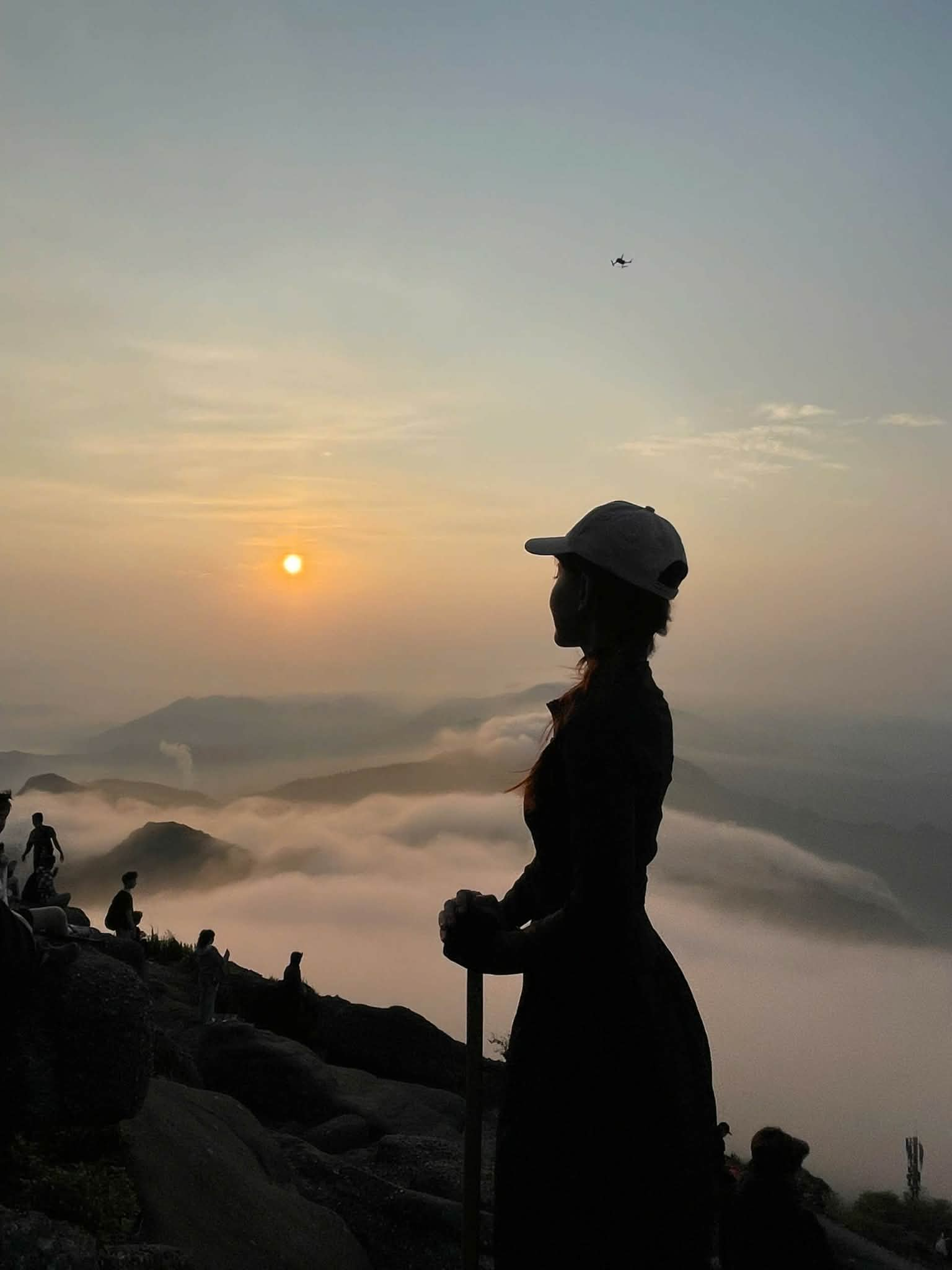
Between 5:15 and 5:30 AM, the horizon to the east begins to bleed. What was once pitch darkness dissolves into a faint gradient of deep indigo, violet, and bruised lavender. Looking down from the rocky precipice, the earth has vanished completely. There are no valleys, no towns, no distant highways. In their place lies a boundless, silent ocean of pure white clouds, rolling in colossal, slow-motion waves against invisible stone shores.
The scale of this mist ocean is staggering. Miles of thick vapor rest suspended between earth and sky, filling every gorge and valley as far as the eye can see. Through this undulating white expanse, the highest peaks of the surrounding Dong Trieu mountains pierce the surface like dark, solitary islands marooned in an arctic sea. The stillness is absolute; the vastness makes humans feel impossibly minute, perched precariously on a shelf of rock suspended above infinity.
Then comes the crowning moment. The rim of the horizon ignites into molten amber, and a pale golden disc of sun lifts deliberately out of the haze. The transformation is instantaneous and breathtaking. Rays of sunlight strike the crests of the cloud banks, igniting the cool silver mist into shades of soft rose, vibrant apricot, and brilliant, blinding gold. Ribbons of fog drift across the lower ridges like translucent silk, wrapping the contours of the mountain slopes in a dynamic dance of light and shadow. The entire panoramic wilderness resembles a grand, living ink-wash painting, monumental in scale and impossible to tame with a camera frame.
Standing on the wind-battered summit, leaning against a trekking pole with the warmth of the first sunbeams breaking the highland chill, every drop of sweat and every burning step taken since 2:00 AM becomes profoundly justified. The exhaustion evaporates, replaced by a quiet, reverent awe. Yen Tu has welcomed pilgrims, hermits, and emperors for nearly a millennium, yet in this pristine morning light, high above the clouds, nature reveals an untamed, sacred majesty that belongs to no era—a raw spectacle of sky, stone, and sun that only the dawn-climbers will ever truly know.