
The Widow’s Heart
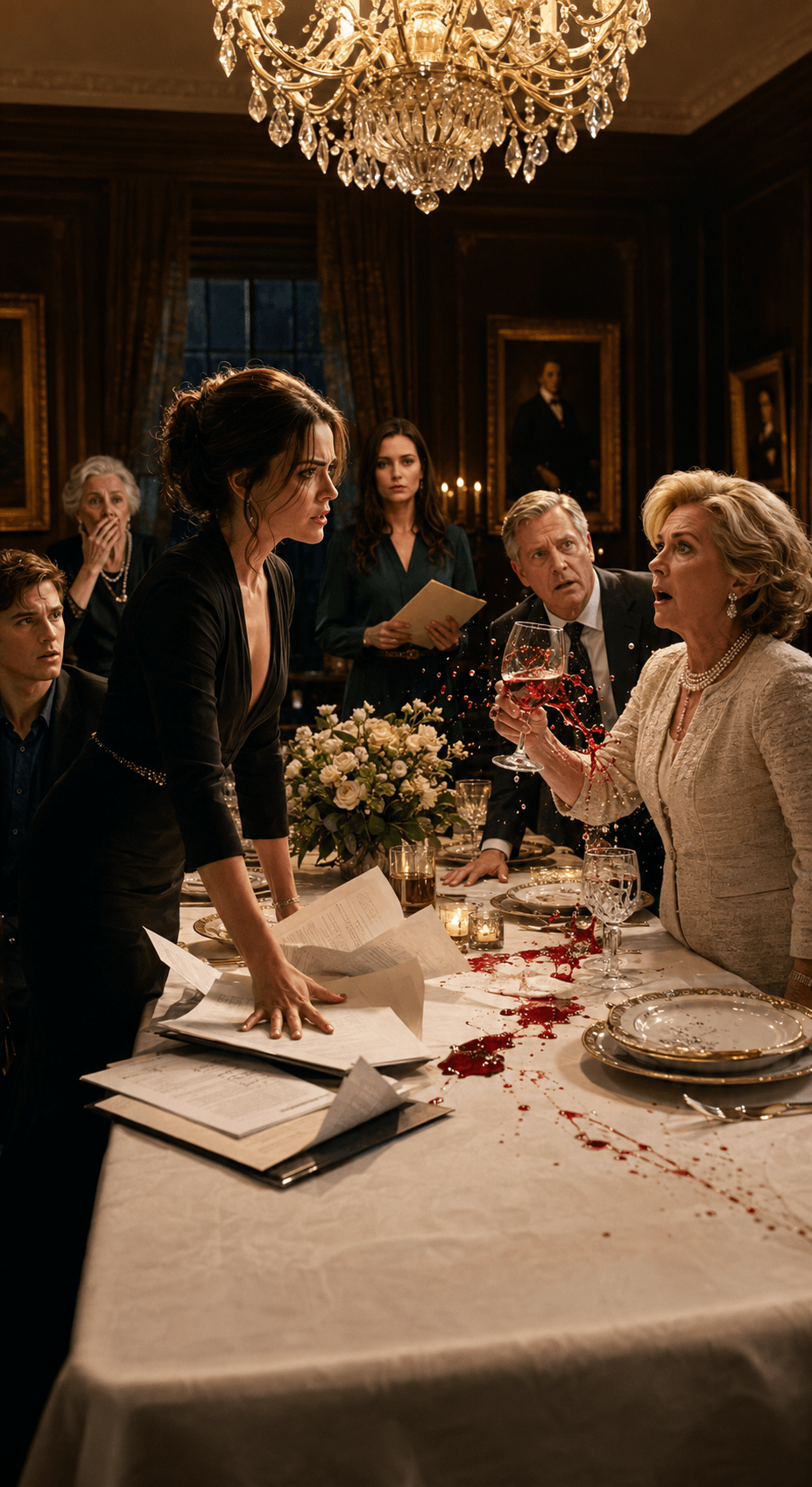
“You have no idea what it was like being married to your father for thirty-four years.”
She faked a dying heart to steal her children’s inheritance. She never expected her daughter-in-law to read between the lines.
Chapter 1: The Performance
The first time Margaret Whitfield clutched her chest at dinner, Claire almost believed her.
“Mom?” Daniel was on his feet before his napkin hit the floor, phone already in his hand. “Mom, talk to me—”
“I’m fine,” Margaret whispered, one hand pressed flat over the silk of her blouse, the other gripping the table edge hard enough to whiten her knuckles. “Just—dizzy. Don’t call anyone. I don’t want to make a scene.”
She made the scene anyway. By the time the ambulance arrived, four neighbors had gathered on the lawn, and Margaret had somehow found the strength to ask, twice, whether the paramedics thought she’d “make it to see her grandchildren grow up.”
Claire stood in the doorway of her mother-in-law’s dining room, watching sixty-one years of practiced elegance fold itself into a hospital gurney, and felt something cold settle low in her stomach that had nothing to do with worry.
She’d been married to Daniel for six years. She’d watched Margaret perform grief at a garden party when a acquaintance’s dog died. She’d watched her perform humility at a charity gala while wearing a necklace that cost more than Claire’s first car. She knew what Margaret’s face did when she wanted something and what it did when she was actually afraid, and tonight, in the two seconds before the paramedics reached her, Margaret’s eyes hadn’t been afraid.
They’d been checking to see who was watching.
The diagnosis came back three days later: a minor arrhythmia, nothing requiring more than monitoring and medication. Margaret’s private physician, Dr. Alan Cross, delivered the news personally, sitting in the Whitfield family’s sunroom with a folder of test results and a gravity in his voice that made Daniel’s shoulders sag with relief.
“It’s not nothing,” Dr. Cross said, glancing at Margaret before continuing, “but with the right care — reduced stress, no major upheavals — she should be fine for years.”
No major upheavals. Claire turned the phrase over in her head that night, lying awake beside Daniel, who slept the deep, guilty sleep of a man who’d spent three days terrified of losing his mother.
Two weeks later, at Sunday dinner, Margaret set down her wine glass with the careful precision of someone building toward something.
“I’ve been thinking,” she said, “about your father’s estate.”
Daniel’s father, Richard Whitfield, had died eighteen months earlier, leaving behind a will that split his considerable fortune — real estate holdings, a stake in the family’s manufacturing business, a modest but real fortune in stocks — evenly between Daniel and his older sister, Renata, with Margaret retaining the house and a comfortable living trust. The will had been ironclad, drafted by Richard’s own longtime attorney, uncontested by anyone.
“Alan says stress is the worst thing for my heart,” Margaret continued, dabbing her mouth with her napkin. “And nothing stresses me more than watching you two children wait years for what should already be settled. I want to accelerate the distribution. Move everything to you and your sister now, while I’m — while I still can.”
Daniel reached for his mother’s hand. “Mom, you don’t have to do that. The doctors said you’re fine.”
“For now.” Margaret’s voice trembled, right on cue. “I don’t want to leave things unfinished, Daniel. I’ve seen what happens to families when the person holding everything together goes without warning.”
Claire watched her husband’s face soften with love and grief and guilt, watched him nod, watched him already halfway to agreeing to whatever his dying mother asked of him — and felt the cold thing in her stomach turn into something sharper.
Move everything to you and your sister now.
Not to a trust. Not into escrow pending proper legal review. Now. Directly. While the estate’s largest remaining asset — Richard’s forty percent stake in Whitfield Manufacturing, currently the subject of a very lucrative buyout offer that Margaret, as trustee, was the only signatory required to approve — sat exactly where a woman desperate to control its fate would want it.
Claire was an accountant. She’d spent eleven years reading financial statements for a living, learning to see the difference between what numbers said and what people wanted them to say. And something about the timing — the “heart episode” three weeks before the buyout offer’s deadline, the sudden urgency to distribute an estate that had been calmly, legally, uneventfully processing for a year and a half — didn’t add up to grief or fear.
It added up to a deadline.
“You’re quiet,” Daniel said in the car home, glancing at her over the dashboard lights.
“Just thinking about the buyout offer,” Claire said carefully. “The one for your dad’s stake in the company.”
“What about it?”
“Your mom’s the trustee until the estate distributes. If she moves everything to you and Renata now, who becomes the signatory on the manufacturing stake?”
Daniel frowned, the question clearly not one he’d considered. “I don’t know. Whoever inherits it, I guess. Me and Renata, jointly.”
“Right. Which means the buyout offer — the one that’s supposedly worth twelve million for that stake — would need both of your signatures to close. Right now, it just needs hers.”
“What are you saying?”
Claire chose her words the way she chose numbers in a spreadsheet — precisely, with room to be wrong. “I’m saying I think it’s worth asking why she wants to move fast on this specific asset, at this specific time, right after a health scare that turned out to be nothing serious.”
Daniel’s jaw tightened. “She’s my mother, Claire. She just had a heart episode. You think she’s — what, faking a medical emergency to manipulate an estate settlement?”
“I think it’s worth being careful. That’s all.”
He didn’t answer. The rest of the drive passed in a silence that Claire recognized as the particular silence of a man who loved his mother too much to consider what his wife had just implied, and loved his wife too much to say so out loud.
Chapter 2: What the Records Show
Claire didn’t mention it again for two weeks. She’d learned, over six years of marriage into the Whitfield family, that direct confrontation with Margaret never worked — the woman had spent four decades as the wife of a manufacturing magnate, absorbing blows and deflecting scrutiny with the fluency of someone born to it. If Claire wanted answers, she’d have to find them the way she found everything else worth finding: quietly, in the numbers no one thought to hide.
She started with public records. Whitfield Manufacturing was privately held, but the buyout offer — from a mid-sized industrial conglomerate called Corcoran Group — had triggered SEC disclosure requirements on Corcoran’s end, since they were publicly traded. Claire found the filing on a Tuesday night after Daniel had gone to bed, her laptop glowing in the dark of their home office.
The offer had been on the table for four months. It had a hard expiration date: forty-five days from now.
Move everything to you and your sister now, while I still can.
Forty-five days was exactly enough time to distribute the estate, transfer the manufacturing stake to Daniel and Renata, and then — Claire’s stomach turned as the pieces clicked together — pressure two adult children, one of them grieving and guilt-ridden about his mother’s supposed heart condition, into a fast decision about a twelve-million-dollar buyout that Margaret herself had no legal standing to approve once the trust dissolved.
Unless she still had influence over one of them. Unless one of them trusted her judgment completely, especially on anything medical, anything about what stress might do to a dying woman’s heart.
Claire thought about Dr. Alan Cross, sitting in the Whitfield sunroom with his folder of results, his gravity, his careful phrase — no major upheavals.
She started digging into him next.
It wasn’t hard to find, once she knew to look. Dr. Cross had been Margaret’s personal physician for eleven years — longer, Claire realized with a slow chill, than Margaret and Richard’s marriage had shown any visible strain, and precisely as long as a series of small, deniable inconsistencies Claire found scattered across old family photos, medical office holiday cards accidentally kept in a drawer of correspondence Margaret had asked Claire to help sort through after Richard’s funeral, a handwriting she recognized from prescription pads matching a signature on decades-old birthday cards addressed only to “M.”
Claire wasn’t a private investigator. She was a woman with a laptop, a legal pad, and eleven years of training in following inconsistencies until they resolved into a pattern. But the pattern here didn’t need much digging to become obvious once she knew where to look: Margaret Whitfield and Dr. Alan Cross had been involved, in some capacity, for over a decade — quietly, carefully, in a marriage where Richard Whitfield’s frequent business travel had left ample room for a private physician’s frequent house calls.
It explained a lot. It didn’t yet explain the heart episode, or the sudden urgency, or the convenient timing against a twelve-million-dollar deadline.
For that, Claire needed the actual medical records — not the summary Dr. Cross had presented at dinner, but the underlying test data.
She couldn’t get those legally. Not without Margaret’s consent, which would never come, or a court order, which would require exactly the kind of accusation Claire wasn’t ready to make out loud to a family that would close ranks around Margaret in an instant.
But she knew someone who could.
Renata Whitfield-Cole, Daniel’s older sister, had spent fifteen years building a career as a malpractice attorney specifically because, she’d told Claire once over wine at a family barbecue, she’d grown up watching her mother manage every doctor, every diagnosis, every hospital stay like a performance for an audience only Margaret could see, and had wanted, professionally, to understand exactly how much control a patient’s family could actually exert over medical documentation.
Claire had always assumed it was a joke. A dark one, sure, but a joke — the kind of thing you said about your difficult mother at a barbecue, not a genuine professional origin story.
She called Renata on a Thursday afternoon, from her car in a grocery store parking lot, because some conversations couldn’t happen inside a house that might have Margaret in it within the hour.
“I need your help with something,” Claire said, “and I need you to hear the whole thing before you decide I’m crazy.”
Renata was quiet for a long moment after Claire finished. Long enough that Claire started to wonder if she’d miscalculated — if fifteen years of professional distance from her mother had never actually cooled the loyalty underneath.
“The Corcoran deadline,” Renata finally said. “Forty-five days.”
“You knew about it?”
“I do the family’s legal work when Dad’s estate attorney is out. I saw the buyout terms three weeks ago.” A pause, heavy with something that sounded, to Claire’s relief, less like defensiveness and more like a puzzle finally clicking into a shape Renata had been half-expecting for years. “I didn’t put it together with the heart thing. I should have. God, I should have — she’s done this before, smaller versions of it, my whole life, and I still didn’t see it.”
“So you’ll help?”
“Claire.” Renata’s voice had gone flat and hard in a way that reminded Claire, suddenly, forcefully, of exactly whose daughter she was. “I’ve spent fifteen years learning how to pull medical records that people don’t want pulled. Give me a week.”
Chapter 3: The Records
Renata called six days later, not on the phone but in person, showing up at Claire’s office during lunch with a manila folder and the particular tightness around her mouth that Claire recognized from every negotiation Renata had ever described winning.
“Close the door,” Renata said.
Claire closed it. Renata didn’t sit.
“I called in a favor with a records clerk I’ve used before — completely off the books, completely deniable if anyone asks, which nobody’s going to ask because nobody knows to look. I got copies of every test Dr. Cross has run on my mother in the last four months.” She dropped the folder on Claire’s desk like it weighed more than paper had any right to. “There’s no arrhythmia, Claire. There’s nothing. Her heart is fine. Better than fine — her cardiologist workup from two years ago, the real one, from a hospital, before Cross became her only doctor, shows a woman in excellent health for sixty-one.”
Claire opened the folder with hands that weren’t quite steady. Pages of lab results, EKG printouts, physician’s notes in Dr. Cross’s careful handwriting — and threaded through all of it, a second set of documents Renata had pulled from the hospital where Margaret had been briefly admitted the night of the dinner-table collapse.
“The ER doctor that night ran her own panel,” Renata said, tapping a page. “Independent of Cross. Normal sinus rhythm. No arrhythmia detected. She wrote it up as a possible anxiety episode and recommended a follow-up that never happened, because Margaret discharged herself against medical advice the next morning and went straight back to Cross.”
“He overrode an ER doctor’s actual findings.”
“He didn’t override them. He just made sure nobody in the family ever saw them. He gave you and Daniel his own diagnosis, dressed up with just enough real medical language to be convincing, and because he’s been ‘her doctor’ for eleven years, nobody thought to ask for a second opinion.” Renata finally sat, dropping into the chair across from Claire’s desk like her legs had given out. “I want to be furious that she’d do this. I can’t even manage surprised. I just keep thinking about every stomach flu, every migraine, every ‘fainting spell’ from my entire childhood, and wondering how many of them were real.”
Claire flipped to the last page in the folder — a printed email chain Renata had also, apparently, found a way to access, between Dr. Cross’s personal account and Margaret’s. The dates spanned back four months, precisely to when the Corcoran buyout offer had first landed on Richard’s — now Margaret’s — desk.
The most recent one, dated the morning of the dinner-table collapse, read simply:
Tonight. Make it look real enough that Daniel calls an ambulance himself — he won’t question it if he sees the fear on your face. I’ll handle the workup after. — A.
Claire read it three times before she trusted herself to speak.
“He told her exactly how to fake it,” she said. “This isn’t a doctor covering for a patient’s exaggeration. This is a doctor scripting a performance.”
“And I think I know why,” Renata said quietly. “Look at the second attachment.”
Claire turned the page. It was a property listing — a beachfront estate in the Turks and Caicos, currently under contract, closing date sixty days out. Buyer of record: A. Cross and M. Whitfield, jointly, under a holding company neither name had ever appeared on before.
“They’re not just faking a heart condition to accelerate an inheritance,” Renata said. “They’re planning to disappear with a chunk of it the second the manufacturing stake sells. Sixty days puts the closing right after the Corcoran deadline. She gets the estate to distribute fast, pressures me and Daniel into approving the buyout under emotional duress before we’ve had time to think, takes her cut of the trust liquidation for ‘medical expenses’ and ‘end of life planning’ that Dad’s estate attorney will never think to question given the circumstances — and vanishes into a life with a man she’s apparently loved more than any of us knew, funded by money that was supposed to be ours.”
The two women sat in silence for a long moment, the folder open between them like a wound.
“Does Daniel know any of this?” Renata finally asked.
“No.” Claire closed the folder gently, like it might still hurt someone if handled wrong. “I didn’t want to bring it to him without something real. He’d never believe me over her. Not without proof.”
“Well.” Renata stood, straightening her blazer with the crisp, controlled motion of a woman who’d just decided exactly how a case would be argued. “Now we have proof. The question is how we use it.”
Chapter 4: The Dinner
They decided on the anniversary dinner.
It was Renata’s idea — a family tradition Margaret had insisted on every year since Richard’s death, a formal dinner at the Whitfield estate to “honor his memory,” attended by extended family, Richard’s oldest business partners, and, this year, Dr. Alan Cross himself, invited as Margaret’s “trusted physician” to reassure everyone that her health was stable enough for the family to move forward with the estate’s early distribution.
“She’s going to use it as the moment to announce the transfer,” Renata said, three days before the dinner, sitting at Claire’s kitchen table with a legal pad covered in notes. “Cross will be there to vouch for her health, to make it feel urgent and emotional. Everyone will be watching. It’s the perfect stage for her.”
“Then it’s the perfect stage for us too,” Claire said.
Daniel didn’t know yet. That was the hardest part of the plan, and the part Claire had argued about longest with Renata — whether to tell him beforehand, gently, in private, or let him learn the truth alongside everyone else.
“If we tell him first,” Renata had said, “he’ll try to protect her. He’ll find some way to soften it, delay it, give her a chance to explain herself privately. I love my brother, but he’s spent his whole life being the son who believes the best about her. If we want the truth to actually land — to actually stop the transfer before it’s too late — it needs to happen where she can’t spin it into something smaller.”
Claire had spent three sleepless nights turning that plan over, weighing the cost of blindsiding her own husband against the cost of watching his mother and her secret lover walk away with a fortune stolen through a lie about her own mortality. In the end, she’d agreed, with one condition: she would sit beside Daniel that night, hold his hand through it, and never once let him doubt that she’d kept the secret out of necessity, not distrust.
The dining room glowed with candlelight when Claire arrived, Margaret’s usual staging — crystal, white linen, a floral arrangement large enough to require its own chair. Dr. Cross stood near the bar in a suit too well-tailored for a family doctor’s salary, laughing at something Margaret’s brother had said, entirely at ease in a room full of people who had no idea what he’d helped orchestrate.
Daniel squeezed Claire’s hand as they took their seats. “You okay? You’ve been quiet all week.”
“I’m okay,” Claire said, and meant it, for the first time in days, because tonight it would finally be over.
Margaret waited until the main course had been cleared to stand, tapping her wine glass with a spoon, the whole table falling into the practiced hush she’d trained them all into over decades of these performances.
“I want to thank you all for being here,” she began, her voice warm, faintly tremulous in exactly the way that made grown men reach for their napkins. “This dinner has always been about honoring Richard’s memory. This year, it’s also about something he would have wanted — making sure his children are taken care of, without unnecessary delay, while I still have the chance to see it done myself.”
A murmur of soft, sympathetic sounds rippled around the table. Dr. Cross nodded gravely from his seat, right on cue.
“Alan has been wonderful these past months,” Margaret continued, “monitoring my health, making sure I have every good day I can. He’ll tell you himself — stress is the enemy now. And nothing has weighed on me more than knowing Daniel and Renata are still waiting for what’s rightfully theirs.” She lifted her glass, eyes glistening. “So tonight, I’m formally requesting the estate attorney begin immediate distribution. Effective this week.”
She turned toward Dr. Cross, extending her glass toward his in a small, private toast that read, to anyone paying attention, as gratitude between a patient and her doctor.
Claire stood.
The room’s soft murmur died into silence — the particular silence of thirty people realizing, all at once, that something was about to happen that hadn’t been on the evening’s script.
“Before anyone raises a glass to that,” Claire said, her voice steadier than she’d expected, “I think everyone at this table deserves to see what’s actually in Margaret’s medical file. Because it’s not what Dr. Cross just implied.”
Chapter 5: What the Table Saw
For a moment, nobody moved. Margaret’s glass stayed raised, frozen in the air, catching candlelight in a way that would have looked elegant if her face hadn’t gone the color of old paper.
“Claire.” Daniel’s hand found her wrist under the table, not pulling her down, just holding on, like he needed something steady while the ground shifted. “What are you doing?”
“Sit down, dear,” Margaret said, and her voice had lost its tremor entirely, gone flat and cold in a way Claire had only glimpsed once before, years ago, when a caterer had shown up eleven minutes late to a charity gala. “This isn’t the place—”
“You’re right,” Claire said. “It’s not the place you wanted. You wanted a place where nobody would ask questions. Where the only doctor in the room was the one writing your test results for you.”
Renata rose from her seat two chairs down, a second folder in her hands — the twin of the one she’d shown Claire in her office six days earlier, except this one was thick with printed pages, tabbed and organized with the precision of a woman who’d spent fifteen years building cases for juries.
“I’m an attorney,” Renata said to the table at large, her voice carrying the particular authority of someone who’d spent a career learning how to hold a room. “Most of you know that. What you don’t know is that four days ago, I obtained my mother’s actual medical records — not the summary Dr. Cross presented to this family, but the underlying data. Including the independent ER workup from the night of her supposed cardiac episode, which found nothing wrong with her heart at all.”
“This is outrageous,” Dr. Cross said, standing so fast his chair scraped hard against the floor. “You have no right to access those records, and whatever you think you’re implying—”
“I’m not implying anything,” Renata said, and set the folder down in front of her mother with a soft, deliberate thud. “I have your emails, Alan. All of them. Including the one from the morning of the collapse, telling my mother exactly how to perform an episode convincing enough that Daniel would call an ambulance himself.”
The table had gone utterly silent now, thirty faces turned toward the head of it, Richard’s oldest business partner setting down his wine glass with the careful stillness of a man watching a car accident he couldn’t look away from.
“And I have the property listing,” Renata continued, “for the beachfront estate in Turks and Caicos, currently under contract, closing sixty days from now, purchased jointly under a holding company by ‘A. Cross and M. Whitfield’ — a company that didn’t exist until four months ago. The same week the Corcoran buyout offer landed on this family’s desk.”
“Mom.” Daniel’s voice cracked on the single word. He’d let go of Claire’s wrist somewhere in the last minute, both hands flat on the table now, like he needed it to hold him up. “Tell me she’s wrong. Tell me this is some kind of misunderstanding.”
Margaret’s mouth opened. Closed. For the first time in the six years Claire had known her, Margaret Whitfield had no performance ready, no grief to summon, no elegant deflection waiting in the wings.
“You have no idea,” she finally said, low and venomous, all pretense gone, “what it was like being married to your father for thirty-four years. Being managed. Being handled, the way he handled every business deal, every difficult employee, every inconvenient truth. I gave up thirty-four years of my own life to be Richard Whitfield’s wife, and when he died, I finally had a chance to have something that was mine—”
“By stealing from your own children,” Renata said, quiet and lethal. “By making Daniel believe you were dying. By using his grief to rush a twelve-million-dollar decision through before either of us had time to think clearly.”
“I was going to give you the money either way!” Margaret’s voice rose, cracking now, the elegant control finally, completely gone. “I just wanted my share first — my share of a life I spent building this family, this business, this — and you would have had every penny eventually regardless—”
“Eventually,” Claire said, “isn’t the same as honestly, Margaret.”
Dr. Cross had gone very quiet, very pale, his eyes darting toward the dining room’s exit with the particular calculation of a man reassessing an escape route. He didn’t get the chance to use it. Renata’s husband, who’d spent the entire evening seemingly absorbed in his phone, looked up and said, mildly, “I called the estate attorney twenty minutes ago, when Renata gave me the signal. He’s on his way over now, along with — well, he mentioned it might be worth having a fraud investigator present too, given what Renata described. They should both be here within the hour.”
Margaret sat down slowly, the folder still open in front of her, the printed email glowing accusingly under the chandelier light. Around the table, aunts and uncles and old family friends who’d known her for decades sat in a silence thick with the particular horror of watching a woman they’d trusted reveal exactly how much of herself had been theater.
Chapter 6: After
The estate attorney arrived within the hour, as promised, along with a forensic accountant Renata had already quietly retained the week before — a woman named Priya Desai who took one look at the email chain and the property listing and said, with the flat competence of someone who’d seen this exact scheme in six different forms over her career, “This is going to be an easy case. Insurance fraud, potentially, depending on whether any policy was involved in the ‘episode’ claim, plus straightforward fraud against the estate and against Daniel and Renata directly, given the coercion documented in these emails.”
Dr. Cross left before the attorney arrived, walking out of the Whitfield estate’s front door into a cold night with nothing but his car keys and the particular gait of a man who already knew, somewhere in his gut, that running wouldn’t actually save him. He was arrested six days later, at his office, on charges of insurance fraud and conspiracy. The Turks and Caicos purchase collapsed within the week, the holding company’s assets frozen pending investigation.
Margaret didn’t run. She sat in the Whitfield dining room until nearly midnight, answering the estate attorney’s questions in a voice that had gone hollow, all the elegant performance burned out of it, leaving behind something that looked, for the first time Claire could remember, genuinely old.
“I’m not proud of what I did,” she said finally, to Daniel, the two of them alone in the sunroom while Claire and Renata waited outside, giving them the privacy of a conversation that had needed to happen for thirty-four years and had finally, catastrophically, arrived. “But I’m not going to pretend I regret wanting something of my own, after a life spent being your father’s.”
“You could have asked for it, Mom,” Daniel said, and Claire, listening through the cracked door, heard something break in his voice that she knew would take a long time to heal. “You could have just — asked. Instead of making me believe you were dying. Instead of using that to get what you wanted.”
Margaret didn’t have an answer for that. Claire suspected, watching through the doorway, that she never really would.
The manufacturing stake buyout closed four months later — legitimately, this time, negotiated fairly between Daniel, Renata, and Corcoran’s team, with the estate attorney overseeing every signature and Priya Desai’s forensic report ensuring no further “urgency” could be manufactured by anyone with something to hide. The money split evenly, as Richard’s original will had always intended, with a portion set aside in a trust neither Daniel nor Renata would touch — earmarked, at Renata’s insistence, for their mother’s legal defense and, eventually, whatever restitution the courts required.
Margaret faced a plea deal eight months after the dinner — reduced charges in exchange for full cooperation in the case against Dr. Cross, whose sentencing hearing revealed he’d run a smaller, similar scheme with another patient nearly a decade earlier, one that had never been caught. Margaret’s own sentence was probation and a substantial fine, the judge citing her age, her cooperation, and the absence of any prior record, though the family’s name would carry the story for years regardless of what any court decided.
Claire never felt triumphant about any of it. She’d spent months bracing for Daniel to resent her — for uncovering something he’d have preferred to never know, for the particular cruelty of learning his mother’s love had come with a price tag attached the whole time. Instead, six weeks after the dinner, he found her in their kitchen late one night, and said, quietly, “Thank you for not telling me sooner.”
“What?”
“If you’d told me before the dinner, I would have tried to protect her. I would have found some way to believe there was an explanation, and given her time to disappear, or cover it up better, or—” He shook his head. “You knew that about me before I did. You knew I needed to see it, all at once, in front of everyone, or I never would have let myself believe it.”
Claire didn’t have a response for that beyond reaching for his hand, the same way he’d reached for hers under that dinner table, months ago, in the last moment before everything changed.
“I just didn’t want you to lose more than you already had to,” she said. “A mother who loved you, even if she also lied to you. I couldn’t give you both at once. I could only give you the truth, and let you figure out what to do with the rest.”
Outside their kitchen window, the first frost of the season had settled over the yard, and somewhere across town, in a house that no longer held any performances, Margaret Whitfield sat alone with a truth she’d spent thirty-four years learning how to avoid, finally, for the first time, with nowhere left to hide from it.