
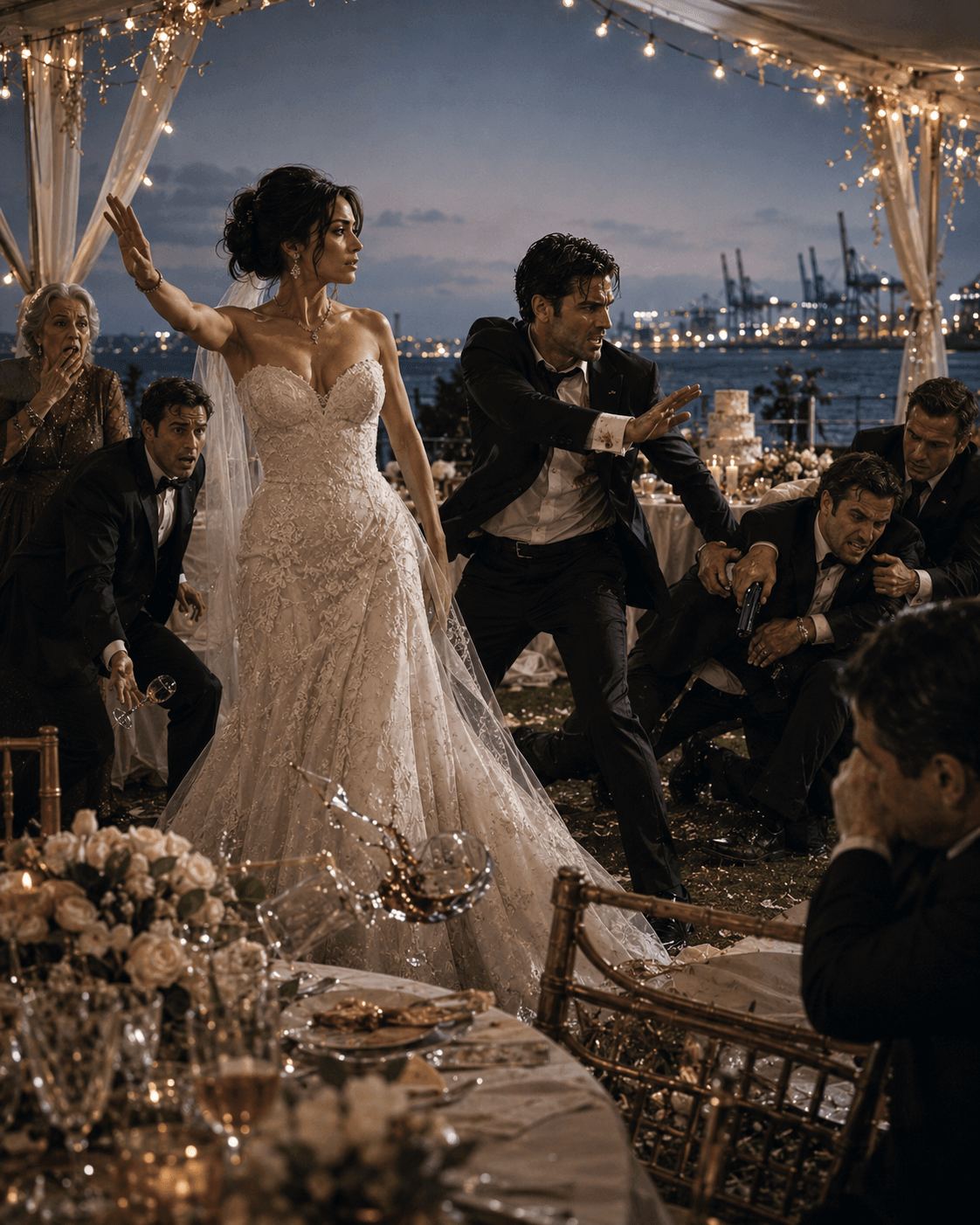
“You can bleed, or you can bleed and still tell me everything. Those are the two versions of tonight that exist for you.”
She inherited an empire at twenty-seven and buried her enemies without raising her voice. He was supposed to marry her for peace — until he found out he’d rather die defending her chair than ever see her lose it.
Chapter One: The Cost of Talking
The knife was already in Marlowe’s hand when the warehouse door rolled shut behind her.
“Hands on the table, Denny.” She didn’t raise her voice. She never had to. “Both of them.”
Denny Ruiz had run the graveyard shift on Pier 4 for six years, which was long enough to know better than to hesitate, and he didn’t — he laid his palms flat on the steel table like a man laying down cards he already knew he’d lost. Sweat had gone through his shirt in a dark map down his spine. Six men stood along the walls of the warehouse, arms crossed, watching the way men watch a fire they’re grateful isn’t burning them.
“I want it on record,” Marlowe said, setting her father’s lighter down beside Denny’s left hand, “that I know exactly what you told the Renards, and when, and what they paid you for it.” She flicked the lighter open. Didn’t light it. Just let the click sit in the quiet. “Twelve thousand for the Thursday manifests. That’s an insulting number, Denny. You undersold my family for less than a used truck.”
“Marlowe — Ms. Calloway — I can fix this, I can find out what else they know, I can —”
“You can bleed,” she said, “or you can bleed and still tell me everything. Those are the two versions of tonight that exist for you. There isn’t a third.” She picked the knife back up. “I need the men on this floor to understand something before I need you to understand it. So we’ll do this part first, and the talking after. That’s the deal.”
She didn’t enjoy it. That was the thing people never believed about her — the newspapers thirty miles up the coast liked to write about the Calloway girl who took her father’s empire and turned it bloodier, as if cruelty were a hobby she’d picked up out of boredom instead of a currency she spent because the exchange rate on mercy, in this business, had been running against her family for a decade. She brought the blade down clean, once, and Denny screamed in a way that filled the whole cavern of the warehouse and came back off the corrugated ceiling twice before it died.
Two fingers on the table. Denny sobbing, cradling his hand against his chest, and around the room, six men who would go home tonight and tell their wives nothing, and tell every other man on the docks everything.
“Now,” Marlowe said, crouching so she was eye-level with him, voice gentle in the specific way that was somehow worse than shouting, “tell me what else you sold them.”
He told her everything. It took four minutes.
She was still wiping her hands with the rag Silas Bell handed her — her second, twenty years in her father’s service, loyal in the specific tired way of a man who’d buried more friends than he had left — when her phone buzzed against the table.
Dad’s lawyer. Not her father. Her father hadn’t dialed his own phone in eight months, not since the stroke had taken the left side of his face and half his sentences.
She answered it in the alley outside, because whatever came out of Whitman Cole’s mouth deserved fresh air.
“Marlowe.” He never called her Ms. Calloway; he’d known her since she was six. “Your father wants to see you tonight. Says it’s urgent. Says—” a pause, the particular pause of a man choosing his next words with tongs — “he’s already spoken to Graham Ashford. Says the peace is going to be signed a different way than anyone expected.”
Marlowe went still in the way she went still before violence, not after it. “Say that again.”
“He wants you to marry the Ashford boy,” Cole said. “By the end of the month.”
She looked back through the warehouse door at Denny’s blood cooling black on the steel table, at the fresh, useful terror in six men’s faces, at the empire she had bled for and would keep bleeding for.
“Tell my father,” she said, “that I’ll be there in twenty minutes. And tell him I said no on the way.”
She hung up before he could answer. Whatever her father wanted, whatever the Ashfords wanted, whatever this fresh humiliation dressed up as peace was supposed to accomplish — it changed nothing about the two fingers currently going cold on Pier 4, and it changed nothing about the fact that the last time she’d let an Ashford close enough to matter, it had cost her family a war.
She was not doing that again. Not even for peace.
Especially not for peace.
Chapter Two: The Terms of Surrender
Her father’s study still smelled like his pipe tobacco even though he hadn’t been able to hold a match steady in eight months. Warren Calloway sat by the window in the wheelchair he refused to be photographed in, the right side of his face still handsome, the left side slack and unreadable, like God had erased half a man and left the rest as a rough draft.
“You said no,” he said. The words came slow, dragged a little at the edges, but the mind behind them was as sharp as it had ever been, and that was the cruelest part of what the stroke had done to him — it had left the blade and dulled the hand that swung it.
“I said no,” Marlowe agreed, “because it’s insane, and because you know exactly why it’s insane, and because I refuse to believe you’d ask me to do it if you weren’t already dying and scared of what happens to this family when you’re gone.”
“That’s fair.” Her father’s mouth pulled into something that wanted to be a smile. “Doesn’t make me wrong.”
“Dad—”
“The Renards are three weeks from making a move on the port,” he said, cutting through her the way he’d cut through every objection she’d raised since she was fourteen. “You know it. I know it. Graham Ashford knows it. They’re circling because they think a twenty-seven-year-old woman running this family is a door left open. They think the Ashford-Calloway line is still a fault line they can drive a truck through.” He drew a slow breath. “A wedding closes that door in a way twenty more years of careful treaties never will. It’s not romance, Marlowe. It’s architecture. You build the wall out of something they can’t argue with.”
“There are a hundred men in this city I could marry who aren’t him.”
“Name one who brings Fenwick Street with him.” Her father’s eyes, the good one and the ruined one both, didn’t waver. “Name one whose family has spent thirty years building the exact infrastructure the Renards would need to touch before they could touch us. You marry Desmond Ashford, our port and their cranes become one target instead of two, and no outside family attacks a fortress that size. That’s the whole equation. Everything else is feelings, and feelings are not going to keep three hundred people employed on those docks when I’m gone.”
She turned to the window. Down the bluff, the port lights were coming up gold against the dark water, the same view she’d had from this room her whole life, the same view her father had stood at when he first put a gun in her hand at eleven years old and told her the family didn’t survive on luck.
“He betrayed me,” she said quietly. “You remember that part of the equation too, don’t you?”
Her father’s face — the half that still moved — softened in a way she rarely saw. “I remember a seventeen-year-old boy telling his father where the Cortland meeting was, and I remember your brother nearly dying because of it, and I have never once asked you to forgive that.” A pause, weighted. “I’m only asking you to marry it. There’s a difference, and I think you’re smart enough to survive on that difference until you don’t need it anymore.”
Marlowe closed her eyes. Somewhere in her chest, an old wound that had scarred over wrong twelve years ago pulled tight.
“When does Graham want the announcement?”
“Sunday.” Her father’s voice gentled. “Marlowe. I wouldn’t ask this if I thought there was another door. I’ve spent two months looking for another door.”
“I know,” she said, and meant it, which was somehow the worst part. “That’s the deal, then. Sunday.”
Chapter Three: The Man on the Balcony
Desmond Ashford was already on the Vane Street balcony when she came out to face the reporters, which told her two things before he’d said a word: that he’d arrived early to case the room like a man walking into an ambush, and that whatever his father had told him, he hadn’t wanted to come.
He looked the way she remembered him looking, only sharper — like the boy she’d known had been sanded down into every hard edge that boy’s face had only hinted at. Dark suit, no tie, jaw like something built rather than grown. He didn’t smile when she stepped out beside him. He looked at her the way you’d look at a debt finally coming due.
“Ms. Calloway,” he said.
“You used to call me Marlowe.”
“That was before you had a man’s fingers on a table three hours before our engagement was announced.” His voice was clipped, formal, the words landing like they’d been filed down to exactly the shape he wanted. “News travels fast on the docks.”
“Good,” she said. “It’s supposed to.”
Something moved behind his eyes — not quite admiration, not quite disgust, something colder and more interested than either. “My father tells me this is architecture. Not romance.”
“Your father’s right for once.”
“And if I refuse it?”
“Then the Renards take the port within the year, your family’s cranes go quiet within two, and every man who works either dock finds out exactly how much your pride costs them.” She kept her voice level, almost bored. “You’re welcome to refuse. I’d just make sure you’re the one who explains it to them.”
Desmond’s jaw tightened, the only crack in an otherwise perfect stillness. “You always did enjoy this. Backing a man into a corner and calling it business.”
“I don’t enjoy any of it,” she said, and for a half-second, something honest slipped through the flat wall of her voice before she caught it. “But I don’t run from it either. That’s the difference between us, Desmond. It always was.”
He looked at her a long moment, and for once his composure faltered enough that she saw the boy underneath the sanded-down man — seventeen years old, guilty about something he’d never once explained, watching her the way you watch a door closing that you know you deserve to be shut out of.
“Understood,” he said finally, and it was the same word he’d used the night everything broke between them, twelve years ago, right before he walked away and let her believe the worst about him without a single word of defense.
Below them, the reporters were being let through the gate, and somewhere behind the tall hedge a photographer’s flash caught them both standing two feet apart on a balcony that had seen three generations of Calloway decisions.
“They’re going to want us to look like we mean it,” Marlowe said.
“I’m aware.”
“Can you manage that?”
Desmond’s mouth curved, not quite a smile, more a warning. “I managed a decade of hating you quietly, Ms. Calloway. I imagine I can manage an hour of pretending I don’t.”
She almost laughed. She hated that she almost laughed.
“That’s the deal, then,” she said, and held out her hand for the cameras, and felt him take it like a man signing a contract he fully intended to renegotiate the second the ink dried.
Chapter Four: Collision
The engagement bought them three weeks and one very specific problem: neither family trusted the other’s security, which meant Marlowe spent her mornings walking Fenwick Street with two Calloway men at her back, learning the rhythm of cranes and container schedules the way she’d once learned the tide charts on Bellhaven’s docks, and Desmond spent his afternoons in the Calloway warehouse office learning, with visible discomfort, the specific paperwork of an empire built on things that didn’t appear on paper.
“You keep two sets of books,” he said, on the fourth afternoon, looking at a ledger she’d handed him with the particular disdain of a man raised to believe legitimacy was a moral position rather than a business strategy. “One that’s true and one that isn’t.”
“One that’s true and one that’s legal,” Marlowe corrected, not looking up from her own work. “They’re rarely the same document. You’d know that if Ashford Maritime didn’t launder half its cash through a construction company your father’s spent thirty years pretending is clean.”
“That’s different.”
“It’s identical. You just have better lawyers.” She finally looked up. “Is this going to be a problem? You sitting in my office looking down your nose at how I run mine?”
“I’m not looking down my nose.”
“You are. It’s the same face your father makes.” She capped her pen. “Get used to it, Desmond. This is the marriage. Not the balcony. Not the cameras. This—” she gestured at the office, the ledgers, the two armed men outside the door — “is what you’re actually agreeing to.”
He was quiet a moment, and when he spoke again, some of the polish had worn off the words. “I know what I’m agreeing to. I’ve known since I was seventeen that this family would eventually cost me something.”
“That’s an interesting way to describe an engagement.”
“It’s an honest one.” He met her eyes. “You want honest, or do you want me to keep performing whatever it is you think you already know about me?”
Marlowe leaned back in her chair, studying him the way she studied any man whose motives she hadn’t fully priced in yet. “I know you told your father where the Cortland meeting was. I know my brother Callum spent six weeks in a hospital bed because of it. I know you never once denied it, not to my father, not to me, not to anyone in twelve years, which either means you did it and you’re at least honest about your sins, or—” she tilted her head — “you didn’t do it and you’ve spent twelve years letting everyone believe you did for reasons I genuinely cannot imagine.”
Something crossed his face too fast to name. “Does it matter which, at this point?”
“It matters to me,” Marlowe said, quieter than she meant to. “It’s the only unanswered question I’ve carried this long.”
He looked at her like a man standing at the edge of a confession, close enough to feel the drop. Then his jaw set, and the moment closed like a door.
“Ask your questions about the port,” he said. “Leave the rest alone.”
She let him have that, for now — filed it away the way she filed everything, in the cold, patient part of her mind that had learned young that people gave up their truths on their own schedule, not yours, and the ones worth having were rarely handed over on the first ask.
Three days later, the Renards made their first move, and it wasn’t subtle.
A Calloway freighter, the Bellhaven Grace, went dark off the coast at 2 a.m. with eleven crew and forty million dollars of product aboard. Marlowe was standing in the situation room of the Vane Street house within twenty minutes of the call, hair still damp from sleep, giving orders in the same flat, unhurried voice she used for everything, while Silas Bell and four captains waited for her to tell them how many men were about to die tonight.
Desmond arrived unannounced at 3 a.m., let in by a guard who clearly hadn’t known whether to stop him and had decided, on balance, not to.
“You don’t belong in this room,” Marlowe said, not looking up from the coastal chart spread across the table.
“I belong wherever the Renards are about to start a war that ends with my cranes on fire,” Desmond said. “What do you need?”
She looked up then, surprised despite herself. “You’re offering Ashford resources. For Calloway product.”
“I’m offering resources for our port,” he said, and the correction landed harder than either of them expected. “Isn’t that the architecture your father sold you?”
Marlowe held his gaze a beat longer than necessary, recalculating something behind her eyes. “Fenwick Street has a spotter boat license the Coast Guard actually respects. Get it on the water in the search grid before dawn, official, above-board — it’ll buy my men cover to move without the Renards realizing we already know where the Grace is.”
“You know where it is.”
“I know where it should be, if the men on it are half as competent as I trained them to be.” She turned back to the chart. “Can you get the boat moving in twenty minutes, or was that offer for the cameras?”
Desmond was already dialing. “Understood,” he said, and for the first time since the balcony, the word didn’t sound like a wall going up. It sounded like the beginning of something neither of them had signed up for.
By dawn, the Bellhaven Grace was found adrift with her crew alive, her cargo untouched, and a message spray-painted across her hull in Renard colors that needed no translation: this could have gone differently.
Marlowe stood on the Bellhaven pier as the sun came up orange over gray water, watching her men bring the crew ashore, and felt Desmond come to stand beside her, close enough that his shoulder nearly touched hers.
“They wanted you to know they could have taken it,” he said quietly. “The cargo. The crew. All of it.”
“I know what they wanted me to know.”
“What are you going to do about it?”
Marlowe watched the last crewman step onto the dock, alive, shaking, alive. “I’m going to let them think the warning worked,” she said. “And then I’m going to make sure the next time they touch anything of mine, it’s the last mistake they get to make.” She glanced sideways at him. “Thank you. For the boat.”
“Understood,” he said again, and this time, when their eyes met, neither one of them looked away first.
Chapter Five: The Old Men Who Doubt Her
The Calloway captains had run this port under her father for twenty years, and most of them had made their peace with a daughter taking his chair — but Roland Fitch, who’d been running the Pier 6 crews since before Marlowe was born, had never once made that peace quietly.
He made his lack of peace known at the first full council meeting after the Grace incident, in front of eleven men and Desmond, who’d been invited — pointedly, by Marlowe — as a show of the new alliance’s teeth.
“With respect,” Fitch said, in the tone men use right before they say something with no respect in it at all, “your father would’ve had the Renard captain who ran that operation dead inside a week. You let them sail off with a message painted on our own boat like we’re the ones apologizing.”
The room went still in the particular way rooms go still when someone’s finally said the thing everyone’s been thinking.
Marlowe didn’t raise her voice. She never did.
“Roland,” she said, “how many men did we lose on the Grace?”
“None. But—”
“How much product did we lose?”
“None, but that’s not the—”
“Then explain to me,” she said, leaning forward, voice still gentle, still terrible, “what exactly you think a dead Renard captain buys us that a fully recovered ship and eleven living crew members doesn’t. Walk me through the math, Roland. I’m genuinely curious what equation gets you to my way was better.“
Fitch’s jaw worked. “It sends a message.”
“It sent a message. The wrong one — that we panic and escalate the second someone tests us. My way sent a different message: that Calloway ships come home intact no matter what’s thrown at them, and that when the actual reckoning comes, it’ll be on my schedule, not theirs.” She let that sit a moment. “I didn’t inherit my father’s chair to run his exact playbook forever, Roland. I inherited it to keep this family alive longer than his playbook would have. If that’s a problem for you, I’d rather hear it now, in this room, than find out about it from someone else later.”
The silence stretched. Fitch looked around the table for support and found men suddenly very interested in their own hands.
“No problem,” he said finally, low.
“Good.” Marlowe sat back. “Because the next captain who questions a decision of mine in this room is welcome to. That’s what this table is for. The next captain who does it like he’s hoping I’ll flinch—” her voice didn’t change at all, which was exactly what made it land — “should remember what happened to Denny Ruiz’s hand, and ask himself if his mouth is worth the same math.”
Fitch nodded, once, and didn’t speak again for the rest of the meeting.
Afterward, in the hallway, Desmond fell into step beside her.
“You didn’t need to threaten him,” he said. “You’d already won the room.”
“I know,” Marlowe said. “I did it anyway, because Roland Fitch needed to lose in front of everyone, not just lose the argument. There’s a difference, and it’s the difference between men who fall in line and men who wait for you to be weak once.”
Desmond studied her for a long moment, something shifting behind his composed face. “You didn’t get angry. Not once.”
“Anger’s expensive,” she said. “I only spend it on things worth the price.”
“And Roland Fitch wasn’t.”
“Roland Fitch,” Marlowe said, “was a lesson for the other ten men in the room. That’s a different budget entirely.”
He didn’t answer, but she felt him watching her the rest of the walk down the hall, and she recognized the particular quality of that silence — not the wary silence of a man cataloging her weaknesses, but the quiet, unwilling silence of a man revising an opinion he’d been carrying for a long time.
Chapter Six: What He Never Said
It happened on a night that had nothing to do with the wedding, the port, or the Renards — a small mercy of a night, the first one either of them had spent together that wasn’t in service of the architecture.
They’d ended up on the Vane Street balcony again, this time with a bottle of her father’s bourbon between them and no reporters, no cameras, no families watching to see if the performance held. Marlowe had her shoes off. Desmond had his tie undone. The port lights burned gold along the water the way they always did, indifferent to whatever was or wasn’t happening between the two people watching them.
“Ask it,” Desmond said, out of nowhere, staring at the water.
“Ask what?”
“The question you’ve been not-asking for three weeks. About Cortland.” He turned to look at her, and in the low light his face had none of its usual armor. “You said it was the only unanswered thing you were still carrying. Ask it properly, and I’ll answer it properly. I’m tired of being a story you’re only half sure of.”
Marlowe set her glass down. “Did you tell your father where the Cortland meeting was.”
“No.”
The word landed harder than she expected, twelve years of assumption cracking under one syllable.
“Then who did?”
Desmond looked back out at the water, and when he spoke, his clipped formality had gone somewhere else entirely — somewhere rawer, older. “Corbin was fourteen. He used to follow me everywhere that summer, trying to prove he belonged in rooms our father didn’t think he was ready for yet. He overheard me on the phone with you, the night before, when you told me where the meeting was because you trusted me with it.” His hand tightened around his glass. “He went to our father with it before I even woke up the next morning. Told him he’d found out through his own initiative. Made himself the hero of it.”
“And you let your father believe it was you.”
“My father asked me directly if I’d told Corbin, and I said no, which was true. He never once asked if I’d told him, because it never occurred to him that his fourteen-year-old would sell out his own brother’s girl for a pat on the head.” Desmond’s voice had gone very quiet. “By the time I understood what Corbin had actually done, your brother was already in a hospital bed, your father already thought my family had orchestrated an ambush, and Corbin was already sitting at our father’s right hand, praised for information that had gotten a Calloway nearly killed. If I’d told the truth then, it would have destroyed my own brother in front of a man who’d already lost one son to a car wreck three years earlier. I was seventeen. I made a choice, and it wasn’t the right one, but it wasn’t the choice you’ve spent twelve years believing I made either.”
Marlowe sat with that a long moment, the bourbon going warm and forgotten in her hand.
“You let me hate you,” she said finally, “for twelve years. To protect Corbin.”
“I let you hate me,” Desmond corrected, “because the alternative was you hating a fourteen-year-old boy who’d already decided, by seventeen, that being praised mattered more to him than being honest. I thought if I took it, it would end there. I didn’t know he’d still be finding new ways to need the credit fifteen years later.” He looked at her, something desperate and old in his face. “I’m not telling you this so you forgive me. I’m telling you because you asked for honest, and I’ve spent twelve years giving you the version of me that was easier to hate than the truth.”
Marlowe studied him — the boy she’d trusted at fifteen, the man who’d carried someone else’s guilt for twelve years rather than let it fall on a brother he clearly still didn’t entirely trust — and felt something in her chest that she hadn’t accounted for anywhere in the architecture her father had described.
“That’s a stupid, self-destructive thing to have done,” she said quietly. “For someone who apparently talks like a man reading a contract, you make remarkably emotional decisions.”
Something that was almost a laugh escaped him. “Understood,” he said, and this time it sounded like relief.
She reached over, without entirely deciding to, and put her hand over his on the railing. He went very still, the way she’d noticed he did whenever something mattered more than he wanted it to.
“I’m not saying it’s fixed,” she said. “Twelve years doesn’t undo on one confession.”
“I know.”
“But I believe you.” She held his eyes. “And I don’t say that to many people.”
He turned his hand over under hers, palm to palm, and for the first time since the balcony three weeks ago, neither of them was performing anything for anyone.
Chapter Seven: The Traitor Underestimates Her
She should have suspected her uncle sooner. That was the thought that kept circling Marlowe’s mind two weeks later, at 11 p.m., in the Bellhaven warehouse office, staring at a shipping manifest that made no sense unless someone with her father’s old authorization codes had rerouted a Renard-bound shipment through Calloway paperwork on purpose.
Whit Calloway had run logistics for the family for eighteen years, had held her as a baby, had stood behind her father’s chair at every council meeting she could remember, and had never once, in all that time, said a single word about being passed over when his older brother chose his daughter over him to inherit the throne.
Until now, apparently, when the numbers said otherwise.
“You’re sure,” Silas Bell said, standing across the desk from her, voice careful.
“I’m sure. His authorization code, his signature, on a manifest that moved forty crates of our product through a shell company the Renards have used twice this year.” Marlowe closed the file. “He’s been feeding them information. Probably since before the engagement was even announced. Maybe longer.”
“Why.”
“Because he watched his brother hand this family to a twenty-seven-year-old woman instead of him, and he decided he’d rather burn it down and rebuild it under Renard protection than keep serving under someone he thinks doesn’t deserve the chair.” Marlowe’s voice was flat, controlled, and underneath it, something colder than anger. “He’s been waiting to be underestimated in the right room. He’s been counting on me being too focused on Desmond and the wedding to watch my own family’s books.”
“What do you want to do?”
Marlowe looked out the office window at the dark water, thinking of Roland Fitch in the council room, of the difference between a lesson that lands and one that doesn’t.
“I want to let him think it’s still working,” she said. “I want him confident enough to make one more move, somewhere I can see it coming. And then I want the whole family in one room when I end it, so no one else in this organization ever again mistakes my age for my inexperience.”
Silas studied her a long moment. “Your father would have killed him the night he found out.”
“My father isn’t in that chair anymore,” Marlowe said. “I am. And I’m not going to make my example quiet. I’m going to make it impossible to misunderstand.”
When she told Desmond, two nights later, in the low light of her office with the door locked and Silas posted outside, he didn’t flinch the way she’d half-expected — the way a man raised on Ashford legitimacy might, at the casual math of what she was describing.
“Your uncle,” he said instead, working through it. “Feeding the Renards. While we’re standing in front of cameras selling them a united front.”
“That’s the shape of it.”
“And you want to use the wedding.”
Marlowe met his eyes. “The whole port will be there. Every captain, every Ashford executive, half the Renard-adjacent businessmen we’ve spent three weeks pretending to charm. If I deal with Whit privately, it’s a family matter that leaks in whispers for six months. If I deal with him in front of everyone who matters, on the one day both families are already watching to see if I’m strong enough to hold this together—” she spread her hands — “it stops being a rumor and starts being a fact everyone in that room witnessed with their own eyes.”
“You’re going to do this at our wedding.”
“I’m going to do this because it’s our wedding,” Marlowe said. “It’s the only day guaranteed to have every relevant witness in one place. You said it yourself, weeks ago — this was never romance. It’s architecture. This is a load-bearing wall, Desmond. I need you to tell me now if you can stand next to it while I build it, because I will not have you flinch in that room when it matters.”
He was quiet a long moment, and she watched him weigh it — the version of himself that had spent his whole life inside a family that dressed its violence in boardrooms and permits and called it clean, against the version of himself standing in front of a woman who’d never once pretended her hands were.
“My father will want me to distance Ashford Maritime from whatever happens,” he said finally. “The second it looks like Calloway business is about to get bloody in public, he’ll be in my ear about optics before the echo’s even died.”
“I know.”
“I’m telling you that so you understand what it costs me to say this next part.” He held her gaze. “I don’t care what he wants. I’ll stand next to it.”
Something in Marlowe’s chest loosened that she hadn’t realized was still held tight. “Understood,” she said, borrowing his own word, and for the first time, it made him actually smile.
Chapter Eight: The Wedding
The Calloway house on Vane Street had been dressed in white and gold for a wedding that both families understood, on some level, as a treaty signing with better catering. Three hundred guests filled the lawn overlooking the bluff — Calloway captains in their good suits, Ashford executives in theirs, and scattered among them, men whose names never appeared on any guest list but whose presence Marlowe had tracked since the invitations went out three weeks ago: two known Renard associates, invited by Whit Calloway himself, seated at a table close enough to the altar to see everything clearly.
Marlowe wore her mother’s dress, altered at the waist, and her father’s lighter tucked into a hidden pocket sewn in for exactly that purpose.
Desmond wore black, and the chess knight, in his jacket pocket, though she wouldn’t learn that until later.
The ceremony itself was almost unbearably ordinary — vows exchanged, rings placed, a kiss that drew applause from three hundred people who had no idea what was coming after the cake was cut — and Marlowe found, standing across from him under the white arch with the port glittering behind them, that some small, unguarded part of her meant the vows more than the architecture required her to.
I will build this with you, she’d written, instead of the traditional line, and watched Desmond’s composure crack for the first time in front of an audience, just slightly, just enough that only she was close enough to see it.
Then the toasts began, and Whit Calloway stood, glass in hand, exactly on schedule, and gave a warm, generous speech about his brother’s legacy and his niece’s strength that would have moved a stranger to tears.
Marlowe let him finish. Let the applause roll through the crowd. Let him sit back down, satisfied, believing the day was going exactly as he needed it to.
Then she stood.
“Before we cut the cake,” she said, voice carrying easily across the lawn in the particular flat, unhurried register that every Calloway captain in that crowd had learned, by now, to be afraid of, “I want to thank someone else. My uncle Whit has run this family’s logistics for eighteen years, and I want everyone here to understand exactly how thorough that work has been.”
Whit’s smile didn’t move yet, but something behind his eyes did.
“Eighteen years of manifests,” Marlowe continued, “which is how I know, down to the crate number, exactly which forty units of our product he rerouted to a Renard-controlled shell company six weeks ago, using my father’s old authorization codes.” She let the words land across the silent lawn, watched three hundred faces turn toward her uncle in real time. “I know because I checked every signature on every manifest that’s crossed my desk since the day I found out this family was under threat, because unlike my uncle, I don’t assume no one’s watching just because I’m the one who’s supposed to be underestimated in this room.”
Whit was on his feet now, face gone gray. “Marlowe, this is — you’re making a scene at your own—”
“I’m making a statement at my own wedding,” Marlowe said, calm, terrible, unhurried. “Because you didn’t just betray this family quietly, Uncle Whit. You did it counting on the fact that I’d be too busy playing bride to notice, which means the actual insult isn’t the betrayal. It’s that you never once believed I was paying attention.” She nodded once, toward the tree line, where four Calloway men who’d been positioned since before the ceremony began stepped forward. “That’s the mistake. Not greed. Not ambition. Underestimating me. And I intend to make sure it’s the last time anyone at this table makes it.”
The two Renard associates were already rising from their seats, reaching for something under their jackets, and this — this was the moment Marlowe had built the entire day around, the moment she’d told Desmond three weeks ago that she needed him standing beside her when it came.
He didn’t hesitate.
As the first Renard man’s hand cleared his jacket, Desmond moved between Marlowe and the table with the flat, practiced speed of a man who’d apparently learned more from his father’s legitimate security than he’d ever let on, and put himself between the gun and his wife of eleven minutes without a single second of visible doubt.
“Understood,” he said to Marlowe, low, not looking away from the Renard man, “means I meant it.”
The Calloway men closed the distance before a shot was fired. Whit was on his knees on his niece’s wedding lawn inside thirty seconds, the two Renard associates disarmed and face-down beside him inside sixty, and three hundred guests sat in a silence so complete Marlowe could hear the wind moving through the tent canvas.
“Take my uncle somewhere private,” she said to Silas, voice unchanged, as if she were still discussing seating arrangements. “We’ll finish this conversation without an audience. The audience already got what it needed.”
As Whit was led away, ashen, silent, Marlowe turned back to the three hundred faces still frozen across the lawn — captains, executives, the men whose loyalty she’d need for the next thirty years — and reached for her glass.
“The cake,” she said, “is still happening. I’d hate for anyone to think a little family business ruins a good wedding.”
A beat of stunned silence.
Then, from somewhere near the back, a Calloway captain started laughing — the release of three hundred people who’d just watched their new boss handle an assassination attempt at her own wedding with less visible strain than most people show over a delayed flight — and the laughter caught, and spread, and within a minute the band was playing again and the moment had folded itself, impossibly, back into a party.
Desmond found her by the cake table twenty minutes later, still slightly pale under his composure. “You knew they’d draw.”
“I hoped they would,” Marlowe said. “It’s cleaner this way. Now there’s no ambiguity in this room about what happens to anyone who thinks my family is a door left open.” She studied him. “You didn’t hesitate.”
“I told you I wouldn’t.” He reached into his jacket pocket, and for the first time, showed her what he’d carried in there all day — the small black chess knight, its edges worn smooth by seventeen years of a nervous thumb. “I’ve had this since we were twelve. You carved it for me the summer before everything went wrong, and I never once let it out of my pocket, not through any of it. Not because I was sentimental. Because it was the only proof I had that the boy who deserved you still existed somewhere underneath everything I let people believe about me.”
Marlowe took the small carved piece from his palm, turning it over, feeling twelve years compress down into something she could hold in one hand.
“Corbin,” she said quietly. “Your father invited him today.”
“I know.” Desmond’s jaw tightened. “He’s three tables back. I saw him during the vows.”
“What are you going to do about him?”
“I already told him, an hour before the ceremony, that the story ends today,” Desmond said. “That I’m done letting him spend other people’s blood on his own ambition, and that if he ever touches anything of yours or mine again — the port, the family, either one — I’ll tell our father exactly whose hands the Cortland meeting was really in, seventeen years late or not.” He met her eyes. “I chose which family I’m protecting, Marlowe. It’s not the one I was born into anymore.”
She looked at him for a long moment — the man who’d spent twelve years carrying his brother’s guilt and had just, in the space of one wedding day, put it down in favor of the woman he’d once betrayed by omission — and felt something settle into place that had nothing to do with architecture at all.
Resolution: The New Chair
They dealt with Whit two days later, in the same warehouse office where Marlowe had cut Denny Ruiz’s fingers off a month before, though this time the sentence was different — not death, which would have made him a martyr for every old-guard captain who still resented a woman’s chair, but exile, stripped of every authorization code and every dollar he’d tried to steal, put on a boat to somewhere far enough that his name stopped meaning anything within a year.
“You could have killed him,” Desmond said afterward, watching the boat pull away from Bellhaven Pier.
“I could have,” Marlowe agreed. “But dead men become stories other ambitious men tell themselves about what almost worked. A man who tried to burn down his own family and ended up powerless, penniless, and forgotten on a container ship — that’s not a story anyone wants to be the hero of. That’s the better lesson.” She glanced at him. “You’re surprised.”
“I’m recalibrating,” Desmond said. “Constantly, apparently, where you’re concerned.”
Three weeks later, at the first council meeting held after the wedding, Roland Fitch was the one who stood first when Marlowe walked in — not out of fear this time, though there was still plenty of that in the room, but with something that looked, unmistakably, like respect.
“Ms. Ashford-Calloway,” he said, using the hyphenate the papers had already started running with, “the Renard families have gone quiet on the port since the wedding. Word from three different captains says they’ve written off Bellhaven and Fenwick both as too costly to touch.”
“Good,” Marlowe said, taking her seat at the head of the table, Desmond settling into the chair beside it that had been added, at her insistence, the week after the wedding — not at the foot, not to the side, but level with hers, an architecture of its own that every captain in the room had noticed and none of them had questioned twice. “Then we build the next thirty years on that.”
Desmond caught her eye across the table, and though his face gave away nothing to the room — clipped, formal, exactly as controlled as the day she’d met him on that balcony — she saw the small, private warmth underneath it that had become, in the last two months, entirely hers alone to see.
Later, on the Vane Street balcony, with the port lights burning gold below them the way they always did, she found the chess knight in his jacket pocket where he still, out of habit, carried it, and closed her hand around it instead of handing it back.
“I want you to know,” she said, “that I didn’t marry you for the architecture. Not by the end. I want that on record, since apparently everything in this family ends up on some kind of record eventually.”
Desmond’s mouth curved — not the sanded-down almost-smile he’d worn the first night on this balcony, but something looser, more honestly his. “Understood,” he said, and for once, the word held nothing back at all — no performance, no distance, no wall.
He kissed her the way a man kisses something he fought to keep rather than something he was handed, slow and certain, twelve years of unfinished business finally settling into something that felt, for the first time in either of their lives, like peace they’d chosen instead of peace they’d been assigned.
Below them, the port kept working the way it always had — cranes turning, ships coming in, the whole vast machine of two families’ fortunes running on through the dark — but for once, standing on that balcony, neither of them was thinking about the architecture at all.
THE END