The Vance Clause — A Second Chance Secret Child Romance
The seven-minute watch said 9:53, which meant it was actually 9:46, which meant Eleanor Vance had exactly fourteen minutes to get her daughter to school before the tardy bell, and exactly six hours before the hearing that would determine whether she lost everything.
Bea was counting something on her fingers in the back seat — a habit she’d developed lately, tallying invisible things that she refused to explain. Nora had stopped asking. Some obsessions were better left unexamined, like the way Bea had started organizing her books by color instead of author, or the way she’d begun checking the locks three times before bed.
“Mom,” Bea said. “When you were married to Daddy, did you have a different name?”
The car in front of them braked too suddenly. Nora’s foot slammed the pedal, coffee sloshing against the lid. “Why do you ask?”
“I noticed you sign checks with ‘Vance’ but the lawyer lady called you ‘Mrs. Ashford.'” Bea’s voice was calm, almost clinical. “On the phone. When she thought I was in the other room.”
Nora’s grip tightened on the steering wheel. Six hours. The evaluation clause. The forged records that had appeared in court filings three weeks ago, alleging a pattern of alcohol abuse that existed nowhere in reality. The paid witness — a woman Nora had never met — who claimed to have seen her drunk at school events, at grocery stores, at a restaurant Nora had never even visited.
“Vance is Grandma Ruth’s name,” Nora said carefully. “I use it because she gave us the bookstore. And because—”
“Because you don’t want to be an Ashford anymore.”
The statement hung in the air, too accurate for an eight-year-old to have constructed alone.
“Bea. Did someone say something to you?”
“Grandma Margaret called yesterday. When you were at the store.” Bea’s voice didn’t waver. “She said if I wanted to live in the big house with the pool, I could. She said you were sick and needed help, and that I should tell the judge that.”
Nora pulled to the curb, put the car in park, and turned around. Bea was watching her with those dark eyes — Julian’s eyes, damn them — her small face composed into an expression of studied neutrality that made Nora’s chest ache.
“Bea. Look at me.” Nora waited until Bea’s gaze met hers. “You are not going to live with Grandma Margaret. You’re not going to tell the judge anything you don’t want to tell. And I am not sick.”
“I know,” Bea said simply. “I noticed the hospital papers in your desk. The real ones. With the blood test that says you have low iron, not—” she paused, searching for the word, “—intoxication.”
Nora blinked. “You read the hospital papers?”
“I read everything.” Bea shrugged, a tiny motion that looked borrowed from someone much older. “Grown-ups leave things everywhere. It’s not my fault I’m observant.”
That’s not nothing, Nora thought. That’s not nothing at all.
The Chicago courthouse was a limestone monolith that had been standing for over a century, its steps worn smooth by generations of litigants and lawyers and desperate parents. Nora climbed them with the measured calm of someone who had learned to compartmentalize terror into manageable pieces, the trust documents tucked into her leather satchel like a shield she wasn’t sure would hold.
She hadn’t been in this building since the divorce six years ago. Hadn’t been in this city for more than forty-eight hours at a stretch since she’d fled it with a toddler and a single suitcase and the irrational, consuming need to be anywhere Julian Ashford wasn’t.
But Ruth Vance’s will had been clear. The trust she’d established for her great-grandchildren required the custodial parent’s physical presence in Illinois for all legal proceedings regarding its administration. A clause that had seemed arbitrary and outdated when Ruth’s lawyer first explained it — and now seemed like prophecy.
Your grandmother knew, the lawyer had said last week, his voice tight with barely suppressed fury at the forged documents. She knew the Ashfords would try something like this. That’s why she built in the evaluation clause. That’s why she specified an independent lab. She knew.
Nora had cried then, in the conference room of a Portland law office, because Ruth had been dead for four years and was still protecting her from beyond the grave.
Now she pushed through the heavy doors and into the marble-floored lobby, and the first thing she saw was Julian.
He was standing by the elevators with his mother, his back to her, those familiar broad shoulders encased in a suit that probably cost more than her monthly rent. Margaret Ashford was speaking in low, urgent tones, her hand touching her pearls — the gesture that meant she was calculating, maneuvering, preparing for battle.
Nora could have turned around. Could have called her lawyer, could have requested a different entrance, could have done any of the things a reasonable person would do when faced with the architects of her personal destruction.
Instead, she walked forward.
“The thing is,” she heard Julian say, his voice carrying the particular tension of a man being pressured into something he didn’t want, “I don’t see why the lab records are even in question. If the independent evaluation is required—”
“It’s not required until the judge rules on the motion,” Margaret interrupted, her voice smooth as poisoned honey. “And the judge won’t rule if we can demonstrate a pattern of instability. The motion is procedural, Julian. We’re simply protecting Beatrice’s interests.”
“Beatrice’s interests.” Nora’s voice cut through the lobby’s ambient noise like a blade through silk. “That’s what you’re calling it.”
Julian turned. For a moment — just a moment — his careful composure cracked, something raw and unguarded flickering in his grey eyes before the mask slammed back into place.
“Eleanor.” His voice was flat. “You’re early.”
“I’m exactly on time.” She stopped three feet away, close enough to see the way his jaw tightened, the way his left hand moved to rub his ring finger — a habit she recognized, a tell she’d once known better than her own heartbeat. “And it’s Nora. It’s been Nora for six years. You’d know that if you’d ever bothered to learn.”
“The girl has always had an inflated sense of—” Margaret began.
“Mrs. Ashford.” Nora turned to face the older woman, noting with grim satisfaction the slight flinch at the formality. “I’d say it’s lovely to see you, but I’ve been practicing honesty lately. So I’ll just say that your pearls are lovely. Cultured, I believe. Such a fitting choice.”
Margaret’s hand flew to her necklace. Julian made a sound that might have been a cough or might have been a laugh, quickly strangled.
“The hearing is at two o’clock,” Julian said, stepping between them with the practiced ease of a man who had spent his life managing his mother’s moods. “We should discuss the evaluation clause before we go in. My lawyer says—”
“Your lawyer can say whatever your mother tells him to say.” Nora pulled the trust documents from her satchel, the thick folder landing on the nearest surface — a marble-topped table that probably cost more than her car — with a satisfying thump. “But unless he’s read Ruth Vance’s original trust documents, he’s wasting everyone’s time.”
She flipped the folder open to a page marked with a yellow sticky note, her grandmother’s handwriting visible in the margins — sharp, angular, the penmanship of a woman who had built an empire from nothing and had no patience for fools.
“The mandatory evaluation clause,” Nora said. “Section 7, paragraph 12. ‘In the event of any challenge to the custodial parent’s fitness, said parent shall submit to evaluation by an independent medical facility selected by the trust’s designated neutral arbiter. Blood work and toxicology screening shall be conducted by a laboratory unaffiliated with any party’s medical providers.'”
She looked up, meeting Julian’s eyes first, then Margaret’s.
“The forged records your witness submitted? They claim I had blood alcohol levels of 0.14 during a school event on October 14th of last year. But here’s the thing—” she let the word hang, watching the color drain from Margaret’s face, “—I was in Portland on October 14th. At a parent-teacher conference. With seventeen witnesses and a signed attendance sheet. And the lab your expert cited? Has no record of any sample from me. Ever.”
The silence that followed was the most satisfying sound Nora had heard in years.
Margaret’s pearls clicked as she dropped her hand. “That’s—that’s impossible. The documentation was—”
“Forged.” Nora closed the folder. “Which the independent evaluation will prove. Today. At two o’clock. And then we’ll discuss what happens when you file false evidence in a custody proceeding.”
She turned to walk away — a clean exit, a perfect exit, the kind of exit she’d rehearsed in her head for six years — but Julian’s hand caught her elbow.
“Eleanor.” His voice was low, urgent, stripped of its usual formality. “The thing is—I didn’t know. About the records. About any of it. I would never—”
She looked at his hand on her arm, then at his face. The mask was gone now, replaced by something that looked almost like desperation. Almost like the man she’d once believed existed beneath the ice.
“You would never,” she repeated slowly. “You would never have married me if you’d known I was pregnant. You would never have let your mother call me a fortune hunter in front of your entire family. You would never have believed I was having an affair with a man I’d never met.”
His grip loosened. His face went white.
“Bea is eight years old,” Nora said quietly. “She’s never met you. She’s never even seen a picture of you, because I burned them all. And now your mother is trying to take her away from me using evidence so obviously fabricated that a first-year law student could tear it apart.”
“The thing is—”
“No.” She pulled her arm free. “The thing is, Julian, that I have spent six years building a life for that child. And I will burn your entire empire to the ground before I let you or your mother touch a single hair on her head.”
She walked toward the elevators, her heels clicking on marble, her heart pounding so loudly she was sure everyone in the lobby could hear it.
Behind her, Margaret was already speaking, her voice rising in pitch: “That woman is unstable, Julian. You can see it. The way she spoke to me — the accusations — we should file a restraining order. We should—”
The elevator doors closed before Nora could hear the rest.
CHAPTER TWO
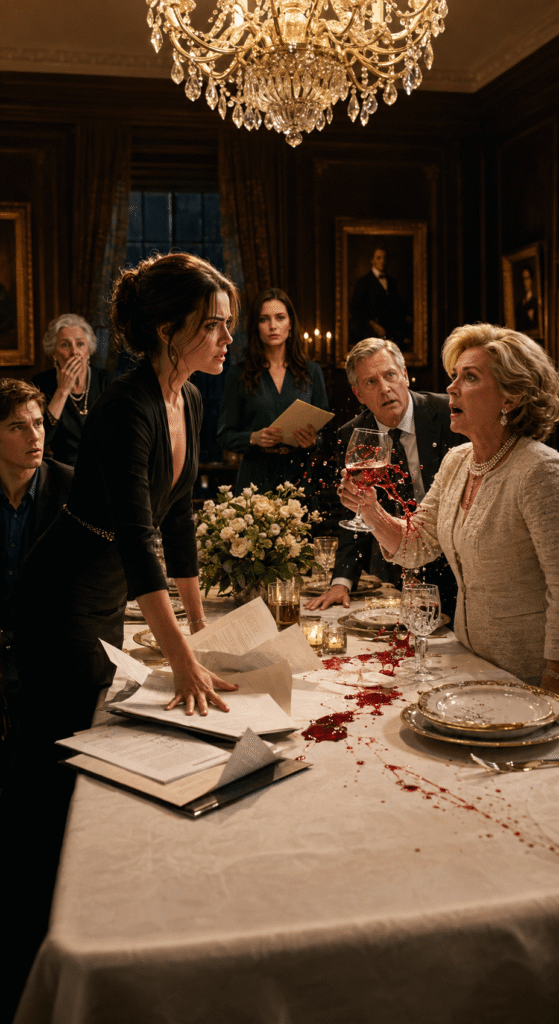
The courtroom was smaller than Nora had expected — a family court proceeding room with worn carpet and fluorescent lights that hummed at a frequency designed to induce headaches. She sat at the petitioner’s table with her lawyer, a sharp-eyed woman named Diane who had spent thirty years dismantling men like Julian Ashford, and she did not look at the respondent’s table where Julian sat with his mother and three attorneys.
Bea was not in the room. Bea was at a hotel across town with Nora’s best friend, watching movies and eating room service and asking questions that Nora would have to answer eventually.
When this is over, Nora promised herself. When this is over, I’ll tell her everything.
The judge was a woman in her sixties with steel-grey hair and glasses that she peered over like a weapon. She called the hearing to order at precisely 2:00 p.m., and Nora felt the familiar tightness in her chest — the same tightness she’d felt on her wedding day, the same tightness she’d felt when she’d signed the divorce papers, the same tightness she’d felt when she’d driven away from the Ashford estate with a sleeping toddler in the back seat and no idea where she was going.
“The court will hear arguments on the motion for evaluation,” the judge said. “Petitioner first.”
Diane stood. “Your Honor, the petitioner requests that the mandatory evaluation clause in the Vance Trust be enacted immediately. As outlined in our filing, the respondent has submitted evidence alleging behavior that would constitute grounds for custody modification. The trust specifically anticipates such challenges and requires independent verification before any action is taken. Given the seriousness of the allegations, we request that the evaluation be conducted today, as the laboratory has already been placed on standby.”
The judge nodded, turning to the respondent’s table. “Counsel for the respondent?”
Julian’s lawyer rose — a tall man with silver hair and a practiced smile. “Your Honor, the respondent maintains that the evidence submitted is credible and warrants immediate protective action. The child’s welfare is paramount. We request that the court order temporary custody to the respondent pending full evaluation, given the petitioner’s alleged instability.”
“Alleged,” Nora murmured under her breath.
Diane’s hand found her knee under the table, a warning.
“The court is not inclined to remove a child from a custodial parent based on unverified allegations,” the judge said dryly. “The evaluation clause was clearly designed for exactly this scenario. Mr. Ashford, I’m ordering the independent medical evaluation to proceed immediately. The results will be submitted to this court within twenty-four hours. Until then, custody remains with the petitioner.”
Margaret’s voice cut through the room before Julian could respond: “Your Honor, if I may—”
“You may not.” The judge’s gaze was arctic. “Mrs. Ashford, you are not a party to these proceedings. You will remain silent or you will be removed.”
Margaret’s pearls clicked. Her mouth opened, then closed.
Julian turned to look at Nora, and for a moment, the years fell away. She saw him as she’d first seen him — at a charity gala, standing alone by a window, looking like a man who’d forgotten how to be anywhere but at the center of a storm. She’d thought he looked lonely. She’d thought she could save him.
That’s not nothing, she’d told herself then, when he’d smiled at her for the first time. That’s not nothing.
She’d been wrong.
“Petitioner is directed to proceed to Chicago Memorial for evaluation immediately,” the judge said. “Respondent’s evidence will be held pending verification. The court will reconvene tomorrow at 2:00 p.m. Adjourned.”
The hospital was a forty-minute drive from the courthouse. Nora spent it staring out the window, watching the city she’d once called home blur past like a fever dream. Diane was on the phone with the lab, confirming the appointment, and Nora let the words wash over her without really hearing them.
She was thinking about the day she’d left.
It had been raining — because of course it had, because the universe had a sense of dramatic irony — and she’d been holding Bea, who was eighteen months old and running a fever, and Margaret had been standing in the doorway of the nursery saying, “You can’t possibly think you’re fit to raise this child. You can barely take care of yourself.”
And Julian had been there, standing behind his mother, his face unreadable. He hadn’t said anything. He hadn’t defended her. He’d just stood there, a statue in a bespoke suit, while his mother systematically dismantled everything Nora had believed about her marriage.
“The divorce papers are ready,” Margaret had said. “Sign them, and we’ll make sure you have enough to start over somewhere. Somewhere far away. Somewhere better suited to a woman of your… limitations.”
Nora had signed. She’d packed. She’d driven until she couldn’t drive anymore, and then she’d found a motel room, and then she’d found a job, and then she’d found Ruth.
Ruth Vance, her grandmother, who had taken one look at the exhausted young mother with the baby on her hip and said, “Well. It’s about time you showed up.”
Ruth, who had given her a bookshop and a purpose and a reason to keep going. Ruth, who had died three years later, leaving behind a trust fund for Bea and a set of legal clauses that had been designed to protect her great-granddaughter from exactly the kind of people who had driven Nora away.
The hospital loomed ahead, its glass façade reflecting the grey October sky.
“Ready?” Diane asked.
No, Nora thought. But she nodded anyway.
The evaluation took three hours. Blood work, urine samples, an interview with a psychiatrist who asked questions that Nora had been dreading for weeks — about her mental state, her parenting, her history, her marriage.
“Why did you leave your husband?” the psychiatrist asked.
Nora considered lying. Considered saying something vague about irreconcilable differences, about growing apart, about the usual things that ended marriages. But this was a woman who had been chosen by Ruth Vance’s trust, a woman who had probably seen every kind of family dysfunction imaginable, and Nora was tired.
“Because his mother arranged for a man to come to our home and claim I was having an affair with him,” she said. “Because when I denied it, Julian believed her instead of me. Because I realized that if I stayed, my daughter would grow up thinking that was what love looked like.”
The psychiatrist’s pen stilled. “That’s a serious allegation.”
“I have the documentation,” Nora said. “The man eventually came forward. He admitted Margaret paid him. But by then, the damage was done. Julian had already filed for divorce. I’d already signed.”
“Did your husband ever apologize?”
“He never even acknowledged it happened.” Nora looked down at her hands. “That’s the thing about Julian Ashford. He doesn’t apologize. He just moves on, like nothing ever happened, like people are chess pieces he can rearrange on a board.”
The psychiatrist made a note. “And your daughter?”
“Bea is the best thing that ever happened to me.” Nora’s voice cracked, just slightly. “She’s smart and observant and she asks questions I can’t always answer. She deserves better than the Ashfords. She deserves better than what I had.”
The interview ended. The blood work was processed. And Nora sat in the hospital lobby, waiting for Diane to return with the results, her grandmother’s watch ticking seven minutes fast on her wrist.
The results came back at 6:47 p.m.
Diane found Nora in the cafeteria, staring at a cup of coffee she hadn’t touched. The lawyer’s face was grim — but not, Nora realized, grim in the way of bad news. Grim in the way of someone who had just been handed ammunition and was already calculating the trajectory.
“The lab has no record of any sample from you prior to today,” Diane said, sitting down across from her. “The records the Ashfords submitted are complete fabrications. The witness they hired — I did some digging — has a history of perjury. She’s been paid by the Ashford family before.”
Nora let out a breath she hadn’t realized she’d been holding. “So we have them.”
“We have them.” Diane’s smile was sharp as a knife. “Tomorrow, in open court, we’re going to prove that Margaret Ashford filed false evidence in a custody proceeding. That’s perjury. That’s fraud. And given that she’s been orchestrating this from the start—”
“What about Julian?”
Diane paused. “What about him?”
“Did he know?” Nora asked. “About the fabricated evidence. Did he know his mother was lying?”
“I don’t know.” Diane’s voice was gentle. “But it doesn’t matter, does it? He signed the filings. He’s a party to the motion. Even if he didn’t know, he authorized it. He let it happen.”
Nora stared at her coffee. The surface had gone cold, a thin skin of oil forming on top.
The thing is, Julian had said, in the lobby, with that particular tension in his voice, I didn’t know.
Maybe it was true. Maybe he hadn’t known about the forged records, the paid witness, the elaborate construction of lies his mother had built. Maybe he’d just been going along, the way he always went along, a man too paralyzed by his own guilt and his own history to ever stand up to the woman who had shaped him.
But that wasn’t enough. It had never been enough.
“Call a press conference,” Nora said.
Diane blinked. “What?”
“The hearing tomorrow. The evidence. All of it.” Nora looked up, her eyes hard. “I want it public. I want everyone to know what Margaret Ashford did. I want it in the newspapers and on the news and in every gossip column that’s ever speculated about why the Ashford heir’s wife disappeared.”
“Nora, that’s—”
“That’s the only way this ends.” Nora stood, her chair scraping against the linoleum. “Margaret Ashford has spent thirty years controlling her family through fear and manipulation and money. The only way to stop her is to drag her into the light.”
Diane was quiet for a moment. Then she nodded slowly. “You know this will hurt Julian too. His reputation, the company—”
“I know.” Nora picked up her satchel, her grandmother’s watch glinting on her wrist. “But that’s not nothing, is it? It’s the consequence of his choices. And it’s time he faced them.”
The hotel room was quiet when Nora let herself in at 9:15 p.m. Bea was asleep on the pullout couch, her notebook clutched to her chest, her face peaceful in a way that broke Nora’s heart.
She doesn’t know, Nora thought. She doesn’t know what’s coming.
Her phone buzzed. A text from an unknown number — no, not unknown. She recognized it, even after six years. She’d deleted it from her contacts, but the digits were burned into her memory like a brand.
Julian: We need to talk. About Bea. Please.
Nora stared at the screen for a long moment. Then she typed back:
Nora: You had six years to talk. Tomorrow, in court, you’ll have your chance. And Julian?
Julian: What?
Nora: Don’t ever contact me directly again.
She blocked the number, turned off her phone, and sat down on the edge of the bed. Bea stirred, her eyes fluttering open.
“Mom?” Her voice was sleepy, confused. “Did we win?”
“We won today,” Nora said softly. “And tomorrow, we’ll win again.”
“Good.” Bea’s eyes closed. “I noticed you were worried. You were doing the thing with your watch.”
“What thing?”
“Checking it over and over. Like you do when you’re scared.” Bea’s voice was barely audible now, slurring with sleep. “But you don’t have to be scared, Mom. Grandma Ruth told me. Before she died. She said the trust would protect us.”
Nora’s throat tightened. “She told you that?”
“She said you were the bravest person she ever knew. And that you just needed to remember.” Bea snuggled deeper into the pillow. “I remember for both of us.”
Nora sat there for a long time, watching her daughter sleep, her grandmother’s watch ticking seven minutes fast on her wrist. Tomorrow, everything would change. Tomorrow, the truth would come out, in front of cameras and reporters and a judge who would see Margaret Ashford for what she really was.
Tomorrow, Julian would finally understand what he’d lost.
And it would be too late.
The next morning, Nora dressed in a charcoal suit she’d bought at a consignment shop three years ago — the one that made her feel armored, untouchable. She pinned her hair back, applied lipstick the color of dried blood, and looked at herself in the hotel bathroom mirror.
“You survived worse,” she told her reflection. “You survived losing Ruth. You survived raising a child alone. You survived the Ashfords once. You can do it again.”
Her phone buzzed. Diane, with the final details of the press conference.
The courthouse steps were crowded when Nora arrived at 1:30 p.m. — reporters with cameras, a few photographers, the kind of crowd that gathered when a wealthy family’s dirty laundry was about to be aired. Nora walked past them with her head high, not responding to the shouted questions, her grandmother’s watch ticking seven minutes fast on her wrist.
Seven minutes, she thought. That’s how long it took me to leave him. Seven minutes to pack a suitcase and walk out the door. And he never came after me. Not once.
Inside, the courtroom was already full. Margaret Ashford was seated at the respondent’s table, her pearls gleaming under the fluorescent lights, her expression the studied neutrality of a woman who had never been challenged in her life. Julian sat beside her, his face pale, his hands flat on the table.
He looked up when Nora entered. Their eyes met.
Don’t, she thought, not sure if she was talking to him or to herself. Don’t try to apologize. Don’t try to explain. It’s too late.
The judge entered. The hearing began.
And Nora watched, with a satisfaction that bordered on savage, as Diane stood up and began to dismantle the Ashford family’s lies, piece by piece, in front of the entire world.
CHAPTER THREE
The press conference had been Diane’s idea, executed with surgical precision. By the time the judge called the hearing to order at 2:00 p.m., every major news outlet in Chicago had a reporter in the courtroom, and the court’s own media liaison was visibly sweating.
Nora didn’t look at Julian. She looked at the judge, at the folders stacked on the bench, at the court reporter’s fingers hovering over her keyboard.
“Your Honor,” Diane began, “the petitioner requests that the fabricated evidence submitted by the respondent be struck from the record, and that the court initiate contempt proceedings against the respondent and his counsel for knowingly filing false documentation.”
The judge’s eyebrows rose. “That’s a serious motion, Counselor.”
“The laboratory results speak for themselves.” Diane held up a folder. “Chicago Memorial — an independent facility selected by the trust’s neutral arbiter, as specified in the mandatory evaluation clause — has confirmed that no record exists of any blood sample or toxicology screening for the petitioner prior to today’s date. The documentation submitted by the respondent purports to show results from a lab that has no matching sample on file. The witness who signed the affidavit has been paid by Ashford Hotels & Resorts on three separate occasions over the past eighteen months, each payment routed through a shell company.”
Margaret’s pearls clicked. “This is absurd,” she said, her voice rising. “The documents were provided by a reputable—”
“Mrs. Ashford.” The judge’s voice was ice. “I warned you yesterday. One more outburst, and I will have you removed from this courtroom.”
Margaret’s mouth snapped shut.
Julian stood up. “Your Honor, if I may—”
“You may not,” the judge said. “The respondent’s counsel will address the court, not the respondent himself.”
Julian’s lawyer rose, looking like a man who had just realized he’d been handed a losing hand. “Your Honor, the respondent was not aware of any irregularities in the documentation. We were provided with the materials by a third-party investigator, and we had no reason to doubt their authenticity—”
“You didn’t verify?” The judge’s voice was deceptively mild. “You filed a motion for emergency custody based on unverified evidence from a third-party investigator? That’s either gross negligence or willful misconduct, Counselor. Which is it?”
The lawyer opened his mouth. Closed it.
“I thought so.” The judge turned to Nora. “Mrs. Vance, the court apologizes for the distress this proceeding has caused you. The motion for custody modification is denied. The respondent is ordered to pay all legal fees incurred by the petitioner. And the court will be referring this matter to the State’s Attorney for potential criminal charges.”
Margaret made a sound — a small, choked noise, like a pearl being crushed. Julian’s face had gone the color of old paper.
Nora should have felt triumphant. She should have felt vindicated. But all she felt was tired — bone-deep, soul-deep tired, the exhaustion of a woman who had been fighting for so long she’d forgotten what peace felt like.
“Your Honor,” she said, standing. “If I may.”
The judge nodded.
“I didn’t come here to destroy the Ashford family.” Nora’s voice was steady, calm. “I came here to protect my daughter. But I think it’s time everyone in this room understood what’s actually at stake.”
She reached into her satchel and pulled out a photograph — old, creased, taken six years ago. A picture of Julian holding Bea, just a few days old, his face soft with a wonder she’d never seen before or since.
“This is my daughter,” Nora said. “Bea. She’s eight years old. She’s never met her father. She’s never seen a picture of him, because I was so afraid of what the Ashfords would do that I erased him from our lives completely.”
The courtroom was silent.
“Bea knows she has a father. She knows his name. She knows he lives in Chicago and that he runs a big company. And she’s asked me, every year, why he doesn’t want to meet her.”
Nora looked at Julian. His face was a mask of controlled agony, his hands gripping the edge of the table so hard his knuckles had gone white.
“I told her the truth,” Nora said. “That some people aren’t ready to be parents. That it wasn’t her fault. That she was perfect and lovable and deserving of everything good in the world, and that if her father couldn’t see that, it was his loss.”
She turned back to the judge.
“Bea is the reason I’m here. Not the trust, not the inheritance, not the bookstore my grandmother left me. Bea is the reason I got out of bed every morning for the past six years, the reason I built a life from nothing, the reason I kept going when I wanted to give up.”
Her voice cracked, just slightly.
“And I will spend the rest of my life protecting her from anyone who tries to use her as a weapon. Including her father. Including her grandmother. Including every person in this room who thought they could manipulate a child for their own ends.”
She sat down. The courtroom was utterly silent.
The aftermath was chaos.
Reporters surged forward, cameras flashing, questions overlapping into a wall of noise. Diane was already on her feet, ushering Nora toward a side exit, but Nora’s eyes were fixed on Julian.
He hadn’t moved. He was still sitting at the respondent’s table, his mother beside him, his lawyers conferring in urgent whispers. But his gaze was locked on the photograph Nora had left on the podium — the picture of him holding Bea, his face young and unguarded and hopeful.
He looks like a different person, Nora thought. He looks like the man I thought I married.
Then Margaret touched her pearls, and Julian flinched, and the moment shattered.
Nora turned and walked out of the courtroom without looking back.
The press conference was held on the courthouse steps, under a grey October sky that threatened rain. Nora stood at the microphones with Diane beside her, her grandmother’s watch ticking seven minutes fast on her wrist, and she told the truth.
She told the reporters about the fabricated evidence, the paid witness, the forged lab records. She told them about the trust clause Ruth Vance had written decades ago, anticipating exactly this kind of attack. She told them about the six years she’d spent building a life for her daughter, away from the Ashfords and their money and their manipulation.
And then she told them about Bea.
“Her name is Beatrice,” Nora said, her voice steady despite the cameras. “She’s eight years old. She’s smart and funny and she asks questions that would make most adults uncomfortable. She’s the best thing that ever happened to me, and I will spend the rest of my life making sure she never has to go through what I went through.”
A reporter shouted: “Is it true that Julian Ashford is the father?”
Nora paused. Looked directly into the camera.
“Julian Ashford has never met his daughter,” she said. “He’s never called. He’s never written. He’s never sent a birthday card or a Christmas present or a single word of acknowledgment that she exists. As far as I’m concerned, he forfeited the right to be called her father a long time ago.”
She stepped away from the microphones, and the reporters surged forward, and Diane pulled her toward a waiting car.
Behind her, the courthouse doors opened, and Julian Ashford stepped out into the grey light.
Nora didn’t see him until it was almost too late.
She was in the back of a black sedan, Diane in the front seat, the driver navigating through the chaos of reporters and cameras. The car was pulling away from the curb when a figure appeared in her window — Julian, his suit disheveled, his face pale, his hand pressed against the glass.
“Eleanor,” he said, his voice muffled but audible. “Please. Just five minutes. I need to—”
The car accelerated. Julian’s hand slipped away.
Nora watched him in the side mirror — a tall figure standing alone on the sidewalk, reporters swarming around him, his mother nowhere in sight. He looked small, she thought. He looked lost.
Good, she thought. Let him feel what it’s like to lose something that matters.
Then she turned away, and the car carried her into the city, and she didn’t look back.
Bea was waiting at the hotel, her notebook open on her lap, her face alight with curiosity.
“Mom! I saw you on TV!” She bounced off the couch, throwing her arms around Nora’s waist. “You were so brave. You looked like a superhero.”
Nora hugged her tightly, breathing in the scent of hotel soap and strawberry shampoo. “I’m not a superhero, baby. I’m just your mom.”
“Same thing.” Bea pulled back, her dark eyes serious. “I noticed the news people were asking about Daddy. Did you tell them he doesn’t want to meet me?”
Nora’s heart clenched. “I told them the truth. That he’s never met you. That it’s his loss.”
“Good.” Bea nodded firmly. “I don’t want to meet him either. I have you, and I have the bookstore, and I have Grandma Ruth’s watch that you wear all the time even though it’s seven minutes fast.”
Nora looked down at her wrist. “You noticed that?”
“I notice everything.” Bea grinned. “Can we get ice cream? Celebratory ice cream? For winning?”
Nora laughed — a real laugh, the first one in days. “Yes. We can get celebratory ice cream.”
They went to a small shop around the corner from the hotel, and Bea ordered a sundae with three kinds of toppings, and Nora watched her daughter eat with the ferocious joy of a child who had no idea how close she’d come to losing everything.
Tomorrow, Nora thought. Tomorrow, I’ll take her home. Back to Portland. Back to the bookstore. Back to our life.
She didn’t know that Julian was already planning his next move.
CHAPTER FOUR
Julian Ashford had not slept in forty-eight hours.
He sat in his office at Ashford Hotels & Resorts headquarters, staring at the photograph Nora had left in the courtroom. It was creased and faded, the colors muted from years of being kept in a drawer, but he could see everything — the curve of the baby’s cheek, the softness of her hair, the way his own face had looked in those first few days of fatherhood.
He’d forgotten that face. He’d forgotten that version of himself — the one who had held his daughter and felt something crack open inside him, something he’d been too young and too afraid to understand.
The thing is, he thought, I didn’t know she was pregnant when she left.
That was the lie he’d been telling himself for six years. The lie his mother had reinforced, the lie his lawyers had carefully constructed. She left without telling you. She took your child and disappeared. She’s the villain here, not you.
But the photograph told a different story. The photograph showed a man holding his newborn daughter, which meant Nora had told him about the pregnancy. Which meant he’d known.
Which meant he’d let them go anyway.
His phone buzzed. His mother.
Margaret: The damage control team is assembled. We need to discuss strategy before the morning news cycle.
Julian stared at the message. Then he typed back:
Julian: I’m not doing damage control.
Margaret: Don’t be dramatic, Julian. We can still salvage this. The press will move on in a few days. The important thing is protecting the company.
Julian: The company. Is that what you call it?
Margaret: What else would I call it?
Julian set the phone down. He walked to the window, looking out at the Chicago skyline — the city his family had helped build, the empire his father had left him, the legacy he’d been raised to protect.
The thing is, he thought, I never wanted any of it. Not the company, not the money, not the power. I wanted her. And I let her go.
He picked up the phone again. Typed a message to his assistant:
Julian: Find out where Eleanor Vance is staying. And book me a flight to Portland.
Nora and Bea flew home the next morning.
The flight was uneventful — Bea entertained herself with her notebook, drawing elaborate maps of imaginary kingdoms, and Nora stared out the window at the clouds and tried not to think about Julian’s face in the courtroom, the way he’d looked at the photograph, the way his hand had pressed against the car window as if he could somehow reach through the glass.
It doesn’t matter, she told herself. It’s too late. It’s been too late for years.
But when they landed in Portland, when they walked through the familiar doors of The Dog-Eared Page, when Bea ran to her favorite reading nook and curled up with a book like she’d never been away — Nora felt something loosen in her chest.
Home, she thought. We’re home. And we’re safe.
She didn’t know that Julian was already on a plane.
She didn’t know that he’d spent the entire flight writing and rewriting a letter he would never send.
She didn’t know that he was about to walk through her door and change everything.
CHAPTER FIVE
The Dog-Eared Page occupied the ground floor of a converted Victorian on Hawthorne Boulevard, its windows fogged with condensation, its shelves crammed with used books and mismatched furniture and the particular chaos of a place that had been loved into existence. Nora had bought it from Ruth’s estate four years ago, using the modest inheritance her grandmother had left her — not the trust, which was untouchable, but a separate bequest that had come with a handwritten note: For the girl who finally learned to run.
She was restocking the mystery section when the bell above the door chimed.
“Welcome to the Dog-Eared Page,” she called without turning. “Coffee’s fresh, pastries are half-price after three, and if you’re looking for the new Colson Whitehead, we’re sold out but I can order it.”
“I’m not here for a book.”
Nora’s hand stilled on the spine of a Ruth Ware novel. She knew that voice — knew it in her bones, in the hollow place behind her sternum that had never quite healed.
She turned.
Julian stood just inside the doorway, his tall frame silhouetted against the grey Portland afternoon. He looked exhausted — dark circles under his eyes, his jaw unshaven, his usually immaculate suit wrinkled in a way that suggested he’d slept in it. In his hands, he held a leather folder, worn at the edges, the kind of thing that had been opened and closed so many times the hinges had softened.
“You can’t be here,” Nora said.
“I know.” He didn’t move. “The thing is—I had to come.”
“Your mother knows you’re here?”
“My mother thinks I’m in Chicago, handling damage control.” A ghost of something — not quite a smile — flickered across his face. “She’s going to be very disappointed.”
Nora set the book down carefully, precisely, the way she did everything when she was trying not to scream. “How did you find me?”
“Your lawyer’s filing. The trust documents list the bookstore as your primary residence.” He paused. “I bought a copy of your lease agreement. It’s public record.”
“Of course it is.” She walked around the counter, putting it between them like a barricade. “What do you want, Julian?”
He opened the folder. Inside were photographs — dozens of them, spread across the worn leather like evidence at a trial. Bea at age three, blowing out birthday candles. Bea at five, dressed as a ladybug for Halloween. Bea at seven, standing in front of the bookstore with a sign that read “Ask me about my favorite book!”
Nora’s blood went cold. “Where did you get these?”
“Your mother’s Facebook page.” Julian’s voice was barely above a whisper. “She posts everything. Every milestone. Every achievement. Every picture of Bea that you send her.”
Nora’s hand flew to her mouth. Her mother — her sweet, well-meaning, technologically clueless mother — had been posting pictures of Bea for years, her profile set to public because she didn’t understand privacy settings.
“I’ve been watching her grow up through a screen,” Julian said. “For four years. Ever since I found the profile. I didn’t know about Bea until then — I swear to you, Eleanor, I didn’t know. My mother told me you’d had a miscarriage. She told me there was no child.”
Nora’s legs gave out. She sat down hard on a nearby stool, her heart pounding so loudly she could hear it in her ears.
“A miscarriage,” she repeated.
“That’s what she said. After you left. She said you’d lost the baby and that you were too distraught to stay married.” Julian’s hands were shaking. “I believed her. God help me, I believed her, because it was easier than believing that I’d driven you away.”
“Bea was eighteen months old when I left.” Nora’s voice was flat, dead. “I was holding her when your mother told me I was unfit. I was holding her when she called me a drunk and a whore and a gold-digger. And you stood there. You stood there and watched.”
Julian flinched as if she’d struck him. “I know.”
“You know.” Nora laughed — a harsh, broken sound. “You know. That’s what you have to say? Six years, Julian. Six years of raising a child alone, of working two jobs, of begging my grandmother for help because I had nothing — and all you have to say is that you know?”
“I didn’t come here to apologize.” Julian closed the folder, his movements careful, deliberate. “I know that’s not enough. The thing is—I don’t know what enough looks like. I don’t know if there’s anything I can do that would make up for what I did. But I had to see her, Eleanor. I had to see my daughter.”
Nora stood. She walked to the door, her legs steadier now, her heart a cold, hard knot in her chest.
“You want to see her?” She held the door open. “Then you can come back tomorrow. During business hours. As a customer. And if Bea decides she wants to talk to you, that’s her choice. Not yours. Not mine.”
Julian nodded slowly. “And if she doesn’t want to talk to me?”
“Then you leave. And you don’t come back.” Nora’s voice didn’t waver. “Those are my terms, Julian. Take them or leave them.”
He looked at her for a long moment — his grey eyes searching her face, looking for something she wasn’t sure she still had to give.
“The thing is,” he said finally, “I’ll take them.”
He walked out into the grey afternoon, and Nora closed the door behind him, and then she leaned against it, her whole body shaking, and she cried for the first time in six years.
CHAPTER SIX
Bea was doing her homework at the small table in the back of the bookstore when Nora told her.
“There’s someone I need to talk to you about,” Nora said, sitting down across from her. “Someone who might come to the store tomorrow.”
Bea looked up from her math worksheet, her pencil pausing mid-equation. “Is it Daddy?”
Nora’s breath caught. “How did you—”
“I noticed.” Bea set her pencil down carefully, the way she did everything, with the precise movements of a child who had learned to control what she could. “You’ve been weird all day. Checking your watch even more than usual. And you were crying in the bathroom earlier. I heard you.”
Nora’s eyes burned. “Bea—”
“It’s okay, Mom. I’m not mad.” Bea’s voice was steady, calm — too calm for an eight-year-old. “Grandma Ruth told me he might come someday. She said he was like a storm — that he’d stay away for a long time and then show up when you least expected it.”
“Grandma Ruth said that?”
“She said a lot of things.” Bea pulled her notebook from her backpack — the same notebook she’d been carrying for months, the one Nora had never looked inside. “I wrote them down. So I’d remember.”
She flipped through the pages. Nora caught glimpses of handwriting — Bea’s neat, careful script, interspersed with drawings and diagrams and lists. Things Grown-Ups Think I Don’t Notice. Things Grandma Ruth Told Me. Things I Want to Ask My Dad If I Ever Meet Him.
“I have a list,” Bea said. “Questions. For him. Is that okay?”
Nora swallowed hard. “You can ask him whatever you want.”
“Even if it makes him sad?”
“Especially if it makes him sad.” Nora reached across the table and took her daughter’s hand. “You don’t have to protect him, Bea. That’s not your job. Your job is to be a kid, and to tell the truth, and to ask for what you need. Can you do that?”
Bea nodded solemnly. “I can do that.”
“Good.” Nora squeezed her hand. “Now finish your homework. And don’t tell anyone about this yet — not Grandma, not your friends, not the bookstore staff. It’s just between us for now.”
“I understand.” Bea picked up her pencil. “Mom? Do you think he’ll like me?”
Nora’s heart cracked. “He’d be crazy not to.”
Julian arrived at 10:00 a.m. the next morning, exactly when the store opened. He was dressed more simply today — dark jeans, a grey sweater, no tie — and he looked even more exhausted than he had the day before. He stood in the doorway like a man waiting for permission to enter.
“Good morning,” Nora said, her voice carefully neutral. “Coffee’s fresh. Pastries are half-price after three.”
“I’m not here for the pastries.” He stepped inside, his eyes scanning the store — the crammed shelves, the mismatched armchairs, the small stage in the corner where local authors did readings. “This is your grandmother’s?”
“Mine now.” Nora gestured toward the back. “Bea’s doing her homework. She knows you’re coming.”
Julian’s face went pale. “She knows?”
“She’s eight, Julian. She’s not stupid.” Nora crossed her arms. “She has questions. I told her she could ask them. Whatever happens after that is up to her.”
Julian nodded slowly. Then he walked toward the back of the store, his footsteps measured, deliberate, like a man approaching his own execution.
Nora followed at a distance, close enough to intervene if necessary, far enough to give them privacy. She watched as Julian stopped at the edge of the reading area, where Bea sat at a small table with her notebook and a glass of apple juice.
“Hello,” Julian said. His voice cracked on the word.
Bea looked up. She studied him for a long moment — his face, his clothes, his hands — with the same dark eyes he’d seen in the courtroom, the same dark eyes that stared back at him from the photographs.
“Hello,” she said. “I’m Beatrice. But everyone calls me Bea.”
“I know.” Julian’s voice was barely above a whisper. “I’ve seen your pictures.”
“From Grandma’s Facebook?” Bea’s expression didn’t change. “I noticed you looked at them. She told me you friend-requested her four years ago, and she accepted because she didn’t know who you were.”
Julian’s jaw tightened. “I should have told her who I was. I should have—”
“Why didn’t you?” Bea interrupted. “You knew where we were. You knew my name. You could have called or written or come to see me. Why didn’t you?”
The question hung in the air like a knife.
Julian sat down in the chair across from her — slowly, carefully, as if his body had forgotten how to move. “The thing is,” he said, “I was afraid.”
“Afraid of what?”
“Afraid that you wouldn’t want to know me.” Julian’s hands were clasped in his lap, his knuckles white. “Afraid that your mother would tell you what I did — how I treated her, how I let my family treat her — and that you’d hate me. Afraid that I’d already lost you before I even got a chance to know you.”
Bea considered this. “That’s not a very good reason.”
“No,” Julian agreed. “It’s not.”
“I have a list,” Bea said, pulling her notebook closer. “Questions I want to ask you. Some of them are hard.”
“I’ll answer them.” Julian’s voice was steady now, resolved. “Whatever you want to ask. I’ll tell you the truth.”
Bea nodded, flipping through the pages. “First question. Why did you believe Grandma Margaret instead of Mom?”
Julian closed his eyes. When he opened them, they were bright with tears he didn’t try to hide.
“Because I was weak,” he said. “Because I’d spent my whole life letting my mother make decisions for me, and I didn’t know how to stop. Because I was so afraid of becoming my father — a man who abandoned his family, who chose business over love — that I let my mother turn me into someone even worse.”
“That’s a sad answer,” Bea said quietly.
“I know.”
“My second question.” Bea’s voice didn’t waver. “Do you love my mom?”
Nora, standing just out of sight, felt her heart stop.
Julian was silent for a long moment. Then he said, “Yes. I always have. Even when I was too stupid and too scared to show it.”
“Then why didn’t you come after us?”
“Because I didn’t know how.” Julian’s voice broke. “Because I was raised to believe that Ashfords don’t chase. That we don’t apologize. That we don’t show weakness.” He paused. “But I’m trying to learn. That’s why I’m here.”
Bea studied him for another long moment. Then she closed her notebook.
“I don’t know if I like you yet,” she said. “But I don’t hate you. That’s a start.”
“It’s more than I deserve,” Julian said.
Bea nodded. Then she picked up her pencil and returned to her math worksheet, as if the most significant conversation of her life had been nothing more than a minor interruption.
Julian sat there, watching her work, and Nora watched him watch her, and the whole store seemed to hold its breath.
CHAPTER SEVEN
The weeks that followed were strange, tentative, a careful dance of boundaries and small concessions.
Julian came to the bookstore every day. He didn’t push. He didn’t demand. He sat in the corner with a cup of coffee and a book, and sometimes Bea would wander over and ask him a question, and sometimes she wouldn’t, and he accepted both with the same quiet patience.
The bookstore staff — a motley crew of retired teachers, aspiring writers, and one very opinionated cat named Hemingway — watched the whole thing with varying degrees of suspicion and amusement.
“He’s not what I expected,” said Marge, a seventy-year-old former librarian who had worked at the store since Ruth’s time. “I thought he’d be more… I don’t know. Ashford-y.”
“What does that mean?” Nora asked, restocking the fiction section.
“Cold. Distant. Expensive suit.” Marge peered over her glasses at Julian, who was helping Bea with a jigsaw puzzle at the back table. “He’s wearing a sweater that has a hole in the elbow. A real hole. He didn’t even try to hide it.”
Nora looked over at Julian, and sure enough, there was a small tear in the elbow of his grey sweater — the same sweater he’d worn on his first visit, she realized. He’d worn it every day since.
He’s trying, she thought. He’s actually trying.
The thought was terrifying.
The mid-story complication arrived on a Tuesday.
Nora was in the back office when Diane called, her voice tight with barely controlled fury.
“Margaret Ashford is challenging the trust.”
Nora set down her coffee. “What?”
“She’s filed a motion claiming Ruth Vance wasn’t of sound mind when she wrote the evaluation clause. She’s arguing that the clause is invalid because it was designed to target the Ashford family specifically, and that it constitutes a personal vendetta rather than a legitimate legal protection.”
“That’s ridiculous. Ruth was sharp as a tack until the day she died.”
“Of course it’s ridiculous. But it’s also a delay tactic.” Diane’s voice hardened. “If she can get the clause thrown out, she can re-file the custody motion without the mandatory evaluation. And she’s petitioning for a hearing in Chicago — which means you’ll have to come back.”
Nora’s stomach dropped. “When?”
“Three weeks. I’ll send you the details.” Diane paused. “Nora, there’s something else. Margaret has subpoenaed the bookstore’s financial records. She’s claiming the trust funds are being mismanaged — that you’re using Bea’s inheritance to subsidize a failing business.”
“That’s a lie. The trust is untouched. I haven’t taken a single penny.”
“I know. But she’s going to drag it through the courts anyway. She’s trying to bankrupt you, Nora. She’s trying to make you give up.”
Nora looked through the office window at Bea, who was laughing at something Julian had said, her small face bright with joy.
“She’s not going to win,” Nora said.
Julian found her in the office an hour later, her head in her hands.
“I heard,” he said. “My mother called. She wanted to know why I wasn’t in Chicago, handling the crisis.”
“What did you tell her?”
“I told her I was where I needed to be.” Julian sat down in the chair across from her desk. “The thing is, Eleanor — I can stop this. I have power of attorney over my mother’s legal affairs. I can withdraw the motion, cancel the subpoena, and force her to drop the challenge.”
Nora looked up. “Why haven’t you?”
“Because I wanted to ask you first.” Julian met her eyes. “I know you don’t trust me. I know I haven’t earned it. But I’m not going to make decisions for you anymore. If you want me to stop her, I’ll stop her. If you want to fight this yourself, I’ll support you. Whatever you choose.”
Nora stared at him. In six years of marriage, Julian had never once asked her what she wanted. He’d never offered to stand up to his mother. He’d never put her needs before the company’s.
“Why now?” she asked. “Why are you doing this now?”
“Because I saw the photograph.” Julian’s voice was low, rough. “The one you left in the courtroom. The one of me holding Bea when she was born. I looked at it, and I remembered everything — how I felt in that moment, how terrified and hopeful and alive. And I realized that I’d let my mother take that from me. I’d let her take you, and Bea, and the only chance I ever had to be the man I wanted to be.”
He paused.
“The thing is, I don’t care about the company. I don’t care about the inheritance. I don’t care about any of it. I just want a chance to prove that I can be better. Not for you — I know you don’t owe me anything. For Bea. For myself.”
Nora was quiet for a long moment. Then she said, “Stop her. But not because I’m asking you to. Because it’s the right thing to do.”
Julian nodded. He pulled out his phone, typed a message, and hit send.
“It’s done,” he said.
CHAPTER EIGHT
The news of Julian’s defection hit the Ashford family like a bomb.
Margaret called within minutes, her voice shrill with fury. Nora could hear her through the office door — the accusations, the guilt trips, the threats. Julian listened in silence, his face unreadable, and then he said, “I’m sorry you feel that way, Mother. But I’m not changing my mind.”
He hung up. He turned to Nora.
“She’s going to escalate,” he said. “She’s going to try to turn the board against me. She’s going to spread rumors, call in favors, do everything she can to force me out of the company.”
“And you’re okay with that?”
“I’m counting on it.” Julian smiled — a real smile, the first one Nora had seen in years. “Because it gives me a reason to do what I should have done a long time ago.”
“What’s that?”
“Start my own company.” He leaned back in his chair. “Hotels, but not like Ashford. Smaller. More personal. Places where people actually want to stay, not just places where they’re tolerated because of the name on the door.”
Nora blinked. “You’re going to leave Ashford Hotels?”
“I’m going to leave my mother’s version of Ashford Hotels.” Julian’s voice was steady. “I’m going to build something of my own. Something I can be proud of. Something Bea can be proud of.”
“You’d give up everything? The inheritance, the board seat, the—”
“I’d give up anything.” Julian met her eyes. “I already gave up the only thing that ever mattered.”
CHAPTER NINE
The gala was Margaret’s idea.
The Ashford Foundation’s annual fundraising event, held at the family’s flagship hotel in downtown Chicago, was the social event of the season — a black-tie affair that drew politicians and celebrities and every wealthy family with something to prove. Margaret had been planning it for months, micromanaging every detail from the flower arrangements to the seating chart.
She hadn’t expected Julian to attend.
“I’m going,” he told Nora over breakfast at the bookstore’s café. “And I’m bringing you and Bea.”
Nora set down her coffee cup. “Absolutely not.”
“Eleanor—”
“Your mother has spent the last six years trying to destroy me. She’s filed false evidence against me, tried to take my daughter, and is currently attempting to invalidate my grandmother’s trust. I am not going to her party.”
“That’s exactly why you need to be there.” Julian leaned forward. “My mother has spent decades controlling the narrative. She’s the victim, she’s the matriarch, she’s the one holding everything together while everyone else falls apart. I want to shatter that narrative. In public. In front of everyone who matters.”
“And how do you propose to do that?”
“By telling the truth.” Julian’s voice was quiet but firm. “About what she did. About the fabricated evidence. About the lies. About all of it.”
Nora was silent for a long moment. Then she said, “Bea doesn’t need to see this.”
“Bea deserves to see her father stand up for her.” Julian paused. “The thing is, Eleanor — I’ve spent my whole life being afraid of my mother. And I’m done. I’m done being afraid. And I want Bea to know that she never has to be.”
Nora looked at him — really looked at him — and saw something she hadn’t seen in years. Not the cold, distant heir she’d married. Not the weak, indecisive man who had let his mother destroy their family. Someone new. Someone harder. Someone who had finally learned to fight.
“Fine,” she said. “We’ll go. But if your mother says one word to Bea, one cruel word, we’re leaving.”
“Deal.”
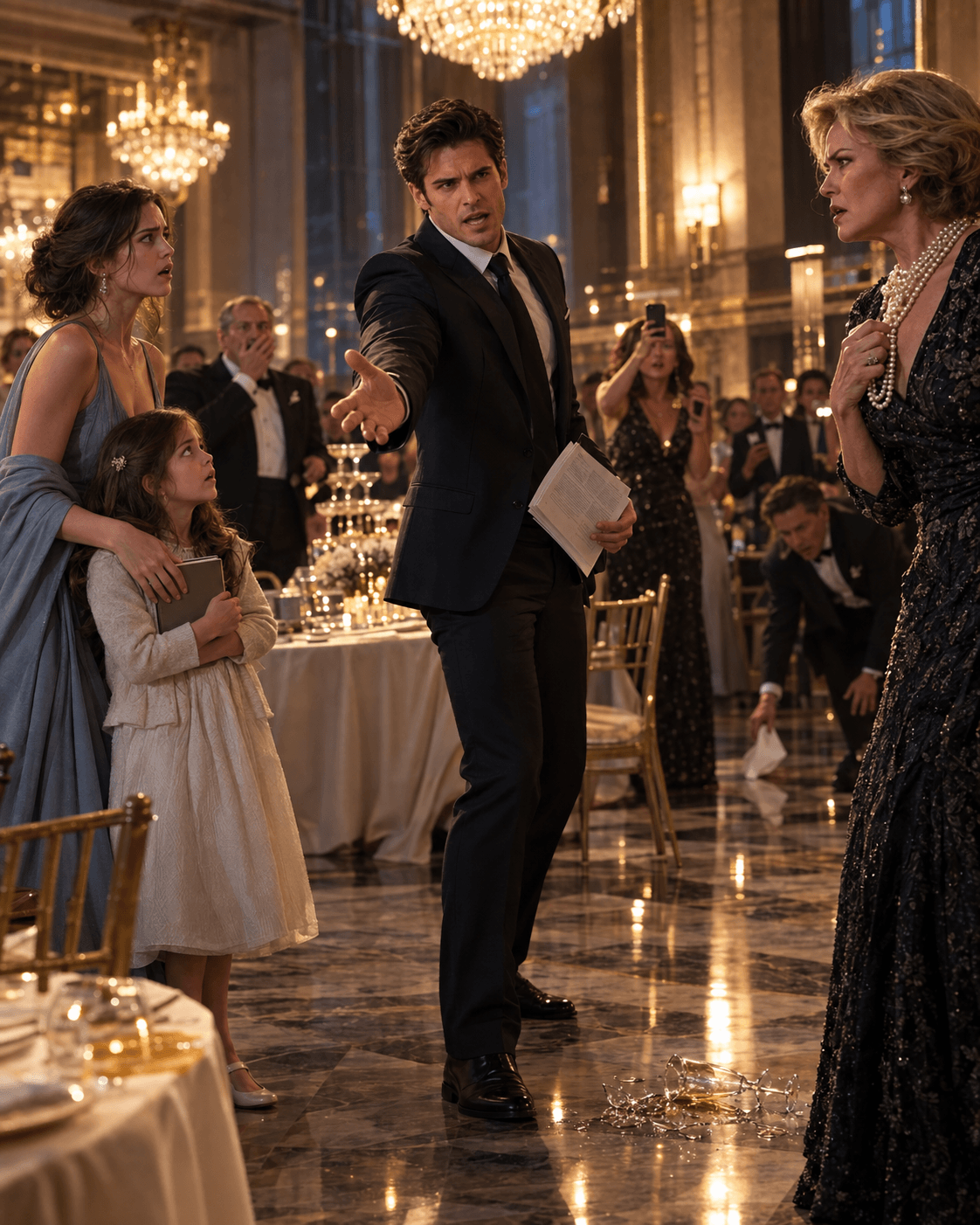
The gala was everything Nora remembered and worse. Crystal chandeliers, champagne towers, a string quartet playing something tasteful and forgettable. The women wore couture, the men wore tuxedos, and everyone wore the same expression of carefully calibrated boredom.
Nora wore a black dress she’d bought at a vintage shop — not designer, but elegant, timeless. Her grandmother’s watch was set seven minutes fast on her wrist. Bea wore a navy blue dress with a white collar, her dark hair pulled back with a ribbon, her notebook tucked into a small purse that matched her shoes.
“You look beautiful,” Julian said, offering his arm.
“I look like I don’t belong here.”
“You never belonged here. That was the point.” He smiled. “You were always too good for this world.”
They walked into the ballroom together, Bea between them, and the room went silent.
Margaret was standing near the stage, pearls around her neck, champagne in her hand. Her face went through a rapid series of expressions — surprise, fury, calculation — before settling into a smile that didn’t reach her eyes.
“Julian,” she said, her voice carrying across the room. “How lovely. I didn’t expect you to come.”
“I know.” Julian stopped a few feet away. “That’s why I came.”
The room was watching — the board members, the investors, the society columnists, everyone who had ever wondered about the Ashford family’s private dramas. Nora felt their eyes on her, on Bea, and she lifted her chin.
Margaret’s gaze flickered to Bea. “And this must be… the child.”
“Her name is Beatrice,” Julian said. “She’s eight years old. She’s my daughter. And if you ever refer to her as ‘the child’ again, we will leave this room and never come back.”
Margaret’s hand flew to her pearls. “Julian, don’t be dramatic—”
“I’m not being dramatic.” Julian stepped forward, his voice rising just enough to carry. “I’m being honest. For the first time in my life, in front of everyone who matters, I’m being honest.”
He turned to face the room.
“My mother fabricated evidence against my wife. She paid a witness to lie. She filed false documents in a custody proceeding. She tried to take my daughter away from her mother using methods that were illegal, immoral, and cruel.”
The room was utterly silent.
“When I found out, I didn’t believe it. I couldn’t believe it. My mother — the woman who raised me, who sacrificed everything for me — couldn’t possibly be capable of such things.” Julian’s voice hardened. “But she was. She is. And I spent six years believing her lies instead of trusting the woman I loved.”
He turned back to Margaret.
“You took everything from me,” he said. “You took my marriage. You took my daughter. You took my self-respect. And I let you. Because I was weak, and afraid, and I didn’t know how to be anything else.”
Margaret’s face had gone white. “Julian, this is neither the time nor the place—”
“No,” Julian agreed. “But it’s the time and place I chose. And I’m not finished.”
He reached into his pocket and pulled out a document — the same document Diane had filed in court, the one that proved the lab records were forged.
“This is a copy of the evidence that proves my mother committed perjury and fraud. I’m giving it to every reporter in this room. I’m giving it to the board. I’m giving it to the State’s Attorney’s office, which is already investigating.”
Margaret’s champagne glass slipped from her fingers and shattered on the marble floor.
“I’m resigning from Ashford Hotels & Resorts, effective immediately. I’m relinquishing my board seat. I’m walking away from the company my father built, because I refuse to be part of anything my mother touches.” Julian’s voice was steady. “And I’m telling the truth — finally — about what she did.”
He turned to Nora, his eyes bright with tears he didn’t try to hide.
“You deserved better,” he said. “You deserved a husband who believed you. You deserved a family that welcomed you. You deserved everything I failed to give you. And I’m sorry. I’m so sorry.”
Nora’s throat was tight. She couldn’t speak. She couldn’t move.
Then Bea stepped forward, her small hand slipping into Julian’s.
“It’s okay, Daddy,” she said, her voice carrying across the silent room. “I noticed you were trying. That’s what matters.”
CHAPTER TEN
The aftermath of the gala was chaos.
Margaret was escorted from the hotel by security, her protests echoing through the marble lobby. The board convened an emergency meeting and voted to remove her from her position as chairwoman. The State’s Attorney’s office announced a formal investigation. The society columnists had the story of the decade.
Nora, Julian, and Bea slipped out a side door and walked through the streets of Chicago, the city lights blurring through Nora’s tears.
“You called me Daddy,” Julian said, his voice choked.
“I noticed you earned it,” Bea replied.
Nora laughed — a real laugh, the kind she hadn’t made in years.
Three months later, Julian opened his first hotel — a small boutique property on the Oregon coast, forty rooms, sustainable design, locally sourced food. He named it The Ruth, after Nora’s grandmother.
Nora stood beside him at the ribbon-cutting, Bea between them, her notebook clutched in her hand.
“You did this,” Julian said, his voice low. “You made me want to be better.”
“No,” Nora said. “You did it yourself. I just stopped getting in the way.”
He turned to her, his grey eyes searching her face. “Can I ask you something?”
“You can ask.”
“The thing is—” He paused. “I know I haven’t earned it yet. I know I have years of work ahead of me. But I wanted to ask — if you’d let me try. To be part of your life. Not as your husband, not yet. Just as someone who loves you. Someone who’s willing to wait.”
Nora looked at him — at the man who had once been her husband, at the man who had failed her and hurt her and let her go. At the man who had stood up to his mother, walked away from his inheritance, and built something new.
“Not yet,” she said. “But maybe someday.”
It was not a yes. It was not a no. It was a beginning.
The bookstore was quiet on Sunday mornings — the only time Nora allowed herself to sleep in, to linger over coffee, to watch the fog roll in from the river. Bea was reading in her favorite armchair, Hemingway the cat purring on her lap, and Julian was at the small table, answering emails on his laptop.
It had been a year since the gala. A year of careful, halting progress — of joint therapy sessions and difficult conversations and more than a few setbacks. Julian had moved to Portland permanently, renting a small apartment near the bookstore. He saw Bea every weekend, took her to soccer practice and science fairs and the father-daughter dance at her school.
He and Nora were not together. Not in the way they had once been. They were something else — something slower, something more honest. They were learning each other again, without the weight of the Ashford name or the interference of Margaret’s ambitions.
Margaret had been convicted of fraud and perjury. She was serving eighteen months in federal prison, her pearls confiscated as evidence, her reputation shattered. She had not spoken to Julian since the gala.
Nora didn’t feel sorry for her. Some things couldn’t be forgiven.
“Daddy?” Bea looked up from her book. “Can I ask you something?”
“Always.”
“Why did you wait so long to come find us?”
Julian closed his laptop. He looked at Nora, and Nora looked back, and something passed between them — not quite forgiveness, not quite peace, but something close.
“The thing is,” Julian said, “I didn’t think I deserved to. I thought I’d already ruined everything, and that there was no point in trying to fix it.”
“But you tried anyway.”
“I tried anyway.”
Bea nodded, considering this. Then she set her book down and walked over to him, wrapping her small arms around his neck.
“I’m glad you did,” she said.
Nora watched them — her daughter and her almost-husband, tangled together in the Sunday morning light — and felt something loosen in her chest. Something that had been knotted for years.
That’s not nothing, she thought. That’s not nothing at all.
The terms were simple. Nora had written them herself, in the back of the bookstore, one rainy afternoon when she’d finally decided to stop running.
If we do this — if we try again — these are the rules:
You will never lie to me. You will never hide things from me. You will never let anyone — your mother, the board, anyone — come between us again.
You will be a father to Bea every day, not just when it’s convenient. You will show up. You will be present. You will earn her trust the way you earned mine — slowly, carefully, one day at a time.
And you will never, ever forget what it cost us to get here.
Julian had read the list, signed it, and framed it. It hung in his new office at The Ruth, next to a photograph of Bea at her first soccer game and a picture of Nora that Ruth had taken on the day the bookstore opened.
The wedding was small.
Just Bea and Marge and Hemingway the cat and a handful of friends from the bookstore. It was held in the garden behind the Victorian, under a canopy of fairy lights, with the smell of roses and salt air drifting in from the coast.
Bea was the flower girl. She wore a yellow dress and carried a bouquet of wildflowers, and she insisted on walking down the aisle first, ahead of everyone else.
“I noticed you were nervous,” she told Nora. “I wanted to show you it was okay.”
Nora knelt down and hugged her. “You’re the bravest person I know.”
“I learned it from you,” Bea said.
When Julian saw Nora walking toward him — her grandmother’s watch ticking seven minutes fast on her wrist, her eyes bright with tears, her smile wide — he started crying.
“The thing is,” he said, when she reached him, “I don’t know how to tell you how much I—”
“You don’t have to tell me,” Nora said. “You already showed me.”
He kissed her. Bea cheered. Hemingway the cat yowled. And somewhere, Nora imagined, Ruth Vance was watching, a sharp smile on her face, satisfied that her granddaughter had finally found what she deserved.
A family. A home. A love that had been tested and battered and broken — and rebuilt.
That’s not nothing, Nora thought.
It was everything.