Caleb Foster slammed his fist against the wall of the command tent so hard the folding table rattled and every cup of cold coffee jumped.
You’re calling it off?
His voice cracked.
She’s still out there.
The search coordinator didn’t blink.
We’ve covered every grid.
Four days, son. Nobody survives that. Caleb grabbed his backpack off the ground, shoved past the man, and walked straight into the dark.
Nobody stopped him. Nobody believed him.
But here’s the thing about men who’ve spent their whole lives reading fire, they know when something still burning.
The command tent smelled like burnt coffee, damp wool, and defeat. Caleb Foster stood at the back edge of the crowd, 30, maybe 40 searchers packed into a camp hall that had no business holding that many bodies, and he listened to the Colorado State Search and Rescue Coordinator explain in careful, measured language why Eleanor Grant was already dead.
“We’ve exhausted every viable grid sector,” said the coordinator, a trim man named Davis with silver hair and the particular calm of someone who had delivered this kind of news before.
“Four days of aerial support, ground teams, canine units, thermal imaging.
The storm hit hard Tuesday night. Temperatures dropped to 19°.
Without shelter. Without confirmed absence of shelter, Caleb said quietly. Davis paused.
He looked up from his briefing notes and found the source of the interruption. His eyes landed on Caleb, the way eyes always landed on Caleb in rooms like this, slightly annoyed, professionally polite.
“I’m sorry.”
“You said without shelter.”
Caleb said.
“But we haven’t confirmed there’s no shelter.
We just haven’t found her yet.”
The tent went quiet, not respectful quiet, the other kind, the kind where everyone is deciding whether to take you seriously or feel sorry for you. A woman standing near the front, some kind of executive coordinator flown in from Denver, turned around slowly.
“Mr.Foster, Caleb Foster, Mr.Foster.”
She said it like she was filing it somewhere unimportant.
“The search teams have covered over 300 square miles.
The helicopter wreckage was found 2 miles off course from the flight plan.
The weather event that Tuesday night “I know what the weather did Tuesday night.”
Caleb said.
“I was fighting wildfires up in that range for 11 years.
I know what that storm did to the terrain.
Then you understand why.”
“I understand why you’re calling it.”
He said. Not aggressive.
“Just honest.
I don’t agree with it.”
Davis stepped forward. Not confrontational, but definitively closing the conversation.
“We appreciate your participation in the volunteer search.
Truly. But we have to make decisions based on statistical probability and resource allocation.
We have crews who’ve been out 4 days.
We have families.”
“She has a family, too.”
Caleb said. That landed differently than he meant it to.
He saw it in Davis’ face, a flicker of something real before the professional mask came back down.
“The official search is suspended as of 6:00 p.m.tonight.”
Davis said.
“Anyone who wishes to continue on their own time, on their own recognizance, is free to do so.
But we cannot authorize. Caleb had already stopped listening.
He picked his pack up off the ground, a battered Osprey he’d owned since his firefighting days, worn at both straps, and repaired with electrical tape on the left hip belt, and he walked out of the tent into the cold afternoon air.
Nobody called after him. The parking lot outside the command site was a field of mud, satellite trucks, and generator cables.
Three news vans sat with their lights off. A young reporter Caleb, vaguely recognized from Channel 9 in Denver, stood near her van, scrolling her phone, not broadcasting.
There was nothing left to broadcast. The story had shifted from missing billionaire to search suspended.
The next news meant an end. Would be about grief and legacy, and what Eleanor Grant had meant to the business world.
He walked past all of it. His truck was parked at the far end, a 2009 Ford F250 with 190,000 mi and a cracked windshield he kept meaning to fix. He opened the tailgate and laid his pack flat, and went through it with the efficiency of someone who did this without thinking.
Water, 3 L. He added one more from the jug he kept behind the seat.
Emergency blanket, medical kit, 550 cord, handheld radio tuned to the ranger frequency. Signal mirror, fire kit, 2 days of food, not comfort food, just calories.
He added one thing he didn’t usually carry, a folded piece of paper printed from his laptop that morning.
A topographic map of the northern range with the official search grids outlined in red marker. And something else.
Something the search teams hadn’t noticed or hadn’t cared about or maybe had noticed and dismissed.
He’d been studying it for 2 days.
His daughter Maya had asked him at breakfast why he was still going back up there.
She was 9 years old, missing her two front teeth, and she had her mother’s eyes, serious and brown and capable of looking directly into the center of you in a way that made lying feel not just wrong but structurally impossible.
“Because she might still be alive,” he’d said.
“But the TV people said.”
“I know what the TV people said.”
Maya had stirred her cereal in circles.
“Dad, if she was alive, wouldn’t they have found her by now?”
“Not necessarily.”
“Why not?”
He’d thought about how to explain it.
He’d thought about systems and grids and the way technology tells you where to look based on where things usually are.
He’d thought about how wildfires jump roads and defy wind models and show up exactly where the map says they can’t be.
“You remember when you lost your stuffed rabbit?”
he said finally.
“Mr.Buttons?”
“Yeah, where did everyone look?”
“In my room.”
“In the living room, in the car.”
“And where was he?”
Maya had scrunched her face.
“In the recycling bin.”
“Because I accidentally” “Because you accidentally put him there when you were half asleep,” Caleb said.
“And nobody looked in the recycling bin.”
“Because that didn’t make sense.”
“It wasn’t on the list of places rabbits go.”
His daughter had stared at him.
“She’s in the recycling bin,” Caleb said.
Maya hadn’t laughed.
She just nodded very slowly, like she was 9 years old and already understood things about her father her father that he hadn’t fully said out loud yet.
“Be careful,” she’d told him.
He had kissed the top of her head and left before the sun came up. The elevation gain started at 7,400 ft and climbed from there.
Caleb moved the way men move when they’ve spent years in terrain like this.
Not fast, not showy, but steady and completely without wasted motion. His breathing settled into a rhythm.
His eyes moved constantly. Not in the anxious scanning way of someone afraid, but in the reading way.
The way you look at a mountain when you’re trying to understand what it’s saying.
He was not following the official search grids. He was following something else. The storm that hit Tuesday night had come from the northwest.
He’d checked the weather station data himself.
Winds sustained at 38 mph, gusting to 55 at elevation. Hard rain turning to sleet above 9,000 ft.
The helicopter had gone down somewhere in that window.
But here was what nobody seemed to be thinking about, or what they’d thought about and moved past too quickly.
People move with the wind at their backs.
It’s instinctive.
It’s biological.
You’re wet and cold and scared and you move down wind because your body tells you that’s the direction of less resistance.
It’s not rational.
It’s not navigational.
It’s not what a trained survival expert would do.
But Eleanor Grant was not a trained survival expert. She was a 48-year-old woman who just survived a helicopter crash in the dark in a storm and her body would have told her to move away from the wind.
The official search grids had been built around the wreckage site and the flight path.
They’d searched upwind.
They’d searched crosswind.
They’d done everything by the book.
Nobody had walked straight downwind for 4 miles and looked in the drainage systems. By midmorning, Caleb was in territory he knew.
He’d worked a fire up here in 2014, the Ridgeline Complex, 40,000 acres, 3 weeks of his life that felt like 3 years.
He knew the way the terrain buckled and folded in ways the maps didn’t fully capture.
He knew there were canyons up here that didn’t show properly on standard topo because they were narrow and the contour lines ran together.
He’d told this to the search coordinator 2 days ago.
Davis had nodded and said they’d make a note.
They had not made a note. Or if they had, nobody had walked out here.
He found the first sign 2 hours in and it almost wasn’t a sign at all.
A branch, broken at chest height, fresh break pale yellow-white wood still exposed, not yet oxidized to gray. The branch had been a young aspen and it had been broken by weight passing through, not by wind.
Wind breaks branches up. This one had been pushed down into the left.
Caleb stopped. He crouched down.
Below the branch, the ground cover was dense pine duff and old oak leaves pressed flat by last week’s rain.
He looked for 3 full minutes before he saw it.
A partial boot print, one heel left side, size that could be a woman’s size 10 or a man’s size eight.
He took out his phone and photographed it. Then he stood up and looked at the direction the branch pointed and the direction the boot print faced.
Downwind, both of them. He said nothing out loud. He simply adjusted the weight of his pack and kept moving.
The second sign came 40 minutes later. A piece of fabric, deep burgundy, snagged on a split rail deadfall, a fallen spruce that had come down in the storm maybe, or maybe the season before. And now lay across the natural game path at exactly the height where someone moving through quickly in the dark might catch the hem of a jacket.
Caleb’s jaw tightened.
He had seen Eleanor Grant’s photograph approximately 100 times in the past 4 days.
The media had run every image they had of her boardroom photos, the Forbes cover from 2 years ago, a candid from some charity gala in Chicago. But the one that kept appearing, the one the networks loved because it was human and accessible, was a picture from a skiing trip three winters ago.
A woman in a burgundy fleece laughing at whoever was behind the camera. Burgundy fleece. He photographed the fabric.
He didn’t call anyone yet.
Not because he was keeping it secret, but because he knew what would happen if he called it in. Davis would send a team.
The team would take hours to mobilize. And the terrain ahead, based on what he remembered from the fire and what he could see from the topo, was going to require moving fast and moving now. He made a decision.
He kept going. The canyon opened up below him without warning.
That was the thing about this particular fold in the terrain, it didn’t announce itself.
The ground just dropped away, and suddenly there was a narrow cut, maybe 60 ft deep and 200 ft long, running east to west with a small seasonal creek at the bottom that the storm had swollen to a genuine stream. Caleb stood the edge and looked down.
It wasn’t on the official search map.
Not because the map makers had missed it, but because the The was so narrow and deep that it registered on the topo as a single compressed contour line, easy to overlook if you were building a search grid on a computer screen, easy to route around.
He didn’t hesitate.
He found a route down the eastern wall, not technical climbing, but steep enough to require using both hand and he descended. The creek at the bottom was cold and clear and running hard.
He crossed on stepping stones, soaking one boot to the ankle when a stone shifted, and came up on the south-facing wall.
That’s where he found the shelter, not a proper shelter.
Eleanor Grant had not built a proper shelter because she didn’t know how.
What she had done, and Caleb felt something move in his chest when he understood what he was looking at, was find a natural overhang in the canyon wall. A ledge of sedimentary rock that jutted out maybe 4 ft.
And she had gathered every piece of material within reach, branches, bark, handfuls of pine duff and dead leaves, a section of plastic that turned out to be part of the helicopter’s interior paneling that had blown down canyon in the storm.
She had packed all of it around herself like insulation. Like a nest, like someone who was not ready to die, but had no idea how to survive, and had done the thing that instinct tells every living creature to do when the cold comes, build a wall between yourself and it.
Caleb stepped forward. Eleanor, he said, not a shout.
Just her name said clearly, Eleanor Grant. Nothing moved. His heart hit the back of his ribs hard.
He crossed the remaining distance in four steps, crouched down, and pulled aside a section of bark panel. And Eleanor Grant opened her eyes.
They were brown.
He hadn’t known that.
In all the photographs, the lighting made them look lighter hazel, almost.
But in the gray-green light at the bottom of that canyon, her eyes were dark brown and full of something that wasn’t quite consciousness yet.
She was somewhere between sleep and waking, between alive and the other thing, and when her eyes found his face, they didn’t understand what they were looking at.
“It’s okay,” Caleb said.
His voice came out lower than he intended.
“I’ve got you.
You’re okay.”
Her lips moved, no sound.
“Don’t try to talk yet.
Just” He put two fingers against the side of her neck.
Her pulse was there, thready and fast, but there.
“You’re okay.”
“I’m going to get you out of here.”
She grabbed his wrist.
The grip was shockingly strong, stronger than he expected from someone who’d been lying in a canyon for four days, and it stopped him cold.
Her eyes had changed. The drifting look was gone. She was looking at him with pure, focused, desperate urgency.
And when she spoke, her voice was cracked and barely audible, but completely, absolutely clear.
“It wasn’t an accident.”
Caleb went very still.
“The helicopter,” she whispered.
“Before we went down, I heard something underneath us.”
“It wasn’t mechanical.
It wasn’t a failure.
It was” She stopped, swallowed, closed her eyes briefly like the effort was enormous.
“There was an explosion beneath the floor of the cabin.”
“I heard it before the pilot did.”
Caleb held himself very still.
“Do you understand what I’m telling you?”
she said.
“I understand.
They know I survived.”
Her grip on his wrist tightened.
“If I survived, they know.
Because they’ll look for a body, and there won’t be one, and they’ll know.”
That means they’re already.
Hey, he said it quietly but firmly. One thing at a time.
Right now, the one thing is getting you warm and getting you out of this canyon. You understand?
Everything else waits. She stared at him.
Who are you? She whispered. Caleb Foster.
I’m a volunteer.
You’re not with the search team?
Search team called it off yesterday. Something moved across her face. Something between disbelief and a terrible exhausted understanding of what that meant.
You came out here alone, she said. Yes, why?
He reached past her and started assessing her injuries leg clearly.
The angle of her left leg, even inside the nest of insulation she’d built, was wrong.
And her right hand, when the makeshift material fell away, was wrapped in a section of her shirt that had gone stiff and dark.
Because the math didn’t add up, he said.
He was talking while he worked, not because he was nervous, but because he’d learned long ago that talking kept people present.
The wind direction and the terrain you were in a place nobody looked. Four days, she said.
Yeah, I counted.
I wasn’t sure, I kept losing time.
But I think four days. Four days, he confirmed. He opened his pack and found the emergency blanket, crinkled it out, and wrapped it around her shoulders.
You did good. This shelter, you built this?
I didn’t know what else to do.
You did the right thing, he said, and he meant it. Staying put, keeping warm, building a barrier, you did everything right.
I broke my leg. I can see that. I tried to walk out the first night.
I fell. Her voice was flat and factual, someone reporting information.
I crawled back here.
I thought she stopped.”
“You thought nobody would find you,” he said.
She didn’t answer.
She didn’t have to.
“I found you,” he said simply.
He pulled a water bottle from the pack and helped her drink small sips carefully, watching her face for signs of nausea.
“And now I’m going to get you out, but I need to tell you something first.”
“What?
What you told me about the helicopter, I believe you.”
He held her gaze steadily.
“And because I believe you, I need you to trust me when I say we are going to do this quietly.
No radio broadcast of your position.
No calling in your location to the main channel until I know who’s listening.”
Eleanor Grant, 4 days in a canyon, broken and dehydrated, and barely conscious, studied his face with an attention that Caleb found almost unsettling.
“You believe me,” she said.
Not a question, something like wonder in it.
“I believe you,” he said.
She nodded once, slowly. Like something had settled.
“Okay,” she said, “okay.”
“I trust you.”
Caleb Foster looked at this woman, this face he’d seen on a hundred television screens and magazine covers for 4 days.
Reduced to pale skin and cracked lips and dark circles and the absolute absence of pretense, and he felt the weight of what she just said land on him like a physical thing.
“I trust you.”
He couldn’t remember the last time someone had said that to him and meant it.
He put it somewhere quiet and got to work. Getting her out of the canyon took 2 hours.
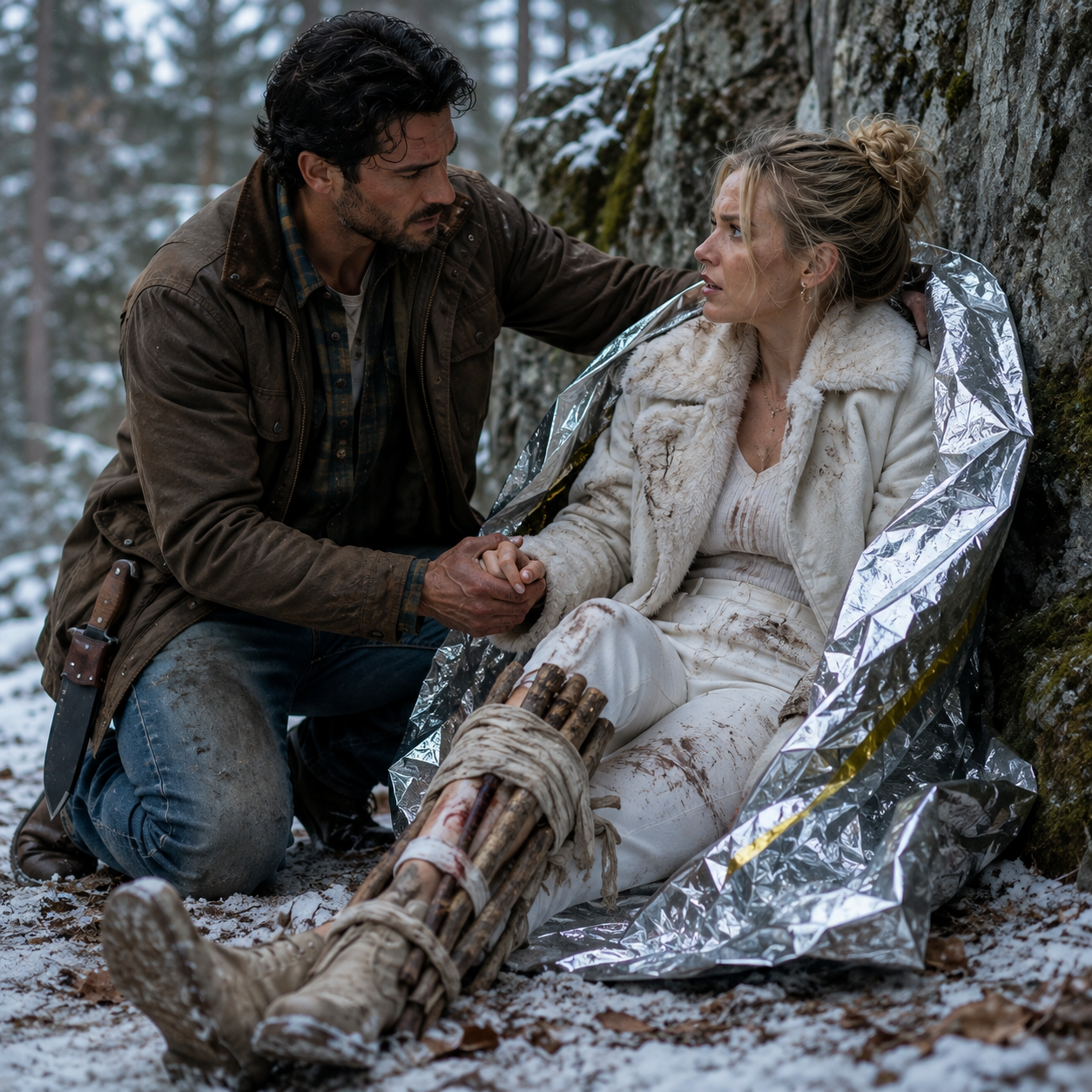
He improvised a splint for her leg using two sections of deadfall and the cords from his pack’s compression straps.
He redressed her hand, a deep laceration, probably from the crash, badly in need of proper medical care, but stable for now. He got three full liters of water into her, slowly, over the course of the work, watching her color come back by degrees.
She didn’t complain, not once.
He’d carried injured people before, not many, but enough.
There was always a point where people either went quiet in a bad way, retreating somewhere inside themselves, or they went quiet in a different way, a purposeful way, conserving everything for the work of survival. Eleanor went quiet in the second way. She bore the pain of the splint without making a sound, though he could see what it cost her in the set of her jaw, and the way her knuckles went white against the tasty blanket.
When he explained that getting up the canyon wall was going to hurt, she had nodded and said, “Tell me what to do.”
and meant it. He did most of the physical work.
She worked with one good arm and one good leg, and whatever reserve she had left, and between them they got her up the east wall of the canyon in a way that was not graceful or clean, or anything like a movie, but worked. At the top, she sat on the ground and breathed for two full minutes while Caleb reconstituted the pack and thought about the route back to his cabin.
Not the command site, not the parking lot, the cabin. Because she was right.
If the explosion was deliberate, and everything in his gut said she was confused or hallucinating, that she was as sharp and certain as someone gets, then whoever had arranged it knew the search had been suspended. Knew that if a body surfaced now, it would surface through unofficial channels first. Which meant they might be watching those channels.
“My cabin is 7 miles from here.”
he said.
“It’s going to be slow.”
“Are you up for it?
Eleanor looked at him. Some of the color had come back to her face and in it he could see now what the photographs had captured not glamour, not executive polish, but something more fundamental. A quality of attention.
The way she looked at him was the way someone looks when they are actually completely focused on you, not performing focus, but inhabiting it.
What’s your plan after the cabin?
She asked. Get you stable. Get contact with people I trust not through the main radio channel.
Then figure out who we can tell.
You’re treating this like an op, she said.
I spent 11 years in wildfire, said. Different kind of operation. But yeah, same instinct.
Something in her face shifted. Not quite a smile, too much pain for that, but something.
You said nobody else was looking, she said.
That’s right.
You came out here by yourself because you thought the math didn’t add up.
Yes. She looked at him for a long moment. The wind moved the trees above them.
Somewhere to the north a raven called once and went quiet.
Why does a former wildfire fighter care about a billionaire he’s never met?
She asked.
There was no edge in it, genuine curiosity with a kind of directness that made Caleb think she’d spent her whole life cutting to the center of things.
He stood up and adjusted the pack straps. Because she was a person before she was a billionaire, he said.
Come on, let’s move.
He reached down and she took his hand and they began the long walk back through the mountain. They had gone perhaps a mile when Eleanor spoke again.
She was, Eleanor said. Caleb glanced at her.
They were moving side by side on flatter terrain. He had fashioned a crude crutch from a section of fallen aspen and she was using it well.
Her jaw set, her pace deliberate and slower than he wanted but functional.
“What you said.”
She clarified.
“She was a person before she was a billionaire.
She was.”
She paused.
“I’m not sure I’ve been a person in a very long time.”
Caleb didn’t say anything.
“I mean that honestly.”
She said.
“Not self-pity.
Just I can’t remember the last time I did something that wasn’t calculated.”
“Positioned.
When did I stop being someone and start being a brand?”
She shook her head slightly.
“I’ve had four days with nothing to think about except whether I was going to die and that’s the thing I kept coming back to.”
“How long since I was just a person?”
“What answer did you come up with?”
Caleb asked. She laughed a short painful sound, more air than voice.
“Somewhere around 2019.”
“Give or take.”
He watched the terrain ahead.
“What happened in 2019?”
She was quiet for a moment. When she spoke, her voice had changed. The executive directness still there but something softer underneath it.
Something she wasn’t used to letting out.
“My father died.”
She said.
“And within about eight months, I’d made three major acquisitions, restructured the executive board and appeared on the cover of Forbes.”
“I thought I was moving forward.”
She walked three more steps.
“I think I was disappearing.”
Caleb said nothing for a long moment.
“My wife died in 2020.”
He said. Eleanor stopped walking. He walked two more steps before he noticed and stopped too, turning to look at her.
She was looking at him with that same quality of complete attention, and in her face was something he hadn’t expected, not pity, not sympathy in the platitude sense, but recognition.
The specific quiet recognition of someone who has been in that particular country.
“I’m sorry,” she said.
“Yeah,” he said, “just that.”
They started walking again, and for a long time neither of them said another word, and somehow the silence between them was different than it had been an hour before, less empty, more like something shared. The specific wordless language of people who have both learned what it costs to keep going when the ground drops out from underneath you.
The mountain held them both in the late afternoon light, and they kept moving through it together, and the cabin was still 6 mi away, and neither of them knew yet what was waiting there. But Caleb Foster, for the first time in a long time, did not feel alone in the wild.
And Eleanor Grant, for the first time in years, felt like a person. The cabin was dark when they reached it.
That was the first thing wrong. Caleb had left the porch light on.
He always left the porch light on when he was going into the field, not for himself, but because Maya knew what it meant. Porch light on meant Dad was coming back.
It was a thing they’d worked out after her mother died, a small contract between them that cost nothing and meant everything.
The light was off. He stopped 30 yd out in the tree line and put his hand out to stop Eleanor without touching her.
She felt the shift in him and stopped immediately, no questions asked, which told him something about her, that she read people, that she had learned to read the particular body language of someone whose threat assessment just changed.
“What?”
she whispered.
“Lights off.”
he said quietly.
“Maybe the bulb?
I changed it 3 weeks ago, LED.”
Rated for 12 years. Silence. She looked at the cabin, then back at him.
“Could be the breaker.”
“Could be.”
he said.
He didn’t move.
“Could be a lot of things.”
He stood there for two full minutes. Eleanor said nothing.
She understood without him explaining that this was not the moment for questions. She stood beside him on one good leg and the Aspen crutch, and she watched the cabin the same way he did. And Caleb thought that whatever else Eleanor Grant was, she was not someone who fell apart under pressure.
He studied the structure, the windows, the driveway.
His truck was still where he’d left it.
But, there were two additional sets of tracks in the mud. He could see them from this angle.
The ground soft enough after the rain to hold the impression. Two vehicles at least, maybe more. Hard to tell from here.
He pulled Eleanor back deeper into the tree line.
“We’re not going in.”
he said.
“Who knows you’re here?”
“The search coordinator knows the general area.”
“That’s it.
Who else?”
He thought about it.
Nobody who’d be a problem.
“Then who left those tracks?”
He didn’t answer because he didn’t have one.
And because the honest answer is someone who shouldn’t be here was not a comfort.
“We need to move.”
he said.
“Now, can you keep going?”
She looked at him steadily. Her face was gray with exhaustion and pain.
She’d been moving on a broken leg for 3 hours.
He could see the toll of it in the tightness around her eyes, the way her jaw was set at an angle that suggested she was managing pain by will alone.
“Where?”
she said.
“Fire tower, about 2 miles north.
Old one decommissioned in 2011.
It’s not on any current operational map.”
“2 miles?”
“Yeah.”
She gripped the crutch.
“Then let’s go.”
They moved north, back into the trees, and Caleb kept his hand on his radio, but did not key it. Not yet. Not until he knew who was listening.
They had gone perhaps 400 yards when they heard the cabin door open.
He pulled Eleanor down behind a fallen log, not gently, because gentle wasn’t the priority, and she went without protest, swallowing whatever sound the impact cost her, and they lay flat in the pine duff and listened.
Two voices, male, too far to make out words, but the cadence was wrong, clipped, professional, the back and forth of people reporting in rather than talking. One of them said something that ended in a question. The other answered in two words, then silence, then a flashlight beam swept the tree line 30 yards to their left.
Caleb did not breathe. Eleanor did not breathe.
The beam moved right. Then left again. Then it went back toward the cabin, and the door closed.
They waited five full minutes without moving.
Then Caleb’s hand found Eleanor’s arm in the dark, and he pressed twice move, and she moved.
They went north. The fire tower was 2 miles, and they covered it in 57 minutes, which was fast enough to matter, and slow enough not to kill her.
And Caleb counted every one of those minutes the way he used to count minutes on the fire line when the wind was changing, and you had to know exactly how much time you had before everything shifted. The tower came out of the darkness above them, a steel structure, four legs, the cab at the top dark and locked. Caleb knew where the spare key was.
He’d been the one to hide it years ago during his firefighting days when crews sometimes used the decommissioned towers for emergency shelter.
He got Eleanor to the base and helped her to sit against one of the steel legs while he climbed 15 ft up the ladder to retrieve the key from behind a junction box bolted to the first landing. When he came back down, she was looking at her hand.
The bandage he’d applied in the canyon had soaked through.
Not badly, the bleeding had slowed, but in the flashlight he’d allowed himself briefly, carefully, her palm looked bad.
Deep, the kind of wound that needed actual attention.
“I need to look at that,” he said later.
“Eleanor.”
“Later,” she said, and the tone was the particular tone of someone accustomed to making decisions that end conversations.
“Get us inside first.”
He got the door open, got her up the stairs one careful step at a time, and they settled into the cab, a single enclosed room at the top of the tower. Glass on all four sides.
Empty except for a metal folding chair and the ghost of a wood stove that had been removed. From up here, he could see the cabin. He could see the lights, two flashlight beams now, moving separately.
One inside, one outside working the perimeter, systematic. Trained.
“They’re searching the cabin,” he said.
Eleanor came to stand beside him, putting her weight on the good leg, one hand on the glass. She watched the lights for a long moment.
“They’re looking for evidence I was there,” she said.
Not a question.
“Yeah.
How long before they expand the search?”
“Depends on how “How they are,” he said.
“If they’re good hour, maybe less.”
She turned away from the window. In the dark of the cab, he could barely see her face, but he could hear the shift in her breathing, not panic, but calculation. The particular sound of a very smart person running through options fast.
“Tell me about the conspiracy,” he said.
“Tell me everything.”
“Because right now, I need to understand what we’re actually dealing with.”
She didn’t hesitate.
It was like she’d been waiting for someone to ask.
“Three men,” she said.
“Sifo, Coo, and the chairman of our private equity advisory board.”
“Warren Holt, David Raines, and Philip Carver.”
“They’ve been skimming from subsidiary accounts for 4 years, complex enough that it took me 18 months to trace it.
And I have a forensic accounting team that costs $2 million a year to run.”
“How much money?”
“Conservative estimate, 400 million.”
Caleb let that number sit in the air for a moment.
“And they knew you’d found it.”
“I made one mistake,” she said.
And in her voice was the flat, cold tone of someone who had spent 4 days replaying a specific error.
“I told my general counsel I was close to filing charges.”
“24 hours later, Philip Carver asked to meet me in Denver.”
“He offered me the helicopter as a gesture of goodwill.
Philip owns a private aviation company, and he’d lent me aircraft before.”
“I should have known.”
“I shouldn’t,” Caleb said.
She looked at him.
“Don’t do that,” he said, “not now.”
“You can do it later when it’s safe to.
Right now, I need you thinking forward, not backward.”
She stared at him for a moment. Then something shifted in her expression, something almost like relief. Right, she said.
Forward the evidence you have. Where is it? Server-side encrypted.
My forensic accountant has a copy. Her name is Rosalie Chen.
She’s in Denver.
She’s the only person outside my legal team who has access.
Is she safe?
She doesn’t know about the helicopter.
She knows about the investigation, but I didn’t tell her I was filing.
I was being careful. A pause.
I was being careful about the wrong things. Rosalie Chen, he said. He committed it.
Denver. If we can get to her. First we need to get off this mountain without those men finding us, he said.
Do you know how many there are? No.
Do you know who hired them? Philip Carver has relationships with three private security firms. None of them are the kind that show up in a Google search.
She paused. These are not rent-a-cops, Caleb.
These are men who are very good at making problems disappear. He looked back out the window. The lights at the cabin were still moving.
Okay, he said. Okay, she repeated. And in the way she said it, he heard both a question and a kind of trust that had no business existing between two people who had known each other for less than six hours.
He turned from the window and started thinking.
There was a way off this mountain that didn’t involve roads, and he knew it because he’d walked it in 2014 when a fire cut the main access route and the crew had needed to extract a injured jumper by foot.
It was steep and slow, and it would take everything Eleanor had left, but it came out 12 miles east near a small town called Grover where there was a diner that opened at 5:00 a.m.M a payphone, an actual payphone, because the diner owner was 82 years old and kept it for sentimental reasons. That was about as off-grid as communication got. 12 miles on a broken leg through the night with armed men somewhere below them.
He looked at Eleanor Grant. She was watching him with that direct, complete attention. The emergency blanket was still around her shoulders.
Her hair, which had been dark and smooth in every photograph he’d ever seen of her, was matted and wild.
Her face was pale and carved down to the thing essential, all the professional surface stripped away, leaving something plainer and, he thought, considerably stronger.
“I have a route,” he said.
“How hard?”
“12 miles, most of it in the dark.”
She closed her eyes for 3 seconds. Then opened them.
“What’s at the end of it?”
“A payphone.”
“A diner and a way to reach people we can trust.”
“A payphone,” she said flatly.
“Analog,” he said.
“Can’t be monitored the way digital can.”
“Not quickly, anyway.”
She almost smiled.
“A billionaire’s life saved by a payphone.”
“Story for your grandkids,” he said.
“Let’s move,” she said.
He helped her to her feet and they went back down the tower stairs into the dark. And behind them, at the cabin, a light came on bright sudden, flooding the front of the structure. Not a flashlight, a work light.
The kind you bring when you’re planning to be thorough.
They were accelerating the search. Caleb and Eleanor moved north and east into the trees, and the mountain swallowed them. He set the pace by her, not his pace, hers.
Every 10 minutes he checked her face and her breathing and the way she was moving the crutch. She was tough in a way that surprised him.
Not because he’d expected softness, but because toughness in the abstract is different from toughness at hour four on a broken leg in the dark, on a mountain, with men hunting you.
The abstract kind is easy. This kind costs something real.
She did not ask him to slow down. She did not complain.
What she did, as they moved, was talk quietly, carefully, in the specific way of someone maintaining verbal contact because they understand it keeps both people sharp.
“Tell me about the firefighting,” she said.
“Long story.”
“We have 12 miles,” he told her.
Not all of it. Not the parts that still lived in the raw part of his chest, but enough.
How he’d started at 22, straight out of a community college forestry program.
How wildfire fighting was not what people imagined it to be, not dramatic charges against walls of flame, but methodical, grinding, technical work.
Reading terrain, reading fuel, reading the way wind moved through country in ways that the people who built the models couldn’t always predict.
“You read things,” she said.
“What do you mean?”
“The tracks.
The branch, the terrain, the way you found me.
You read things other people walk past.”
“That’s the job.”
“No,” she said.
“I’ve been around a lot of people whose job requires reading things.
Analysts, investigators.
They read what’s there.
You read what’s supposed to be there, but isn’t.”
“That’s different.”
He was quiet for a moment.
“My wife used to say I was better at listening to mountains than to people,” he said.
Eleanor was quiet, letting the sentence live.
“Was she right?”
she asked finally. He thought about it honestly.
“Yeah,” he said, “pretty much.”
“What was her name?
Sarah. What was she like?
The question was so direct and so simple that it caught him off guard, not unpleasantly, but the way a door opening in an unexpected place does. Loud, he said, in the best way. She had opinions about everything and she was wrong about maybe 30% of them and she would argue the other 70% so hard that even when you were right, you started to doubt yourself.
He paused. She laughed a lot.
Maya has her laugh.
Maya’s your daughter.
9 years old.
She’s why you came back out this morning, Eleanor said.
Not a question. He glanced at her sideways.
What do you mean?
You didn’t come back out because of me, she said.
It was matter-of-fact, not unkind.
You don’t know me.
You came back because you’re the kind of man who needs to be able to look at his daughter and know he didn’t quit when something mattered.
She navigated a section of uneven ground carefully.
I’m the thing that mattered today.
Tomorrow it might be something else.
But Maya is why you couldn’t walk away.
Didn’t say anything for a long time.
Yeah, he said finally.
I guess that’s about right.
They kept moving through the dark. Around the 90-minute mark, Eleanor started to flag.
He knew it before she said anything. The pace changed.
The rhythm of the crutch became slightly less controlled and her breathing went from the managed, deliberate cadence she’d been maintaining to something shorter and higher.
Stop, he said.
I’m fine.
We’re stopping, he said.
Not negotiable. 10 minutes.
She stopped because her body demanded it, even if her will hadn’t yet agreed.
He helped her sit against a tree trunk and she let him and he got the last liter of water out of his pack and made her drink while he watched the terrain behind them. Nothing.
No lights, no sound that shouldn’t be there.
Talk to me about Warren Holt, he said, keeping her sharp. Keeping her present. She drank, handed the bottle back.
CFO, 12 years with the company.
He was my father’s hire originally, one of the reasons I kept him when I took over.
He knew where every dollar came from and went to, and for 6 years that knowledge was an asset. She rested her head back against the bark.
Then it became a liability for both of us.
He’s the one who built the structure?
The skimming architecture? Yes.
Philip brought the contacts and the offshore accounts.
David made sure the operational numbers were clean enough that a surface audit wouldn’t catch it.
But Warren built the mechanism. She paused.
He’s very good.
It took my team 18 months to unravel it, and they knew what they were looking for. How did you know to look?
Gut, she said simply.
I couldn’t find a specific number that was wrong.
But that pattern of certain subsidiary revenues was too consistent. Real business has noise, variability, friction, the normal irregularity of markets.
These numbers were too smooth. She looked at him.
Like a trail with no animal tracks.
You know something’s wrong because nothing is too perfect.
He looked at her. Yeah, he said, exactly like that.
A pause.
We’re the same kind of reader, she said.
He stood up. 10 minutes is up.
You ready? She looked up at him from the ground with those dark eyes.
Behind her, the first barely there suggestion of lighter sky was beginning to differentiate itself from the tree line. Not dawn, the suggestion of pre-dawn. The difference between the darkest part of the night and the part where night begins to negotiate with morning.
“I’ve been ready for 4 days.”
she said. He reached down.
She took his hand and they kept going. The next crisis came 40 minutes later and it came fast. They were crossing a ridgeline exposed for about 200 yards moving low and steady when Caleb heard the sound.
Rotors, distant, but coming from the south. He stopped, grabbed Eleanor and pulled her flat without ceremony.
The helicopter swept over them high and wide. Not military, not state police. Private, black fuselage, no visible markings in the dark, but he caught the navigation light pattern.
Not a rescue configuration, a search configuration.
“They have a helicopter.”
he said. Eleanor said nothing, which was the correct response because there was nothing useful to say.
The aircraft banked north, swept a wide arc and came back south. It was running a grid, a systematic search grid east to west with a thermal imaging camera. He could see the gimbal housing mounted beneath the forward section.
“Thermal imaging, we need cover.”
he said.
“Dense cover right now.”
He was already moving, guiding her toward the heaviest tree canopy on the north slope of the ridge. Pine, dense, old growth, branches interlocking overhead in a way that would break up their heat signature on a thermal scan.
Not perfect, but thermal imaging through a dense conifer canopy at altitude moving at night, the false positive rate was high enough that a smart operator would flag it, but not act without confirmation.
They got under the trees 6 seconds before the helicopter’s second pass.
He could feel the rotor wash, that close. Eleanor pressed against the tree beside him, her breathing controlled, and in the dark he could just see the line of her jaw, the way she was holding herself together through pure, determined will.
He thought again about what she’d said, “I’ve been ready for 4 days.”
and understood that it was literally true. 4 days alone in a canyon had stripped something from her, but what it had stripped was not strength. It had stripped the performance of strength and left the actual version underneath.
The helicopter passed, then returned, then moved east.
They waited 4 minutes, then Caleb said quietly, “We have to split up.”
Eleanor’s head turned toward him.
“What?”
“The thermal imaging.”
“No.”
she said, “Flat absolute.”
“Listen.”
“I am listening.”
“The answer is no.”
Her voice was low and hard and left no room.
“You are not leaving me alone on this mountain, Eleanor.”
“If we’re together, we’re twice as clear a target on the scan.”
“If we separate by 50 yards, move parallel.
If we separate, one of us gets found and the other has no idea.”
She paused.
“I am not going back into a canyon alone, not again.”
He looked at her. The helicopter sound had faded east. The thermal threat was real, but not immediate.
The argument for separation was tactically sound.
The argument against it was something that wasn’t in any tactical manual he’d ever read, the simple, undeniable truth that she had been alone for 4 days, and that something in her that wasn’t fear exactly, but was something the family of fear had made a very clear decision about staying close to another human being.
He had lost people by separating in terrain like this. He had also saved people by separating in terrain like this.
Stay within voice distance, he said, 30 yards. If you hear me stop, you stop.
If you hear me move, you move. She met his eyes. 30 yards and stay under heavy canopy every time you hear rotors.
Understood. Okay, he said.
Then we stay together. Move. They moved.
The next 90 minutes were the hardest. Not because of the terrain, though the terrain was rough enough.
The hardest part was the silence he maintained. No talking, minimal sound, moving by feel and memory in the growing gray of pre-dawn that was just enough light to navigate by.
Eleanor matched him step for step, 30 yards, exactly as he’d said.
He checked over his shoulder every few minutes. She was always there, a dark shape in the pre-dawn gray, the crutch swinging in a rhythm that had become, over the course of the night, as familiar to him as his own footsteps.
At the two-hour mark, the helicopter stopped coming back. Either it had run its grid and found nothing or it had refueled or the thermal imaging had produced too much canopy interference to be useful. Whatever the reason, the night went quiet in a way that felt different, the particular quiet of a threat that has moved off, not a threat that has disappeared.
It’s gone, Eleanor said when he stopped and they both listened for three full minutes.
For now, he said. How much further?
Three miles, maybe. She exhaled. Three miles, downhill from here.
She looked at him.
You’re being kind about the terrain.
Little bit, he admitted. Something crossed her face, not quite a smile, but adjacent to one.
The first he’d seen that had any warmth in it.
My forensic accountant, she said, resuming movement. Rosalie, when we get to the payphone, I need to call her first.
She has a protocol.
If she doesn’t hear from me within a window she’s set, she’s instructed to deliver the evidence package to the FBI field office in Denver.
She paused.
I don’t know if that window has closed.
When did the window open? It was keyed to the helicopter departure.
If I hadn’t landed within 6 hours, she stopped.
The window has been open for 4 days. Caleb considered this.
So, either Rosalie has already delivered the package, or she hasn’t because she’s been waiting for confirmation from me.
She’s loyal.
She might have held the window open. A pause. Which means the package might still be with her.
Which means she could be in danger. We need to move faster, Caleb said. Yes, Elanor said.
He pushed the pace, she matched it. 1 mile, then 2.
The sky above the trees was moving from gray to the particular pale blue of high altitude predawn. Not sunrise yet, but close. At the final ridgeline before the descent to Grover, Caleb stopped.
Below them, the terrain fell away to the small valley where the town sat, barely a town, really. More a collection of necessary structures arranged around a crossroads.
He could see the diner’s sign.
Not lit yet, but the parking lot light was on. And then he saw something else. Two vehicles parked at the crossroads.
Dark, no lights, no movement that he could see, but they were there.
They anticipated the exit point,” he said.
His voice was very quiet. Eleanor came up beside him and looked.
She saw it immediately. He could tell by the way her posture changed, the slight set of stillness that precedes a decision.
“How many ways out of this valley?”
she asked.
“By road, one main.
Two service tracks, the kind you’d miss if you didn’t know they were there.
And if you know they’re there.”
He looked at her.
“I know they’re there,” he said.
“Then we use those,” she said.
“They’re rough.
They come out 5 miles east near a reservoir.
There’s no payphone there, no diner.
But there might be people,” she said.
“Early fishermen, campers, someone with a phone.”
He thought about it. The reservoir was a state recreation area. Even this early, even on a weekday, a 50-50 shot at someone being there.
“It’s a gamble,” he said.
“Everything tonight has been a gamble,” she said.
“That’s not a reason.”
He looked at the two vehicles at the crossroads. Then at the sky. The light was changing fast now, 20 minutes maybe before full sunrise.
20 minutes before the mountain was light enough to see everything.
“Let’s move,” he said.
They went east, back into the trees, and the last long mile unfolded beneath them as the sky above the peaks began to bloom from pale blue into the first threads of orange. And Caleb Foster thought about Maya at home with her grandfather.
Probably awake by now, probably looking out the window. And the thought moved through him like a physical thing, not fear, but purpose.
The specific driving purpose of a man who has something worth returning to. He moved faster. Eleanor moved with him.
And at the edge of the reservoir, as the first true light of morning broke across the water, they saw a truck parked alone at the launch ramp, an old man in a fishing vest standing beside it, thermos in hand, watching the water. Caleb and Eleanor came out of the trees. The old man turned.
He looked at them, at Caleb’s mud-covered jacket, at Eleanor’s improvised crutch and the emergency blanket still around her shoulders.
At two faces that carried the specific look of people who have been through something the daylight world has no frame for.
He didn’t say anything.
He just reached into his truck, pulled out a cell phone, and held it out.
“You need to call someone,” he said, not a question.
Caleb looked at Eleanor. Eleanor looked at the phone.
“Yes,” she said, her voice cracked on the word.
“Yes, we do.”
She took the phone and she dialed.
The old man’s name was Gerald.
I didn’t ask questions.
He just stood beside his truck at the reservoir launch ramp with his thermos in one hand, his fishing rod leaning against the tailgate, and he watched Eleanor dial with the practiced stillness of a man who had lived long enough to not know that some mornings arrive with things in them you weren’t expecting, and the decent response is to simply make room.
Eleanor’s fingers moved across the screen.
Her hand was shaking, not dramatically, just a fine, persistent tremor that she couldn’t entirely control, the accumulated cost of four days and one very long night settling into her joints all at once.
She dialed Rosalie Chen’s number from memory.
She had always kept important numbers in her head, a habit from before smartphones that she’d never let go of because she understood, in some part of herself, that there would come a day when a phone wasn’t an option.
It rang twice. Hello?
Rosalie’s voice was cautious.
She didn’t recognize the number.
Rosalie, it’s me.
The silence on the other end lasted exactly 3 seconds, and in those 3 seconds, Caleb could hear, even from where he stood, the particular quality of someone trying to decide if they were dreaming. Eleanor. Not a question, a statement of fact that Rosalie seemed to be testing with her own voice to see if it would hold.
Eleanor, you’re Where are you?
The news said I know what the news said. I need you to listen to me very carefully.
Have you delivered the package? Another pause, shorter.
No, I kept the window open.
I’ve been Rosalie’s voice broke slightly.
I’ve been waiting.
I didn’t want to believe.
Good. Do not deliver it yet.
Do not move it. Do not access it from any device that has been online in the past 72 hours.
Eleanor’s voice had shifted.
The exhaustion and pain were still there underneath, but on top of them, something else had taken over. The operational voice.
The woman who ran a billion-dollar company and knew what command sounded like. Are you at home?
I’m at the office.
Leave now. Take nothing from your desk.
Walk out like you’re going to lunch.
Eleanor, what’s happening?
The helicopter wasn’t an accident.
A pause, and in that pause, Caleb heard Eleanor make the decision to say the rest of it plainly and quickly. Philip Carver arranged it. Holton Reigns were involved.
They know I have the evidence, and they know I’m alive, and they will come for the package if they think it can still reach the FBI.
The silence from Rosalie this time had a different quality. Heavier.
The silence of someone whose world has just been rearranged into a shape they weren’t prepared for.
Oh God, Rosalie said quietly. Rosalie, focus.
Can you do what I’m asking?
Yes, her voice steadied. Yes, I can do that.
Walk out of the building, get in a cab, not your car, a cab, and go to the address I’m going to give you.
Write nothing down. Eleanor looked at Caleb.
He her a single nod.
It’s the home of a man named Caleb Foster.
His daughter and her grandfather are there.
You’ll tell them Eleanor sent you and that you need to wait.
Can you remember an address? Yes.
Eleanor looked at Caleb again. He gave her the address. She repeated it into the phone once, clearly.
Go now. Leave your personal phone on your desk. My phone.
Leave it. Buy a prepaid at the drugstore on your way.
Call me back at this number. A beat.
Then Rosalie said very quietly, you’re really alive.
I’m really alive, Eleanor said, and I intend to stay that way.
Go. She ended the call. Her hand dropped to her side and she stood there for a moment with her eyes closed and Caleb watched the rise and fall of her breathing the single controlled exhale of someone who has held themselves together at great cost and is allowing themselves exactly 2 seconds to feel the weight of it before moving on.
Gerald, who had heard all of this without comment, reached into his truck cooler and produced a bottle of water and a wax paper wrapped sandwich. He held them both out without ceremony. Ham and Swiss, he said.
Made it this morning. Eleanor opened her eyes and looked at him. Thank you, she said, and the way she said it, stripped of every professional reflex, just two plain words carrying their full weight, made Caleb look away for a second.
Because it was a level of naked gratitude that felt private to witness.
“Don’t mention it,” Gerald said.
He glanced at Caleb.
“You need the hospital.”
“She needs the hospital,” Caleb said.
“And we need to get her there without anyone knowing where we’re going until she’s inside.”
Gerald looked at Eleanor’s leg, at the improvised splint, at the hand wrapped in Caleb’s shirt material.
He looked at both of them with the particular assessment of an old man who has seen enough of the world to do fast, accurate math.
“My nephew works at Mercy General in Glendale,” he said.
“He’s a charge nurse.
He’s a good man who knows how to be quiet when quiet is the right thing to be.”
Caleb looked at Eleanor.
“Glendale,” she said.
“It’s an hour,” Gerald said.
“My truck’s got a full tank.”
Caleb thought about the vehicles at the crossroads, about the helicopter, about the fact that every road out of this area was potentially watched. He thought about a 70-something fisherman in an unremarkable pickup truck and how invisible that was, and how invisibility was the only tactical asset they had left.
“We need to go now,” Caleb said, “before the sun’s fully up.”
Gerald was already moving to the driver’s door.
“I know the back roads,” he said.
“Been fishing this country for 40 years.
Get in.”
They got in.
Gerald drove the way he did everything, without hurry and without waste, navigating the gravel service roads that ran along the reservoir’s eastern edge with the ease of someone who had never needed a GPS to know where he was.
He didn’t talk.
He turned the heat on without being asked, and the warmth hit Eleanor like a physical thing. She leaned her head back against the seat and closed her eyes, and Caleb watched her face relax by degrees as the truck moved east, away from the mountain, away from the lights that had been searching through the dark. She was asleep inside 4 minutes.
He let her sleep. Gerald drove.
After 20 minutes, the old man said quietly, without taking his eyes off the road, “That woman’s been through something bad.”
“Yes,” Caleb said.
“You find her up there?”
“Yes.”
A long pause. The road curved south, and the mountains began to flatten out into the high plains of eastern Colorado.
“My son did a search and rescue course back in ’09.
He said the hardest thing about the job was knowing when the people giving the orders were wrong and not being able to say so.”
Caleb looked at him.
“He’d have liked you,” Gerald said simply.
He didn’t say anything else about it.
Caleb looked out the window and watched Colorado unspool from mountain to plain in the early morning light, and he thought about Maya and whether Rosalie had gotten out of the office yet. And whether the men at the crossroads had stayed put or moved, and whether the helicopter was still running grids somewhere above the tree line. Then he thought about Sarah.
He thought about what she would have made of this specific morning because she would have made something of it. Sarah always made something of everything.
She had that quality of treating ordinary extraordinary moments as narratable, as worth describing. She would have sat in this truck, and she would have watched the mountains going by, and she she would have said something that was simultaneously a joke and completely serious.
Something that would have made him laugh and think at the same time. He missed that.
He missed it the way you miss a specific frequency of sound after you’ve lost your hearing in one ear, not abstractly, but with a precise located awareness of the exact thing that’s gone.
He was still thinking about this when Eleanor’s phone buzzed against his leg.
He looked at it.
Gerald’s number forwarded.
Rosalie calling back. He answered quietly.
“It’s Caleb.
She’s sleeping.
Talk to me.”
A beat.
“Okay.
I’m in a cab.
I left my phone.
I have the package on an encrypted drive.”
She stopped.
“Who are you exactly?”
“I’m the man who found her.”
Another beat.
“The news said the search was called off.”
“The news was right.
I kept going.”
He could hear her processing this.
Then, with the directness of someone whose mind worked in the same way Eleanor’s did, fast and straight, “Are you law enforcement?”
“No, military.
Former wildland firefighter.
And Eleanor trusts you.”
“She said so.
That’s enough.”
Rosalie said, and Caleb heard in that three-word sentence the echo of the same quality he’d heard in Eleanor.
At the canyon, the decision to trust made fast and made completely, because the situation left no room for the slower version.
“I’m going to the address.
But there’s something you need to know.”
“Tell me.
I got a call this morning before Eleanor called.”
“3 hours ago.”
A pause. And in the pause, the particular tension of someone about to say something that changes the shape of the problem.
“From David Wind Still, Eleanor’s CEO.”
“Yes.
He called my personal cell, which I’ve never given him, which means someone got it for him.
He said he was concerned about the investigation and wanted to talk before I made any decisions I’d regret.
Those were his exact words. He was warning you off or threatening me, depending on how you read it. Her voice was steady but tight.
Which means they know about me. They know I have the package.
Caleb, if I’d waited another few hours.
You didn’t, he said.
You’re out.
You’re moving.
The package is secure? On my person, encrypted. They need my biometrics and a 16-character passphrase to open it.
A pause.
I’ve been carrying it inside my bra for 4 days because I was afraid to leave it anywhere.
He almost smiled. Okay, get to the address.
Don’t stop anywhere except the drugstore.
And if you feel like you’re being followed, I’m a forensic accountant, not a field operative, she said.
I know.
If you feel like you’re being followed, don’t go to the address.
Go to any fire station and walk inside and don’t leave.
He thought for a second. Fire stations are public buildings.
They can’t follow you in without making it obvious.
A brief pause.
That’s actually very smart.
Drive safe, he said. He ended the call. Gerald was watching the road.
Trouble?
The people looking for her know about someone else who’s carrying evidence, Caleb said.
She’s on her way to my house.
Gerald nodded slowly. You got family at your house?
My daughter and her grandfather. Gerald said nothing for a moment.
Then he reached into the center console and produced a cell phone, old, one of the basic models, and held it out.
My nephew’s number is in there, under Jim.
Call him now.
Tell him you’re coming.
He’ll make sure she gets in the side entrance.
No intake desk. No paperwork trail. Caleb took the phone.
He called Jim. Jim answered on the second ring with the immediate alertness of a charge nurse who was accustomed to calls that required that kind of attention.
And Caleb explained the situation in the same way he’d learned to communicate on a fire line, fast, clear, no extra words.
Jim listened without interrupting.
When Caleb finished, Jim said, “How bad is the leg?”
“Broken.
Left tib-fib, I think. And a hand laceration 4 days old.
She’s dehydrated but coherent and walking.”
“Walking on a broken leg for how long?”
“8-9 hours.”
A short silence.
“She’s tougher than most,” Jim said.
“Yeah,” Caleb said, “she is.
I’ll be at the side entrance.”
“Blue scrubs, gray beard.
Don’t come to the front.”
A pause.
“You said nobody can know she’s there.”
“Nobody,” Caleb said.
“That includes my supervisors?”
“Especially your supervisors.”
“At least for the first hour.”
Another pause. Caleb could hear Jim weighing something professional obligation against whatever his uncle had told him over years of fishing trips and family dinners about the kind of man Caleb Foster was.
“1 hour,” Jim said.
“After that I need to notify someone.”
“A patient this critical, 1 hour.
I’ll have the right people there by then.”
“Then move fast,” Jim said, and the line went quiet.
Gerald made the turn onto the highway without being asked, and the truck accelerated, and Eleanor slept, and Caleb sat with the weight of the next hour arranged in front of him like a map with too many possible routes and not enough confirmed roads. He needed law enforcement he could trust. Not local.
The scope of the conspiracy was wide enough that local contacts could be compromised, and he had no way to assess which ones. Federal made more sense, but the FBI field office in Denver was the destination Rosalie had been originally instructed to use.
And if Carver’s network was sophisticated enough to put people on the mountain with thermal imaging in the middle of the night, it was sophisticated enough to have a line into a field office.
He needed someone with jurisdiction and without exposure. He sat with that for 5 minutes.
Then he thought of a name. Her name was Agent Patricia Means, and he had never met her, but Sarah had Sarah, who had done volunteer work with a victims advocacy organization, had once attended a federal training event where Means had presented on financial crime investigation.
Sarah had come home talking about this woman.
“Sharp,” she’d said.
“Doesn’t care about politics.
Cares about the case.”
He’d never expected to use that memory for anything.
He’d just kept it the way he kept all of the things Sarah had told him, filed somewhere important because she had told it to him, and that made it important.
He reached back into Gerald’s phone and looked up the Denver FBI field office main number.
He called. He asked for Agent Patricia Means.
He was told she was not available.
He said, “My name is Caleb Foster.
I have Eleanor Grant alive in a vehicle currently approaching Glendale. I have evidence of the conspiracy that caused her helicopter to go down, and I have approximately 1 hour before the men who tried to kill her figure out where she is.
If Agent Means is not available, I need whoever handles financial crimes too. Hold, please, the operator said. He held for 40 seconds.
Then a voice came on, female, crisp, with the particular economy of someone who had been interrupted doing something important and was going to give him exactly as much attention as the first 30 seconds justified, not 1 second more. This is Means, agent Means.
My name is Caleb Foster. I know this call sounds like is she alive? Caleb blinked.
Yes, where is she? On route to Mercy General in Glendale. Side entrance, 1 hour.
Not long. How did you find her? I followed the wind direction and the drainage patterns and the the search team missed her because they built the grid around the flight path instead of the terrain.
A longer pause. Then, with a shift in register that told him she had moved from skeptical to something else entirely.
Who knows she’s at Mercy General?
Currently, you, me, a charge nurse named Jim, and my driver. Keep it that way. The sound of movement, a door, fast footsteps.
She was already moving. Foster.
Yeah. You did something that matters this morning.
She did something that matters, he said. She survived.
He heard what might have been a brief, genuine sound of agreement. Then 1 hour.
Don’t use that phone again after you hang up.
He hung up. Gerald glanced at him sideways.
Feds? FBI, Caleb said.
Good, Gerald said and drove. Eleanor woke up 20 minutes outside Glendale.
She woke the way some people do after the kind of sleep that isn’t restful but necessary, abruptly, fully, with her eyes open and her mind running before her body caught up.
She looked at the window, at the planes, at the light, and then she looked at Caleb, and he could see her remembering where she was and how she’d gotten there in the span of about 4 seconds.
“Rosalie,” she said, “moving packages secure.
She got a call from Rains this morning.”
Eleanor’s jaw tightened.
He knows. He knew before this morning. He had her personal cell number.
She processed this.
He watched her face move through calculation, through something that might have been a flash of fear eight, and then wasn’t, through the other side of it.
“If he called her, he’s scared.
He wouldn’t risk that contact if he was confident.”
“Scared people are more dangerous,” Caleb said.
“Yes,” she said.
“But they also make mistakes.”
She looked at his hands.
“You made calls.
Rosalie, my daughter’s grandfather.”
“Jim at the hospital and FBI FBI.”
She said it carefully, like testing the weight of it.
“Who?
Agent Patricia means financial crimes.”
Eleanor was quiet for a moment.
“I don’t know that name, Sarah.
Did,” he said.
She heard her speak once.
“Said she was sharp and didn’t care about politics.”
A pause. Eleanor looked at him, and in that look was something layered.
The simple fact of what he’d just said and what it meant about where the name had come from and what it cost him even now to use it.
“Your wife,” Eleanor said quietly.
“Her recommendation,” he said.
“Still good, apparently.”
Eleanor nodded. She did not push past it.
She understood, he thought, that some things were said and then needed to be left at their own distance. The truck reached the outskirts of Glendale.
Gerald navigated to the hospital by memory without GPS, finding the side street that ran behind Mercy General with the ease of a man who had driven his nephew to work more times than he could count. He pulled up to a steel door in the rear of the building and stopped.
Jim was there, gray beard, blue scrubs, exactly as advertised, and the specific expression of a medical professional who has been briefed on a situation outside his normal scope and has decided as a matter of character to handle it.
Eleanor got out of the truck and Jim’s eyes moved to her leg, her hand, her face that practiced clinical inventory, and he said without preamble, “We’re going straight to imaging.
There’s a room reserved.
Nobody on that floor knows who you are.”
“Thank you,” Eleanor said.
“Thank my uncle,” Jim said and glanced at Gerald, and something passed between them old and private and entirely genuine.
Gerald waved it off. Jim started to guide Eleanor toward the door.
She stopped and turned back. She looked at Gerald for a moment.
This old man who had been at a reservoir at dawn with a thermos and a sandwich and a cell phone, who had asked nothing and given everything, who had driven an hour on back roads without knowing the full story and not particularly needing to.
“Mr.Gerald,” she said, “I don’t know your last name.”
“Hobbs,” he said.
“Gerald Hobbs.
I’m going to remember that name,” she said.
For a long time, Gerald looked at her steadily.
“Just get better,” he said.
“That’s all I need.”
She went inside. Caleb turned to Gerald.
“I owe you.”
“You don’t owe me anything,” Gerald said.
He was already moving back to the driver’s door.
“That’s not how it works.”
He paused with one hand on the door handle and looked at Caleb with an expression that was uncomplicated and entirely serious. You went up that mountain when everyone else quit.
That’s a thing worth doing.
You don’t owe me anything for helping with a thing worth doing.
He got in his truck and drove away. Caleb stood at the side entrance of the hospital and watched him go.
Then he went inside. Jim had Eleanor in a room small quiet away from the main ward. An IV was already going into her left arm.
Jim had cut away the splint and was examining her leg with the focused economy of someone who didn’t waste motion.
And what he found he communicated with his face rather than words serious but fixable. The kind of thing that would heal.
Means is coming, Caleb said standing in the doorway. How long? Eleanor asked.
She said 1 hour.
It’s been 40 minutes.
Rain and the others when they find out the FBI is involved.
They’ll run or they’ll go to ground, Caleb said.
Means will know that.
She’ll move fast.
Eleanor nodded. She was looking at the IV drip at the clear fluid going into her arm. Caleb, yeah.
Your daughter, is she safe? He checked his watch.
Rosalie should be at his house by now. His father-in-law Doug who was quiet and capable and not someone who frightened easily should have answered the door.
He hadn’t called ahead because he hadn’t wanted to use the phone more than necessary.
But Doug knew Rosalie’s name from a passing mention months ago and Doug knew in the way Doug knew most things.
How to handle a situation that arrived unexpectedly. She should be, he said. I need to call and confirm.
Use the hospital line, Jim said without looking up from his examination. The room phone is a direct line.
It won’t show a number.
Caleb picked up the room phone and dialed home. Doug answered on the third ring with the particular voice he used when he was being careful, not alarmed, just alert.
The voice of a 70-year-old former engineer who still thought in systems.
Hello, it’s me.
A pause, then normally well.
We’ve been wondering, is everything okay there?
We have a visitor, Doug said. Young woman, she said Eleanor sent her.
She’s sitting in the kitchen with Maya.
They’re eating cereal.
Caleb exhaled slowly. Good, keep her there.
Don’t let anyone in you don’t recognize.
Anyone I do recognize? Trust your judgment.
My judgment says this morning is unusual, Doug said.
It is, Caleb said, but it’s almost over.
Maya wants to know if you’re okay, Doug said.
He thought about what to say.
He thought about Maya’s serious brown eyes and the way she had told him to be careful.
And meant it the way a 9-year-old means things completely without the protective irony that adults develop over time. Tell her I found the person, he said. Tell her she was in the recycling bin.
A brief pause on Doug’s end, then quietly, a small sound Doug putting his hand over the phone, relaying the message.
And from somewhere in the background, faint but unmistakable, Maya’s laugh.
Her mother’s laugh.
That specific pitch and rhythm that lived in Caleb’s chest like a permanent resident.
He held onto it for a second.
I’ll be home as soon as I can, he said, and hung up.
When he turned back to the room, Eleanor was watching him with that full direct attention.
Jim had moved away to get something from a cabinet, and in the brief privacy, she said quietly, She has your wife’s laugh, doesn’t she?”
It wasn’t a question.
“Yeah,” he said.
She held his gaze.
“She’s lucky,” she said, “to have a father who went up a mountain.”
He didn’t know what to say to that.
He was saved from needing to by the sound of the door at the end of the hall opening and fast, professional footsteps. Agent Patricia Means was 47 years old, and she looked exactly the way Sarah had described her.
Like a woman who moved through the world at a slightly higher wattage than the people around her. Not loud, not dramatic, but present in a way that reorganized the gravity of whatever room she entered.
She was with two other agents, both in field clothes, both moving with a particular efficiency of people who had been briefed on the way and were ready to work. She came through the door, saw Eleanor, and her face did something brief and human before the professional register reasserted itself.
“Miss Grant,” she said.
“Agent Means,” Eleanor said.
“I’m glad you’re alive.”
“So am I,” Eleanor said.
And then, without ceremony, “Philip Carver, Warren Holt, David Raines.
The evidence is on an encrypted drive currently in the possession of my forensic accountant, Rosalie Channing, who is at this address.”
She looked at Caleb. He said the address. Eleanor repeated it to Means.
“She has the full investigation package.
Four years of subsidiary account data, internal communications, wire transfers.
It’s complete and it’s clean.”
Means was already on her radio, relaying the address. One of her agents stepped out of the room.
“The helicopter?”
Means said.
“Philip Carver’s private aviation company arranged it.
He provided the aircraft. The explosion was beneath the cabin floor.
I heard it before the pilot did.
Eleanor’s voice was flat and precise.
I can give you the timeline, the contacts, every conversation that preceded it. All of it. Means looked at her for a long moment.
Then she looked at Caleb.
You’re Foster, she said.
Yes, I was told you found her based on wind direction. And drainage patterns.
She moved downwind after the crash. Nobody had looked in the canyon drainage systems. The search team did their job the right way, he said.
I just had different information. Means studied him with the same kind of total attention that Eleanor used.
Then she said, I’m going to need a full statement.
Everything you saw, heard, observed the men at the cabin, the helicopter, the vehicles at the crossroads. I know, he said.
It’s going to take time.
I know that, too. Is there anything you need first?
He thought about it. He thought about a phone call from an old man with a thermos and a forensic accountant in a cab with a drive inside her coat and a little girl eating cereal in a kitchen with a stranger and a 9-year-old laugh that lived in his chest.
I need to know my daughter is safe, he said. Means looked at one of her agents. A nod.
The agent stepped out and Caleb understood without being told that in the next few minutes a federal asset would be quietly positioned in a non-threatening vehicle somewhere near his house and Doug would see nothing and Maya would see nothing.
And Rosalie would be collected with the drive, the careful, painstaking process of dismantling $400 million worth of someone else’s criminal architecture would begin.
And somewhere up on the mountain, the men with the work lights and the thermal imaging helicopter once once understand that the problem they had been sent to solve had instead solved them. Caleb Foster sat down in the chair in the corner of the hospital room, the plastic chair, the uncomfortable one.
The kind that exists in every hospital room as though hospitals believe rest should be earned rather than given. And he put his elbows on his knees and his face in his hands.
Not crying, not falling apart, just breathing, just taking the first moment since before sunrise to be still. Eleanor watched him from the bed. Jim had gone to get imaging equipment.
Means and her agents had moved to the hallway, lowering their voices. In the room for a minute, it was just the two of them again, the way it had been in the canyon, the way it had been on the mountain.
“Caleb,” Eleanor said.
He looked up.
“Thank you,” she said.
He looked at her, this woman who had survived something that was supposed to kill her, who had to build a nest out of bark and plastic and sheer refusal.
Who had grabbed his wrist in a dark canyon and said it wasn’t an accident.
“Accident” with the absolute conviction of someone who needed one person in the world to believe them and had found, against all odds and logic, that person.
“Yeah,” he said.
She held his gaze. And in her face, in that direct, precise, exhausted face, was something that had not been there before the mountain.
Something that the four days and the cold and the canyon and the long night walking had put there and that no amount of board meetings or Forbes covers or public image would put back in a box. It was the look of someone who had found out what they were made of.
Not because they wanted to, because they had to. Yeah, he said again, softer.
And outside the window, the morning was fully arrived, and the mountains stood in the distance, unchanged, massive, entirely indifferent the way mountains always are. And at its base, unbeknownst to the men still searching it, the thing they had been sent to bury was already free. The arrests happened fast.
That was the thing nobody outside federal law enforcement understood about how these operations worked. The public saw the news conference, the perp walk, the carefully worded statement from the U.
S.
Attorney’s office, and assumed the whole thing had unfolded in some measured, deliberate sequence.
The reality was that once Means had the drive in hand, and Eleanor The operational window was maybe 4 hours before Carver’s network figured out something had shifted and started moving assets offshore and destroying evidence.
Means knew this. Her team knew this. They moved at 9:47 in the morning, simultaneous arrests, three cities, coordinated to the minute.
Caleb learned all of this from a hospital room chair over the course of 6 hours in fragments delivered by Agent Means between her own calls and movements.
He wasn’t cleared for details.
He didn’t need to be.
What he needed was to sit in that chair and drink the terrible hospital coffee that Jim had produced and let the adrenaline that had been running his system since before sunrise metabolize into something his body could actually rest on. He called Doug at 10:00.
Maya answered, “Dad.”
Just that.
Just his name, but in her voice, her mother’s voice, her own voice, the specific pitch of a who has been holding a worry quietly and is now releasing it, he heard everything.
“Hey Bug,” he said, “you found her.”
“I found her.”
“Is she okay?”
“She’s going to be okay.”
A pause. He could hear Maya processing this with the deliberate seriousness she brought to important things.
“The lady who came this morning,” she said, “Rosalie.”
“She was crying when Grandpa told her Eleanor was at the hospital.”
“Like really crying.
She tried to hide it, but she wasn’t very good at it.”
“Sometimes the best people aren’t good at hiding things,” Caleb said.
“Are you coming home?”
“Few more hours,” he said.
“I have to talk to some people first.”
“Okay.”
Another pause.
“Dad?”
“Yeah.”
“I’m glad you went back up,” she said.
He closed his eyes.
“Me too, Bug.
Me too.”
He hung up and looked at the ceiling for a moment and let himself have that, just that, before he put it away and turned back to the work still in front of him. His statement to Means took 2 hours.
He walked her through everything sequentially, the broken branch, the fabric on the deadfall, the canyon, Eleanor’s words about the helicopter, the lights at the cabin, the fire tower, the helicopter with thermal imaging.
The vehicles at the crossroads, Gerald, the reservoir, all of it. Means had an agent transcribing and another recording. She asked good questions, specific, technical, without leading him anywhere.
She wanted facts, not narrative, and he gave her facts.
At one point, she stopped him and said, “The men at the cabin.”
“Describe exactly what you heard.”
“Two voices, male.”
“Clipped, professional cadence.”
“One asked something that ended in a question.
The other answered in two words. Could you hear any words at all? He thought carefully.
The second man said something that sounded like not yet.
That’s all I caught.
Means wrote that down and looked at her agent. Radio protocol, Means said.
They were checking in with someone. Someone was coordinating from outside the immediate area. Philip Carver?
Caleb asked. Possibly. Or someone Carver hired to manage the operation.
She tapped her pen on her notepad.
This wasn’t improvised.
The helicopter, the search disguise, the vehicles at the crossroads, the thermal imaging aircraft. This was a pre-planned contingency.
They anticipated she might survive. That landed in the room with a particular weight. They thought she might survive, Caleb said.
And they planned for it anyway. The plan was to make sure that if she did survive, nobody found her before they did.
Means looked at him steadily.
You weren’t supposed to be a variable.
Nobody thought I was a variable, he said.
That’s why it worked, she said.
He hadn’t thought of it quite that way before.
He sat with it.
At 11:15, Means’ phone rang.
She answered, listened for 45 seconds, said two words, all three, and then said good in a voice that carried nothing extra, just the flat professional acknowledgement of a thing accomplished. She ended the call and looked at Caleb.
Warren Holt was taken into custody 40 minutes ago in Denver. David Raines was arrested at DIA. He was at the gate international departure.
She paused. Philip Carver was found at his private hangar in Aurora, apparently in the process of filing a flight plan for the Cayman Islands.
Caleb looked at her.
“All three?”
she confirmed. He nodded.
He didn’t feel what he’d expected to feel, not triumph, not satisfaction, exactly.
What he felt was more like a structural thing. A sense of something that had been load-bearing and wrong being removed and replaced with something that could actually hold weight.
“The men on the mountain?”
he asked.
“Four individuals.
Two are in custody. Local law enforcement coordinated after we flagged the Crossroads vehicles this morning.
The other two are still in the search area, but we have teams moving.”
She paused.
“They’re not going far.
There’s only one road out.”
“I know,” he said.
At noon, Eleanor’s room was moved.
Not because she was in danger, the immediate threat had been neutralized or was being neutralized, but because the hospital administrators had been quietly briefed and the floor supervisor had. With the particular efficiency of someone who has decided that the best response to an extraordinary situation is to treat it as ordinary, arranged for a private room on the fourth floor with an actual window and a reclining chair that was not made of molded plastic.
Caleb walked with Eleanor through the corridor while Jim coordinated the move. She was in a wheelchair, the leg was confirmed broken in two places.
Surgery scheduled for that afternoon and she moved through the hospital hallways with an expression that was harder to read than the directness she’d shown on the mountain.
Something more interior, more complicated, he noticed it.
“What?”
he said. She glanced at him.
“What do you mean?
What?”
“You’ve got something running behind your eyes.”
She was quiet for a moment. The wheelchair moved. Jim navigated ahead of them.
“Holt was with my father for 12 years,” she said.
“Before me, he attended my father’s funeral.
He gave a eulogy.”
She paused.
“He cried.
I remember thinking at the time that at least Warren was genuinely devastated.
That at least there was that.”
Caleb said nothing.
“400 million dollars,” she said.
“He had more money than he could spend in three lifetimes.
And he still She stopped.
“I’ve spent 20 years in business.
I understand greed. I understand rational greed.
The kind that can be modeled and predicted.
What I don’t understand is the kind that makes you cry at a man’s funeral and then steal from his daughter and try to kill her.”
“That’s not greed,” Caleb said.
She looked up at him.
“That’s fear,” he said.
“People who are purely greedy are actually pretty predictable.
Holt was afraid of something, afraid of losing what he had, afraid of being found out, afraid of the version of himself that had been doing it for four years.
Fear makes people do things that greed alone doesn’t explain.”
She studied him.
“You’ve thought about this.”
“I’ve seen fire do unpredictable things,” he said.
“Usually it’s not because the fire changed.
It’s because something underneath it changed the moisture content, the terrain, the wind.
And now the fire is doing exactly what that change requires. The fire is just the visible part.
The fear is the fuel.”
She was quiet for a long moment. They reached the elevator.
Jim pressed the button.
“You would have been very good at a lot of things,” Eleanor said.
“I’m pretty good at the thing I do,” he said.
The elevator arrived. They went up. The new room actual afternoon light coming through the window.
And Eleanor turned her face toward it, the way people do when they’ve been in the dark for a long time, and the light is still something to be actively sought rather than taken for granted.
Jim got her settled and did a final check of the IV line and told her the surgical team would be up at 2:00 to prep her.
And then he looked at Caleb with the expression of a medical professional about to say something the patient didn’t request.
“You need to sleep,” Jim said to Caleb.
“I’m fine.”
“You’ve been awake for” Jim paused, calculating, “roughly 30 hours based on what my uncle told me.”
“Your fine is going to stop working soon.”
He gestured at the reclining chair.
“Sleep.
I’ll be back at 1:30.”
He left. Caleb looked at the chair.
“He’s right,” Eleanor said.
“I know.
Sit down to before you fall down,” she said.
“That’s an order.”
He looked at her.
“You’re not my boss.”
“Not yet,” she said.
He sat down.
He didn’t intend to sleep.
He meant to sit, to stay alert, to be present in case Means came back with more questions or the situation shifted in a direction that required action. He was trained in the way that years of field work trains a person to stay functional on minimal rest.
He’d spent nights on the fire line where sleep was a 15-minute thing stolen between shifts.
And he’d learned to be ready on the other side of it.
But the chair reclined and the room was warm.
And the sound of Eleanor’s steady breathing was the particular rhythm of someone who was finally, genuinely, deeply asleep.
And Caleb Foster, who had not stopped moving since 3:45 that morning, was asleep inside 4 minutes. He dreamed about Sarah.
Not a nightmare, not the kind of dream that had populated the first year after she died.
The ones where she was there and then wasn’t, where he kept reaching for her and finding only the specific texture of absence.
This dream was different.
Sarah was in the kitchen, their kitchen, making coffee, and she looked at him over her shoulder with that expression she used when she’d already figured out the answer to something and was waiting for him to catch up.
“You found her,” Sarah said.
“I found her,” he said.
“Of course you did,” she said, and she was smiling.
The specific smile that had always made him feel like the person she saw when she looked at him was a better version than the one he usually managed.
“Caleb, that’s what you do.”
He woke up to the sound of the door. It was 1:23.
He’d slept just over an hour, and he came out of it cleanly, the way fieldwork teaches you present immediately.
No disorientation, aware of the room and Eleanor in the bed and the door opening. It was Means.
She came in quietly, looked at Eleanor still asleep, the surgical prep would wake her soon enough, and then looked at Caleb with an expression he hadn’t seen on her face before.
Not quite satisfaction, but something in the neighborhood.
“Sit down,” he said, pulling himself upright.
“I’ll stand,” she said.
“This is quick.”
She moved to the window, checked the line of sight out of habit, then turned back.
“The fourth man on the mountain was taken into custody 40 minutes ago.
All four are in federal custody.”
A pause.
“The aviation investigation team has confirmed the explosion.
The device was an improvised incendiary attached to the main fuel line junction beneath the passenger cabin. It was designed to trigger after a specific altitude was reached.
It wasn’t a timer.
It was barometric. Which means it was calibrated specifically for the flight plan.
Caleb processed this. They knew the flight plan.
“Philip Carver filed the flight plan.”
Means said. He owned the aircraft.
He knew exactly when and where it would be in the air. And if Eleanor had changed the departure time or the route, the device still would have triggered.
It was altitude-based, not time-based. She paused.
They built redundancy into it. They were not taking chances.
He thought about Eleanor in the canyon saying, “I heard it before the pilot did it.”
He thought about what it meant that she was sitting in a meeting room somewhere when the people who arranged this were finalizing the calibration. The casual monstrousness of it.
She needs to know all of this, he said.
“She’ll be fully briefed.”
Means said.
“After surgery, when she’s ready.”
She looked at him.
There’s something else.
Her tone had changed. Not ominous exactly, but careful in a way that was new.
“What?”
he said.
“Warren Holt talked.”
Means said.
“Within 2 hours of arrest, before his attorneys got there, he talked.”
“That’s either panic or it’s a deal play, probably both.”
“What he said.”
She stopped.
“Organize something.
Foster, what he said changes the shape of this case significantly.”
“Tell me.
The conspiracy wasn’t just Holt, Raines, and Carver.”
She said.
“There’s a fourth principal.
Someone who has been coordinating with all three of them for 2 years. Not just aware of the skimming, but directing a larger financial total operation that the skimming was funding. Caleb went very still.
Who?
That’s the part we’re still working on, Means said.
Holt gave us a name, but claimed he only knew it as an alias.
We’re running it now.
Is Eleanor in danger from this fourth person? Means looked at him directly.
We don’t know yet, which is why I’m telling you, because you are currently the person she trusts most in this building, and I need you to understand the full picture.
She paused.
The four men on the mountain, they weren’t Carver’s contractors.
Holt says Carver didn’t even know they were there.
Someone else sent them. The room seemed to tighten slightly.
Someone else knew she was alive, Caleb said. Someone else knew she was alive before we did, Means said.
Before the public statement, before the search suspension even. She held his eyes. Someone with access to the search and rescue communications.
He thought about the command tent, about Davis, the coordinator.
About the executive from Denver who had filled Eleanor’s position in a place that felt unimportant.
You need to look at the search operation, he said. We already are, she said.
A knock at the door. The surgical prep team arriving early.
Means stepped back.
The room filled with the efficient, purposeful movement of medical professionals with a timeline, and Eleanor woke, not startled, but steady, the way she always woke, and her eyes found Caleb’s across the room before they found anything else.
He gave her a single nod, small, deliberate.
We’re okay.
Still okay. She read it accurately and nodded back. They took her to surgery at 2:15.
Caleb stood in the hallway after the gurney disappeared through the double doors and let himself stand still for a moment, doing nothing, going nowhere, not reading any terrain at all. Means appeared beside him. The press is going to find out within the next few hours, she said.
Someone always talks.
When it breaks, it’s going to be very loud.
I know.
Eleanor’s communications team is already being briefed.
They’ll control the statement.
She paused. Your name is going to come out.
You understand that. Yeah.
People are going to want to talk to you. He looked at the double doors.
I’m not interested in talking to people.
I know, she said, but they won’t care.
I’ll care, he said.
She looked at him for a moment.
For what it’s worth, Foster, what you did this morning required judgment and courage and a particular set of skills that most people don’t have.
I want you to know that I see that clearly. He looked at her. She survived because she was stubborn enough to build a nest out of bark and refused to die, he said.
I just found her. She did the hard part.
Means studied him. You really believe that? I really believe that, he said.
She nodded, something quiet and genuine in it. Then her phone went off and she was back in operational mode before the second ring, moving down the hallway, already talking, the careful machine of federal law enforcement continuing to turn. Caleb went back to the room.
He called Doug. The arrests have been made, he said.
It’s going to be on the news soon.
When it is, don’t answer the door unless you know who it is.
Understood, Doug said.
Maya’s been remarkably calm about all of this.
She’s 9 years old and she’s already more capable of handling things than most adults I know, Caleb said.
She gets that from her mother, Doug said. Caleb said nothing for a moment.
She gets some of it from you, too, Doug said quieter. She gets the part that goes back when everyone else walks away.
He didn’t know what to do with that, so he said he’d be home by evening and hung up.
The afternoon unfolded in the way of afternoons that contain too much to hold in fragments and intervals, reports filtering back through Means and her team, each one rearranging the map slightly.
The fourth principal, the unnamed coordinator behind Carver’s operation, was still unidentified, but the FBI’s financial crimes unit was running a parallel investigation that Means said was moving fast.
The evidence on Rosalie’s drive was apparently even more comprehensive than Eleanor had represented, which said something about Rosalie that Caleb filed away with the other things worth remembering about this day.
The press broke the story at 3:47.
He knew because his phone, Gerald’s old phone, the one he still had, started ringing.
Then Doug called on the hospital room line to say the street outside the house had a news van parked on it. Then Jim came in looking slightly dazed and said that the hospital administrator had called him personally to find out what exactly was happening on the fourth floor.
Caleb handled it the way he handled most things, methodically, without drama, one item at a time. He told Means about the news van near his house. Two agents were redirected to his neighborhood.
He told Jim to tell the administrator that the patient was in surgery and unavailable for comment, and that the hospital’s press liaison should handle all media inquiries.
He did not answer the phone. By 4:30, Eleanor was out of surgery.
She came back to the room in the particular dazed clarity of someone coming out from under anesthesia present but not fully anchored, the words coming slightly slower than normal. Jim went through the surgical results. Clean break, good repair, 6 to 8 weeks non-weight bearing, full recovery expected.
She absorbed this with the meta-aided patience of someone who would process it properly later. She looked at Caleb.
“What did I miss?”
she said.
“All three arrested,” he said.
“Four men from the mountain in custody.
The evidence drive delivered to FBI.”
He paused.
“And there’s a fourth person involved that we don’t have identified yet.”
Her eyes sharpened immediately. Even through the anesthesia residue, the information landed exactly where it needed to.
“Holt talked,” she said, not surprised, “within 2 hours.”
“He always was the weakest structurally,” she said.
“The most afraid,” she processed, “a fourth principal.”
“Means is working it.
Okay.”
She looked at the ceiling.
“Okay then, Caleb.”
“The news, it’s out,” he said.
“Since about 4:00.
My communications team briefed before the arrests.”
She nodded slowly. The anesthesia was making her careful about rapid movement.
“They’ll have a statement ready.
They know how to do this.”
A pause.
“They don’t know how to handle the part about you.”
“I’m not a part,” he said.
“You’re the entire story,” she said.
“You understand that, right?
That from the media’s perspective, this is not a story about a financial conspiracy or federal arrests.
This is a story about one man who went up a mountain when everyone else went home.
“That’s a simpler story than what actually happened,” he said.
“Simple stories are the ones that travel,” she said.
She was looking at him with the direct attention that he’d come to recognize as simply her way of engaging with things that mattered.
“They’re going to come after you, Caleb.
Interviews, offers, book deals, probably. The full weight of public attention.
I know.
What are you going to do?”
He looked at her.
He thought about the command tent, about Davis’s reasonable face delivering the reasonable decision that Eleanor Grant was statistically dead.
He thought about his truck at the edge of the parking lot, about his pack with the electrical tape on the hip belt, about a topographic map with red marker outlines of the places no one had looked.
“I’m going to go home,” he said.
“I’m going to have dinner with my daughter.
And I’m going to be a father for the next couple of weeks without being anything else.”
Eleanor looked at him for a long moment. Something in her face was working through something complex, and when it came out the other side, what was there was simpler than what went in.
“I envy that,” she said quietly.
“I genuinely envy that.”
“The simplicity?”
“The knowing exactly who you are and exactly what you’re going home to,” she said.
“I’m going to walk out of this hospital into the loudest public moment of my life, and I’m not sure I know anymore who I am outside of what people expect me to be.”
He thought about what she’d said on the mountain.
“When did I stop being someone and start being a brand?”
He thought about four days in a canyon, stripping everything down to the essential question of survival, and what that kind of stripping reveals.
“You know more than you think,” he said.
“You built a nest out of bark and plastic to stay alive.
You grabbed my wrist in a canyon and told me the truth about what happened to you without knowing if I’d believe you or not.
You walked 12 miles on a broken leg in the dark.”
He held her gaze.
“That’s not a brand.
That’s a person.
And that’s the person you take out of this hospital.”
She was quiet for a long moment. Her eyes were very bright, which might have been the anesthesia and might have been something else.
“You’re going to make me cry,” she said, “and I haven’t cried in about 7 years.”
“Don’t,” he said.
“Jim will think something’s wrong with your vitals.”
She laughed a real one, sudden and unguarded.
The laugh of someone who hadn’t expected to laugh and didn’t have any defense up against it.
It changed her face completely, made her look younger and less composed and more alive.
“Thank you,” she said, “for the second time.
I’m going to keep saying it until it feels adequate.”
“It already feels adequate,” he said.
“Stop thanking me.”
“No,” she said, and she meant it.
The door opened. Means with two agents moving with renewed purpose.
“We have a development,” Means said.
Caleb looked at her. Eleanor looked at her.
“The fourth principal,” Means said.
“Holt gave us the alias 2 hours ago.
We’ve been running financial pattern matching against the alias’s transaction history.”
She paused. And in the pause was the particular weight of someone about to say something that changes the architecture of everything that came before it.
“The alias traces back to a shell company registered in the Cayman Islands in 2019.
The beneficial owner of that company is an individual who has been actively involved in the search and rescue operation for Eleanor Grant for the past 4 days. The room went very quiet.
Active in the operation, Caleb said carefully. How active? Means looked at him.
Then she said the name.
And the name she said was not someone Caleb had heard of, but the way Eleanor’s face changed when she heard it, the specific blanching, the specific stillness, the look of someone who has just had a 4-year mystery resolve itself into a shape that is both worse and simpler than they expected, told him that Eleanor had heard of this person.
Had known this person. Had trusted this person.
How? Eleanor said.
Her voice was very quiet. Quiet the way a room goes quiet when something structural has just changed.
His company has a contract with the state search and rescue infrastructure, Means said. Communication systems.
He’s had access to SAR radio traffic for 3 years.
He knew everything, Eleanor said. Every grid, every search pattern.
He could direct the private team to stay ahead of the search. Yes, Means said.
Eleanor closed her eyes. She was still for a long moment. Then she opened them, and what was in them was not quite anger, and not quite grief, and not quite the cold precision of someone calculating next steps, but all three of those things existing simultaneously in a face that had, over the past 24 hours, learned not to flinch.
Get him, she said. We already have agents at his office, Means said.
He doesn’t know we’ve made the connection yet.
He doesn’t know Holt talked.
Good, Eleanor said.
There’s one more thing, Means said.
Of course there is, Eleanor said.
He made a phone call 45 minutes ago to a number we’ve been monitoring in connection with the mountain operation.
Means paused. The call lasted 11 seconds.
The last thing said before the line went dead was, she checked her notes. Package is burned, cut losses.
Caleb was out of his chair before Means finished the sentence. My house, he said. Foster, my daughter is in my house, he said.
His voice was very flat and very clear. Maya and Doug and Rosalie are in my house and someone just told someone to cut losses.
Means was already on her radio. He could hear the call going out his address.
The agents already in the area, emergency response. It was happening. The machine was moving.
The right people were being redirected. But Caleb Foster was already in the hallway, moving for the exit.
And the 40 miles between him and his daughter had never in his life felt as long as they did in that specific moment. Foster, Means caught his arm. We have agents there.
They were positioned 30 minutes after Eleanor arrived at this hospital. Your family is covered. He stopped.
He made himself stop. He made himself apply the same discipline to this moment that he applied to every moment on a fire line when the instinct said run toward the fire and the training said stop and read it first. He stood in the hallway and he breathed.
His phone, Gerald’s phone rang.
He answered.
Maya’s voice, completely calm.
9 years old and completely calm. There are police cars on the street.
I know, he said.
Grandpa says it’s okay.
Grandpa’s right, he said.
It is okay. Is there someone with you?
Inside the house?
There’s a lady, agent something.
She showed us a badge. She said to stay away from the windows.
Do what she says, he said. Dad, are you okay? He pressed his back against the wall and looked at the ceiling for exactly 1 second.
I’m okay, he said.
I’m coming home.
Maya says And then, because she was 9 years old and her mother’s daughter and she had at some point in the past 24 hours fully understood the shape of what her father had done and what it had cost and what it meant.
Dad, I’m proud of you.
He closed his eyes.
I’ll be there in an hour, he said.
He ended the call. He looked at Means. I need a car, he said.
She held his gaze for 3 seconds. Then she turned to the agent on her left. Give him your keys.
The agent handed over keys.
Caleb went back to Eleanor’s room first.
He stood in the doorway. She looked at him from the bed. That direct, complete attention.
And she read his his face the way she’d been reading it since a canyon in northern Colorado.
And she said nothing. Because there was nothing to say except what she said with her eyes, which was go.
I’m okay.
Go, he went.
He drove 40 miles on a federal agent’s fleet vehicle with the particular focus of a man who has spent 11 years in terrain where one wrong decision costs everything.
And when he pulled up to his house and saw the agents on the street and the lights in the windows and the completely ordinary exterior of a small house all in Colorado that had managed, against every pressure applied to it that day, to simply remain standing and intact and full of the people he loved most in the world, something in his chest that had been running on wire and willpower since before sunrise, finally fully released. He got out of the car.
The door opened before he reached it, and Maya came out at the kind of speed that 9-year-olds move when they have been waiting and waiting and the waiting is finally finally over, and she hit him at full force with both arms around his middle. And he put his arms around her and held on, and she held on back, and neither of them said anything for a long moment. Then Doug appeared in the doorway, tall, quiet, the particular dignity of a man who carries his grief and his love in equal measure, and he looked at his son-in-law with an expression that had no performance in it.
Just recognition. Just the simple acknowledgement of one person for another who has done something real.
“Dinner’s on,” Doug said.
Caleb looked at him.
“Spaghetti,” Doug said.
Maya insisted. And Caleb Foster, who had walked into a mountain alone before sunrise and had not stopped moving for the better part of a day, walked into his house, and the door closed behind him.
And outside the agents held their positions, and the press gathered at the end of the street, and and the machine of consequence continued to grind through everything that needed grinding. Inside it was just dinner, and for the first time in a very long time, that was exactly enough. The spaghetti got cold before anyone ate it.
Not because anything went wrong, because Maya talked. She talked the way she always talked when something big had happened and she was processing it, the words coming out in a continuous stream that moved from question to observation to question without pause.
Covering everything from whether Eleanor’s leg would heal completely to whether the men on the mountain were going to prison to whether Gerald the fisherman knew he was going to be on the news.
Caleb answered every question. Not because he had the energy for it.
He was running on fumes and the ghost of an hour’s sleep in a hospital chair, but because Maya’s questions were the right questions and they deserved real answers.
And because the act of answering them was itself a kind of re-answering. This is your kitchen. This is your daughter.
This is your father-in-law across the table eating cold spaghetti with the quiet contentment of a man who has learned that the company matters more than the temperature of the food. This is the life you came back to.
Rosalie Chen sat at the end of the table and said almost nothing and Caleb watched her when she wasn’t watching him.
She was small and precise and clearly exhausted and she held her fork with the careful attentiveness of someone who had been running on anxiety for 4 days and had not yet given her body permission to fully exhale. Every few minutes she looked at her phone, the prepaid one, and then put it down.
“She’s okay.”
Caleb said. Rosalie looked up.
“I know.”
“I just stopped.”
“I’ve worked with Eleanor for 6 years.”
“I know she’s not.
I know she doesn’t need me to worry about her.”
“But I’ve been worrying about her.”
Caleb said.
“Yes.”
she said simply, no apology for it.
“She knows.”
he said.
“She told me your name before she told me anything else.”
Before the conspiracy, before the helicopter, before any of it. First thing she said when she could form a coherent sentence was to protect the package.
Second thing was to protect you. Rosalie looked at him for a long moment.
Then she looked back at her plate.
“She’s not what people think she is.”
she said quietly. The public version, the magazine version.
That’s real, but it’s The surface, Caleb said.
Yes, the underneath is kinder. And lonelier, and a lot more afraid of things than she ever lets anyone see. She paused.
I don’t think she’s had a real friend in years.
Not someone who knew her before the company grew to what it is now. Everyone who gets close has something to gain.
Even the ones who mean well, they’re always aware of what she represents.
The money, the access, the brand. She looked at him again.
You didn’t know any of that when you went up the mountain.
No, he said.
That’s why she trusts you, Rosalie said.
That’s why she could look at you in a canyon and say, I trust you 4 hours after meeting you.
Because you had nothing to gain. You were just a man with a backpack who thought the math was wrong. Doug was looking at his plate, but listening in the way he always listened completely without advertising it.
Maya had finally, mercifully, run out of questions and was eating. Caleb looked at his own plate of cold spaghetti and thought about a woman in a hospital room on the fourth floor of Mercy General, 40 miles away, in surgery that was now probably finished. Waking up into a world that had been comprehensively rearranged around her and doing it alone.
He thought about lonely and what Rosalie had just said about it. He made a decision.
Doug, he said. Hmm.
Can you stay with Maya tonight? Doug looked at him. Then he looked at Rosalie.
Then he looked back at Caleb with the expression of a man who has followed the entire conversation and arrived at the same place 2 minutes ago.
I’ll take the guest room, he said.
Go. Caleb looked at Maya.
She was looking at him with those serious brown eyes that missed nothing.
“You’re going back,” she said.
“For a couple hours,” he said.
“Because she’s alone?”
He held her gaze.
“Yeah.”
Maya twirled spaghetti onto her fork with a deliberate care of someone making a decision. Then she looked up.
“Okay,” she said, “but bring food.”
“Hospital food is terrible.”
He almost smiled.
“How do you know what hospital food is like?”
“TV,” she said, and put the fork in her mouth.
He drove back through the dark, 40 miles in the other direction, with a container of spaghetti in the passenger seat that Doug had reheated and covered in foil. The road was empty, and the mountains were black shapes against the sky, and Caleb drove with a particular stillness of a a man who has stopped running on adrenaline and is operating on something quieter and more durable.
He thought about what the next days would look like. The news was already everywhere.
He’d seen a clip on Doug’s television before he left, a breaking news graphic, Eleanor’s photograph, the words “billionaire found alive” in the size of type usually reserved for elections and disasters.
His name was in it. They had his name already, and they had a photograph, his county volunteer ID photo, which was not a flattering image, but was apparently the best available.
And which was now on the screen of every television in America next to the phrase “local volunteer defies odds.”
He did not want to be the phrase “local volunteer defies odds.”
He wanted to go back to the mountain. He wanted to read terrain that needed reading.
He wanted to pick Maya up from school and help her with her homework and make dinner and be ordinary. But he had learned, standing in that command tent 48 hours ago, that the ordinary life was not something you could fully protect by wanting it hard enough.
Sometimes the world came for it anyway. And the question was not how to prevent that, but what you did when it did.
He parked at the hospital’s rear entrance.
Jim was off shift, but he’d left Caleb’s name with the overnight nurse.
And she waved him through with the matter-of-fact efficiency of someone who has been briefed that an unusual situation requires an unusual accommodation and has decided to treat it as a logistical problem, rather than a policy one. He took the elevator to the fourth floor.
Eleanor’s room was lit by the soft overbed lamp and the ambient glow of monitors.
She was awake.
She was sitting up with her laptop open on the tray table, and when he came through the door, she looked up and her face did something complicated surprise, and then something that wasn’t quite relief, but was in that territory.
And then the familiar directness settling back in.
“You came back,” she said.
“Brought spaghetti,” he said.
She looked at the foil container.
“My father-in-law’s recipe,” he said.
“He makes it once a week.
It’s the best thing I eat on a regular basis.”
She looked at him for a long moment. Then she closed the laptop.
“Hand it over,” she said.
He found a plastic fork from the bag Duggett packed.
And he sat in the good reclining chair, the one that wasn’t made of molded plastic, and he watched Eleanor Grant eat home-cooked spaghetti at 11:00 at night in a hospital room with the particular expression of someone who has not eaten a real meal in 4 days and is not going to pretend otherwise.
She ate half the container before she said anything. Then she said they got him. The fourth one, Marcus Webb, she said.
That was the name, Marcus Webb. He runs a technology infrastructure company communications systems for emergency services in six western states. She set down the fork.
I met him twice, once at a conference, once at a fundraiser. He shook my hand both times.
He told me he admired what I’d built.
Her voice was very flat. I thought he was just networking.
How is he connected to Carver? Investment relationship going back eight years.
Carver’s private equity fund was a major backer of Webb’s company in the early days.
Which means Webb owed Carver a significant professional debt. And when Carver needed someone with access to SAR communications, she stopped. He was the perfect asset.
He had legitimate reasons to be involved in the search. Nobody questioned his presence, and he fed information to the men on the mountain, Caleb said. In real time, she said.
Every grid, every team position. Every planned movement.
She picked up the fork again and then put it back down. Those men on the mountain were never in danger of being found. Not because they were good, because they had a map of exactly where everyone else was.
Caleb thought about the thermal imaging helicopter. About the vehicles at the crossroads.
About how precisely positioned everything had been. Not luck, intelligence.
Real-time intelligence from someone sitting at a community meeting, watching the official search unfold, and reporting it to the men whose job was to make sure Eleanor Grant did not emerge from that mountain alive. When did they arrest him? he asked.
“6:15,” she said.
He was at his office.
He hadn’t run.
Means thinks he believed the operation was still viable until the moment the agents walked in. She paused.
Apparently, he asked, very calmly, to speak with his attorney.
Means said he didn’t show any emotion at all.
“That’s its own kind of answer,” Caleb said.
“Yes,” she said.
“The ones who show no emotion aren’t people without feelings.
They’re people who made the decision so long ago that there’s nothing left to feel about it.”
She looked at him.
“Warren cried.
Did Means tell you that?”
She mentioned he talked. He cried when they arrested him.
Not performance real crying, the kind you can’t fake.
Because Warren had feelings about it the whole time. The guilt, the fear, the knowledge of what he was doing. He just made the decision to continue anyway.
A pause.
That’s a particular kind of moral injury.
Living with the knowledge of your own wrongdoing for years.
“I almost” she stopped.
“I almost understand it.
Not the act, but the paralysis that comes after the first wrong step, when you’re in too far to go back and not brave enough to confess.
“You have compassion for the man who tried to kill you,” Caleb said.
She looked at him steadily.
“I have comprehension,” she said.
“It’s not the same thing.
He’s still going to spend a long time in prison.
But I can hold both the consequence and the understanding.
That’s what my father taught me.
He said the most dangerous thing in business was to stop being able to understand people who made choices you disagreed with.
Because the moment you stop understanding them, you stop being able to predict them.”
“Your father sounds like he was a smart man,” Caleb said.
“He was,” she said.
And in the simplicity of it was the specific texture of grief that has been carried for long enough to become part of the landscape, still present, still real, but integrated rather than overwhelming.
“He would have liked you,” she said.
“He respected people who were better at the actual work than they were at talking about the actual work.”
Outside the window, the city was doing what cities do at 11:00 at night, running at reduced speed, the particular quiet that is not silence, but a lower register of the same constant sound. Caleb looked at it and felt the pull of home, of Maya asleep under her blanket with Mr.Buttons restored to his proper location, of the ordinary texture of a life that was his.
And he also felt something else, something he hadn’t expected to feel, and wasn’t entirely sure what to do with.
He sat with it for a moment and then named it to himself.
Honestly, he didn’t want to leave yet.
Not because of obligation, not because Eleanor needed him in any practical sense. She had federal agents in the hallway and a medical team on call and a communications infrastructure being rebuilt around her in real time.
She didn’t need Caleb Foster.
He just didn’t want to leave yet.
He thought about Sarah in the kitchen of his dream with that expression that meant she’d already figured something out and was waiting for him.
“Can I ask you something?”
Eleanor said.
“Yeah, what happens now for you?”
“Specifically,” he thought about it honestly, “I go home.
I talk to as few reporters as I can get away with. I take Maya to school.
I go back to work in about 2 weeks when the current project phase winds up. He paused.
“I try to be normal, and the attention, because it’s going to be my “I know what it’s going to be,” he said.
“I’ve already had three calls from numbers I don’t recognize, and a text from someone claiming to be a literary agent.”
“What did you do with them?”
“Ignored them.”
She almost smiled.
“There’s going to be a book written about this, regardless of whether you cooperate,” she said.
“Probably several.”
“That’s their business,” he said.
“Not mine.”
She looked at him.
“You genuinely mean that?”
“I genuinely mean that,” he said.
She was quiet for a long moment.
Then she said, “I’ve been thinking, in the hours since surgery, about what comes next for me.
The company, the legal process, the very public reality of what happened, and what it’s going to mean for the organization.”
She paused.
“All of that is going to require a lot of work, and a lot of time, and it’s going to be, in many ways, the hardest professional period of my life.”
“You’ll do it,” he said.
“I know I’ll do it,” she said.
Not arrogance, just the particular confidence of someone who has never really doubted their own capacity for work, only their relationship to it.
“The question isn’t whether I can do it.
The question is what kind of person I want to be when I’m doing it.”
She looked at the wall for a moment.
“Four days in a canyon changes you.
Not in a cinematic way, not like, I came out with some grand revelation about the meaning of life.
But in a specific way, it changes what feels important and what feels like noise.”
“What feels like noise?”
he asked.
“The performance,” she said.
“The brand management, the calculated presence.
All of it is not wrong, exactly, but it’s been so much of the foreground for so long that I’d stopped being able to see what was behind it.
She looked at him. You know what I kept thinking about in the canyon?
Tell me.
My mother’s kitchen, she said.
She used to cook on Sunday mornings and the whole house smelled like whatever she was making.
I haven’t thought about that in probably 15 years.
But in that canyon, that’s what came back.
Not a board meeting. Not a successful acquisition.
My mother’s kitchen on a Sunday morning.
He thought about his own versions of that thing, the specific things that surfaces when the noise goes away.
Sarah’s laugh, Maya’s hand in his when she was smaller.
The smell of pine and cold air on a fire line when the wind was right and the job was going well.
That’s not a small thing, he said.
No, she said.
It’s not.
The monitors beeped softly. The city moved outside the window. Somewhere down the hallway, a cart rolled past.
Then Eleanor said something that he hadn’t expected.
I’m going to build something different, she said.
I’ve been thinking about it since this afternoon.
Not instead of the company.
The company is my father’s work and my work and it has real value and I’m going to fight for it through every legal proceeding until it’s stable.
But alongside it, something that uses what I now know about what actually matters. What kind of something, he said. She looked at him directly.
I want to build a wilderness rescue foundation. Not to duplicate what exists.
The state and federal infrastructure is solid. But to fund training that teaches rescuers to read terrain the way you read it.
To look for what’s supposed to be there but isn’t.
To understand that a search grid built by a computer is only as good as the assumptions that built the model. She paused.
To teach people to think like you think. He looked at her.
“I want you to run it,” she said, “not administer it.
I have people for that.
I want you to design the curriculum to teach the instructors to be the person who decides the mountain actually means in practice and how to teach it to people who want to learn.”
The room was very quiet.
Eleanor, “Before you say no,” she said, “I want you to understand that I am not offering this out of gratitude.
Gratitude is a transaction and this is not a transaction.
I’m offering it because it’s the right thing to build and you’re then you’re the right person to build it.
And because the reason we’re both sitting in this room right now is that you read something everyone else walked past.
And that skill is too important to stay in one person’s head.”
She held his eyes.
“People are going to die on mountains that you could have taught someone to find them on.
That’s not a small thing either.”
He sat with it.
Not with the ego of it, that wasn’t the thing.
He sat with the actual weight of what she was describing.
The training he’d accumulated over 11 years, the specific knowledge of how terrain lies, how weather changes a situation, how the absence of signs is as readable as the presence of them.
He’d never thought of it as something teachable because he’d never been asked to think of it that way.
“Maya,” he said, “what about her?
She’s nine.
She’s in school here.
Her grandfather is here.
Her mother is” He stopped.
“Everything she has that’s stable is here.”
“I know,” Eleanor said.
The foundation would be headquartered in Denver, 40 miles from where you are now. She paused.
I did the math before I asked. He looked at her. You did the math before you asked.
I do the math before I ask anything, she said.
It’s not a habit I’m planning to break.
He almost smiled.
I’m not giving you an answer tonight, he said.
I know, she said. I need to think about it. Talk to Doug.
Talk to paused. I need to think about it. Take your time, she said.
Take as much as you need. She settled back against her pillow. The anesthesia residue was clearly pulling at her again.
The late hour and the medication combining into an argument her body was making for rest.
But Caleb, for what it’s worth, yeah, the thing you said on the mountain about how she was a person before she was a billionaire.
She looked at him.
I’ve been thinking about that for 12 hours, about who I was before all of this, and who I want to be on the other side of it.
She paused. I think the foundation is part of the answer.
And I think you might be part of the answer, too. Not She caught herself. Not like that.
I mean as an example. As proof that the way you move through the world quietly, without needing credit, doing the work because the work matters is possible. That it exists.
He didn’t say anything.
I need to be around people who remind me that’s possible, she said.
I spent too many years around people who convinced me it wasn’t.
Get some sleep, he said.
I’m serious, she said.
I know you’re serious.
Sleep anyway. She closed her eyes. The monitors continued their soft rhythm.
Caleb sat in the chair and did not move for a long time. Three weeks later, on a Tuesday morning, Agent Patricia Means stood at the podium at the Denver Federal Courthouse and outlined the charges against Philip Carver, Warren Holt, David Rains, and Marcus Webb to a room packed with reporters and cameras, and a level of public attention that made the kind of noise Caleb had predicted and had no interest in. He was not in the room.
He was 40 miles away, standing at the edge of a meadow with four trainee search and rescue volunteers from three different Colorado counties pointing at a section of broken vegetation along the meadow’s north edge.
“What does that tell you?”
he said. Three of them said nothing.
The fourth, a young woman named Petra, 24 years old, former park ranger, who moved through terrain with a natural attentiveness that reminded him of something he couldn’t quite name, stepped forward and looked at it for a long moment.
“Something came through here moving fast,” she said.
“Moving with the wind.
The break angle is downward and east, which means” she stopped.
Recalibrated.
“Which means whatever made this was pushed, not pushing.
It was following the path of least resistance.
And if the thing that made this was a person,” Caleb said, “then they were scared and cold and moving on instinct,” she said.
“Not navigation, instinct.”
He looked at her.
“So, where do you look?”
She turned and studied the terrain.
He could see her doing it, the same calculation he’d done on the mountain, reading the drainage, reading the wind, reading what the land would offer to someone who had no map and no plan and only the most basic biological instruction to keep moving away from pain.
She pointed. She pointed at exactly the right place.
He let it land for a moment.
Then he said, “That’s what we’re building here.
Not a system, a way of seeing.”
He looked at all four of them.
“Systems fail, technology fails, weather corrupts data, and batteries die, and radio signals bounce wrong, and experienced teams make assumptions that cost lives.
What doesn’t fail is a person who has learned to look at a mountain and read what it’s saying.”
He paused.
“That’s what Eleanor Grant’s survival taught us, not that one man got lucky.
That one man looked at the thing everyone else had looked at and saw something different.
That’s a teachable skill.
That’s why we’re here.”
They worked for three more hours.
At noon, Caleb’s phone rang.
“Eleanor’s name.”
He answered.
“How’d the first session go?”
she said.
“Petra Chen’s going to be excellent.”
He said.
“She pointed at exactly the right drainage on the first try.”
“Any relation to Rosalie?”
“No, different Chen.”
“Colorado’s full of talented Chens, apparently.”
He could hear the smile in her voice, the real one, the unguarded one that had come out once in a hospital room and was coming, he’d noticed, less rare.
“I saw the press coverage this morning.”
“I didn’t.”
He said.
“I know you didn’t.
That’s why I’m telling you that it was balanced.
Means did a good job at the podium. The charges are solid.
The financial evidence is comprehensive enough that Holt’s attorney is apparently already negotiating terms.
Reins still holding out, but Means isn’t worried.
She says the wire transfer documentation alone is sufficient for conviction without any testimony.”
A pause.
“Carver has said nothing, not one word.
He’s going to run the clock and cost himself an enormous amount of money and ultimately go to prison anyway.
But that’s his choice.
And Webb, a longer pause. Webb pled guilty this morning, she said.
First thing, without negotiation, his attorney called Means at 7:00 a.m.and said his client wanted to cooperate fully. She paused again. He also asked, through his attorney, to pass on a message to me personally.
“What message?”
he said.
“I’m sorry.
I knew what it would cost her and I did it anyway.
I’m sorry.”
Her voice was even. His attorney said he cried when he said it.
Caleb thought about Warren Holt crying at Eleanor’s father’s funeral.
He thought about what Eleanor had said in the hospital about the people who feel everything and keep going anyway. He thought about the particular moral weight of a man who weeps and still makes the decision and weeps again in the aftermath and what that means about the gap between knowing and doing.
“How do you feel about it?”
he asked.
“Complicated,” she said.
“The way real things are.”
A pause.
“My therapist would say that’s healthy.
I’ve started seeing a therapist.”
“Good,” he said.
“She’s excellent.
Rosalie recommended her.”
Another pause.
“I’m going back to work next week, reduced hours.
The board has been more supportive than I expected.
The ones who remain.”
“Enough,” she said.
“The ones who were there for the right reasons are still there.
The ones who weren’t have mostly resigned quietly, which tells its own story.”
A pause.
“The company is going to be fine, smaller for a while, more careful, but fine.”
He was walking back toward the trailhead where his truck was parked, the trainee group dispersing to their own vehicles behind him.
“Caleb,” Eleanor said, “yeah, Maya’s school project.”
“The one she mentioned, the one about community heroes.”
He stopped walking.
“What about it?”
“She called me last week,” Eleanor said.
He went very still.
“She called you?”
“She got my number from Rosalie.”
Who should have known better, but clearly didn’t think it through.
There was warmth in her voice.
“She interviewed me for 20 minutes.
She asked very specific questions.”
“She wanted to know what it felt like when I heard your voice in the canyon.”
“She wanted to know if I thought you were afraid when he found me, or just determined.”
“What did you tell her?”
“I told her that in my experience, truly determined people don’t have room to be afraid.”
“And she said, very seriously, ‘That’s exactly what I thought.’
And then she asked me three more questions about wilderness survival, and one about whether I thought her dad should take the foundation job.”
He closed his eyes for a second.
“Maya, she’s remarkable,” Eleanor said.
“She has your instincts and her mother’s ability to walk directly into the center of a conversation without apology.”
A pause.
“She already knows the answer, by the way.”
“To the foundation question.”
“I know she does,” he said.
“Do you?”
He opened his eyes and looked at the mountain. The same mountain.
The one he’d walked up alone in the dark with a worn-out Osprey and a printed topo map, following something nobody else had thought to follow.
It stood the way it always stood, massive, indifferent, entirely itself.
And at its base, somewhere in the drainage system of a narrow canyon that didn’t appear virtual in trap map was the place where something had changed.
Not just for Eleanor, who had survived when she was supposed to disappear. Not just for Caleb, who had found her. But in some less definable way for the shape of what was possible.
For the question of whether ordinary people with hard-won knowledge and the refusal to walk away constituted a force in the world worth reckoning with. He already knew the answer.
He had known it since 4:00 in the morning, before sunrise, when he’d shouldered his pack and walked into the dark, and the tent behind him had held 40 people who had done the reasonable thing, and he had done the other thing.
And the difference between those two choices had turned out to be the difference between a woman found and a woman lost.
“I’m going to say yes,” he said.
“I want to be on the mountain when I say it officially.
Is that strange?”
“No,” she said, and in her voice was something that had been building since a canyon in northern Colorado, not between them, exactly, but alongside them.
Something real that had been built from the materials of a very specific and irreputable set circumstances, and that had turned out to be sturdier than either of them had expected.
“Then go stand on your mountain,” she said, “and call me after.”
He put the phone in his pocket. He turned and looked up at the mountain. Petrakra was asking one of the other trainees about the drainage system to the east, her voice carrying that particular energy of someone who has just understood something important and wants to make sure the understanding has fully arrived.
He stood there for a moment. He thought about everything the mountain had cost him in the past several days, the sleep, the cold, the miles, the sustained focus of operating in the space between what was known and what needed to be known.
He thought about what it had returned. A woman alive who was supposed to be dead.
And a version of himself that he had not visited since before Sarah died. The version that believed his particular way of seeing the world was not a liability or an eccentricity, but a skill.
Something real. Something that other people could learn and use and carry into their own mountains.
He thought about Maya at the dinner table eating spaghetti and asking questions with her mother’s directness and his own relentlessness.
He thought about Doug in the guest room quietly making coffee every morning and saying nothing that wasn’t worth saying.
He thought about Gerald Hobbs at a reservoir at dawn with a thermos and a sandwich asking nothing and giving everything driving an hour on back roads because it was the right thing to do. And that was sufficient reason.
He thought about Jim and Rosalie and Petra pointing at exactly the right drainage on her first try. He thought about Sarah in the kitchen smiling.
He had spent three years after Sarah died understanding loss in the way you understand a terrain that has shifted beneath you not by mapping it accurately, but by learning step by step where the ground was solid and where it would give. He had built something in that time quietly and without fanfare that looked from the outside like ordinary life, but was from the inside the deliberate.
Careful work of a man who had decided to keep going even when going required carrying something very heavy. And the mountain had given him this not as a reward.
Mountains don’t reward.
They simply are what they are terrain, conditions, the absolute consequence of decisions made within them. The mountain had given him this because he had gone in when everyone else had left, and that was the only thing that had ever been required.
He turned back toward his truck. The training session was over for the day.
Tomorrow there would be another one, and the day after that, another.
And slowly, across the months ahead, a group of people would learn to read what was supposed to be there, but wasn’t.
To look at a branch and a boot print and a piece of burgundy fabric and understand what they were saying. And to follow what they were saying, even when the reasonable response was to stop.
That was the work. It was quiet and unglamorous, and it happened far from cameras and podiums and federal press conferences.
And it would save lives that would never make the news, because saving them didn’t require kind of that trap was just that the kind of skill that finds you in a dark canyon when you’ve stopped believing anyone is coming.
Caleb Foster got in his truck. He drove home.
Maya was on the porch. When he pulled up, she had learned his engine the way kids learn the sounds of the people who matter, and she was up and moving before he got the door open.
And she came off the porch at full speed, the way she had the night he came home from the hospital, and he caught her and swung her up, and she wrapped her arms around his neck and said, directly into his ear, “Did you decide?”
“Yes,” he said.
She pulled back and looked at his face. Those serious brown eyes that missed nothing.
“Yeah?”
she said.
“Yeah,” he said.
She nodded once, the same slow, deliberate nod she’d given him at the breakfast table, the morning before everything, when he’d told her about the recycling bin.
“Okay,” she said.
“Good.”
And then, because she was 9 years old and had her mother’s gift for saying the true thing plainly, “Mom would have told you to do it 2 weeks ago.”
He looked at her.
“She would have,” Maya said.
“Yeah,” he said.
“She would have.”
He put his daughter down and took her hand, and they walked inside together, and the door closed behind them, and the mountain stood in the distance the way it always stood unchanged, massive, holding everything it knew the way mountains always do, in silence and in permanence, patient as stone. Some people walk past the thing that matters and do not see it.
Some people see it and keep walking because walking away is the reasonable thing, and the world is full of reasons. And some people stop. Some people read what nobody else read and follow where it leads and find the thing that everyone else had already given up on and carry it back into the light.
Not because they are extraordinary, because they refuse to quit. That is the only difference that has ever mattered, and it is enough. It has always been enough, and it will be enough long after the headlines have faded and the cameras have moved on and the mountain stands alone again in the dark, patient and permanent, waiting for the next person willing to look.