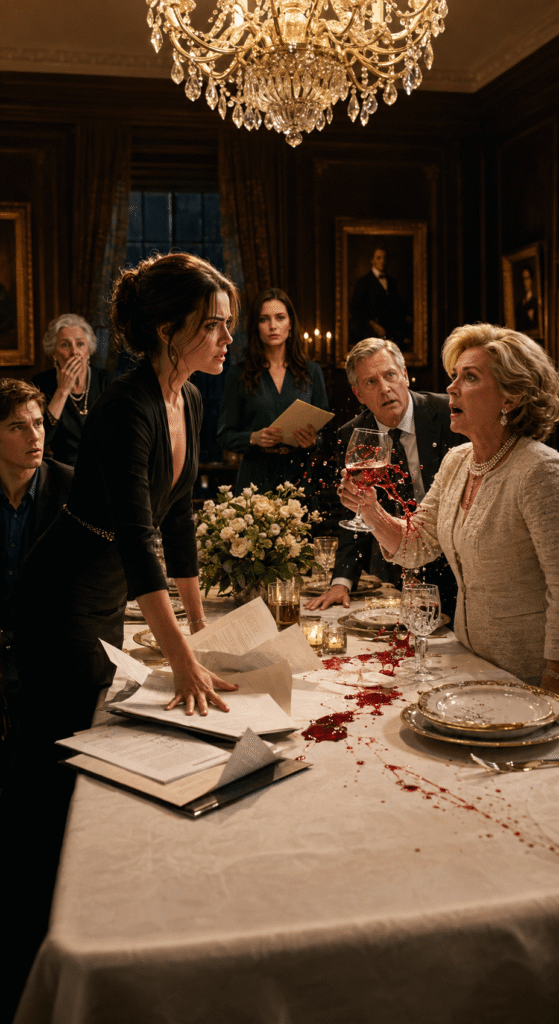

“You’ve spent ten years handling my company’s paperwork during every moment I was too devastated to read closely.”
She thought she was signing routine paperwork through her worst years. She never expected to find her father’s decade-old warning waiting for exactly this moment.
Chapter 1: Ten Years of Signatures
Maggie found the first loan document by accident, looking for her father’s old fishing license in a box she’d almost thrown away.
It was a Saturday in early October, the kind of gray, restless afternoon that made attics feel more bearable than they should, and she’d gone up looking for nothing more sentimental than proof of a fishing license renewal so Thomas could take his nephew out on the lake before the season closed. Instead, three boxes down, beneath a stack of old tax returns and a manila folder labeled in her father’s careful block handwriting — DOYLE HARDWARE / MISC 2015 — she found a document that made her sit down hard on the dusty attic floor and read it three times before she trusted what it said.
It was a $200,000 “bridge loan” from Doyle Hardware Supply, her father’s company — her company now, had been for over a decade — to an entity called Byrne Family Holdings, dated six weeks after her father’s funeral. The loan was secured against nothing. The terms were repayable “at borrower’s discretion, subject to future negotiation,” language so vague it barely qualified as a loan at all, more like a gift wearing a loan’s clothing to survive an audit. Her signature sat at the bottom of the page — shaky, cramped, unmistakably hers, the handwriting of a woman three weeks into grief so total she’d barely remembered to eat, let alone read fine print.
She carried it downstairs into the kitchen where Thomas stood at the counter, making coffee with the unhurried domesticity of a man who had no idea his Saturday was about to change.
“Thomas,” she said, setting the paper down on the counter beside the coffee maker, “what’s this?”
He glanced at it — just a glance, quick, almost too quick — and something crossed his face that Maggie might have missed if she hadn’t spent eleven years learning every version of his careful calm. It was there and gone in less than a second: not surprise, not confusion, but recognition, immediately smoothed over into practiced ease.
“That’s old paperwork, Mags. From right after your dad died.” He poured his coffee, didn’t look up. “Mom needed some liquidity for an investment opportunity, and the company had cash sitting mostly idle in a low-yield account. It made sense at the time.”
“Two hundred thousand dollars of idle cash,” Maggie said slowly, “and I don’t remember signing this.”
“You signed a lot of things that month.” His voice stayed gentle, reasonable, the tone he used when he wanted a conversation to end quickly and without conflict. “You were a wreck, Maggie. Understandably. I handled what I could of the business side so you wouldn’t have to think about it on top of everything else.”
Maggie looked at her own signature again, at the way the letters wavered, at the date — nineteen days after the funeral, she now realized, counting backward, nineteen days after she’d stood at her father’s graveside and felt, for the first time in her adult life, entirely unmoored. “How many things did I sign that month, Thomas?”
He didn’t answer right away. He took a sip of coffee instead, buying time in the particular way people do when the honest answer is worse than any delay will make it seem, and in that silence — three full seconds, maybe four, but long enough that Maggie counted them — something she’d spent a decade not examining too closely began, finally, to come into focus.
“I want to see everything,” she said. “Every document with my signature on it, related to the company, going back to the funeral. Tonight, if we can find it all.”
“Maggie.” Thomas set down his mug with exaggerated patience, the tone of a man explaining something obvious to someone being deliberately difficult. “You’re going to spiral over ten-year-old paperwork that doesn’t matter anymore. Let’s not do this. It’s a beautiful Saturday. Let’s just—”
“I’m not spiraling,” Maggie said, and heard her own voice come out steadier than she felt. “I’m asking a simple question. How many things did I sign?”
He didn’t answer that one either. He picked up his coffee and walked toward the living room instead, and that silence — louder than anything he could have said — told Maggie more in five seconds than a decade of Sunday dinners with his mother ever had.
She thought, standing alone in the kitchen after he’d gone, about her father. James Doyle had built Doyle Hardware Supply from a single storefront on Route 9 into a regional distributor with eleven locations and a manufacturing partnership that supplied three national chains — forty years of careful, unglamorous work, the kind that didn’t make headlines but built something real. He’d been a widower for the last six years of his life, after Maggie’s mother died of ovarian cancer, and Maggie had watched him pour the particular loneliness of that loss into the company, into her, into making sure that when he was gone, she’d have not just a fortune but something that mattered.
He’d left her the whole company outright. Not in a trust, not with a board of trustees managing it on her behalf until some arbitrary age of presumed wisdom, but hers, entirely, the day the will was read — because he’d believed, with the particular faith fathers sometimes place in daughters they’ve watched grow into capable women, that she’d know how to protect it.
She hadn’t. Not for ten years. She’d trusted her husband to handle “the paperwork,” the way any reasonably happy wife trusts a partner she loves, and in doing so, she now understood with a slow, sick certainty, she’d handed him a decade of open doors.
Chapter 2: The Box
It took Maggie three days to find them all.
Not because they were hidden well — that was the worst part, she thought later, the thing that made her feel most foolish. They weren’t buried in some secret compartment or locked filing cabinet. They were filed exactly where household paperwork gets filed: among tax documents, insurance renewals, warranty cards for appliances long since replaced, in a section of the attic labeled, in Thomas’s handwriting this time, “Company Misc.” — a folder she’d walked past a hundred times over the years without a single flicker of curiosity, because why would she? She trusted him. That was the whole architecture of the theft: trust, patiently exploited, one document at a time.
Eleven documents total, spanning ten years. Maggie laid them across the dining room table on the third night, arranging them chronologically, and made herself read each one slowly, completely, the way she should have read them the first time.
The pattern revealed itself with a clarity that made her hands shake.
The first loan — the $200,000 bridge loan — had come six weeks after her father’s funeral. The second, eighteen months later, was smaller: $75,000, transferred to a different Byrne-controlled entity, timed almost exactly to the week Maggie had been hospitalized with a severe case of pneumonia that had left her sedated and barely conscious for the better part of two weeks. The third came during her difficult second trimester with their son, a period of bed rest and preeclampsia scares that had consumed her entire capacity for anything beyond survival. The fourth arrived the month her mother’s sister — the last member of her mother’s side of the family, and someone Maggie had been close to — died unexpectedly of a stroke.
Each subsequent document followed the same design: smaller transfers, individually modest enough not to trigger alarm, always timed to a moment of documented personal crisis, always signed by Maggie during a window when she’d been least capable of reading fine print with the scrutiny it deserved.
But the largest transfer wasn’t a loan at all.
Six years ago — Maggie remembered this one distinctly, or thought she had, until she reread it now with clear eyes — she’d signed what she’d believed was a routine tax restructuring, converting Doyle Hardware Supply from a sole proprietorship into an LLC, something their accountant had supposedly recommended for liability protection. Thomas had brought it to her on a night when their son had a 104-degree fever, when she’d spent six sleepless hours in an emergency room waiting for a diagnosis that turned out, thankfully, to be nothing more than a bad ear infection — but six hours of terror had left her hollowed out, exhausted, signing whatever was placed in front of her without the energy to ask a single follow-up question.
The actual document, read now, restructured far more than tax liability. It reassigned forty percent equity in Doyle Hardware Supply to Constance Byrne, listed as a “founding strategic advisor” — a title that had never existed while Maggie’s father was alive, a role Constance had never performed a single documented hour of work under, an ownership stake worth, at current valuation, well over a million dollars.
Maggie sat at her kitchen table at eleven o’clock that night with all eleven documents spread in front of her like evidence at a crime scene, because that was exactly what they were, and felt something in her chest — grief, still, but curdling now into something colder — finally crystallize into resolve.
She thought about calling Thomas’s name, waking him from where he slept upstairs, demanding an explanation right then, in the raw heat of discovery. She didn’t. Instead, she thought about her father’s attorney — a man named Walter Ferris, who’d handled every major document of Doyle Hardware Supply for thirty years, who’d said something strange to her at the funeral reception, ten years ago, something she’d been too grief-fogged at the time to fully absorb.
If anything ever feels wrong with the company, Maggie, call me before you call anyone else. Your father asked me to say that, specifically. He was very particular about it.
She’d nodded at the time, filed it away as one of the countless well-meaning platitudes people offer the newly bereaved, and never thought of it again. Now, sitting alone with eleven documents that represented, she was beginning to understand, a decade of deliberate theft, the memory surfaced with the force of a held breath finally released.
She found his number in an old address book the next morning, her hands trembling slightly as she dialed, and didn’t bother rehearsing what she’d say.
Chapter 3: What Her Father Knew
Walter Ferris’s office hadn’t changed in the six years since Maggie had last visited it — same dark wood shelves sagging slightly under decades of case files, same faint smell of old paper and the pipe tobacco he’d supposedly quit sometime during the Clinton administration. He was older now, visibly so, his hands moving with the careful deliberateness of a man whose joints had begun charging interest on every sudden gesture, but his eyes, when Maggie laid the eleven documents across his desk one by one, sharpened with a focus that belied his age entirely.
He listened without interrupting once — through the bridge loan, the pneumonia-timed transfer, the preeclampsia-era withdrawal, her aunt’s death, all the way to the LLC restructuring and the forty percent equity transfer — his expression growing steadily grimmer with each document, until he finally exhaled slowly through his nose and sat back in his chair like a man absorbing a blow he’d long expected but hoped never to actually receive.
“Your father asked me to keep a file,” he said quietly. “Specifically about this family. Constance Byrne, in particular. Started it about four years before you married Thomas.”
Maggie felt something cold move through her chest. “You knew about her? Before any of this happened? Before I even married him?”
“Knew of her,” Walter clarified, standing, moving toward a locked cabinet behind his desk with the slow, unhurried gait of a man who’d rehearsed this exact retrieval many times in his mind, hoping never to need to perform it. “I represented another family, years before your engagement — a different client, I won’t use her real name here, some confidentiality obligations outlive even a case’s relevance — whose son married into money the same way Thomas married into yours. Constance Byrne was the mother-in-law in that marriage too, Maggie. Twenty-two years ago now, before she remarried into money of her own and rebuilt an entirely respectable reputation on top of it.”
He pulled out a thick folder, its edges soft with age, the label on its spine written in her father’s own careful block handwriting: BYRNE — PRECAUTION.
Maggie’s understanding of the last decade of her life shifted, quietly and completely, on its axis. “She’s done this before.”
“Exactly once before, that I know of with certainty,” Walter said, sitting back down heavily, opening the folder to reveal pages of notes in his own handwriting, dated continuously across more than two decades. “And it worked, the first time, precisely the way it’s worked here. Small transfers during moments of grief and vulnerability. Each one individually defensible on its own terms — a loan here, a restructuring there — none large enough alone to trigger the kind of scrutiny that might have caught the pattern. A decade passed, and the daughter-in-law woke up one day owning a fraction of what she’d inherited, with no single document damning enough, on its own, to prove intent.”
“How did my father know it would happen to me? How did you know?”
“Your father met Constance Byrne at a charity dinner, four years before you married Thomas,” Walter said. “A gala for the children’s hospital, if memory serves. He mentioned her to me afterward — nothing suspicious, just a passing comment about an interesting woman he’d met, a widow who’d apparently rebuilt an impressive fortune after her first husband’s death. It was only later, once your engagement to Thomas was announced and I did some routine background diligence — standard practice for any major family merger like a marriage this size, Maggie, your father insisted on it for every significant business relationship, and by then you and Thomas certainly qualified — that I recognized her name from the Castellano case file I’d kept for over a decade by then.”
“The Castellano case?”
“Diane Castellano. The prior daughter-in-law.” Walter’s expression grew heavier. “By the time I made the connection, you and Thomas were already deep into wedding planning. Your father made a decision then that I argued against, quite forcefully, at the time — not to interfere with your happiness based on a stranger’s decade-old pattern of behavior he couldn’t yet prove would apply to his own daughter’s marriage.”
“So he just — let it happen? Knowing what he knew?”
“He protected you the only way he could without destroying your relationship with Thomas before it had even properly begun,” Walter said, his voice gentler now, watching Maggie’s face carefully. “He asked me to build a file. Every public record I could access about Constance Byrne’s financial history, every court filing from the Castellano case, expert forensic analysis he quietly commissioned years before his death, specifically to build a template — a pattern recognition guide, if you will — for exactly this kind of fraud, should it ever surface again. I’ve been updating that file continuously for over a decade, Maggie, cross-referencing it quietly against Doyle Hardware’s own financial filings every year, without ever once telling you it existed.”
He turned the folder around fully now, sliding it across the desk toward her — a complete financial history of Constance Byrne’s prior scheme, court documents from the Castellano case Maggie had never once heard of in eleven years of family dinners, expert analysis from a forensic accountant her father had retained years before his death.
“Why didn’t you say something sooner?” Maggie’s voice cracked slightly, grief and fury tangling together in a way she hadn’t expected. “Any of the times I saw you, any of the paperwork Thomas filed through your office over the years—”
“Because your father’s instructions to me were explicit, Maggie, and I gave him my word,” Walter said. “Not to interfere unless you asked, unless you came to me yourself with suspicion of your own. He didn’t want you living inside a decade of preemptive distrust, watching your own marriage through a lens of suspicion based on a warning you never asked for and might never need. He wanted you to have the evidence ready the instant you needed it — not a moment before. A happy woman who never opens this file is worth infinitely more, he told me once, than a suspicious one who spends a decade waiting for a threat that might never come.”
Maggie sat with the weight of that for a long moment — her father’s decade-long silence, his careful, painful restraint, a love so protective it had chosen watchful patience over interference, gambling everything on the hope that she’d never need what he’d quietly built for her.
“He was wrong to gamble that,” she said finally, quietly.
“Perhaps,” Walter said. “Or perhaps he simply understood something about grief and love that made the gamble feel worthwhile to him. Either way, Maggie — the gamble’s over now. The only question left is what you intend to do with what he left you.”
Chapter 4: Building the Case
Maggie didn’t confront them immediately. She spent the next twelve days doing what her father, apparently, had always hoped she would eventually be capable of doing — reading, methodically, everything Walter’s file contained, cross-referencing it against her own eleven documents, building a case rather than reacting to a wound. It was, she realized somewhere around day four, the first time in a decade she’d approached anything related to the company with the same discipline her father had always brought to it, and there was a strange, grim comfort in that — as if grief and betrayal had finally handed her back a piece of herself she’d quietly surrendered the day she married Thomas.
The Castellano case, the one Constance had orchestrated twenty-two years earlier, followed an almost identical arc to Maggie’s own. Diane Castellano — a young heiress to a family printing business, married into the Byrne family before Constance’s current surname, back when Constance had been married to a man named Gerald Reyes — had been systematically stripped of ownership over eleven years through the same pattern of loans and “restructurings,” signed during her father’s death, a difficult childbirth, and a car accident that had left her hospitalized, in and out of surgeries, for the better part of a year. By the time Diane finally noticed the pattern, she owned just eighteen percent of a company her own grandfather had built from a single letterpress in 1962.
Diane had sued. She’d lost — not, Walter’s notes made painfully clear, because the fraud hadn’t been real, but because her attorney at the time hadn’t understood the pattern well enough to argue it as one coordinated scheme. He’d fought each transfer individually, letting Constance’s legal team paint eleven isolated business decisions instead of one deliberate, decade-long campaign designed around a single woman’s worst moments. The court had seen ambiguity where there should have been a clear conspiracy, and Diane had walked away with almost nothing, her family’s business permanently diminished, her own name quietly whispered about in social circles as “the daughter-in-law who tried to sue her husband’s mother and lost.”
Maggie read that last detail three times, feeling something sharpen inside her into cold, deliberate resolve. She was not going to make the same mistake Diane’s attorney had made. She was not going to let this become eleven separate, defensible stories. She was going to make it one story — the only true one — and make sure a judge understood exactly what it meant.
She met with a forensic accountant Walter recommended two days later — a meticulous, unflappable woman named Priya Desai, whose office smelled of strong coffee and whose desk held exactly one framed photograph, of a courtroom sketch from a case she’d apparently won a decade earlier, framed like a trophy. Priya spent two full weeks reconstructing the entire financial impact of the decade of transfers, cross-referencing bank records, corporate filings, and tax documents with the same patient thoroughness Maggie had come to associate, oddly, with her own late father.
“This isn’t ambiguous,” Priya said finally, sliding a completed report across her desk on the day of their third meeting — nearly sixty pages, tabbed and organized, laying out in devastating, undeniable clarity exactly how forty percent equity, $200,000 in unsecured “loans,” a series of smaller withdrawals, and a slow, steady drain of company equipment and inventory had cumulatively cost Doyle Hardware Supply nearly $4 million in real value over ten years, all of it systematically redirected into various holding entities controlled by Constance Byrne.
“This is one of the cleanest fraud patterns I’ve documented in fifteen years of doing this work,” Priya continued, “precisely because whoever orchestrated it before — this Diane Castellano case your attorney found — clearly taught your mother-in-law exactly what worked and exactly what got caught the first time. She refined the method for round two. Smaller individual transfers. Longer, more randomized gaps between them. Better documentation justifications, each one carefully worded to survive a cursory audit. She learned, Maggie, from almost getting caught the first time. She got better at this.”
“Can we prove intent?” Maggie asked. “Not just the pattern — can we prove she actually planned it, rather than just happening to benefit from a series of coincidences?”
Priya’s smile turned thin and deeply satisfied, the expression of a woman about to deliver the best part of very bad news. “That’s the interesting part. I subpoenaed records from Constance’s personal financial planner — a man named Gregory Voss, who’s apparently managed her investments for the past fifteen years — and buried in his files, I found a spreadsheet. A literal, dated spreadsheet, going back eleven years, tracking projected transfer amounts against what he labeled, in his own handwriting, ‘anticipated vulnerability windows.'”
Maggie felt her stomach turn over slowly, sickeningly. “Vulnerability windows.”
“His exact phrase. Cross-referenced, Maggie, against known family events — your father’s declining health in his final year, your pregnancy timeline, medical records his office somehow had access to that I still haven’t fully traced the source of, though I have some theories.” Priya tapped the relevant page. “She didn’t just benefit from your worst moments. She planned around them, like a project timeline. Every single transfer in that file corresponds almost exactly to a date on this spreadsheet, planned months, sometimes years, in advance.”
Maggie sat with that for a long moment, feeling something that had been simmering grief for the better part of two weeks finally, fully, curdle into something colder and infinitely more useful — the particular clarity that comes not from anger alone, but from anger married to evidence.
“I want everything ready before I confront them,” she said. “I don’t want this to be an accusation they can spin into a misunderstanding over Sunday dinner. I want it to already be a case.”
“It already is,” Priya said. “You just haven’t served it yet.”
Chapter 5: The Confrontation
Maggie called the confrontation for a Sunday dinner two weeks later — the same dining room where Constance had, for over a decade, presided over family meals with the particular warmth of a woman who’d never once, Maggie now understood with the full clarity of hindsight, actually liked her, only ever calculated her.
The evening began ordinarily enough. Thomas’s father, Edward, a quiet man who’d spent thirty years of marriage letting his wife make every significant decision in the family, made small talk about the weather. Thomas seemed distracted, glancing at Maggie occasionally with an expression she couldn’t quite read — guilt, maybe, or the particular unease of a man who’d noticed, over the past two weeks, that his wife had grown quieter, more watchful, without understanding why.
Maggie waited until the plates had been cleared, until the particular lull between dinner and dessert when Constance usually began steering conversation toward whatever family matter she wished to manage that week, and set a thick folder on the table between the four place settings.
“I found the loan documents,” Maggie said. “All eleven of them. I’ve had a forensic accountant review the full pattern, going back ten years.”
Thomas’s fork clattered against his plate. “Maggie, this isn’t the place—”
“It’s exactly the place,” Maggie said, her voice steadier than she’d expected, steadier than she’d felt for most of the preceding two weeks. “You’ve spent a decade handling my company’s paperwork specifically during moments when I was too devastated by grief or illness to read it closely. I think everyone at this table deserves to understand what that paperwork actually said, and when.”
Constance’s expression didn’t change at first — the same composed, faintly amused warmth she’d worn at a hundred family dinners — but her hands, Maggie noticed, had gone very still against the white tablecloth, fingers curling slightly inward.
“You’re upset,” Constance said, her voice gentle, almost pitying. “And grief, even years later, can make people see conspiracies in ordinary business decisions that were made to help this family. Your father would have wanted—”
“My father,” Maggie said, cutting through the sentence with a coldness that surprised even her, “kept a file on you for over a decade, Constance, because he recognized your name from a case twenty-two years ago involving a woman named Diane Castellano. Does that name mean anything to you?”
For the first time in eleven years of family dinners, Maggie watched Constance Byrne’s composure fully, visibly crack — a fissure spreading fast across a surface that had never once shown weakness in Maggie’s presence.
“That was a misunderstanding,” Constance said, too quickly, her voice climbing half an octave. “Diane and I had a business disagreement decades ago that was resolved fairly in court—”
“Resolved because her attorney at the time didn’t understand the pattern well enough to prove intent,” Maggie said. “Mine does. I have a forensic accountant’s sixty-page report tracing eleven separate transfers over ten years, each one timed precisely to a documented moment of personal crisis in my life. I have your financial planner’s own spreadsheet, in his own handwriting, referring to ‘anticipated vulnerability windows.’ I have every signature I made under circumstances any competent court is going to recognize as diminished capacity, not informed consent, Constance.”
Thomas had gone entirely pale, staring at his mother with an expression Maggie hadn’t seen from him in eleven years of marriage — not the practiced calm he wore for difficult conversations, but something raw and stricken, the look of a man realizing, in real time, exactly what he’d allowed himself to participate in.
“Mom,” he said quietly, his voice barely audible. “Tell me this isn’t true. Please. Tell me there’s an explanation.”
Constance didn’t answer him. She was looking at Maggie instead, her composure now fully abandoned, replaced by something calculating and cold that Maggie suspected, with a fresh wave of nausea, had been sitting beneath careful warmth for the entirety of their eleven-year relationship.
“If you pursue this,” Constance said, her voice low and hard now, all pretense gone, “I will make absolutely certain that everyone in this family, everyone in our social circle, understands exactly what kind of daughter-in-law drags a grieving family through public court proceedings over old paperwork. You will destroy this family’s reputation to win a private business dispute, Maggie, and everyone will know your name for it.”
“You already destroyed this family’s reputation,” Maggie said, standing slowly, gathering the reports back into her bag with hands that had, somewhere in the last several minutes, finally and completely stopped shaking. “I’m simply the first person who’s had the evidence to prove it. And unlike Diane Castellano, twenty-two years ago, I’m not going to let a lazy legal strategy turn eleven deliberate acts of theft into eleven unrelated coincidences.”
She left without waiting for a response, Thomas calling her name behind her, his voice cracking with something that sounded, for the first time in years, genuinely afraid — not of losing her, she suspected, but of what he was only now beginning to understand about the woman who’d raised him.
Chapter 6: The Lawsuit
The lawsuit took fourteen months to resolve — longer than Maggie had hoped, faster than Walter had cautiously warned her to expect, aided enormously by the coherence Priya’s forensic report and Walter’s decades-old Castellano file gave her legal team from the very first filing.
Constance fought it aggressively from the start. She retained an aggressive litigation firm out of the city, one known for scorched-earth tactics in high-net-worth family disputes, and her attorneys immediately countersued for defamation, claiming Maggie’s public filing had damaged Constance’s reputation and business relationships before any court had ruled on the merits. They attempted, twice, to have the case dismissed entirely on statute-of-limitations grounds for the earliest transfers, arguing that a decade of unchallenged signatures constituted clear, informed consent regardless of the circumstances under which they’d been obtained.
Maggie’s legal team — led by a sharp, relentless attorney named Priya had recommended alongside her own accounting work, a litigator named Daniel Osei who specialized in exactly this kind of coordinated fraud case — countered with the one thing Diane Castellano’s attorney had never managed to assemble twenty-two years earlier: a unified theory of the crime, rather than eleven disconnected disputes.
“The defense wants this court to see eleven separate business transactions,” Osei argued during the pretrial motions, “each individually defensible, each occurring in a different context, each therefore requiring separate legal analysis under separate statutes of limitations. But that framing only works if you ignore the single, continuous, provable intent behind every one of them. We have a financial planner’s own spreadsheet, in his own handwriting, tracking these transfers against what he explicitly called ‘anticipated vulnerability windows’ — dates chosen years in advance, correlated precisely with medical records, family deaths, and documented periods of diminished capacity. This isn’t eleven stories, Your Honor. It’s one story, told eleven times.”
Judge Rebecca Alvarez, a woman known throughout the county for her meticulous patience with complex financial fraud cases, allowed the case to proceed as a single coordinated claim rather than eleven separate ones — a ruling that Walter, watching from the gallery, called “the whole ballgame” the moment it came down.
Discovery revealed layers Maggie hadn’t anticipated. Gregory Voss, Constance’s financial planner, initially refused to cooperate, invoking client privilege on his spreadsheet notes, until Priya’s forensic team demonstrated that the notes documented active participation in ongoing fraud rather than privileged financial advice — a distinction that stripped away his legal protection entirely and left him facing potential criminal exposure of his own.
Faced with that exposure, Voss cooperated fully, providing testimony that filled in gaps Maggie hadn’t even known existed: Constance had, in fact, obtained information about Maggie’s pregnancy complications directly from a hospital billing clerk she’d cultivated as a source years earlier, paying small, regular sums for advance notice of any medical event significant enough to represent a “vulnerability window” worth exploiting. The billing clerk, confronted with this revelation by hospital administration, resigned immediately and faced her own separate legal consequences for HIPAA violations.
“She built an entire information network,” Priya told Maggie one evening, reviewing the latest discovery documents over coffee in Maggie’s kitchen — the same kitchen where Maggie had first confronted Thomas over the bridge loan document, now transformed into something closer to a war room, papers spread across every surface. “This wasn’t opportunistic. This was infrastructure. She invested actual capital, over years, into building the ability to know exactly when you’d be least capable of scrutiny.”
Maggie absorbed that revelation the way she’d absorbed most of the case’s discoveries by that point — with a numbness that had slowly, over months, hardened into something closer to grim resolve than raw grief. “How does someone become like that?”
“I don’t think that’s a question forensic accounting can answer,” Priya said gently. “But I do think it’s worth remembering that whoever she is, whatever made her capable of this — none of it makes what happened to you any less real, or any less worth fighting.”
Chapter 7: Under Oath
The trial itself lasted six days, condensed from what could have easily stretched into weeks, thanks largely to the overwhelming clarity of Priya’s forensic timeline and Voss’s cooperating testimony. Maggie testified on the second day, walking the court through each of the eleven documents in careful, unemotional detail — the funeral, the pneumonia, the pregnancy complications, her aunt’s death — refusing, deliberately, to let her voice crack during any of it, because Osei had coached her carefully: Let the documents carry the emotion. Your job is to be the clearest, calmest witness this jury has ever seen.
Thomas testified on the fourth day, called by Maggie’s own legal team as a hostile witness, though by that point in the proceedings, “hostile” felt like the wrong word for a man who answered every question with the flat, exhausted honesty of someone who’d spent fourteen months coming to terms with his own complicity.
“Did you review the contents of these documents before presenting them to your wife for signature?” Osei asked him.
“Not carefully,” Thomas admitted. “My mother told me what they were for, and I trusted her explanation. I didn’t independently verify the terms.”
“Even the document that transferred forty percent equity in your wife’s company to your mother?”
“Even that one.” Thomas’s voice had gone quiet, barely audible in the courtroom’s hushed silence. “I told myself it was a formality. I didn’t want to look closely enough to have to ask harder questions.”
“Why not?”
Thomas was silent for a long moment, and when he finally answered, his voice carried a rawness Maggie hadn’t heard from him in the entirety of their marriage. “Because some part of me already suspected what I’d find, and I didn’t want to be the person who had to choose between my mother and my wife. So I chose not to look. I understand now that not looking was its own choice. I’m not proud of it.”
Constance’s own testimony, delivered on the fifth day, offered no such reckoning. She maintained, under increasingly pointed cross-examination, that every transfer had been a legitimate business decision, that Voss’s spreadsheet notation about “vulnerability windows” referred to nothing more sinister than standard financial planning terminology about market timing, and that Maggie’s case represented nothing more than a bitter, grieving daughter-in-law’s attempt to rewrite a decade of consensual family financial decisions.
“Ms. Byrne,” Osei said, near the end of his cross-examination, “can you explain why eleven separate transfers, over ten years, each happen to correspond precisely with a documented death, illness, or medical crisis in Maggie Doyle Byrne’s life?”
“Coincidence,” Constance said, her voice cold and steady. “Grief creates opportunities for family members to step in and help manage burdens the grieving person can’t handle alone. That’s not fraud. That’s family.”
“And the payments to a hospital billing clerk for advance notice of medical events?”
For the first time, Constance’s composure wavered visibly. “I have no knowledge of any such payments.”
“The billing clerk has already testified, under oath, three days ago, that those payments came directly from an account traced to your personal finances,” Osei said. “Would you like to revise your answer?”
Constance did not revise her answer. She simply stopped answering questions with any real substance at all, retreating into a series of “I don’t recall” responses that Judge Alvarez noted, in her closing remarks to the jury, spoke louder than any direct admission could have.
Chapter 8: The Verdict
The jury deliberated for eleven hours across two days before returning a verdict that found Constance Byrne liable for fraud, breach of fiduciary duty, and financial exploitation of a vulnerable adult across all eleven documented transfers — a coordinated pattern, the verdict explicitly stated, rather than eleven isolated incidents, precisely the theory Osei had built the entire case around.
The financial judgment came to $6.2 million — the $4 million in forensically calculated damages, plus punitive damages Judge Alvarez authorized given the deliberate, premeditated nature of the scheme, a sum that would take years to fully collect given the complexity of unwinding a decade of transfers across multiple holding entities, but that represented, for the first time in over a decade, complete legal vindication.
Thomas didn’t testify against his mother beyond his required testimony. He also didn’t testify meaningfully for her. He sat through most of the trial’s remaining days in a kind of stunned, guilty silence, and six months after the verdict, having spent that time in what he described to Maggie as “trying to figure out how to be a person who didn’t just look away from things,” he moved out of the house they’d shared for eleven years.
“I didn’t know the full extent of it,” he told her, during their final conversation before the divorce finalized. “I want you to believe that, even if it doesn’t change anything now. I didn’t know about the billing clerk, or the spreadsheet, or how deliberately it was planned.”
“I believe you didn’t know everything,” Maggie said. “I needed you to have wondered, though. Even once, in ten years. You never did.”
He didn’t have an answer for that. Their divorce finalized the same season as the final collection judgment against Constance — a court-ordered restitution that, combined with the return of her father’s original equity stake, restored Doyle Hardware Supply entirely to Maggie’s sole ownership for the first time since her father’s death.
Chapter 9: The File, Returned
Maggie visited Walter’s office one final time, eighteen months after she’d first walked in with eleven damning documents spread across his desk. He’d officially retired by then, though he still kept the office, still kept the same sagging shelves of dark wood and old paper, unable, he admitted with a small smile, to fully let go of forty years of a career he’d loved.
“I wanted to ask you something,” Maggie said, settling into the same chair she’d occupied that first devastating morning. “Diane Castellano. Is she still—”
“Alive, yes. Older than me now, if you can believe such a thing is possible.” Walter smiled, the first genuinely warm expression Maggie had seen from him in months of grim, methodical case-building. “I called her, actually, once your case started building real momentum. Told her what was happening, what your evidence had uncovered. She cried on the phone with me, Maggie. Twenty-two years, and nobody had ever fully believed her account of the pattern was real until your case proved it beyond any doubt.”
“I’d like to meet her,” Maggie said. “If she’s willing.”
“I think,” Walter said, “she would like that very much indeed.”
They met three weeks later, over coffee in a small café equidistant from both their homes — two women separated by two decades and one nearly identical scheme of fraud, finding in each other’s company the particular, unexpected relief of finally being believed by someone who understood, intimately, exactly how it had felt not to be.
“Your father was a good man,” Diane said near the end of their long conversation, turning her coffee cup slowly between weathered hands. “Building that file for over a decade, hoping with everything in him that you’d never actually need it, but making absolutely certain you’d have it the moment you did.”
“He didn’t do it entirely alone,” Maggie said. “He did it because your case, twenty-two years ago, taught Walter exactly what pattern to watch for. If you hadn’t fought back then, even knowing you’d likely lose, there wouldn’t have been anything for my father to recognize in Constance when he met her at that gala, years before I ever fell in love with her son.”
Diane’s eyes went bright with tears she didn’t bother hiding, and for a long moment neither woman said anything at all, sitting together in the quiet, hard-won warmth of an ordinary café afternoon that neither of them — not twenty-two years ago, not eighteen months ago — could have imagined arriving at.
A year after the verdict, Maggie stood in the same attic where she’d first found the bridge loan document, sorting through the same boxes with an entirely different purpose now — not searching for a fishing license, but deciding, finally, what of her father’s life and her marriage’s decade were worth keeping.
She kept his old tools. She kept photographs of the company’s original storefront, faded now, curling slightly at the edges. She kept, somewhat to her own surprise, a single photograph of Thomas from their wedding day — not out of lingering love, exactly, but as an honest artifact of a version of her own life she wasn’t willing to pretend hadn’t happened.
She donated the eleven original loan documents, along with copies of Priya’s forensic report and Walter’s decades-old Castellano file, to a legal aid organization specializing in financial exploitation of vulnerable adults, on the condition that the case study — anonymized, but detailed in its methodology — be used to train young attorneys to recognize exactly the kind of coordinated, patient fraud that had nearly cost her everything, and had once, twenty-two years earlier, actually succeeded against a woman who’d deserved far better representation than she’d received.
She used a portion of the collected judgment to establish a small fund, administered quietly through Osei’s firm, specifically to help other families identify and litigate coordinated financial exploitation before a decade passed rather than after — the first case they funded involving a woman in a neighboring state facing an almost identical pattern, who found, through a referral that eventually traced back to Diane Castellano’s own quiet advocacy work, exactly the kind of forensic and legal support Maggie had needed and, through her father’s decade of patient preparation, ultimately received.
“You didn’t have to do any of this,” Priya told her, the day the fund’s paperwork finalized, the two women sitting together in Maggie’s newly reorganized office at Doyle Hardware Supply — her father’s old desk, restored now to its rightful place, her own name freshly painted on the door.
“I know,” Maggie said. “I wanted to. Somebody protected me for a decade without my ever knowing it, and someone else believed my case mattered enough to build it properly. I’d like to be that, for someone else, whenever I can.”
Outside her window, the company’s loading dock hummed with the ordinary, unremarkable business of an ordinary Tuesday — trucks arriving, inventory being sorted, a life her father had built from nothing, finally, fully, entirely her own again.
THE END