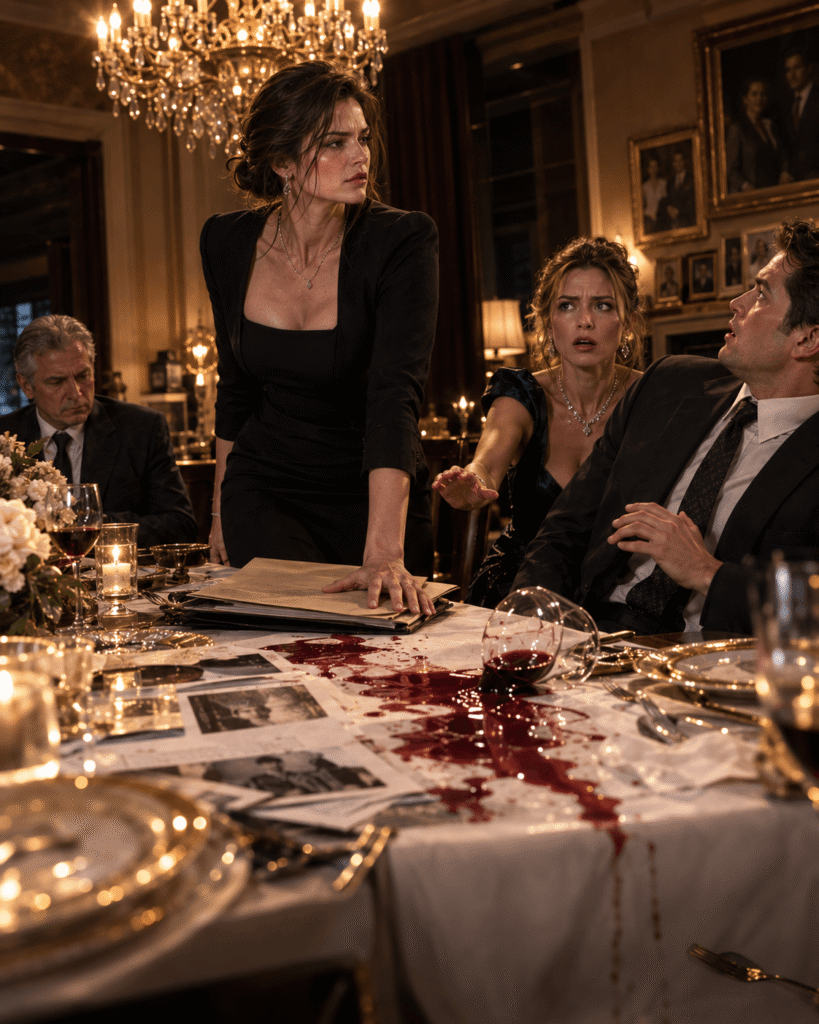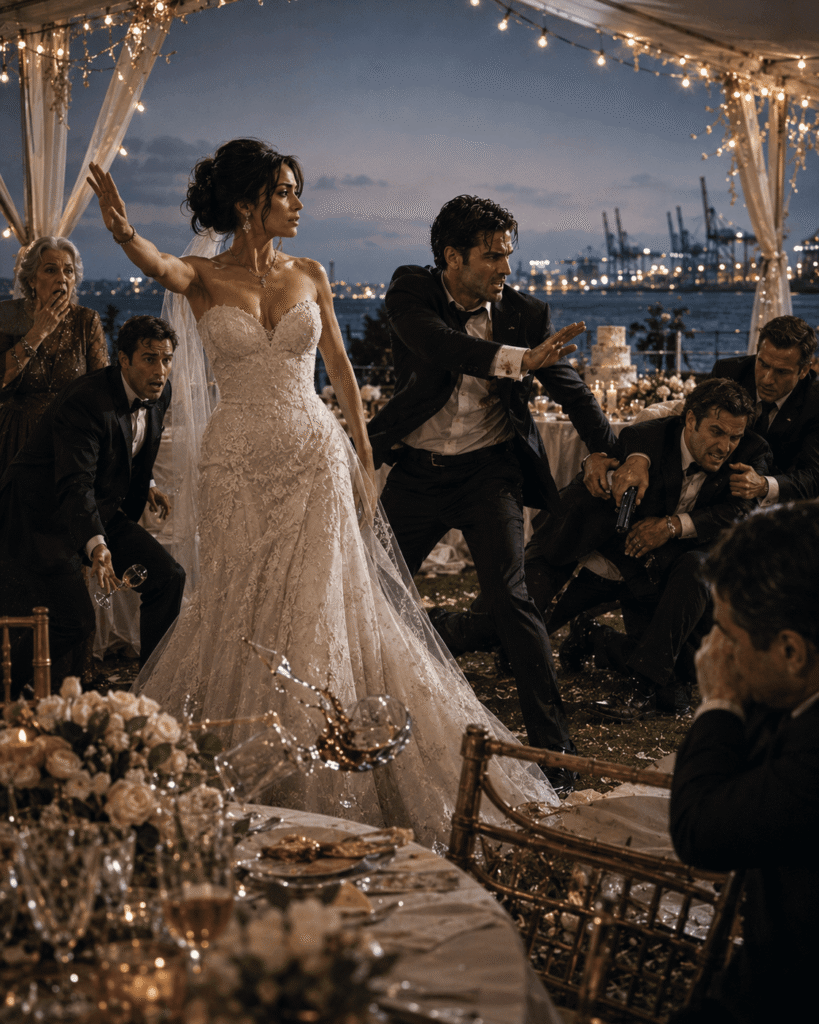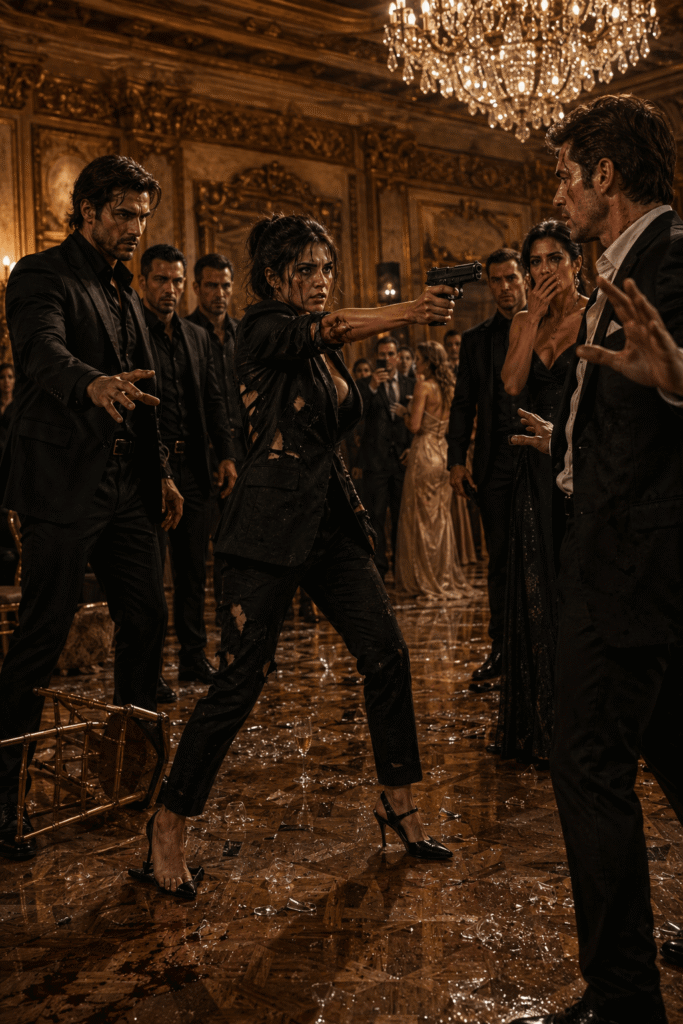

“You’re mine now, and I protect what’s mine.”
She came to expose his crimes. She stayed to fight his war—and won both his heart and his freedom.
Chapter 1: The Audit
The door to the conference room didn’t open so much as surrender, swinging inward with a soft, expensive hush that was somehow more intimidating than a slam. Marisol Reyes didn’t look up from her spreadsheets, not immediately. She let the silence stretch for a single, deliberate beat, the way she’d learned to do in courtrooms filled with hostile witnesses. Let them feel the weight of the room before she did.
Then, she lifted her gaze.
Reid Ashford stood in the doorway like he’d been poured into his suit, all sharp lines and casual dominance. He didn’t enter. He just stood there, one hand in his pocket, his head tilted slightly as if she were a puzzle he hadn’t decided was worth solving yet. The light from the wall of windows behind her caught the silver at his temples, threading through hair the color of wet tobacco. He was older than the photos in the financial filings—late forties, maybe, where she’d expected mid-thirties—but the years had only sharpened him. He looked like something carved from the bones of an old city: elegant, dangerous, and far too confident in his own permanence.
“Ms. Reyes.” His voice was low, with a Savannah drawl that felt slow as molasses and twice as sticky. “I’d say it’s a pleasure, but we both know why you’re here. Pleasure rarely enters into it.”
She didn’t rise. Didn’t offer her hand. “Mr. Ashford. You’re late.”
“I’m the one who signs the checks that pay for this building. I’m not late. I’m deliberate.” He stepped inside, letting the door close behind him with another whisper of sound. The room shrank. It wasn’t the physical space—the conference room was generous, all glass and polished walnut—but his presence seemed to eat the air. “You’ve been camped out in my offices for three days, requesting documents my people tell me you’ve already read twice. Either you’re very thorough, or you’re looking for something you’re afraid you won’t find.”
“Or something I’m afraid I will.” Marisol finally stood, meeting his gaze. She’d worn her armor that morning—a cream silk blouse, black trousers, heels that added three inches she didn’t need but wanted. Her dark hair was scraped back into a low bun tight enough to give her a headache. Good. The pain kept her sharp. “Your company’s investment portfolio is a labyrinth. Intentionally so, I suspect.”
“Suspicion is the currency of your profession.” Reid moved toward the conference table, trailing his fingers along the polished surface. The gesture was idle, but his eyes never left her. “And mine. Which is why I agreed to this audit. Clean books, clean conscience.”
“Mr. Ashford, if you had a clean conscience, you wouldn’t need an audit.”
His mouth curved. It wasn’t a smile, exactly—more like the flash of a blade before it struck. “You’ve got teeth, Ms. Reyes. I like that. Most people walk in here trying to flatter their way into a settlement.” He pulled out a chair, but didn’t sit. Instead, he braced his hands on the back of it, leaning forward. “But let’s be clear. You’re here because your little non-profit watchdog group—”
“The Coastal Accountability Project.”
“—yes, that. You’re here because they saw my name attached to a half-dozen shell companies and decided I must be laundering money. You’re here to find the smoking gun, hang it around my neck, and walk away with a headline.” He straightened, unbuttoning his suit jacket with one practiced motion. “But you won’t find one, because there’s nothing to find. I build buildings. I restore history. I make money. It’s boring, legal, and very well documented.”
Marisol tapped her tablet, bringing up a screen she’d prepared. “Then explain Andover Holdings. A subsidiary of your company that purchased $4.3 million in property on Daufuskie Island last year. The property has no development permits, no zoning applications, no construction activity at all. It’s just sitting there, undeveloped, while its value mysteriously inflates on paper.” She turned the screen to face him. “That’s not real estate development. That’s a parking lot for money you can’t explain.”
Reid’s expression didn’t flicker. Not a twitch, not a blink. “Daufuskie’s a long-term play. Land appreciates. You buy low, you wait, you sell high. That’s not a crime, it’s patience.”
“Except Andover Holdings doesn’t have any other assets. It exists solely to hold that one property. And its registered agent is a law firm that also represents three other shell companies, each holding similarly inert assets across the Lowcountry.” Marisol set the tablet down. “It’s a pattern, Mr. Ashford. And patterns tell stories.”
“Then read the whole story.” He came around the table, and for a moment she thought he’d stop across from her, but instead he kept coming, stopping only when he was close enough that she could smell him—sandalwood and salt, like a beach after a storm. “Andover’s a subsidiary of a subsidiary. The law firm is a family firm, been handling Ashford business for sixty years. The other companies you’re tracking? They belong to my cousins, my uncles, my sister. We’re an old family, Ms. Reyes. We spread our eggs across many baskets. It’s not criminal. It’s prudent.”
Marisol held her ground. “Prudent is a word people use when they’re hiding something.”
“And ‘audit’ is a word people use when they’re looking for an excuse to justify their own prejudice.” Reid leaned in, just a fraction. “You’ve already decided I’m guilty. This isn’t an audit. It’s a hunt.”
She could feel the heat coming off him, the sheer physical weight of his attention. It would have been easier if he’d been ugly. Or cruel. Or even overtly threatening. But Reid Ashford was none of those things on the surface—he was composed, polished, with a voice like smoke and eyes that seemed to see right through her. He was the most dangerous kind of adversary: the kind who made you forget he was one.
“Maybe,” she said, forcing steel into her voice. “But I’m not the one who’s got something to hide.”
Something moved in his expression then, a shadow of something that was gone before she could name it. He stepped back, and the air between them loosened. “You’ve got two more days,” he said. “That’s what the board approved. Use them wisely. But I’d suggest you stop chasing ghosts and start focusing on what’s actually in front of you.”
“And what’s that?”
Reid walked to the door. “Me. My company. My city.” He paused with his hand on the handle, looking back over his shoulder. “And the fact that you’re in my world now, Ms. Reyes. I don’t know if you’ve noticed, but it has a way of swallowing people whole.”
He left before she could respond. The door whispered shut, and Marisol let out a breath she hadn’t realized she’d been holding. Her hands were trembling, just slightly. She pressed them flat against the cool surface of the table, willing them steady.
Get it together, Reyes. He’s just a man.
But as she gathered her files and made her way out of the conference room, she couldn’t shake the feeling that she’d just been given a warning she didn’t fully understand.
She had two days. And she intended to use every second.
Chapter 2: The Blackmail
Reid Ashford stood in the private elevator of the Blackwood Building, the restored cotton warehouse his company had converted into its headquarters, and let the silence settle around him like a second skin.
Marisol Reyes.
He’d read her file before she ever set foot in Savannah. Harvard Law, top ten percent of her class. Three years at a white-shoe firm in Atlanta before she’d walked away to join the Coastal Accountability Project, taking a seventy percent pay cut to chase corporate malfeasance up and down the Eastern Seaboard. A whistleblower attorney, they called her. A woman who’d built her career on exposing men like him.
Except she had no idea what she was actually exposing.
The elevator chimed, the doors sliding open on the top floor. Reid stepped into his corner office, all glass and reclaimed wood, the Savannah River glittering below like a spill of mercury in the late afternoon light. He didn’t look at the view. He crossed to the bar, poured himself two fingers of bourbon, and drained it in a single swallow.
“Bad meeting?”
The voice came from the doorway. Reid didn’t turn. “Hello, Whit.”
Whitley Ashford—his cousin, his consigliere, the man who handled the family’s less legitimate interests with the same polished efficiency Reid brought to the legitimate ones—stepped inside, closing the door behind him. He was younger than Reid by a decade, handsome in a softer way, with sandy hair and a smile that never quite reached his eyes. “I heard the auditor’s been rattling cages. Found some friends in low places.”
“Andover. Daufuskie. The law firm.” Reid set the glass down. “She’s good. Better than I expected.”
“Then get rid of her.” Whit dropped into one of the leather chairs facing the desk, crossing one ankle over his knee. “Not permanently, of course. But call her boss. Threaten a lawsuit. Make some noise. You’re good at noise.”
Reid turned. “I’m not making noise. That’s exactly what she wants. Right now, she’s fishing. She’s got theories, patterns, suspicions. But she doesn’t have proof, and she won’t find any, because the paper trail is clean.” He paused. “Is the paper trail clean, Whit?”
Whit’s smile thinned. “Paranoid, cousin?”
“Careful. And you should be too. If she digs into the wrong property, if she connects Andover to the Daufuskie operation, we’re not just looking at fines. We’re looking at RICO charges.” Reid moved to his desk, lowering himself into the chair. “The laundering through the real estate is one thing. But the other business—”
“—isn’t on the books. Isn’t connected to your name. Isn’t connected to anything.” Whit spread his hands. “You’re untouchable, Reid. You’ve spent twenty years building walls between the legitimate and the… less legitimate. No auditor, no lawyer, no journalist has ever gotten through. This woman won’t either.”
Reid’s jaw tightened. “She’s not just any lawyer. She’s the one who put three executives from Meridian Energy in federal prison last year. She found a trail the SEC had missed for a decade. She doesn’t stop.”
“Then we stop her.” Whit’s voice dropped, the softness bleeding out of it. “I can make some calls. A visa issue, maybe. Her mother’s family is from the Dominican Republic, isn’t it? Immigration trouble would be so inconvenient right now.”
“No.” The word came out sharper than Reid intended. “You don’t touch her, Whit. Not her job, not her family, not her reputation. She’s mine to handle.”
Whit studied him for a long moment. “Yours to handle? Or yours to enjoy? I saw the way you looked at her in the meeting.”
Reid’s hands curled into fists under the desk. “Don’t.”
“Don’t what? Don’t point out that the mighty Reid Ashford has a weakness for dark-eyed women with sharp tongues? Don’t remind you that the last one nearly got you killed?” Whit shook his head, a mocking smile playing at his lips. “You’ve got a type, cousin. And it’s dangerous.”
“I don’t have a type.” Reid stood, moving to the window. The river was dark now, the sun bleeding out over the marshlands to the west. “I have a problem. And her name is Marisol Reyes. The question is what to do about her.”
“The question,” Whit said quietly, “is what you’re willing to do about her. Because if you’re not willing to get your hands dirty, she’s going to bury us all.”
Reid didn’t answer. He stood at the window, watching the light die over the water, and thought about Marisol Reyes. About the way she’d held his gaze, unflinching. About the way she’d laid out her evidence like a woman dealing cards, each one another nail in a coffin she fully intended to build.
She was dangerous. She was clever. And she was absolutely, catastrophically wrong about what she was looking for.
Because the money she was tracing wasn’t laundering for drug trafficking, or arms dealing, or any of the other sins a woman like her would expect. It was something else entirely. Something he’d spent fifteen years trying to bury.
And if she kept digging, she was going to unearth it.
And then neither of them would survive.
His phone rang at 2:47 a.m.
Reid was awake instantly, the way he’d trained himself to be during the years when sleep meant vulnerability. He reached for the phone, already knowing who it would be before he saw the caller ID.
Unknown.
He answered anyway. “Yes.”
“Mr. Ashford.” The voice was low, distorted, familiar in the way a recurring nightmare was familiar. “I understand you’ve got a problem.”
Reid sat up, swinging his legs over the side of the bed. The penthouse was dark, the city lights casting long shadows across the floor. “I don’t know what you’re talking about.”
“The auditor. The pretty little lawyer from Atlanta. She’s been sniffing around Andover Holdings. Around Daufuskie. Around things that are best left alone.” A pause. “You’ve been sloppy.”
“I’ve been careful. Which is why you’ve been paid, on time, every month, for fifteen years. Don’t call me at three in the morning to critique my housekeeping.”
The caller laughed, a sound like gravel in a garbage disposal. “Careful isn’t the same as clean. And this woman—she’s not like the others. She’s got teeth. If she bites down, she won’t let go.”
Reid’s grip tightened on the phone. “What do you want?”
“Same thing I’ve always wanted. For you to remember who you work for.” Another pause. “And to remind you that if she gets too close, I’ll have to handle her myself. And I won’t be gentle.”
The line went dead.
Reid sat in the darkness, the phone still pressed to his ear, listening to the silence. His heart was pounding, but his hands were steady. After fifteen years, he’d learned to control his fear.
Or, at least, to hide it.
The blackmailer. That was how he thought of him—not by name, never by name, because names had power, and Reid couldn’t afford to give him any more than he already had. The man on the phone had owned him for a decade and a half, ever since Reid’s father had made a catastrophic mistake and left his son to pay for it. The leverage was simple: evidence of money laundering through the family’s real estate holdings—evidence that could send Reid to prison for decades, destroy the company, shatter the legacy his grandfather had built.
The blackmailer didn’t want money. Or rather, he didn’t want only money. He wanted control. He wanted Reid Ashford, the untouchable prince of Savannah, to know that someone else held the strings.
And now Marisol Reyes was threatening to unravel everything.
Reid stood, moving to the window. The city spread out below him, a tapestry of light and shadow, the spires of the old cotton exchange silhouetted against the pre-dawn sky. He’d built this. He’d restored it, protected it, made it thrive. He’d done terrible things to keep it safe.
And now a woman with a spreadsheet and a righteous fury was about to burn it all down.
Unless I stop her.
The thought came unbidden, dark and tempting. He could do it. He had the resources, the connections, the will. Whit had offered to make her disappear—not permanently, not yet, but enough to scare her off. A warning. A threat. He could make her understand that some doors were better left unopened.
But even as he thought it, he saw her face again. The defiance in her eyes. The way she’d refused to flinch.
She’s not afraid of you, a voice whispered in the back of his mind. And that’s the most dangerous thing of all.
Because if she wasn’t afraid, she wouldn’t stop. And if she didn’t stop, the blackmailer would make good on his threat.
And Reid would have to choose: save her, or save himself.
Chapter 3: The Charade
Marisol had two days, but she only needed one.
By noon on the second day, she’d mapped the entire web of subsidiaries, shell companies, and holding trusts connected to Ashford Development Group. The pattern was clear, even if the purpose wasn’t. Money flowed in from legitimate sources—property sales, construction contracts, government grants—and then vanished into a maze of accounts, reappearing weeks later in different forms: a land purchase here, a corporate bond there, a “consulting fee” that led to another shell company that led to another.
It was laundering. She was sure of it now. But laundering for what? Drug money? Weapons trafficking? The amounts were too small for that—millions, not billions—and the timing was wrong. The money sat too long in one place, as if it were being stored rather than moved.
Parking lot for money you can’t explain.
His voice echoed in her head. He’d been playing with her, she realized. Testing her. Seeing how much she’d uncover.
The question was: how much did he want her to find?
She was still staring at her laptop screen when her phone buzzed with a text from an unknown number.
“Dinner. My home. 7 p.m. I have something to show you.”
She stared at the screen for a long moment. It had to be him. Reid Ashford. Who else would command instead of invite?
“I don’t do business over dinner,” she typed back.
“This isn’t business. It’s truth. You want to know what’s really going on? Come and find out.”
She should have refused. Every instinct told her to stay away, to keep her distance, to maintain the professional boundaries that had kept her safe and sane through years of dangerous investigations. But there was something in the message—a note of weariness, maybe, or a hint of vulnerability—that made her pause.
Or maybe it was just her own curiosity. Her own reckless, stupid hunger to understand the man behind the mask.
You’re playing with fire, her mother’s voice whispered in her memory. Don’t get burned.
She typed back: “Send the address.”
The Ashford estate was on St. Simons Island, a two-hour drive from Savannah through the Lowcountry’s winding roads and salt marshes. Marisol drove with the windows down, the humid air thick with the smell of salt and jasmine, the Spanish moss hanging from the live oaks like ghostly curtains. The sun was setting as she crossed the causeway, painting the marsh in shades of gold and crimson, and for a moment she could almost understand why someone would kill to protect this place.
Almost.
The estate itself was a sprawling antebellum mansion, restored to gleaming perfection, its white columns rising against the darkening sky like the bones of some ancient, beautiful beast. Marisol parked her rental car in the circular drive and sat for a moment, gathering herself. She’d changed into a simple black dress—modest, professional, armor of a different kind—and let her hair down. She didn’t want to look like she was trying. But she didn’t want to look like she wasn’t trying, either.
Just get through the dinner, she told herself. Get what he’s offering, and get out.
Reid met her at the door. He’d traded his suit for dark trousers and a white shirt with the sleeves rolled up, exposing forearms corded with muscle and a watch that probably cost more than her car. He looked younger like this, less like a CEO and more like a man comfortable in his own skin. Dangerous, still. But different.
“You came,” he said, stepping aside to let her in.
“You knew I would.”
He smiled, just barely. “I hoped.” He led her through the foyer—marble floors, a curved staircase, a chandelier that glittered like captured starlight—and into a study that smelled of leather and old books. A fire crackled in the hearth, despite the warm evening, and a tray of food waited on a low table: cheese, fruit, cold salmon, a bottle of wine breathing in a decanter.
“This doesn’t look like a business meeting,” Marisol said.
“It’s not. It’s a conversation.” Reid poured two glasses of wine and handed her one. “I wanted to talk to you somewhere neutral. Somewhere where the walls don’t have ears.”
She took the glass but didn’t drink. “You think your office is bugged?”
“I think my office is observed. By people who have a vested interest in what you find.” He moved to the window, looking out over the lawn that sloped down to the marsh. The last light was fading, the sky turning the color of a bruise. “Tell me what you’ve discovered.”
“Why should I? So you can cover it up?”
“Because I’m going to tell you the truth, and you need to know how much of it you’ve already found.”
Marisol hesitated. But she’d come this far. “I’ve found a network of shell companies, all connected to Ashford Development Group. Money flows in from legitimate sources, gets funneled through at least six layers of intermediaries, and ends up in assets that don’t generate income. Land. Art. Jewelry. It’s a classic money laundering operation.” She set her glass down. “The question is: who’s laundering the money? And for what?”
Reid turned to face her. “The money being laundered is mine. My family’s. It’s legitimate, earned from the construction business. But it’s being moved in a way that suggests otherwise.” He paused. “Because someone is making me do it.”
The words hung in the air, heavy as the humidity outside. Marisol stared at him. “Making you?”
“I’ve been blackmailed for fifteen years.” His voice was flat, emotionless, as if he were reciting a ledger. “Someone has evidence that my father was involved in a crime—a serious one—and they’ve been holding it over my head ever since. They force me to launder money through the family business. To buy assets. To park cash in places where it can’t be traced. I do it, and they keep the evidence hidden. I stop, and they destroy everything.”
Marisol’s mind raced. It made sense—the pattern, the odd timing, the way the money seemed to be stored rather than moved. But it also made no sense at all. “Why would they make you launder money that’s already clean? That doesn’t achieve anything except making it look dirty.”
“Exactly.” Reid’s jaw tightened. “They’re not doing it for the money. They’re doing it for control. They want me to be complicit. They want to be able to point to the laundering as evidence that I’m a criminal, if they ever need leverage. It’s a trap. And I’ve been living in it for fifteen years.”
“Then go to the police. The FBI. If you have evidence of blackmail—”
“I don’t.” He shook his head. “That’s the point. The blackmailer is careful. They’ve never shown their face, never given me anything I could use to identify them. Everything is done through intermediaries, encrypted messages, untraceable payments. I have no proof that I’m being coerced. All the evidence points to me being the mastermind. That’s the trap.”
Marisol sank into the nearest chair, her mind reeling. “Why are you telling me this?”
Reid crossed to her, dropping into the chair across from hers. The firelight caught his face, carving shadows under his cheekbones, turning his eyes into pools of darkness. “Because you’re the first person who’s ever gotten this close. You’ve found the shell companies, the shell properties, the law firm. You’re piecing it together. And if you keep going, you’ll find the blackmailer. Or the blackmailer will find you.”
“And why should I believe any of this?” She leaned forward. “You could be lying. This could be another layer of the trap. A way to make me trust you, so I’ll call off the investigation.”
“I could be.” He held her gaze. “But I’m not. And I can prove it.”
“How?”
“Because I’m going to give you access to everything. Full access. Every account, every transaction, every shell company. I’m going to show you exactly what’s been happening, and who’s been doing it.” He paused. “But I need something from you in return.”
Marisol’s stomach tightened. “What?”
“Your silence.” Reid leaned forward, his elbows on his knees, his hands clasped. “You keep the audit open. You keep digging. But you don’t report anything to your superiors until I say it’s safe. Because if the blackmailer finds out what you know, they’ll kill you. And if they kill you, I’ll never be free.”
She stared at him, searching for the lie. But all she saw was exhaustion. And something else, something she couldn’t quite name.
“You’re asking me to compromise my investigation,” she said slowly. “To trust a man I have every reason to believe is a criminal.”
“I’m asking you to help me catch a criminal. The one who’s been pulling my strings for fifteen years.” He reached out, and for a moment she thought he’d touch her hand, but he stopped short. “I know it’s a risk. I know I’m asking a lot. But I’m desperate, Ms. Reyes. And desperation makes me honest.”
The fire crackled. Outside, the first stars were emerging, faint pinpricks in the deepening dark. Marisol could feel the weight of the decision pressing down on her, the choice between her principles and her instincts.
Her principles told her to walk away. To report everything she’d found to the Coastal Accountability Project, let the authorities sort it out. But her instincts—the same instincts that had led her to uncover three major fraud cases in the past—told her that Reid Ashford was telling the truth.
And that if she walked away, she’d be leaving him to drown.
“I need time,” she said finally. “To think. To verify some of what you’ve told me.”
“Take all the time you need.” Reid stood, moving to the door. “But don’t take too long. The blackmailer knows you’re investigating. And they’re already getting nervous.”
He left her alone in the study, the fire dying to embers, the wine untouched. Marisol sat in the silence, her mind churning, and made a decision.
She would stay. She would dig. And she would find out the truth about Reid Ashford—even if it killed her.
Chapter 4: The Gilded Cage
The next morning, Marisol woke to find her life had been rearranged.
Her phone was flooded with messages from the Coastal Accountability Project: her supervisor asking for an update, her colleagues wanting to know her status, an email from Legal informing her that her hotel reservation had been extended indefinitely and that a new “consultant liaison” had been assigned to her case.
The liaison’s name was Reid Ashford.
“What the hell is this?” she texted him, not bothering with pleasantries.
“Protection. You’re staying in Savannah until the audit is complete. I’ve arranged for you to work from my office. All your expenses covered.”
“I’m not your employee. You can’t just—”
“You’re right. I can’t. But the Coastal Accountability Project seems to think it’s a good idea. Maybe you should take it up with them.”
She did. The phone call with her supervisor was short and infuriating.
“Reid Ashford has offered full cooperation,” her supervisor said, his voice tinny through the speaker. “He’s agreed to provide all requested documents, schedule interviews with key personnel, and make his staff available for questioning. In exchange, he asked that the audit be conducted on-site, in Savannah, under his supervision.”
“That’s not an audit. That’s a hostage situation.”
“Don’t be dramatic, Marisol. It’s a generous offer. He could have fought the audit entirely. Instead, he’s rolling out the red carpet.”
Because he wants to control what I see and when I see it, she thought. But she didn’t say it aloud. She couldn’t, not without explaining the conversation she’d had with Reid the night before. The conversation that, if it came to light, would destroy her credibility and his life.
So she swallowed her objections, packed a bag, and moved into the suite Reid had arranged for her at the Blackwood Hotel—his hotel, of course, a restored 19th-century landmark in the heart of the historic district, all antique furnishings and modern convenience.
It was, she realized as she unpacked, the gilded cage. Beautiful, comfortable, and impossible to escape.
The first day in Reid’s office was a masterclass in controlled chaos. Marisol had been given a small conference room adjacent to his, with a view of the river and a steady stream of documents arriving every hour. But every request she made for specific records—transaction logs, ownership documents, tax filings—was met with a delay. Not a refusal, never a refusal. Just a delay, a “we’re working on it,” a “that file is in storage and will take a few days to retrieve.”
Meanwhile, Reid moved through the office like a king surveying his domain. He was everywhere—in meetings, on the phone, walking the halls with his lieutenants trailing behind him. But every so often, his gaze would find hers through the glass walls of her conference room, and he’d nod, just slightly, as if to say: I see you. I know what you’re doing. And I’m watching.
It was infuriating. And, if she was honest with herself, a little exhilarating.
By the end of the first week, Marisol had identified three more shell companies and a trust fund that seemed to exist solely to hold a collection of antique jewelry. The paper trail was getting warmer. But the blackmailer—if he existed, if Reid was telling the truth—remained invisible.
She was beginning to wonder if he existed at all.
The first crack came on a Tuesday.
Marisol was working late, the office empty except for the cleaning staff, when she found a document that didn’t belong. It was in a file of routine expense reports, buried under months of reimbursement requests for travel and entertainment. But the name on the memo caught her eye: Daufuskie Holdings LLC.
And the signature at the bottom was Whit Ashford’s.
She stared at it, her heart pounding. Whit was Reid’s cousin, his right-hand man, the one person Reid trusted above all others. But the document wasn’t authorized by Reid. It was a transfer of $2.5 million from a corporate account to Daufuskie Holdings, with no explanation, no supporting documentation, no trail.
It was sloppy. Amateurish. The kind of mistake a man makes when he’s in a hurry, or when he thinks no one is watching.
Or when he’s setting a trap.
She was still staring at the document when the door opened behind her. She spun, her hand flying to her chest.
Reid stood in the doorway. His tie was loose, his hair disheveled, his eyes shadowed with exhaustion. He looked like he hadn’t slept in days.
“You’re still here,” he said. “I thought I told you to go home.”
“I’m not your employee. I don’t follow your orders.” She held up the document. “What is this?”
He crossed to her, taking the paper from her hand. His face went still as he read it. “Where did you find this?”
“In a file of expense reports. It was misfiled, or planted.” She watched him closely. “It’s a transfer from your company to a shell corporation. Signed by your cousin. For $2.5 million.”
Reid’s jaw tightened. “I see.”
“Is this part of the blackmail? Is Whit—”
“Not here.” He cut her off, his voice low and urgent. “The walls have ears, remember?”
He led her out of the office and into the elevator, his hand at the small of her back, guiding her with a pressure that was both protective and possessive. The elevator descended in silence, depositing them in the parking garage, where a black SUV waited with a driver.
“Where are we going?” Marisol asked as he opened the door for her.
“Somewhere safe.”
The safe place turned out to be the penthouse of the Blackwood Hotel, the same building where she was staying. But this wasn’t her suite—it was his, a sprawling space on the top floor with panoramic views of the city and the river beyond. It was sleek and modern, all glass and steel, with a wall of windows that made her feel like she was floating above the world.
Reid went straight to a bar in the corner, pouring himself a drink. He didn’t offer her one. “What you found tonight—it changes things.”
“It proves your cousin is involved in the blackmail. Or in the money laundering, at least.”
“It proves that Whit made a transfer without my knowledge or authorization. It could be part of the blackmail, or it could be something else entirely.” He drained his glass. “Whit has been with me since the beginning. He knows every secret, every weakness. If he’s working with the blackmailer—”
“Then you’ve been betrayed by the one person you trusted most.” Marisol’s voice was soft. “I’m sorry.”
Reid turned to face her. For a long moment, he just looked at her, his expression unreadable. Then he moved toward her, slowly, deliberately, until he was standing close enough that she could feel the heat radiating from his body.
“You shouldn’t be sorry for me,” he said quietly. “I don’t deserve it.”
“You’re a victim, Reid. Whatever you’ve done, you were coerced—”
“I’m not a victim.” The words were sharp, cutting through the air between them. “I’ve done terrible things. I’ve lied, cheated, manipulated. I’ve built an empire on the backs of other people’s suffering. The blackmail didn’t make me a monster. It just gave me an excuse.”
Marisol’s breath caught. “Then why are you telling me this? Why are you risking everything to help me?”
“Because you make me want to be honest.” He reached out, his fingers brushing her cheek, the touch so gentle it made her shiver. “Because when I look at you, I see the man I could have been, if things had been different. And I want that man to exist. Even if only for a moment.”
She should have pulled away. She should have reminded him of the lines they couldn’t cross, the boundaries that kept them safe. But instead, she found herself leaning into his touch, her eyes closing, her breath coming faster.
“Reid—”
“Don’t,” he whispered. “Don’t talk. Don’t think. Just… be here. With me.”
And then he kissed her.
It wasn’t gentle. It wasn’t tentative. It was fierce and desperate, a collision of need and fear and something deeper, something that had been building since the moment they’d first met. His hands tangled in her hair, pulling her closer, and she responded with equal intensity, her fingers gripping his shirt, her body pressing against his.
For a long, dizzying moment, there was nothing but the heat of his mouth, the strength of his arms, the taste of bourbon and desire.
Then he pulled back, his forehead resting against hers, his breath ragged. “We shouldn’t be doing this.”
“No,” she agreed, her own voice unsteady. “We definitely shouldn’t.”
But neither of them moved.
And in the silence that followed, Marisol realized she was in far more danger than she’d ever imagined. Not from the blackmailer, or the money laundering, or the web of lies that surrounded her.
But from the man standing in front of her. The man she was beginning to trust.
The man she was beginning to love.
Chapter 5: The Unraveling
The next morning, Marisol woke in her own suite, alone, with a headache and a hollow feeling in her chest.
She’d left Reid’s penthouse in the early hours, slipping out while he slept, unable to face the implications of what had happened between them. The kiss had been a mistake—a dangerous, reckless, intoxicating mistake—and she couldn’t afford to repeat it.
You’re not here for him, she reminded herself, splashing cold water on her face. You’re here to find the truth. Nothing else matters.
But the truth, it seemed, was becoming more and more elusive.
She spent the morning in her suite, reviewing the evidence she’d gathered so far. The shell companies, the suspicious transfers, the Daufuskie Holdings document with Whit’s signature. It all pointed to a conspiracy, but the details remained maddeningly vague. Who was the blackmailer? How did Whit fit into the picture? And what, exactly, was Reid hiding?
The last question gnawed at her the most. She’d seen the vulnerability in his eyes, the self-loathing in his voice when he called himself a monster. But she’d also seen the control, the calculation, the way he manipulated every situation to his advantage. Was he really a victim? Or was he playing her, using her to cover his own crimes?
She was still wrestling with the question when her phone buzzed with a text.
“Meet me at the Daufuskie property. 2 p.m. Come alone.”
It wasn’t from Reid’s number. It was from an unknown sender, just like the first message that had drawn her to the estate. But this time, the tone was different. Sharper. More urgent.
She shouldn’t have gone. She knew it even as she got in her car, even as she drove across the causeway toward the ferry that would take her to Daufuskie Island. But her curiosity—her compulsion to follow every lead, no matter the risk—overrode her common sense.
The ferry ride was brief, the island appearing out of the mist like a ghost. Marisol rented a golf cart and drove to the coordinates in the text, winding through live oak forests and past abandoned resort developments until she reached a clearing on the southern tip of the island.
The property was empty. Just a stretch of marshland, a few gnarled trees, and a view of the Atlantic that would have been beautiful if it hadn’t felt so ominous.
She was early. She waited in the cart, her phone clutched in her hand, her eyes scanning the tree line. The minutes ticked by, slow and heavy. The air was thick with humidity and the hum of insects.
At exactly 2 p.m., a figure emerged from the trees.
It was Whit Ashford.
“Ms. Reyes,” he said, his voice smooth and friendly. “I’m glad you came.”
Marisol climbed out of the cart, her heart pounding. “Where’s Reid?”
“Reid doesn’t know I’m here.” Whit moved toward her, his hands in his pockets, his smile never wavering. “This is a private conversation. Between you and me.”
“What do you want?”
“I want to offer you a deal.” He stopped a few feet away, close enough that she could see the coldness in his eyes. “You’re getting too close to things that don’t concern you. So I’m giving you a choice: walk away now, and I’ll make sure you’re well compensated for your trouble. Keep digging, and I’ll make sure you regret it.”
Marisol’s jaw tightened. “Are you threatening me?”
“I’m warning you.” Whit’s smile thinned. “You think you’re dealing with Reid Ashford? The legitimate businessman, the pillar of the community? You have no idea what he really is. What he’s capable of.”
“I know exactly what he’s capable of,” she said, forcing steel into her voice. “And I know what you are, too. A liar. A thief. And a traitor to your own family.”
Whit’s expression flickered—something dark, something dangerous. “You don’t know anything.”
“I know you signed a $2.5 million transfer to a shell company without authorization. I know you’ve been moving money through the family business for years. And I know you’re working with someone—someone who’s been blackmailing Reid.” She took a step toward him. “The question is: why? What did he ever do to you?”
Whit stared at her for a long moment. Then he laughed, a sound that was utterly devoid of humor. “You think I’m the one blackmailing him? You think I’m the villain in this story?” He shook his head. “You’re more naive than I thought.”
“Then explain it to me. Make me understand.”
“I don’t have to explain anything to you.” Whit turned away, walking back toward the trees. “You’ve got twenty-four hours to leave Savannah. If you’re still here after that, I won’t be responsible for what happens.”
He disappeared into the shadows, leaving Marisol alone in the clearing, her heart pounding, her mind reeling.
What have I stumbled into?
Reid called her an hour later, his voice tight with controlled fury.
“What the hell were you thinking, going to Daufuskie alone?”
“How did you—”
“I have security. Everywhere. I know every move you make, every call you take.” There was a pause, and when he spoke again, his voice was softer, but no less intense. “Whit is dangerous, Marisol. He’s not just my cousin. He’s… he’s not who you think he is.”
“Then who is he?”
“Not over the phone. Come to the penthouse. I’ll tell you everything.”
Marisol hesitated. But she was in too deep now. There was no backing out.
“Fine,” she said. “But this time, no kissing.”
A pause. Then, his voice low: “No promises.”
Chapter 6: The Truth in Shadows
The penthouse was dark when Marisol arrived, the only light coming from the city below and a single lamp burning in the corner. Reid stood at the window, his back to her, his silhouette sharp against the glittering skyline. He didn’t turn when she entered.
“You came,” he said quietly.
“You knew I would.”
This time, he did turn. His face was drawn, shadowed with something that looked like grief. “I hoped. But I wasn’t sure.”
Marisol closed the door behind her, leaning against it. “You said you’d tell me everything. So tell me. Who is Whit really? What’s he done?”
Reid moved to the bar, pouring two glasses of bourbon. He handed her one, and this time she took it. “Whit isn’t the blackmailer,” he said. “He’s the leverage.”
“I don’t understand.”
“Fifteen years ago, my father made a deal with a man named Silas Craven.” Reid’s voice was flat, reciting facts he’d clearly gone over a thousand times. “Craven was a fixer—a man who solved problems for wealthy families in the Lowcountry. Drug habits, gambling debts, affairs, unwanted pregnancies. He made things disappear, for a price. My father used his services more than once.”
Marisol’s stomach tightened. “What kind of services?”
“The kind that leave bodies buried in the marsh.” Reid met her gaze, unflinching. “My father wasn’t a good man. He built this company on blood and secrets. And when he died, Silas Craven came to me with proof of everything. Photographs. Documents. Witness testimony. Enough to destroy the Ashford name forever.”
“Silas Craven is the blackmailer.”
“Was.” Reid drained his glass. “Silas died five years ago. Cancer. But before he died, he passed the leverage to his son, Elias Craven. And Elias is worse than his father ever was. He doesn’t want money. He wants control. He wants to own the Ashford family the way his father never could.”
Marisol tried to process it all. “And Whit? Where does he fit in?”
Reid’s jaw tightened. “Whit was young when my father was running his empire. Too young to understand what was happening. But not too young to be implicated. There’s a photograph—Whit, at sixteen, standing in the background of a meeting between my father and Silas. A meeting where a deal was made. A deal that ended in a man’s death.”
“He wasn’t involved. He was just there.”
“Try telling that to a prosecutor.” Reid’s laugh was bitter. “Elias Craven has been holding that photograph over my head for five years. He says if I don’t do what he wants, he’ll release it. Whit will be charged as an accessory. He’ll spend the rest of his life in prison.”
Marisol set her glass down, her mind racing. “So you’ve been laundering money to protect your cousin.”
“I’ve been laundering money to protect everyone.” Reid moved toward her, his eyes burning with intensity. “My sister, Evangeline—she was twelve when our father died. She doesn’t know anything about what he did. If the truth comes out, she’ll lose everything. The company, the estate, the life she’s built. And Whit—Whit would go to prison. And the employees, the hundreds of people who work for Ashford Development Group—they’d lose their jobs, their livelihoods. All because of sins committed by a dead man.”
Marisol stared at him. “So you’ve been sacrificing yourself. For fifteen years. Letting Elias Craven turn you into a criminal, piece by piece, to protect the people you love.”
Reid’s smile was grim. “It sounds noble when you say it like that. It’s not. It’s desperation. It’s cowardice. I could have gone to the authorities years ago, exposed everything, taken my chances. But I was afraid. Afraid of losing the only thing I had left—my family.”
“Then why tell me now? Why risk everything by bringing me into this?”
He reached out, cupping her face in his hands. His touch was warm, grounding, and for a moment she forgot to breathe. “Because you’re the first person who’s made me believe there might be a way out. Not just for me—for all of us. You see the patterns no one else sees. You follow the threads no one else dares to pull. If anyone can untangle this mess, it’s you.”
Marisol’s heart was pounding. His face was inches from hers, his breath warm on her skin. Every instinct told her to pull away, to protect herself, to remember all the reasons this was a terrible idea. But her body refused to move.
“I’m not your savior, Reid,” she whispered. “I’m just a lawyer with a spreadsheet and a grudge against corrupt men.”
“You’re more than that.” His thumb traced her cheekbone, light as a feather. “You’re the only person who’s ever looked at me and seen something worth saving.”
She should have walked away. She should have reminded him—reminded herself—that this was a professional relationship, that she was here to do a job, that crossing this line would only make everything more complicated. But the words wouldn’t come.
Instead, she kissed him.
This time, there was no hesitation. No half-measures. She pulled him to her, her fingers tangling in his hair, her body pressing against his with a desperation that surprised her. He responded in kind, his hands sliding down her back, pulling her closer, deepening the kiss until there was nothing left but heat and need and the sound of their ragged breathing.
He lifted her, carrying her to the bedroom without breaking contact. The city lights spilled through the floor-to-ceiling windows, painting their bodies in silver and gold as they fell onto the bed. His hands were everywhere—in her hair, on her skin, tracing the lines of her body like he was memorizing her. She arched beneath him, gasping as his lips found her throat, her collarbone, the hollow of her shoulder.
“Tell me to stop,” he murmured against her skin. “Tell me, and I will.”
“Don’t stop,” she breathed. “Don’t you dare stop.”
And he didn’t.
Later, tangled in the sheets, the city glowing beyond the window, Marisol lay with her head on Reid’s chest and listened to the steady rhythm of his heart. Her body was sore, her mind hazy, but something had shifted inside her—something she couldn’t quite name.
“What happens now?” she asked quietly.
Reid’s hand moved through her hair, slow and soothing. “Now we find a way to destroy Elias Craven. Together.”
“And if we can’t?”
“Then we burn it all down.” His voice was hard, resolute. “I’ve spent fifteen years protecting secrets that were never mine to carry. I’m done. If Elias wants a war, he’ll get one. But I won’t lose you in the process.”
Marisol lifted her head, meeting his gaze. “You won’t lose me. I’m not going anywhere.”
He kissed her again, soft this time, almost reverent. “Good. Because I don’t think I could survive it.”
The words hung in the air, heavy with meaning neither of them was ready to fully acknowledge. Marisol settled back against his chest, her eyes drifting closed, and for the first time in weeks, she felt safe.
It was, she would later realize, the calm before the storm.
Chapter 7: The Other Victims
The next morning, Marisol woke to an empty bed and a note on the pillow.
“Gone to handle some family business. Stay in the penthouse. Don’t leave until I’m back. — R”
She frowned at the note, then at the clock. It was nearly ten. She’d slept through her alarm, through the sunrise, through the first hours of what should have been a working day. She never overslept. But then again, she’d never spent the night in a billionaire’s penthouse, tangled in sheets that cost more than her monthly rent.
Focus, she told herself. Get up. Get to work. Don’t think about last night.
But it was impossible not to think about last night. The memory of his hands on her skin, his mouth on her throat, the way he’d whispered her name like a prayer—it was seared into her brain, impossible to ignore.
She showered, dressed in the same clothes from the night before, and made coffee in the sleek espresso machine that took up half the kitchen counter. The penthouse was silent, the city spread out below like a living map. She could see the river from here, winding its way to the sea, and the spires of the old cotton exchange where Reid’s office was located.
His world, she thought. I’m living in his world now.
Her phone buzzed. A text from an unknown number.
“Check the third drawer of the desk in the study. You’ll find what you’re looking for.”
Marisol’s blood went cold. She looked around the penthouse, suddenly aware of how exposed she was, how many windows there were, how easy it would be for someone to watch her. But she didn’t call out. She didn’t run.
She went to the study.
The desk was a massive piece of antique mahogany, its surface cluttered with papers and files. She pulled open the third drawer and found a manila envelope, unmarked, sealed. Inside were photographs—dozens of them—showing three different men in compromising positions. Not sexual, not violent. Just… meetings. Handshakes. Envelopes changing hands.
And under the photographs, a list of names.
Marcus Cole. James Okafor. Henry Wu.
Three names. Three strangers. And a note, handwritten in a cramped scrawl:
“These are the others. Ask them what Elias Craven has on them. Ask them what they’ve done to protect their secrets. Then ask yourself if you’re any different.”
Marisol stared at the note, her mind reeling. Three other men. Three other blackmail victims. Three other people living in the same prison Reid had been trapped in for fifteen years.
This is bigger than I thought.
She photographed everything, then carefully returned the envelope to the drawer. If the blackmailer—or whoever had sent the message—knew she was in the penthouse, knew she’d been with Reid, then she was already exposed. The question was: what did they want her to do with the information?
Ask them what Elias Craven has on them.
She pulled up her phone, searching for the names. Marcus Cole was a real estate investor in Charleston. James Okafor was a commercial developer in Hilton Head. Henry Wu was a venture capitalist in Atlanta. All three were in the same industry as Reid, all three had built successful businesses in the Southeast, all three had reputations for being ruthless and untouchable.
And all three are being blackmailed by the same man.
She was still processing the implications when the front door opened and Reid walked in. His face was tight, his jaw clenched. He looked like he’d just received bad news.
“What’s wrong?” she asked, moving toward him.
“Elias Craven called. He wants a meeting. Tonight.” Reid’s voice was clipped, controlled. “He knows about you, Marisol. He knows what you’ve found. And he’s not happy.”
“What did he say?”
“He said the audit has gone on long enough. He wants it shut down, the findings buried, and you on a plane back to Atlanta by morning.” Reid’s hands curled into fists. “Or he’ll release the photograph of Whit and burn everything to the ground.”
Marisol felt the blood drain from her face. “Reid—”
“I told him no.” Reid met her gaze, his eyes blazing. “I told him the audit would continue, that you were under my protection, and that if he touched you, I would kill him myself.”
She stared at him. “You threatened him?”
“I made a promise.” He stepped closer, taking her hands in his. “I meant it, Marisol. Whatever happens, I won’t let him hurt you. I won’t let anyone hurt you. You’re mine now, and I protect what’s mine.”
The possessiveness in his voice should have alarmed her. It should have sent her running for the door, away from this man and his dangerous world. But instead, she felt something else—something warm and fierce and terrifying.
“Reid, there’s something you need to see.” She led him to the study, showing him the envelope and its contents. “Someone sent me this. A list of three other men, all being blackmailed by Elias Craven. All in the same industry as you. He’s been doing this for years, Reid. Building a network of victims, using their secrets to control them.”
Reid’s face went pale as he read through the documents. “Marcus Cole. James Okafor. Henry Wu.” He shook his head slowly. “I know these men. We’ve done business together for years. I never suspected—”
“None of them suspected each other either, probably. That’s how blackmail works. Isolation. Shame. The belief that you’re the only one.” Marisol touched his arm. “But now we know the truth. And we can use it.”
“Use it how?”
“By finding the other victims. By convincing them to come forward. If we can show the authorities a pattern—if we can prove that Elias Craven has been systematically extorting business leaders across the Southeast—then we can build a case that doesn’t depend on any single piece of evidence.” She paused. “But we have to move fast. If Craven finds out what we’re doing, he’ll destroy the evidence and disappear.”
Reid nodded slowly. “Then we start with Marcus Cole. He’s the most vulnerable—his business has been struggling, and he’s got a family to protect. If we can convince him to talk, the others might follow.”
“And Whit? What about him?”
Reid’s expression darkened. “Whit stays out of this. For now. He’s too close to Craven, too entangled in the blackmail scheme. If he finds out we’re building a case, he might panic and do something stupid.”
“You think he’s working with Craven voluntarily?”
“I think he’s desperate.” Reid’s jaw tightened. “And desperate men make terrible decisions. But I can’t protect him if I don’t know what he’s doing. Which is why I need you to keep an eye on him. Watch him. See if he makes any moves that don’t add up.”
Marisol nodded, though the request made her uneasy. Spying on Whit felt like its own kind of betrayal. But she understood the necessity. The web was too tangled, the stakes too high, to trust anyone completely.
Except, maybe, the man standing in front of her.
“One more thing,” she said, pulling out her phone. “The text that led me to the envelope—it wasn’t signed. But whoever sent it knew exactly where I was and what I’d find. That means they’re watching us. Right now, probably.”
Reid’s face hardened. “Then we need to be careful. No more meetings in public places, no more unguarded conversations. If we’re going to take down Elias Craven, we do it quietly. And we do it together.”
He pulled her into his arms, holding her tight. She could feel the tension in his body, the fear he was trying to hide. But underneath it, there was something else—a determination that matched her own.
She looked up at him, meeting his gaze. “I’m not afraid, Reid. Not of Craven, not of the danger. I’ve been waiting my whole life to take down men like him. Men who use their power to destroy others. And now I have the chance.”
Reid’s eyes softened. “You’re remarkable, Marisol. You know that?”
“Don’t get sentimental on me, Ashford. We’ve got work to do.”
He laughed, a sound that warmed her all the way through. “Yes, ma’am.”
Chapter 8: The Gilded Cage Closes
The days that followed blurred into a strange, tense rhythm.
Marisol spent her mornings in Reid’s office, reviewing documents and building the case against Elias Craven. She spent her afternoons following leads, making calls, and quietly gathering information from Whit’s daily activities. She spent her nights in Reid’s penthouse, where she found herself learning the contours of his body, the rhythm of his breathing, the way he held her like she was the only thing that mattered.
It was a dangerous intimacy. She knew that. Every moment she spent with him made it harder to remember why she’d come to Savannah in the first place. The lines between professional and personal had blurred until they were practically invisible, and she wasn’t sure she wanted to redraw them.
But the danger wasn’t just emotional. It was physical, too.
The first sign of trouble came on a Thursday. Marisol was leaving the office when a black sedan pulled up to the curb, its windows tinted, its engine idling. She froze, her hand on the door, her heart suddenly pounding.
The window rolled down. A man’s face appeared—rough, scarred, with eyes like chips of ice. “Ms. Reyes. Mr. Craven would like a word.”
“I have nothing to say to Mr. Craven.”
“That’s fine. He has plenty to say to you.” The man’s hand moved, and Marisol caught the glint of metal. “Get in the car. Now.”
She looked around, searching for an escape route. The street was empty, the office doors locked behind her. Reid was in a meeting on the other side of the building—too far to help, even if she could reach him.
Think, Marisol. Think.
But before she could move, another car appeared—a familiar black SUV with tinted windows. It pulled up behind the sedan, and the driver’s door opened. A man in a dark suit stepped out, his hand resting on the holster at his hip.
“Ms. Reyes,” he said, his voice calm but firm. “Mr. Ashford sent me. Get in the car.”
The scarred man in the sedan laughed. “You think Ashford’s protection means anything to us? You think he can stop Mr. Craven?”
“I think you should leave now,” the security guard said, “before I call for backup and make this a lot more interesting.”
For a long moment, no one moved. Then the sedan’s window rolled up, and the car pulled away from the curb, disappearing into the traffic.
The security guard turned to Marisol. “Are you all right, ma’am?”
She nodded, her hands still shaking. “Thank you. I—thank you.”
“Mr. Ashford is waiting for you in the garage. I’ll escort you.”
She followed him into the parking garage, where Reid was pacing beside his car. His face was pale, his jaw tight. When he saw her, he crossed the distance in three long strides and pulled her into his arms.
“Are you hurt?” he demanded, his hands moving over her as if checking for injuries. “Did they touch you?”
“I’m fine. They didn’t—they just wanted to talk. Reid, they were going to—”
“I know.” His voice was rough. “I saw the surveillance footage. I came as fast as I could.” He pulled back, cupping her face in his hands. “I told you not to go anywhere alone. Why didn’t you wait for my security detail?”
“Because I’m not your prisoner, Reid. I’m not going to live my life in a bubble just because Elias Craven is throwing his weight around.”
“This isn’t about throwing weight. This is about keeping you alive.” His grip tightened. “If anything happened to you, Marisol—if I lost you—I don’t know what I would do. I don’t know who I would become.”
The raw emotion in his voice made her chest ache. She reached up, covering his hands with hers. “I’m still here, Reid. I’m not going anywhere.”
He stared at her for a long moment, then pulled her into a kiss that was desperate and fierce and full of all the things he couldn’t say. She responded in kind, pouring everything she had into that single point of contact.
When they finally broke apart, Reid rested his forehead against hers. “I meant what I said. You’re mine now. And I protect what’s mine.”
Marisol’s lips curved into a smile, even as her heart raced. “I’m not sure I like being claimed. It makes me sound like property.”
“Not property.” His thumb traced her jawline. “More like… an extension of me. The part that makes me human.”
She didn’t know how to respond to that, so she kissed him again. It was easier than words, safer than the admission that was building in her chest.
I’m falling for you, she thought. And I don’t know if that makes me brave or incredibly stupid.
That night, Reid told her the story of his father.
They were sitting on the balcony of the penthouse, the city spread out below them like a glittering sea. Reid had poured them both drinks, and as the night deepened, he’d started talking.
“William Ashford was a legend in Savannah,” he said, his voice low. “He built this company from nothing. Started with a single construction crew, worked his way up to multi-million dollar contracts. Everyone admired him. Everyone wanted to be him.”
Marisol listened, not interrupting.
“But the company was never really about construction. It was about connections. William had a gift for knowing who to bribe, who to threaten, who to flatter. He built a network of politicians and police officers and judges—people who owed him favors, people who would look the other way when he needed them to.” Reid paused. “And when someone got in his way, he knew how to make them disappear.”
“Did you know?” Marisol asked quietly. “What he was doing, I mean. Did you see it?”
Reid shook his head. “Not at first. I was young, and my father kept me away from the darker parts of his business. He wanted me to be legitimate. He wanted me to go to college, get a business degree, take over the company someday. He thought he was protecting me.”
“But you found out eventually.”
“I found out the day Silas Craven showed up at our door.” Reid’s voice hardened. “I was twenty-five. My father had just died—heart attack, they said, though I never believed it. Silas came to the funeral, walked right up to me, and handed me a box of photographs. Documents. Witness statements. All the evidence of my father’s crimes.”
“Blackmail from the very beginning.”
“From the very beginning.” Reid drained his glass. “Silas said he’d kept the evidence as insurance. That William had always paid him to keep quiet, and that the payments needed to continue. If I refused, he’d take it all to the FBI. He said he’d destroy the company, the family, everything my father had built.”
Marisol reached for his hand. “You could have refused. You could have gone to the authorities yourself, explained what happened.”
“And said what? That my father was a murderer and a liar, and that I’d inherited his sins?” Reid shook his head. “I was young and terrified. I thought if I just did what Silas wanted, I could keep the truth buried forever. Keep the company running. Keep my family safe.” He paused. “But the truth has a way of surfacing, doesn’t it?”
Marisol squeezed his hand. “You’re not your father, Reid. You’ve spent fifteen years trying to protect people from the truth. That’s not what a monster does.”
“Then what do you call someone who launders money for a blackmailer? Who signs off on shell companies and fake transactions and lies to the SEC?”
“I call them a survivor.” She met his gaze. “You did what you had to do to survive. And now you’re doing what you have to do to fight back. That counts for something.”
He stared at her for a long moment, his eyes searching hers. Then he pulled her into his arms, holding her tight. “What did I ever do to deserve you?”
“You didn’t do anything,” she whispered. “That’s the point. You don’t have to deserve me, Reid. You just have to let me in.”
He kissed her then, soft and tender, and she felt something shift between them—something deeper than desire, stronger than fear.
This is love, she realized. This is what it feels like to love someone and be loved in return.
The thought terrified her. But it also made her feel more alive than she’d ever been.
Chapter 9: The Betrayal
The next morning, Marisol’s phone buzzed with a text from an unknown number.
“He’s lying to you. Check the offshore account. Then ask yourself who’s really running the show.”
She stared at the message, her blood running cold. It was the same unknown number that had sent her to the envelope in Reid’s desk. The same pattern—cryptic, pointed, impossible to trace.
He’s lying to you.
Marisol looked at Reid, who was still asleep beside her. His face was peaceful in the early morning light, all the lines of tension smoothed away. He looked younger like this. Vulnerable. Human.
No, she told herself. Don’t let them poison you. Don’t let them win.
But the seed had been planted. And as she went about her day, the message echoed in the back of her mind.
Check the offshore account.
She tried to ignore it. She focused on her work, on the case, on the thousand small tasks that occupied her days. But the curiosity gnawed at her, relentless as a toothache.
He’s lying to you.
By evening, she’d given in. She wasn’t proud of it, but she couldn’t help herself. She opened her laptop and began running searches for offshore accounts connected to Ashford Development Group. It took hours—the company’s financial records were labyrinthine—but eventually, she found something.
An account in the Cayman Islands. Opened fifteen years ago, right around the time Silas Craven had first approached Reid. The account was listed under the name Ashford Family Trust, and it had received regular deposits ever since—from the same shell companies Marisol had been tracking.
But here was the thing: the account wasn’t controlled by Reid Ashford.
It was controlled by Whit Ashford.
Marisol stared at the screen, her heart pounding. Whit. Reid’s cousin. The man Reid was supposedly protecting from Elias Craven’s blackmail. He was the one who controlled the offshore account where all the laundered money ended up.
He’s lying to you.
Ask yourself who’s really running the show.
She thought about the conversation she’d had with Reid in the penthouse. The way he’d told her that Whit was a victim, that he was trying to protect him from Craven’s threats. But if Whit controlled the money, then Whit wasn’t just a victim. He was a participant.
Maybe even the mastermind.
She was still staring at the screen when the door opened and Reid walked in. He looked exhausted, his tie loose and his hair disheveled. But when he saw her face, he went still.
“What’s wrong?”
Marisol turned the laptop to face him. “I found the offshore account. The one where all the laundered money goes. It’s under your family’s name. But it’s controlled by Whit.” She paused. “You told me Whit was a victim, Reid. You told me you were protecting him. But this account suggests something else entirely.”
Reid’s face went through a series of emotions—shock, confusion, then something that looked like grief. “Whit controls the account?”
“You didn’t know?”
“I knew there was an offshore account. Craven had me set it up years ago. But he always said it was in his name, that he was the one who controlled the funds.” Reid sank onto the edge of the bed, running his hands through his hair. “If Whit is the one controlling it… then Whit has been working with Craven all along. Not as a victim. As a partner.”
Marisol’s mind raced. “But why? What does Whit get out of helping Craven blackmail you?”
Reid looked up, his eyes hollow. “Revenge. Whit never forgave my father for what he did to his own father. Whit’s father—my uncle—was the one who introduced William to Silas Craven in the first place. He thought he was helping the family. Instead, William cut him out of the business, destroyed his reputation, and left him with nothing. Whit’s father died broke and bitter, and Whit blamed my father. And by extension, me.”
“So this has been about revenge from the start. Whit isn’t just helping Craven blackmail you. He’s the one who recruited him.”
“It would explain a lot.” Reid stood, pacing. “Fifteen years of blackmail, and I never once questioned why Craven was so focused on the Ashford family. There are other wealthy families in Savannah. Other businesses worth exploiting. But Craven was always fixated on us. On me.” He paused. “Because Whit pointed him in my direction.”
Marisol felt the pieces clicking into place. “And the photograph of Whit at that meeting—the one Craven’s been holding over your head—it was never about threatening Whit. It was about keeping you focused on protecting him, so you’d never suspect he was the enemy.”
Reid’s face hardened. “The insurance. The leverage. All the things I thought I was doing to protect him—it was all part of the game. He’s been playing me for fifteen years.”
Marisol stood, moving to his side. “What do we do now?”
Reid was silent for a long moment. Then he turned to her, his eyes burning with a cold, controlled fury. “We confront him. But not yet. Not until we have proof that will stand up in court. Not until we can take down both Whit and Craven at the same time.”
“And how do we do that?”
“By playing the same game they’ve been playing with us.” He took her hands in his, squeezing tight. “We make them think the plan is working. We let Whit believe he’s still in control. And then, when they least expect it, we strike.”
Marisol nodded, though the fear was coiling in her stomach. She’d thought she understood the stakes. She’d thought she was prepared for the danger. But now, with the truth about Whit’s betrayal laid bare, she realized just how deep the web went.
And how easily it could destroy them all.
The confrontation came sooner than either of them expected.
Two days later, Marisol was in the office when Whit walked into her conference room and closed the door behind him. His smile was still in place, but his eyes were cold—colder than she’d ever seen them.
“I know what you found,” he said, not bothering with pleasantries. “The offshore account. The connection to Craven. All of it.”
Marisol’s heart lurched, but she kept her expression calm. “I don’t know what you’re talking about.”
“Don’t lie to me, Ms. Reyes. You’re not very good at it.” Whit crossed to the table, bracing his hands on it. “You think you’re clever, digging into my affairs. But you have no idea what you’re up against.”
“Enlighten me.”
Whit’s smile vanished. “Elias Craven is not a man to be trifled with. He’s been running this family for years, and he’s not about to let some lawyer from Atlanta bring it all down. If you keep pushing, he’ll destroy you. Not just your career. Your life. Your family. Everyone you’ve ever loved.”
Marisol stood, meeting his gaze. “Is that a threat?”
“It’s a promise.” Whit straightened. “I’m telling you this as a friend, Ms. Reyes. Walk away. Go back to Atlanta. Forget everything you’ve seen. It’s the only way to survive.”
“I’ve heard this speech before. From you, in fact. On Daufuskie Island.” She tilted her head. “And I’m still here.”
Whit’s jaw tightened. “That was different. I was trying to warn you then. Now I’m telling you: leave, or I won’t be able to protect you.”
“Protect me?” Marisol laughed, the sound bitter. “You’ve been lying to Reid for fifteen years. You’ve been working with Craven to blackmail him, to destroy everything he’s built. And now you want me to believe you’re trying to protect me?”
Whit’s expression flickered—a flash of something that might have been guilt, quickly suppressed. “You don’t understand. The things Reid’s done, the things his father did—they’re unforgivable. The Ashfords have been bleeding this city dry for generations. Craven and I are just… balancing the scales.”
“By blackmailing an innocent man?”
“Innocent?” Whit laughed. “Reid Ashford is many things, but innocent isn’t one of them. He’s a liar, a manipulator, a man who’d do anything to protect his own interests. He’s exactly like his father.”
“Then why are you so desperate to protect him from the truth?”
Whit’s eyes narrowed. “I’m not protecting him. I’m protecting myself. And if you don’t back off, I’ll have no choice but to protect myself at your expense.”
The threat hung in the air, heavy and cold. Marisol held his gaze, refusing to back down.
“Then do it,” she said quietly. “Whatever you’re going to do, do it. But know this: I won’t stop. I won’t walk away. And when the truth comes out—and it will—you and Craven will have nowhere left to hide.”
Whit stared at her for a long moment. Then he turned and walked out, slamming the door behind him.
Marisol stood alone in the conference room, her heart pounding, her hands shaking. She’d done it. She’d confronted him. And now she was more dangerous than ever—to him, and to herself.
Reid needs to know, she thought, reaching for her phone. He needs to know everything.
But before she could dial, the door opened again.
It was Reid. His face was pale, his eyes wide with shock.
“Marisol,” he said, his voice barely above a whisper. “We have a problem.”
Chapter 10: The Reckoning Begins
“Elias Craven is dead.”
The words didn’t compute at first. Marisol stared at Reid, waiting for him to laugh, to say it was a joke, to take it back. But his expression didn’t change.
“Dead?” she repeated. “How?”
“Shot. Last night. His body was found in a warehouse on the south side this morning.” Reid’s voice was flat, emotionless. “The police are calling it a gang-related killing. But we both know it wasn’t.”
Marisol sank into the nearest chair, her legs suddenly weak. “Whit?”
“I don’t know. If he killed Craven, he’s more dangerous than I thought. And if someone else did…” Reid shook his head. “Either way, the leverage is gone. The blackmail. The hold Craven had over me. It’s all over.”
“But it’s not over.” Marisol looked up at him. “Whit knows what I found. He knows I’ve uncovered his connection to Craven. And without Craven to protect him, he’s going to be desperate. Dangerous.”
Reid nodded slowly. “Which is why we need to move fast. If Whit killed Craven, he’s going to cover his tracks. Destroy evidence. Maybe tie up loose ends.” He paused. “Loose ends like you.”
Marisol felt a chill run down her spine. “Then what do we do?”
Reid crossed to her, taking her hands. “We go to the authorities. Now. With everything we have. The shell companies, the offshore account, the evidence of blackmail. We lay it all out and let the FBI take over.”
“It’s not that simple.” Marisol pulled her hands away, pacing. “Most of what we have is circumstantial. The offshore account is in Whit’s name, but that doesn’t prove he was working with Craven. The shell companies are suspicious, but they could have legitimate explanations. And without Craven to testify, we have no direct evidence of the blackmail.”
“Then what do you suggest?”
She stopped, turning to face him. “We need a confession. From Whit. Something that will hold up in court.”
“And how do we get that?”
Marisol hesitated. The plan forming in her mind was risky—dangerously so. But it might be the only way.
“We set a trap,” she said slowly. “We make Whit think the plan is still working. That Craven’s death hasn’t changed anything. And then, when he lets his guard down, we record him admitting to the blackmail. The laundering. The murder, if he’s responsible.”
Reid’s eyes widened. “You want to wear a wire?”
“Not exactly. But something like it.” She met his gaze. “I’ll meet with Whit. Alone. I’ll tell him I’ve decided to take his offer—that I’m walking away from the investigation. And when he confirms the details, when he admits to what he’s done, we’ll have him.”
“No.” Reid’s voice was sharp. “Absolutely not. It’s too dangerous. Whit is not a rational man right now. If he thinks you’re a threat—if he even suspects you’re lying—he’ll kill you.”
“He won’t. Not if he thinks I’m scared. Not if he thinks I’m giving up.” Marisol moved toward him. “Reid, this is the only way. We need a confession. We need something concrete. And I’m the only one who can get it.”
Reid stared at her, his face a mask of conflict. She could see the war raging inside him—the fear for her safety, the desire to protect her, the knowledge that she was right.
“Let me come with you,” he said finally. “Not in the room. But close. With backup. If anything goes wrong—”
“Then you’ll be there.” She touched his face. “I know. I trust you.”
He closed his eyes, leaning into her touch. “I can’t lose you, Marisol. Not now. Not when I’ve just found you.”
“You won’t.” She kissed him softly. “But we have to do this. For both of us. For everyone Craven hurt.”
Reid opened his eyes, and what she saw there made her heart clench. It was love, yes. But it was also fear, and trust, and a desperate hope that she was right.
“Okay,” he said. “Okay. We’ll do it. But we do it my way. With every precaution, every contingency. And the moment you’re in danger, I’m pulling you out. No arguments.”
Marisol smiled. “Wouldn’t dream of it.”
They spent the next day planning.
Reid arranged for a private meeting room at a neutral location—a restaurant on the waterfront that was closed for renovations. He had his security team sweep the room for bugs, set up surveillance equipment, and position backup units within a two-block radius. He gave Marisol a panic button disguised as a bracelet, and made her promise to use it at the first sign of trouble.
Marisol, meanwhile, prepared her story. She would tell Whit that the risk was too great, that she was leaving Savannah and abandoning the investigation. She would flatter him, appeal to his ego, and slowly steer the conversation toward his involvement with Craven. With luck, he’d be so relieved by her surrender that he’d let something slip—a detail, an admission, a threat that would be caught on tape.
It wasn’t a perfect plan. But it was the best they had.
The day of the meeting, Marisol dressed carefully—professional but not threatening, a soft blue blouse and dark trousers. She left her hair down, the way she did when she wanted to appear approachable. She looked in the mirror and barely recognized herself.
You can do this, she told her reflection. You’ve faced worse.
But as she walked into the restaurant, her heart pounding in her chest, she wasn’t sure that was true.
Whit was already there, sitting at a table near the window, a glass of whiskey in front of him. He looked up when she entered, and his smile was cold.
“Ms. Reyes. I’m surprised you came.”
“I’m surprised you’re still in town.” She took the seat across from him, keeping her voice calm. “After Craven’s death, I assumed you’d be long gone.”
Whit’s smile flickered. “Why would I leave? I have nothing to hide.”
“That’s not what the evidence suggests.”
“Evidence.” Whit laughed, shaking his head. “You keep using that word. But you don’t have any evidence. You have suspicions. Theories. A paper trail that could mean anything.”
Marisol leaned back, pretending to relax. “You’re right. I don’t have proof. Not yet. But I’m close. And with Craven dead, there’s no one left to protect you.”
Whit’s eyes narrowed. “Is that why you’re here? To gloat?”
“No. I’m here to make a deal.” She paused. “You offered me a way out before. I turned you down. Now I’m reconsidering.”
Whit studied her for a long moment. “What changed?”
Marisol looked away, letting her shoulders slump. “I’m tired. Tired of the danger, the threats, the constant looking over my shoulder. I came to Savannah to do a job, and instead I’ve found myself in the middle of a war.” She met his gaze. “I want out. I want my life back. And I’m willing to walk away from everything if you’ll let me.”
For a long moment, Whit said nothing. He just looked at her, his expression unreadable. Then he smiled—a slow, satisfied smile that made her skin crawl.
“I knew you’d come around eventually.” He reached into his jacket, pulling out an envelope. “Inside is a cashier’s check for $500,000. More than enough to start over somewhere warm. All you have to do is sign a non-disclosure agreement and vanish.”
Marisol’s heart lurched. She hadn’t expected him to have a bribe ready. But she forced herself to stay calm. “That’s generous. But I need something more.”
“What?”
“Assurances. That I won’t be… silenced.” She lowered her voice. “I know what happened to Craven. I know you had something to do with it. And if you’re willing to kill your own partner, what’s to stop you from killing me the moment I’m no longer useful?”
Whit’s expression darkened. “That’s a dangerous accusation, Ms. Reyes.”
“Is it? Craven was blackmailing your cousin for years. You helped him. You controlled the offshore accounts, moved the money, kept the scheme running. And now Craven is dead, and you’re still here, offering me bribes. It doesn’t take a genius to connect the dots.”
Whit leaned forward, his voice dropping to a harsh whisper. “You’re right about one thing: Craven is dead. But I didn’t kill him. He was killed because he got sloppy. Because he let a lawyer from Atlanta get too close to the truth.”
The implication hit her like a physical blow. “You’re saying someone else killed him?”
“I’m saying there are forces at play here that you don’t understand. Forces that will destroy anyone who threatens them—including me, including Reid, including you.” Whit’s eyes were hard. “So take the money, sign the papers, and walk away. It’s the only way to survive.”
Marisol’s mind raced. This wasn’t the confession she’d been hoping for. Whit was being careful, deflecting, avoiding direct admission. But there was something in his words—forces at play here that you don’t understand—that hinted at a larger conspiracy.
“Who?” she pressed. “Who killed Craven? Who are you protecting?”
Whit’s jaw tightened. “I’m not protecting anyone. I’m trying to protect myself. And if you’re smart, you’ll do the same.”
He pushed the envelope across the table. “Sign the NDA. Take the money. And forget you ever heard the name Ashford.”
Marisol stared at the envelope. This was the moment of truth. If she signed, she’d be walking away from everything—the investigation, the evidence, the chance to bring the whole scheme crashing down. But if she didn’t, Whit would know she was lying. And then…
Then things would get very dangerous.
She reached for the pen.
Chapter 11: The Trap Springs
Marisol’s fingers closed around the pen. The weight of it felt wrong—too light, too smooth, like it belonged to someone else’s hand. She could feel Whit’s eyes on her, watching, waiting. The surveillance team was listening, she knew. Reid was somewhere outside, probably losing his mind with tension. But in this moment, she was alone.
She signed.
The name wasn’t hers, not really. A looping, illegible scrawl that could have belonged to anyone. If Whit checked it against her real signature, he’d know. But he wouldn’t check. He was too busy smiling, too busy leaning back in his chair with the satisfied air of a man who’d just won.
“Smart choice,” he said, reaching for the envelope. But Marisol pulled it back.
“Not yet.” Her voice was steady, steadier than she felt. “We’re not done.”
Whit’s smile flickered. “We’re not?”
“You said there are forces at play I don’t understand. Forces that killed Craven.” She leaned forward, holding his gaze. “If I’m going to walk away, I need to know what I’m walking away from. I need to know who else is involved.”
“For your own protection, the less you know—”
“The less I know, the more likely I am to stumble into something I can’t escape.” She shook her head. “I’ve spent weeks untangling this mess. I’m not walking away blind. Tell me who killed Craven. Tell me who you’re really working for.”
Whit’s expression hardened. For a long moment, he just stared at her, as if trying to decide whether she was worth the risk. Then he leaned back, running a hand through his hair.
“You want the truth? Fine. But don’t say I didn’t warn you.” He paused, glancing toward the window as if checking for listeners. “Elias Craven wasn’t the only one pulling strings. He was the face, the one who handled the day-to-day operations. But there’s someone above him. Someone who’s been running the whole operation from the shadows for decades.”
“Who?”
Whit’s jaw tightened. “I don’t know his real name. Nobody does. We call him the Architect. He’s the one who set up the blackmail scheme. He’s the one who recruited Craven, who identified the targets, who built the network. Craven was just the muscle. The Architect was the brain.”
Marisol’s mind raced. A larger conspiracy. A shadowy figure running a decades-long extortion scheme. This was bigger than she’d ever imagined.
“And this Architect—he’s the one who killed Craven?”
“He’s the one who ordered it.” Whit’s voice dropped. “Craven was getting careless. He’d started making demands that went beyond the original plan. The Architect doesn’t tolerate loose ends. So he cut him loose.”
Marisol felt a chill run down her spine. “And Reid? Is Reid a target?”
“Reid has been a target for fifteen years. He just didn’t know it.” Whit’s smile was bitter. “The Architect doesn’t just want money, Ms. Reyes. He wants power. He wants to control the entire Southeast—every major developer, every construction firm, every real estate empire from Atlanta to Miami. And the blackmail scheme is his way in. Once he has enough leverage over enough people, he can dictate terms. He can make them do whatever he wants.”
“And you? What’s your role in all this?”
Whit’s eyes flickered. “I’m a survivor. Same as you. Same as Reid. I do what I have to do to stay alive.”
“Is that why you betrayed your own cousin? To stay alive?”
The question hit its mark. Whit flinched, just slightly, before his expression hardened again. “Reid doesn’t understand what he’s up against. He thinks he can fight this. He thinks he can win. But the Architect has been doing this longer than either of us has been alive. He’s untouchable.”
“Everyone’s touchable,” Marisol said quietly. “You just have to find the right pressure point.”
Whit laughed, the sound hollow. “You sound like Reid. All that righteous fury, all that certainty. But you don’t know what it’s like. The things the Architect can do—the people he can reach—it’s not just money or threats. It’s fear. Real, bone-deep fear that never goes away.”
Marisol studied him. There was something in his voice, something raw and honest, that made her pause. This wasn’t the smug, calculating Whit she’d come to expect. This was someone who’d been living in terror for years. Someone who’d made terrible choices to protect himself.
“Why are you telling me this?” she asked softly. “If the Architect is so dangerous, why risk his wrath by talking to me?”
Whit met her gaze, and for a moment, she saw something like regret in his eyes. “Because I’m tired. Tired of being afraid. Tired of looking over my shoulder. Tired of watching people get destroyed because they got too close to the truth.” He paused. “You’re not going to walk away, are you? This is all a play to get me to confess.”
Marisol’s heart lurched. She opened her mouth to deny it, but Whit held up a hand.
“Don’t bother. I’ve known since you sat down.” He shook his head. “You’re too stubborn, too principled, too much like Reid. You were never going to take the money.”
“Then why did you come?”
“Because I wanted you to understand.” He leaned forward, his voice dropping to a whisper. “The Architect isn’t just a threat to Reid. He’s a threat to everyone. And if you’re going to fight him, you need to know what you’re fighting.”
Marisol stared at him. This wasn’t the conversation she’d expected. She’d anticipated denials, deflections, maybe even threats. Not this. Not a confession wrapped in a warning.
“Why should I trust you?”
“You shouldn’t.” Whit’s smile was grim. “I’ve lied to you, betrayed my family, helped extort millions from innocent people. I’m not a good man, Ms. Reyes. But I’m not the enemy. Not anymore.” He paused. “The enemy is still out there. And he’s watching. Right now, probably.”
Marisol felt the hairs on the back of her neck stand up. She glanced around the restaurant, suddenly aware of every shadow, every reflection. “What do you mean?”
“I mean the Architect has eyes everywhere. He knew about your investigation before you even arrived in Savannah. He knew about Craven’s death before the police did. He knows about this meeting, right now, and he’s probably already planning his next move.” Whit’s voice was urgent now, almost desperate. “You need to get out of here. You and Reid both. Leave Savannah, go somewhere the Architect can’t find you. It’s the only way.”
“I’m not running.”
“Then you’re going to die.” Whit stood abruptly, knocking over his whiskey glass. The liquid spread across the white tablecloth like a bloodstain. “I’ve done what I could. I’ve warned you. The rest is up to you.”
He turned and walked out of the restaurant, leaving Marisol alone with her racing thoughts and the surveillance team listening in the van outside.
Reid was waiting for her in the alley behind the restaurant. His face was pale, his jaw tight, his eyes blazing with barely contained fury.
“What the hell was that?” he demanded, grabbing her arms. “I told you to stick to the plan. To get a confession and get out. Instead, you’re sitting there having a heart-to-heart with a traitor while some mysterious ‘Architect’ is apparently planning to kill us all.”
“I got more than a confession,” Marisol said, pulling free of his grip. “I got a name. A target. Whit said the blackmail scheme is part of something bigger—a network run by someone called the Architect. Someone who’s been controlling the entire Southeast for decades.”
Reid’s expression shifted, the fury giving way to something colder. “The Architect. I’ve heard that name before.”
“What? Where?”
“Rumors. Whispers in certain circles. A shadow figure who supposedly controls half the organized crime in the Lowcountry. I always thought it was a myth. A boogeyman invented to keep people in line.” He shook his head. “If Whit is telling the truth—”
“Then we’re in way over our heads.” Marisol finished the thought for him. “But we can’t stop now. If this Architect is real, if he’s behind everything, then we have to expose him. Not just for ourselves, but for everyone he’s hurt.”
Reid was quiet for a long moment. Then he pulled her into his arms, holding her tight. “I can’t lose you, Marisol. I can’t.”
“You won’t.” She pressed her face into his chest, listening to the steady beat of his heart. “We’re in this together. Whatever happens next, we face it together.”
He kissed the top of her head, his arms tightening around her. “Together,” he echoed. “Always.”
Chapter 12: The War Room
That night, they gathered in Reid’s penthouse with the people Marisol had come to think of as their unlikely coalition.
There was Deacon, Reid’s head of security—a former Marine with a shaved head and a permanent scowl who’d been with the Ashford family for twenty years. He’d been the one to pull Marisol out of the street when Craven’s men had tried to grab her, and he’d been watching her back ever since.
There was Evangeline, Reid’s younger sister—a sharp, funny woman in her early thirties who’d come home from Charleston the moment she’d heard about the trouble. She was the only family Reid had left, the only person he trusted completely, and she’d taken an immediate liking to Marisol.
And there was Sal, an old friend of the family who’d been William Ashford’s lawyer back in the day and had stayed on to help Reid navigate the legal minefield his father had left behind. He was in his seventies now, white-haired and sharp-eyed, with a mind like a steel trap.
“This Architect,” Sal said, pacing the length of the living room. “If he’s real, if he’s been running a blackmail network for decades, then he’s not just dangerous. He’s institutional. He’s got people in every level of government, every branch of law enforcement. Going up against him isn’t just risky—it’s potentially suicidal.”
“That’s why we’re not going up against him directly,” Marisol said. “We’re going to expose him. Through the courts, through the media, through public pressure. We’re going to build a case so airtight, so overwhelming, that he won’t be able to hide anymore.”
“And how do you propose to do that?” Sal asked, his tone skeptical. “You have no direct evidence linking this ‘Architect’ to any crime. You have a dead blackmailer, a traitorous cousin, and a web of shell companies that could mean anything.”
“I have Whit’s testimony,” Marisol said. “He confirmed the existence of the Architect. He described the network, the recruitment, the murders. That’s a start.”
“Whit is a known liar and manipulator. His testimony won’t hold up in court.”
“Then we get corroboration.” Marisol turned to Reid. “The other victims—Marcus Cole, James Okafor, Henry Wu. If Whit was telling the truth, they’re all being blackmailed by the same network. If we can convince them to come forward, to tell their stories, we’ll have a pattern. A pattern that points to a single mastermind.”
Reid nodded slowly. “I know Marcus. He’s a decent man, but he’s been running scared for years. If we can convince him to talk, the others might follow.”
“Then that’s our first move.” Marisol turned to Deacon. “I need everything you can find on the three of them. Financial records, personal histories, known associates. Anything that might help us understand what kind of leverage the Architect has over them.”
Deacon nodded, already pulling out his phone. “I’ll have a full workup by morning.”
“And Evangeline,” Marisol continued, “I need you to reach out to the Coastal Accountability Project. Tell them I’ve uncovered evidence of a massive extortion scheme with ties to organized crime. Ask them to mobilize their legal team, their press contacts, their political allies. We’re going to need all the firepower we can get.”
Evangeline’s eyes widened. “You want me to talk to your bosses?”
“I want you to bring them into the fight.” Marisol met her gaze. “This is bigger than one company, one family. This is a network of corruption that spans the entire Southeast. If we’re going to take it down, we need everyone.”
Reid moved to stand beside Marisol, his hand finding hers. “And while you’re doing that, I’ll reach out to my contacts in the construction industry. Other developers, other CEOs. People who might have been targeted without even knowing it. The more victims we can identify, the stronger our case.”
Sal shook his head slowly. “You’re talking about declaring war on a shadow. An enemy you can’t see, can’t predict, can’t defend against.”
“Then we make him visible.” Marisol’s voice was hard. “We shine a light so bright he can’t hide anymore. And we do it before he has a chance to strike back.”
The room fell silent. Outside, the city glittered, oblivious to the conspiracy being plotted in the penthouse above. Marisol could feel the weight of the moment pressing down on her—the danger, the uncertainty, the sheer audacity of what they were attempting.
But she could also feel Reid’s hand in hers, warm and steady, grounding her. And she knew, with a certainty that surprised her, that they would win.
They had to.
The next few days were a blur of activity.
Deacon’s report arrived the following morning, thick with details. Marcus Cole was a real estate developer in Charleston who’d been on the verge of bankruptcy five years ago—until a mysterious influx of capital had saved his company. The money came from an anonymous investor, routed through a series of shell companies in the British Virgin Islands. Since then, Cole had been making regular “consulting payments” to a law firm that didn’t seem to exist.
James Okafor was a commercial developer in Hilton Head who’d been arrested for embezzlement ten years ago. The charges were dropped suddenly, without explanation, and Okafor had gone on to build a thriving business empire. But he’d also transferred several million dollars to an offshore account that matched the pattern Marisol had identified.
Henry Wu was the most disturbing case. A venture capitalist from Atlanta, Wu had been one of the most successful investors in the Southeast—until he’d mysteriously sold his company and retired at the age of forty-five. The sale had been brokered by a law firm with ties to organized crime, and the proceeds had vanished into a labyrinth of shell companies.
“All three men are victims,” Marisol said, laying out the documents on the conference table. “They were all in financial trouble, or legal trouble, or both. And then, out of nowhere, someone offered them a way out—a loan, a legal settlement, a business deal. And once they accepted, they were trapped.”
“Classic blackmail,” Reid agreed. “The Architect finds people at their most vulnerable, offers them salvation, and then uses their desperation to control them forever.”
Marisol nodded. “And he’s been doing it for decades. Building a network of compromised business leaders across the Southeast. People who owe him, who fear him, who can’t escape.”
“So how do we convince them to come forward?” Evangeline asked. “If they’re as terrified as you say, they’re not going to risk everything just because we ask nicely.”
“We don’t ask nicely.” Marisol’s voice was hard. “We show them the alternative. We show them what the Architect has done to others who tried to break free. We show them that their only chance at survival is to stand together.”
“And if they still refuse?” Sal asked.
“Then we make them an offer they can’t refuse.” Reid’s voice was cold. “Protection. Legal immunity. A chance to start over. Whatever it takes to get them on our side.”
The room fell silent. Marisol could see the determination in Reid’s face, the willingness to do whatever was necessary to win. It should have scared her, that darkness. Instead, it made her feel safe.
I chose this man, she reminded herself. I chose this world. And I’m not going to run from it now.
Chapter 13: The First Domino
Marcus Cole’s office was in a restored warehouse in downtown Charleston, all exposed brick and modern steel. It was the kind of space that screamed “success” in a way that felt both impressive and desperate—like a man trying too hard to prove he’d made it.
Reid called ahead, using his name and his reputation to get a meeting. When they arrived, Cole was waiting for them in a conference room with floor-to-ceiling windows and a view of the harbor. He was a tall man, mid-fifties, with a face that had aged beyond its years. His smile was polished, but his eyes were tired.
“Reid Ashford,” he said, shaking hands with the practiced ease of a man who’d spent his life closing deals. “I heard you’d taken an interest in my little operation. To what do I owe the pleasure?”
“I’m not here for business, Marcus.” Reid’s voice was low, serious. “I’m here about the Architect.”
The name hit Cole like a physical blow. His smile vanished, replaced by something raw and terrified. “I don’t know what you’re talking about.”
“Yes, you do.” Marisol stepped forward. “I’m Marisol Reyes. I’m investigating a blackmail network that’s been targeting business leaders across the Southeast. And I believe you’re one of the victims.”
Cole’s face went pale. “I don’t—I can’t—”
“It’s all right.” Reid held up a hand. “We’re not here to threaten you. We’re here to help.”
“Help?” Cole laughed, the sound bitter. “You can’t help me. Nobody can. You don’t understand what he’s capable of.”
“I understand more than you think.” Marisol pulled out a file, laying it on the table. “Five years ago, your company was on the verge of bankruptcy. Then an anonymous investor provided $10 million in emergency funding, routed through a shell company in the British Virgin Islands. Since then, you’ve been making regular payments to a law firm that doesn’t exist. Payments that have drained your company of nearly $3 million.”
Cole’s hands were shaking. “How do you know all this?”
“Because the same thing happened to Reid. And to at least two other men we’ve identified.” Marisol met his gaze. “The Architect has been running this scheme for decades. He finds vulnerable people, offers them salvation, and then uses their secrets to control them. But it doesn’t have to be this way. You can fight back.”
“Fight back?” Cole shook his head. “You don’t know what he’s like. The things he can do. The people he can reach. He’ll destroy me. He’ll destroy my family.”
“Not if we destroy him first.” Reid’s voice was hard. “We’re building a case, Marcus. A case that will expose the Architect and his entire network. But we need victims to come forward. We need people like you to tell their stories.”
Cole stared at them, his face a mask of fear and doubt. Marisol could see the war raging inside him—the desperate hope that maybe, just maybe, there was a way out, fighting against the years of terror and conditioning that told him there wasn’t.
“Why should I trust you?” he whispered. “How do I know this isn’t a trap?”
“You don’t.” Marisol stepped closer. “But ask yourself this: what do you have to lose? You’re already trapped. You’re already living in fear. The only question is whether you stay that way forever, or whether you take a chance on something better.”
For a long moment, Cole said nothing. Then, slowly, he sank into a chair and buried his face in his hands.
“God help me,” he whispered. “I’ll do it. I’ll tell you everything.”
Marisol felt a surge of relief. But it was tempered by the knowledge that this was just the first domino. There were still two more victims to convince, and an entire network of corruption to unravel.
But it was a start.
The next two weeks were the most intense of Marisol’s life.
With Marcus Cole’s testimony, they were able to approach James Okafor with a stronger case. Okafor was harder to crack—he’d built his entire identity around the myth of his own success, and admitting he was a blackmail victim would destroy everything he’d worked for. But eventually, after hours of tense negotiation, he agreed to cooperate.
Henry Wu was the hardest. He’d retired to a private island off the coast of Georgia, where he lived in seclusion with a small staff and a lot of security. It took Reid calling in every favor he’d ever earned just to get a meeting. And when they finally sat down with him, Wu refused to even acknowledge that the Architect existed.
“You’re chasing ghosts,” he said, his voice cold. “There’s no grand conspiracy. No shadowy mastermind. Just a series of unfortunate business decisions.”
“We have evidence,” Marisol said, sliding a file across the table. “Shell companies, offshore accounts, payment records. All pointing to a coordinated extortion scheme.”
“Then take it to the FBI. Let them sort it out.” Wu stood, signaling that the meeting was over. “I want nothing to do with this.”
But as they were leaving, Wu’s wife caught Marisol’s arm in the hallway. She was a small, elegant woman with haunted eyes, and her grip was surprisingly strong.
“He’s afraid,” she whispered. “More afraid than he’s ever been. Whoever this Architect is, he’s threatened our children. Our grandchildren. If my husband talks, he says they’ll be killed.”
Marisol’s heart lurched. “Then help us protect them. Help us put him away so he can’t hurt anyone else.”
The woman’s eyes filled with tears. “I’ll try. But I can’t promise anything. My husband… he’s not the man he used to be. The fear has changed him.”
Marisol squeezed her hand. “I understand. Just… keep talking to him. And if you can convince him to meet with us again, we’ll do everything we can to keep your family safe.”
The woman nodded, then disappeared back into the house. Marisol stood in the driveway, watching the sun set over the Atlantic, and felt the full weight of what they were up against.
This is the Architect’s power, she realized. Not just money or threats. Fear. The kind of fear that burrows into your soul and never lets go.
But she refused to let it win. She refused to let fear define her, or define the people she was trying to save.
We’re going to beat this, she told herself. We have to.
Chapter 14: The Calm Before the Storm
On the night of the gala, the Ashford family’s annual charity event, the tension in the penthouse was suffocating.
Reid stood in the living room, adjusting his bow tie in the mirror, his face set in lines of barely concealed stress. Marisol watched him from the doorway, her own gown—a deep emerald silk that Reid had chosen for her, because he said it brought out the green in her eyes—hanging unopened in its garment bag.
“What if no one comes?” she asked quietly. “What if the Architect’s hold on them is too strong?”
“It won’t be.” Reid’s voice was steady, but she could hear the uncertainty underneath. “We’ve given them something stronger than fear. Hope. And hope is a powerful thing.”
“But is it enough?”
He turned to face her, crossing the room in three long strides. “Hey.” He cupped her face in his hands, forcing her to meet his gaze. “Whatever happens tonight, we’ll face it together. You and me. That’s what matters.”
She leaned into his touch, letting his warmth steady her. “I’m scared, Reid. I’m scared of what the Architect might do when he realizes we’re exposing him.”
“I know. So am I.” He kissed her forehead. “But we can’t let that fear control us. We can’t let him win.”
Marisol nodded, drawing strength from his certainty. “Then let’s go. Let’s finish this.”
The gala was held at the Blackwood Hotel, in the ballroom where Reid’s family had hosted their most important events for generations. It was a space designed to impress—crystal chandeliers, marble columns, floor-to-ceiling windows overlooking the river—and tonight, it was packed with the most powerful people in Savannah.
Marisol moved through the crowd with Reid at her side, her smile carefully calibrated to hide her nerves. She recognized faces from the financial pages, from political campaigns, from society columns. The mayor was there, and the police chief, and a half-dozen state legislators. All of them, she realized, potential allies—or potential enemies.
“I see Marcus,” Reid murmured, nodding toward a cluster of businessmen near the bar. “He looks like he’s about to vomit.”
“He’ll be fine. We briefed him. He knows what to say.”
“And Okafor?”
“Arriving late. His wife is bringing him.” Marisol scanned the room. “What about Wu?”
Reid’s jaw tightened. “No word. He may not come.”
Marisol felt a pang of disappointment, but she pushed it aside. “Then we proceed without him. We have enough to expose the network, even if he won’t testify.”
The plan was simple, or as simple as anything could be in their world. At midnight, during the annual charity auction, a video would play—a montage of testimonials from Cole and Okafor, backed up by documentary evidence tracing the blackmail network. The video was already loaded into the hotel’s AV system, ready to be triggered remotely. Once it played, there would be no going back.
But as the evening wore on, Marisol found herself growing increasingly uneasy. Something felt wrong. The air was too thick, the crowd too subdued. And every time she turned around, she caught someone watching her.
He’s here, she thought. The Architect. He’s here, and he knows what we’re planning.
She was about to find Reid to share her suspicions when a hand closed around her arm.
“Ms. Reyes.” The voice was low, cultured, unfamiliar. “I’ve been looking for you.”
Marisol turned and found herself face-to-face with a man she’d never seen before. He was older—seventies, maybe—with silver hair and a face like a benevolent grandfather. But his eyes were cold, calculating, and his grip on her arm was like iron.
“Who are you?” she demanded, trying to pull free.
“You can call me the Architect.” The man smiled, and it was the most terrifying thing she’d ever seen. “And I believe we need to have a conversation.”
Chapter 15: The Face of Evil
The Architect’s grip on Marisol’s arm was like a manacle—cold, unyielding, impossible to escape. She could feel the strength in those aged fingers, the casual brutality of a man who’d spent decades crushing anyone who got in his way.
“Let go of me,” she said, her voice low and steady despite the terror clawing at her chest.
“In a moment.” The Architect’s smile didn’t waver. “First, I want to admire you. You’re even more impressive in person, Ms. Reyes. The files don’t do you justice.”
“You have files on me?”
“I have files on everyone.” He released her arm, but only to gesture toward the ballroom around them. “Look at them. All these powerful people, drinking my champagne, eating my canapés, pretending they’re in control of their own lives. They have no idea how fragile their little empires really are.”
Marisol rubbed her arm, her mind racing. The gala was still in full swing—music playing, people laughing, the auctioneer warming up on stage. No one was paying attention to them. No one knew what was happening.
“What do you want?” she asked.
“Want?” The Architect’s eyebrows rose. “I want what any reasonable man wants. Peace. Order. The continuation of a system that has worked quite well for decades.” He paused. “And for you to stop trying to tear it down.”
“That’s not going to happen.”
“I thought you might say that.” He sighed, the sound almost paternal. “You’re young, idealistic, convinced of your own righteousness. You think you’re the hero of this story. But let me offer you a different perspective.” He leaned closer, his voice dropping. “I’m not the villain, Ms. Reyes. I’m a facilitator. A keeper of secrets. The men I’ve ‘blackmailed,’ as you call it—they came to me. They begged for my help. I gave them what they needed, and in return, I asked for their loyalty. It’s not extortion. It’s a business arrangement.”
“You threatened their families. You destroyed their lives.”
“I gave them structure. Purpose. A reason to stay in line.” He shook his head. “You see it as cruelty. I see it as necessity. Without me, half these men would be in prison, and the other half would be dead. I’m the only thing standing between them and chaos.”
Marisol stared at him, searching for the lie. But what terrified her most was that he seemed to believe it. He’d convinced himself that he was some kind of savior, not a monster.
“You killed Elias Craven,” she said flatly.
“I removed a liability. Craven was getting sloppy, making demands beyond his station. He was going to bring the whole operation down. So I made a business decision.” The Architect’s eyes were cold. “Just as I’ll make a business decision about you, if you force my hand.”
“Is that a threat?”
“It’s a statement of fact.” He reached into his jacket, and Marisol tensed, expecting a weapon. But instead, he pulled out a photograph—a recent one, showing Marisol’s mother outside her apartment building in Atlanta. “Elizabeth Reyes. Sixty-three years old. Lives alone in a condo in Buckhead. Volunteers at the public library every Tuesday.” He smiled again. “She’s a lovely woman. It would be a shame if something happened to her.”
The blood drained from Marisol’s face. “If you touch her—”
“I won’t have to. Because you’re going to walk away.” He tucked the photograph back into his jacket. “You’re going to leave this gala, pack your bags, and return to Atlanta. You’re going to forget everything you’ve learned. And in exchange, I’ll let you and your mother live.”
Marisol’s hands were shaking. The threat was explicit, undeniable. She thought of her mother—kind, gentle, completely unaware of the danger her daughter had stumbled into. She thought of everything she’d worked for, everything she’d uncovered. And she thought of Reid, and the promise they’d made to face this together.
“No,” she whispered.
The Architect’s smile flickered. “I’m sorry?”
“No.” Louder this time, steadier. “I won’t walk away. I won’t let you threaten me into silence. And if you touch my mother, I’ll make sure every law enforcement agency in the country knows exactly who you are and what you’ve done.”
For a long moment, the Architect just stared at her. Then he laughed—a cold, mirthless sound that made her skin crawl.
“Remarkable,” he said. “You remind me of myself at your age. Full of fire, full of conviction. But fire burns out, Ms. Reyes. Conviction crumbles. And when you’re left with nothing but ashes, you’ll wish you’d taken my offer.”
He turned and walked away, melting into the crowd like a ghost. Marisol stood frozen, her heart pounding, her mind reeling. The threat was clear. The war was declared. And there was no going back now.
She found Reid near the bar, his face tight with tension. He was talking to Deacon, their heads bent close together, but when he saw Marisol approaching, he broke away immediately.
“What’s wrong?” he demanded, scanning her face. “You look like you’ve seen a ghost.”
“Worse. I’ve seen the Architect.” She pulled him aside, her voice low and urgent. “He’s here, Reid. In the ballroom. He approached me, threatened my mother, told me to walk away.”
Reid’s face went pale. “Did he hurt you?”
“No, but he made it clear what will happen if I don’t back off.” She grabbed his arm. “We have to move up the plan. Now. Before he has a chance to retaliate.”
Reid nodded, already signaling to Deacon. “Get the AV team ready. We’re moving the video to the next auction break.”
Deacon nodded and disappeared into the crowd. Reid turned back to Marisol, cupping her face in his hands. “Are you okay? Really?”
“I’m fine.” She leaned into his touch, drawing strength from his warmth. “But my mother—Reid, he knows where she lives. He’s been watching her.”
“Then we’ll protect her. I’ll send a team to Atlanta tonight. She’ll be safe, I promise.”
Marisol felt a surge of gratitude so intense it nearly brought tears to her eyes. “Thank you.”
“Don’t thank me. Just stay close.” He kissed her forehead. “This ends tonight. One way or another.”
The video played at 11:45 p.m., just as the auctioneer was announcing a brief intermission.
The screen at the front of the ballroom flickered to life, and the room fell silent as Marcus Cole’s face appeared. He looked tired, nervous, but determined.
“My name is Marcus Cole,” he said, his voice echoing through the speakers. “For the past five years, I’ve been the victim of a coordinated extortion scheme run by a man known only as the Architect…”
The room erupted. Gasps, murmurs, the clatter of dropped glasses. Marisol watched from the edge of the dance floor, her heart pounding, as the video continued—Cole’s testimony, followed by Okafor’s, followed by the documentary evidence: shell companies, offshore accounts, payment records, all laid out for the world to see.
“This network has been operating for decades,” the voiceover continued, “targeting vulnerable business leaders across the Southeast. Blackmailing them, controlling them, destroying anyone who dared to resist. And tonight, we’re going to expose it all.”
The Architect was standing near the back of the room, surrounded by a small knot of associates. His face was expressionless, but Marisol could see the fury in his eyes—cold, controlled, utterly terrifying.
He didn’t think we’d do it, she realized. He thought he’d scared me into silence.
But they’d done it. The video was playing. The secret was out. And now there was no turning back.
Reid appeared at her side, his hand finding hers. “It’s done,” he said quietly. “The press has the story. The FBI has the evidence. It’s over.”
But Marisol wasn’t so sure. She was watching the Architect, watching the way he moved through the crowd—slowly, deliberately, like a predator selecting its prey.
“It’s not over,” she whispered. “Not yet.”
Chapter 16: The Fall
The aftermath of the gala was chaos.
The video spread within hours—first through local news outlets, then national, then international. The story of the Architect’s blackmail network dominated headlines for days. Marcus Cole and James Okafor became reluctant celebrities, their faces plastered across every screen in the country. The FBI launched a formal investigation, raiding offices and seizing documents across the Southeast.
And the Architect vanished.
One day he was there, a fixture of Savannah society, and the next he was gone—his mansion empty, his accounts drained, his associates scattered to the wind. It was as if he’d never existed.
“He’s running,” Deacon reported, slamming a file onto Reid’s desk. “We’ve got leads on three different properties he might be using as safe houses. Mexico, the Caymans, maybe somewhere in South America.”
“Find him,” Reid said, his voice cold. “I don’t care how long it takes or what it costs. Find him and bring him to justice.”
But Marisol knew it wouldn’t be that simple. The Architect had spent decades building his network, cultivating his connections. He could disappear forever if he wanted to. The question was whether he would—or whether he’d come back for revenge.
He’s not finished, she thought. He’s too proud, too angry. He’ll want to hurt us for what we did.
And she was right.
The first sign of trouble came three weeks later.
Marisol was in the office, reviewing documents for the FBI’s case, when her phone buzzed with a text from an unknown number. It was a single photograph: her mother, walking through the parking garage of her condo building in Atlanta, completely unaware that she was being photographed.
“She’s still alive,” the text read. “For now. But that can change.”
Marisol’s hands were shaking so badly she could barely hold the phone. She called her mother immediately, her heart pounding with every ring.
“Mija!” her mother’s voice came through, warm and familiar. “I was just thinking about you. How are—”
“Mom, listen to me.” Marisol forced herself to stay calm. “I need you to go inside right now. Lock the doors. Don’t open them for anyone. I’ll explain later.”
“What? Mija, what’s wrong?”
“Just do it, please. For me.” Marisol could hear the terror in her own voice. “I’ll call you back in a few minutes.”
She hung up and immediately dialed Reid.
“He’s still here,” she said, not bothering with a greeting. “The Architect. He’s in Atlanta. He’s watching my mother.”
Reid’s voice was sharp. “I’ll send a team. We’ll bring her to Savannah, put her under protection.”
“She won’t come. She doesn’t know what’s happening, and she’s stubborn. She won’t leave her home.”
“Then we go to her.” There was a pause. “I’ll fly up tonight. Bring her back myself.”
“Reid, you can’t—”
“I can and I will.” His voice softened. “She’s your mother, Marisol. That makes her family. And I protect my family.”
Marisol felt tears prick at her eyes. “Thank you.”
“Don’t thank me. Just stay safe until I get back.”
But staying safe was easier said than done. Because the Architect wasn’t just watching her mother. He was watching her, too.
That night, Marisol was alone in the penthouse when she heard a noise.
It was soft—the creak of a floorboard in the hallway outside. Her heart lurched. Reid was in Atlanta, retrieving her mother. Deacon and the security team were with him. She was alone.
She grabbed the panic button from her wrist, her thumb hovering over it as she moved toward the door. The peephole showed nothing—just the empty hallway, dimly lit, stretching toward the elevator.
You’re being paranoid, she told herself. It’s an old building. It settles. It creaks.
But she couldn’t shake the feeling that something was wrong.
She was reaching for her phone when the lights went out.
The penthouse plunged into darkness. Marisol froze, her heart hammering in her chest. The city lights outside cast faint shadows through the windows, but inside, everything was black.
He’s here.
She pressed the panic button, then moved toward the bedroom, her bare feet silent on the hardwood floors. She’d left her phone on the kitchen counter—too far, too risky. The panic button would alert Reid’s security team, but they were in Atlanta. It would take them hours to get back.
She was on her own.
The bedroom door was closed. She eased it open, slipping inside, and locked it behind her. The room was dark, the curtains drawn, the only light coming from the digital clock on the nightstand. She moved to the window, peering through the gap in the curtains. The street below was empty, the city quiet in the late-night hours.
Think, Marisol. Think.
She needed a weapon. The bedroom had a walk-in closet, and in the closet was a safe where Reid kept a handgun. She’d never fired it, but she knew the combination. She’d watched him open it once, when he’d shown her the security features of the penthouse.
Her hands were shaking as she opened the closet door. The safe was in the back, behind a row of suits. She punched in the combination—her birthday, which Reid had insisted on—and the door swung open.
The gun was inside, along with a box of ammunition. She loaded it with trembling fingers, then moved back toward the bedroom door.
The penthouse was still dark. Still silent. But she could feel someone out there, waiting.
This is what he wants, she realized. He wants me afraid. He wants me alone. He wants me to know that no matter what I do, he can reach me.
But she refused to give him that satisfaction.
She took a deep breath, steadied her hands, and opened the door.
The hallway was empty. The living room was empty. The kitchen was empty. Every room she checked was the same—dark, silent, deserted.
But when she reached the front door, she found it slightly ajar.
And on the floor, just inside the threshold, was a single white rose.
He was here, she thought, her heart pounding. He was here, and he left a message.
She picked up the rose, her fingers trembling. There was a note attached, written in the same cramped scrawl she’d seen before:
“This is only the beginning.”
Chapter 17: The Alliance
Reid returned from Atlanta the next morning, her mother in tow. Elizabeth Reyes was a small, birdlike woman with silver-streaked hair and warm brown eyes that reminded Marisol of her own. She was furious, confused, and terrified in equal measure.
“What is going on, mija?” she demanded as Marisol embraced her in the hotel lobby. “That man—that Reid Ashford—showed up at my door at three in the morning and told me I had to come with him. He said my life was in danger.”
“It is, Mom.” Marisol pulled back, taking her mother’s hands. “I’m involved in something dangerous, and the people I’m fighting are willing to hurt you to get to me.”
Elizabeth’s eyes widened. “The news reports. That blackmail scandal. You’re involved in that?”
“I’m the one who exposed it.”
Elizabeth stared at her for a long moment, then pulled her into another hug, this one fierce and protective. “You’re just like your father. Always running toward trouble instead of away from it.”
“Dad would have done the same thing.”
“Your father was a fool, mija. A brave fool, but still a fool.” Elizabeth’s voice was thick with emotion. “I can’t lose you too.”
Marisol felt tears prick at her eyes. Her father had died ten years ago, but the wound was still fresh. “You won’t. I promise.”
But even as she said it, she wasn’t sure she could keep that promise.
That afternoon, they gathered in Reid’s penthouse—Marisol, Reid, Elizabeth, Evangeline, Deacon, and Sal. The atmosphere was tense, all of them aware that the Architect was still out there, still watching, still waiting.
“We need to end this,” Reid said, pacing the living room. “The FBI investigation is moving too slowly. The Architect has too many connections, too many people willing to hide him. If we wait for the authorities, he’ll disappear forever.”
“Then what do you suggest?” Sal asked.
“We go after him ourselves.” Reid’s voice was cold. “We use every resource we have—financial, political, personal—to track him down and bring him to justice. Not the FBI’s version of justice. Ours.”
“That’s vigilantism,” Marisol said quietly. “It’s dangerous. And it could get us all killed.”
“Everything we’ve done so far has been dangerous. And yet we’re still here.” Reid turned to face her. “I’m not saying we abandon the legal case. The evidence we’ve gathered will still be submitted, still be used. But we can’t rely on the system to protect us. Not from someone like the Architect.”
Marisol met his gaze, seeing the determination there—and the fear, too. The fear of losing her, of losing everything he’d built. She understood it. She felt it too.
“Then we do it together,” she said. “All of us. But we do it smart. We do it careful. And we don’t cross the line into becoming monsters ourselves.”
Reid nodded slowly. “Agreed.”
The next few days were spent planning.
Deacon’s team had identified three properties the Architect might be using as safe houses—one in Mexico, one in the Cayman Islands, and one in a remote part of the Appalachian Mountains. Each location was heavily secured, with layers of protection that would make an assault nearly impossible.
“Then we don’t assault,” Reid said. “We infiltrate.”
He laid out his plan: they would use the Architect’s own network against him. Whit—who had, surprisingly, agreed to cooperate with the investigation in exchange for immunity—would reach out to his old contacts, spreading disinformation about the location of key evidence. The Architect, believing his secrets were about to be exposed, would return to the United States to retrieve them. And when he did, they’d be waiting.
“It’s risky,” Sal said, shaking his head. “If Whit is playing us—if he’s still loyal to the Architect—then we’re walking into a trap.”
“Whit has every reason to cooperate,” Reid countered. “He’s facing multiple life sentences if he doesn’t. And he knows the Architect will kill him the moment he’s no longer useful.”
“That doesn’t mean he won’t betray us anyway.”
“Then we’ll be ready for that too.” Reid’s voice was hard. “This ends. One way or another.”
Marisol watched him, seeing the weight of the decision on his shoulders. He’d spent fifteen years living in fear, controlled by men like the Architect. Now, he was finally fighting back. But the cost of that fight could be everything.
We’re in this together, she reminded herself. Whatever happens, we face it together.
Chapter 18: The Trap
The safe house was in the mountains of North Carolina, a sprawling cabin hidden deep in the forest, accessible only by a single winding road. It was the kind of place designed for secrecy—isolated, fortified, impossible to approach without being seen.
Reid’s plan was simple: Whit would call the Architect, claiming that the FBI had discovered the location of his financial records. He’d say that a team was on its way to seize them, and that the Architect needed to retrieve them immediately. Then, when the Architect arrived at the safe house, they’d be waiting.
The operation was set for a moonless night, the kind of darkness that swallowed everything. Marisol insisted on being part of the team, despite Reid’s objections.
“I’m the one he threatened,” she argued. “I’m the one he’s been watching. I deserve to be there when this ends.”
“You’re not trained for this,” Reid said, his voice tight. “If something goes wrong—”
“Then I’ll have you to protect me.” She touched his face. “I trust you, Reid. Let me do this.”
He stared at her for a long moment, then pulled her into a kiss that was fierce and desperate and full of unspoken fear. “Stay close to me,” he whispered against her lips. “No heroics. No risks. Promise me.”
“I promise.”
The night of the operation was cold and still. Marisol crouched in the underbrush near the safe house, the smell of pine and damp earth filling her lungs. Reid was beside her, a rifle in his hands, his eyes fixed on the dark silhouette of the cabin. Deacon and his team were positioned around the perimeter, waiting for the signal.
The minutes ticked by, each one an eternity. Marisol’s heart was pounding, her hands clammy despite the cold. She’d never been so scared in her life—but she’d also never felt so alive.
This is it, she thought. This is the moment everything changes.
The sound of an engine broke the silence—a car, approaching along the winding road. Marisol tensed, her fingers tightening on the gun Reid had given her. It was heavier than she’d expected, and she wasn’t sure she could actually use it. But she would try, if it came to that.
The car pulled up to the cabin, its headlights cutting through the darkness. A figure emerged—tall, silver-haired, moving with the confidence of a man who’d never been caught.
The Architect.
He walked toward the cabin, his footsteps crunching on the gravel. Marisol could see his face in the dim light, calm and composed, as if he were arriving at a dinner party rather than a trap.
And then, from the shadows, Deacon’s team moved in.
It happened fast—too fast to follow. Shouts, scuffling, the crack of a gunshot. Marisol pressed herself against the ground, her heart hammering, as the world exploded into chaos around her.
And then, suddenly, it was over.
The Architect was on the ground, surrounded by armed men. His face was bloody, his clothes torn, but his expression was still calm. Still controlled. Still terrifying.
“Reid Ashford,” he said, his voice carrying through the night. “I was wondering when you’d grow a spine.”
Reid stepped forward, his rifle raised. “It’s over. You’re done.”
The Architect laughed—a cold, mirthless sound. “You think this changes anything? I’m a symptom, not the disease. Cut me down, and another will take my place. The system I built will continue, with or without me.”
“Then we’ll tear down the system too.” Marisol stepped forward, her voice steady despite her fear. “We’ll expose every connection, every corrupt official, every dirty deal. We’ll make sure no one like you ever rises to power again.”
The Architect’s eyes found hers, and for a moment, she saw something like respect in them. “You’re a formidable woman, Ms. Reyes. It’s a shame we couldn’t have worked together.”
“I’d rather die.”
“Careful what you wish for.” The Architect smiled, and it was the most chilling thing she’d ever seen. “This isn’t over. Not by a long shot.”
And then, before anyone could react, he reached into his jacket and pulled out a small device—a remote, Marisol realized, with a single red button.
“Long live the Architect,” he whispered, and pressed it.
Chapter 19: The Blast
The world exploded into fire and noise.
Marisol felt herself thrown backward, her body slamming against the cold ground as the shockwave ripped through the forest. The cabin erupted in a ball of flame, debris raining down around them like burning hail. The heat was immense, searing her skin even from a distance, and the roar of the explosion drowned out everything—the shouts, the screams, the sound of her own heart pounding in her ears.
Reid.
She tried to push herself up, but her body wouldn’t cooperate. Her ears were ringing, her vision swimming, and something warm and wet was running down her face. Blood, she realized distantly. She was bleeding.
“Reid!” she tried to scream, but her voice came out as a ragged whisper. “Reid, where are you?”
The world was chaos. Flames licked at the trees, casting dancing shadows across the clearing. The cabin was gone—completely obliterated, replaced by a smoking crater. And in the center of it all, the Architect’s body lay still, his remote clutched in his charred hand.
He killed himself, Marisol realized. He set off a bomb and killed himself rather than be captured.
But where was Reid? Where was Deacon? Where was anyone?
She forced herself to crawl, her hands scraping against the rough ground. The heat was unbearable, the smoke thick and choking. She could barely see, barely breathe, but she kept moving, driven by pure desperation.
And then she heard it—a voice, calling her name through the chaos.
“Marisol! Marisol!“
She looked up, and there he was—Reid, emerging from the smoke like a phantom, his face streaked with soot and blood, his clothes torn, his eyes wild with terror. He stumbled toward her, dropping to his knees beside her, his hands cupping her face.
“Are you hurt?” he demanded, his voice ragged. “Can you hear me? Marisol, answer me!”
“I’m okay,” she managed, though she wasn’t sure it was true. “What—what happened?”
“He had a failsafe. A bomb, rigged to destroy the evidence. He was never going to let himself be taken alive.” Reid’s jaw tightened. “He’s dead. The Architect is dead.”
Marisol stared at the burning wreckage, the flames reflected in her eyes. It was over. After everything—the blackmail, the threats, the years of fear—it was finally over.
But the cost had been staggering.
“Deacon?” she whispered. “The others?”
Reid’s face went grim. “Some of them didn’t make it. The blast radius was larger than we anticipated.” He pulled her to her feet, his arm around her waist. “We need to get out of here. The fire department will be here soon, and we can’t be here when they arrive.”
“But the evidence—”
“The evidence is gone. Burned with the rest of it.” Reid’s voice was hard. “But we have the testimonies. Cole, Okafor, even Whit. And we have the documents we already submitted to the FBI. The Architect is dead, but his network is exposed. That’s what matters.”
Marisol nodded, though her heart was heavy. They’d won, but at what cost? How many people had died tonight? How many lives had been destroyed in the pursuit of justice?
This is the world I chose, she reminded herself. This is the price of fighting monsters.
But as Reid guided her through the smoke and chaos, his arm strong around her, she knew she’d made the right choice. Because despite everything—the danger, the violence, the terrible toll—she was still standing. They both were.
And that was worth more than she could put into words.
Chapter 20: The Aftermath
The days after the explosion were a blur of hospitals, police interviews, and legal maneuvering.
Marisol had suffered a concussion, three cracked ribs, and a dozen minor cuts and burns. The doctors said she was lucky to be alive—that if she’d been a few feet closer to the blast, she wouldn’t have survived at all. Reid, who’d been at the edge of the perimeter, had escaped with only minor injuries, but the guilt in his eyes was devastating.
“I should have been closer to you,” he said, sitting at her bedside in the hospital. “I should have protected you.”
“You did protect me.” She reached for his hand, wincing at the movement. “You pulled me out of the fire. You saved my life.”
“Barely.” He looked away, his jaw tight. “If you’d died—if I’d lost you—”
“Stop.” She squeezed his hand. “I’m here. I’m alive. And the Architect is dead. That’s what matters.”
But she could see the weight of what had happened pressing down on him—the loss of his security team, the destruction of the evidence, the knowledge that he’d brought this danger into her life. It would take time for him to heal. Time, and patience, and a lot of long conversations.
We’ll get there, she thought. Together.
The legal fallout was intense.
The FBI’s investigation, already underway before the explosion, kicked into high gear. With the Architect dead, his network began to unravel rapidly—associates turning on each other, politicians resigning in disgrace, business leaders scrambling to distance themselves from the scandal. The testimonies of Marcus Cole and James Okafor proved invaluable, providing a roadmap to the Architect’s operations that investigators used to dismantle the entire structure.
Whit Ashford, who’d survived the explosion by staying back at the command post, was arrested and charged with conspiracy, money laundering, and a dozen other crimes. His cooperation earned him a reduced sentence, but he’d still spend years in federal prison. Marisol visited him once, before he was transferred to a facility out of state.
“I’m sorry,” he said, his voice hollow. “For everything. I know that doesn’t mean much, but—”
“It means something,” Marisol said quietly. “But it doesn’t erase what you did. The people you hurt. The lives you helped destroy.”
“I know.” Whit looked away. “I was a coward. I was so afraid of the Architect that I became exactly what he wanted me to be. A tool. A weapon. A traitor.”
Marisol studied him, seeing the brokenness behind his eyes. She’d hated him once—hated his lies, his manipulation, his betrayal of the only family who’d ever loved him. But now, she just felt sad.
“Reid forgives you,” she said. “He won’t say it, but he does. He understands why you did what you did, even if he can’t condone it.”
Whit’s eyes glistened. “Reid is a better man than I’ll ever be.”
“Maybe. But that doesn’t mean you can’t try.” She stood, moving toward the door. “Goodbye, Whit. I hope you find some peace.”
She left without looking back.
Chapter 21: The Rebuilding
It was six months before Marisol returned to Savannah.
She’d spent the intervening time in Atlanta, recovering from her injuries and helping the FBI with their case. The Coastal Accountability Project had given her a leave of absence, then a promotion, and she’d thrown herself into the work with a fervor that surprised even her. But there was always a part of her that felt incomplete—a part that was still back in Savannah, still tangled up in Reid Ashford.
They’d talked every day, of course. Phone calls, video chats, late-night messages that stretched into the early hours. But it wasn’t the same as being together. It wasn’t the same as feeling his arms around her, his breath on her skin, his heartbeat against her own.
And so, when the FBI’s case finally went to trial and the last of the Architect’s associates was sentenced, Marisol packed a bag and drove back to the coast.
Reid was waiting for her at the ferry dock on St. Simons Island, the same place she’d first crossed the causeway all those months ago. He looked different—lighter, somehow, as if the weight he’d been carrying for fifteen years had finally been lifted. His smile was the same, though: slow, warm, and utterly disarming.
“Welcome home,” he said, pulling her into his arms.
“Home,” she repeated, testing the word. “Is that what this is?”
“It is if you want it to be.” He pulled back, meeting her gaze. “I know we’ve been through hell, Marisol. I know I’ve asked too much of you, expected too much. But I also know that I don’t want to spend another day without you in my life.”
She looked at him, this man who’d been her enemy, her ally, her lover, her partner. The man who’d shown her the darkest parts of himself and trusted her not to run. The man who’d saved her life and, in doing so, saved himself.
“I want it to be home,” she said softly. “I want to be with you. But I need you to understand—I’m not the same person I was when I first came to Savannah. I’ve seen things, done things, that changed me. I can’t go back to being just a lawyer with a spreadsheet and a grudge against corrupt men.”
“I don’t want you to go back.” Reid cupped her face in his hands. “I want you exactly as you are. Fierce and brilliant and impossibly brave. The woman who refused to run, even when the world was burning around her.”
Marisol smiled, leaning into his touch. “Then I’m home. Because home is wherever you are.”
He kissed her then, slow and deep, and she felt something settle in her chest—a sense of rightness, of belonging, of finally being exactly where she was meant to be.
The ferry horn sounded behind them, and they broke apart, laughing. The sun was setting over the marsh, painting the sky in shades of gold and pink and deepest purple. It was beautiful, and terrifying, and perfect.
“Come on,” Reid said, taking her hand. “Let’s go home.”
Chapter 22: The New Beginning
The months that followed were a study in contrasts.
Reid threw himself into rebuilding Ashford Development Group, determined to prove that the company could thrive without the shadow of the Architect hanging over it. He fired half the board, hired a new legal team, and implemented transparency measures that would have made his father roll over in his grave. He also established a foundation to support victims of extortion and financial abuse, using his own family’s fortune to help others escape the kind of trap he’d been caught in for years.
Marisol, meanwhile, continued her work with the Coastal Accountability Project, but with a new focus. She’d seen firsthand how the legal system failed victims of sophisticated financial crimes, and she was determined to change that. She began lobbying for stronger whistleblower protections, better resources for white-collar crime units, and harsher penalties for those who used their wealth and power to exploit others.
They worked from the penthouse, their laptops side by side on the kitchen island, their lives intertwined in a thousand small ways. It was domestic, and quiet, and utterly unlike anything Marisol had ever imagined for herself.
But it was also, she realized, exactly what she’d been looking for.
The first time Reid told her he loved her, it wasn’t romantic.
They were in the middle of an argument—a real one, about something stupid, like whose turn it was to do the dishes. Marisol was shouting, and Reid was pacing, and the whole thing was so absurdly normal that she almost missed it.
“I’m not your housekeeper, Reid. I’m not going to—”
“I know you’re not my housekeeper. You’re the most infuriating, stubborn, brilliant woman I’ve ever met, and I love you, but that doesn’t mean I’m going to do the dishes every night just because—”
He stopped mid-sentence, his eyes going wide. Marisol stared at him, her anger evaporating in an instant.
“What did you say?”
“I said I’m not going to do the dishes—”
“After that. You said you love me.”
Reid’s face went red—actually red, like a schoolboy caught in a lie. “I—that’s not—I didn’t mean it like that.”
“Like what?”
“Like a declaration.” He ran a hand through his hair, looking anywhere but at her. “It just slipped out. I didn’t mean to—”
“Reid.” She crossed to him, taking his face in her hands. “I love you too.”
He stared at her, his expression shifting from embarrassment to wonder to something deeper, something that made her heart ache. “You do?”
“I do.” She smiled, her eyes filling with tears. “I’ve loved you since the moment you told me you’d burn the world down to keep me safe. Maybe before that. Maybe since the first time you kissed me and I forgot how to breathe.”
He pulled her into his arms, holding her so tight she could barely breathe. “I love you,” he whispered into her hair. “God, Marisol, I love you so much it scares me.”
“Good,” she whispered back. “We’ll be scared together.”
Chapter 23: The Family We Choose
The wedding was small—just close friends and family, gathered on the lawn of the Ashford estate as the sun set over the marsh.
Evangeline was Marisol’s maid of honor, her eyes bright with happy tears. Elizabeth sat in the front row, beaming with pride. Deacon stood beside Reid as his best man, his gruff exterior cracking just slightly when the vows were exchanged.
Marcus Cole and James Okafor were there too, along with their families. They’d become unlikely friends over the months since the trial, bonded by their shared experience and their determination to rebuild their lives. Henry Wu hadn’t come—he was still too afraid, too broken by years of living under the Architect’s thumb—but he’d sent a generous gift and a note of congratulations.
And Whit, serving his sentence in a federal prison in Virginia, had written a letter that Reid read privately the night before the wedding. Marisol never asked what it said, but she saw the tears in Reid’s eyes when he put it away, and she understood.
Family is complicated, she thought as she walked down the aisle. But it’s also the only thing worth fighting for.
Reid was waiting for her at the altar, his eyes shining with emotion. He looked different than he had when they’d first met—softer, somehow, despite the hard lines of his body and the silver at his temples. He looked like a man who’d finally found peace.
“Ready?” he whispered as she took his hands.
“Ready,” she whispered back.
The ceremony was simple, but the words held weight. Vows of love and loyalty, of partnership and trust. Promises to stand together, no matter what the world threw at them.
For better or worse, Marisol thought. In danger and in safety. Now and always.
When the officiant pronounced them husband and wife, Reid kissed her with a tenderness that took her breath away. The small crowd cheered, and Evangeline threw confetti, and for a moment, everything was perfect.
That night, lying in bed in the same room where she’d first spent the night with him, Marisol traced the lines of Reid’s face with her fingertips.
“What are you thinking?” he asked, his voice soft in the darkness.
“I’m thinking about how different everything looked six months ago,” she said. “I walked into that conference room ready to destroy you. And now…”
“Now you’re stuck with me.” He grinned, pulling her closer. “For better or worse.”
“For better,” she said firmly. “Definitely for better.”
He kissed her, slow and sweet, and she melted into him. The world outside was still dangerous, still complicated, still full of secrets and lies. But here, in this room, with this man, she’d found something worth protecting.
Love, she thought. This is what love feels like.
And it was better than she’d ever imagined.
Chapter 24: The Long Road
The years that followed were not without challenges.
The Architect’s network, though crippled, did not disappear entirely. There were still corrupt officials, still greedy businessmen, still men who thought they could exploit others without consequence. Marisol and Reid fought them together, using their combined resources and influence to expose wrongdoing wherever they found it.
They also built a life together—a real one, with shared meals and inside jokes and quiet Sunday mornings reading the newspaper. They traveled, they argued, they made up. They learned each other’s rhythms, each other’s quirks, each other’s deepest fears and greatest hopes.
And eventually, they built a family.
Their daughter, Elena, was born on a stormy night in October, her arrival marked by thunder and lightning that seemed to shake the very foundations of the estate. Reid held her for the first time with tears streaming down his face, his hands gentle as he cradled the tiny, perfect life they’d created.
“She’s beautiful,” he whispered, his voice breaking. “She looks like you.”
“She has your stubbornness,” Marisol said, exhausted but radiant. “I can already tell.”
Reid laughed, pressing a kiss to their daughter’s forehead. “Then she’ll be unstoppable.”
As Elena grew, so did their commitment to making the world a better place. The foundation Reid had established expanded its reach, helping victims of financial crimes across the country. Marisol’s advocacy work led to new legislation, new protections, new hope for those who’d been silenced by fear.
And through it all, they never forgot the lessons they’d learned in those dark days in Savannah. They never forgot the power of secrets, the weight of lies, the cost of standing up to monsters. But they also never forgot the strength they’d found in each other—the way love had given them the courage to fight, and to win.
We are the sum of our choices, Marisol thought, watching her husband teach their daughter to ride a bike on the lawn of the estate. And we chose each other. Over and over again.
Reid caught her eye and smiled, and she felt her heart swell with a love so deep it still surprised her. This was the life she’d never dared to imagine. This was the happiness she’d never thought she deserved.
And she would protect it with everything she had.
Chapter 25: Legacy
On the tenth anniversary of the night they’d brought down the Architect, Marisol and Reid returned to the site of the explosion.
The cabin was long gone, replaced by a memorial garden—a quiet space with native plants and a stone bench overlooking the mountains. They’d built it together, using the foundation’s resources, as a tribute to the men who’d died that night and a reminder of what they’d fought for.
“It’s peaceful here,” Marisol said, sitting on the bench and looking out at the view. “Hard to believe it was ever a place of such violence.”
“Violence fades,” Reid said, sitting beside her. “But peace—peace endures, if you work for it.”
She leaned her head on his shoulder, feeling the warmth of him against her. The past decade had changed them both, but it had also made them stronger. They were no longer the desperate, frightened people they’d once been. They were warriors, survivors, builders of a better world.
“Do you ever regret it?” she asked quietly. “Any of it?”
Reid was silent for a long moment. Then he shook his head. “No. I regret the people who were hurt, the lives that were lost. But I don’t regret the choices I made. They led me here, to you. And that’s worth everything.”
Marisol smiled, her eyes filling with tears. “I feel the same way.”
He turned to face her, cupping her face in his hands. “I love you, Marisol. More than I ever thought possible. More than I have words to express.”
“I know.” She kissed him softly. “I love you too. Always.”
They sat together in silence, watching the sun set over the mountains, and Marisol felt a sense of peace settle over her. The journey had been long and hard, full of danger and sacrifice. But it had also been beautiful, full of love and hope and the kind of connection that most people only dreamed of.
This is our legacy, she thought. Not the violence, not the fear, not the secrets we had to keep. But this—this quiet moment, this enduring love, this life we built together.
It was enough. It was more than enough.
Later that evening, they gathered with their family and friends for a celebration at the estate. Evangeline was there, now a successful businesswoman in her own right, along with her partner and their two children. Deacon had retired from security work and now spent his days fishing and spoiling his grandchildren. Even Elizabeth had made the trip from Atlanta, her sharp eyes missing nothing as she watched her daughter and son-in-law move through the crowd.
Elena, now nine years old and already showing signs of her mother’s fierce intelligence and her father’s quiet determination, ran up to them with a handful of wildflowers.
“I picked these for you,” she announced, thrusting them at Marisol. “Because it’s your special day.”
Marisol knelt to accept the gift, her heart melting. “Thank you, sweetheart. They’re beautiful.”
“Daddy helped,” Elena admitted, glancing at Reid with a grin. “He said yellow flowers mean happiness.”
“Your daddy is very smart.” Marisol stood, ruffling Elena’s hair. “And he’s right. These yellow flowers make me very happy.”
Elena beamed, then ran off to play with her cousins. Marisol watched her go, her heart full to bursting.
“She’s going to change the world,” Reid said, coming to stand beside her. “Just like her mother.”
“Or her father,” Marisol said, smiling. “He’s changed a few worlds himself.”
Reid pulled her close, pressing a kiss to her temple. “We’ve changed each other’s worlds. That’s what matters.”
Marisol leaned into him, savoring the warmth of his body, the steady beat of his heart. This was her life now—this beautiful, messy, perfect life. And she wouldn’t trade it for anything.
The party went late into the night, the estate alive with laughter and music and the clink of champagne glasses. But eventually, the guests departed, the children were tucked into bed, and Marisol and Reid found themselves alone on the veranda, looking out at the moonlit marsh.
“You know,” Reid said, breaking the comfortable silence, “I never thanked you.”
“For what?”
“For refusing to walk away.” He turned to face her, his expression serious. “That day in the conference room, when we first met—you could have been intimidated. You could have backed down. But you didn’t. You stood your ground, and you forced me to face the truth about my life.”
Marisol smiled. “I was terrified, you know. You were the most intimidating man I’d ever met.”
“And now?”
“Now you’re just my husband. The man who forgets to put his socks in the hamper and sings terribly in the shower.” She grinned. “Terrifying.”
Reid laughed, the sound rich and warm. “I love you, Marisol. Even when you’re mocking me.”
“Especially when I’m mocking you.” She kissed him, soft and sweet. “But I love you too. More than I ever thought I could love anyone.”
He pulled her into his arms, holding her close. “Then I guess we’re both pretty lucky.”
“Pretty lucky,” she agreed, resting her head on his chest. “And pretty stubborn. And pretty damn good at beating the odds.”
They stood there in the moonlight, wrapped in each other’s arms, and Marisol felt a sense of completeness wash over her. The past was behind them, the future stretched out ahead, full of possibility and promise. And whatever came next—whatever challenges, whatever joys, whatever ordinary miracles—they would face it together.
Always together, she thought. Until the very end.
Epilogue: The Next Chapter
Five years later, Marisol stood in a courtroom in Washington, D.C., watching as the President signed the Financial Crimes Victims Protection Act into law.
It had been a long road—years of lobbying, testifying, building coalitions, fighting entrenched interests. But now, standing in the gallery with Reid beside her and Elena in the row behind, she felt a surge of pride so intense it brought tears to her eyes.
We did this, she thought. We took the worst thing that ever happened to us and turned it into something good.
The Act was designed to protect whistleblowers and victims of financial extortion, providing new resources for investigation and prosecution. It was named after the men who’d died in the explosion—the security team members who’d given their lives in the fight against the Architect. Their legacy would live on, not just in memory, but in the lives their sacrifice had helped protect.
After the signing, Reid found her in the hallway, pulling her into a fierce embrace.
“You did it,” he said, his voice thick with emotion. “You actually did it.”
“We did it,” she corrected, pulling back to look at him. “I couldn’t have done any of this without you.”
“I just wrote checks and made phone calls. You did the real work.” He cupped her face in his hands. “I’m so proud of you, Marisol. So damn proud.”
She smiled, leaning into his touch. “Then let’s celebrate. Dinner, just the two of us. Somewhere with too much wine and terrible music.”
Reid grinned. “I know just the place.”
Later that night, they sat in a tiny Italian restaurant in Georgetown, sharing a bottle of Chianti and talking about everything and nothing. The restaurant was loud and crowded, the food was mediocre, and the music was, as promised, terrible. But none of that mattered.
Because they were together. And that was enough.
“What’s next?” Reid asked, twirling pasta around his fork. “For us, I mean. The foundation is running smoothly, the legislation is passed, and Elena is about to start high school. What do we do with the rest of our lives?”
Marisol considered the question. “I don’t know. I’ve spent so long fighting—first for other people, then for myself, then for all the victims out there—that I never really thought about what comes after.”
“Maybe it’s time to think about it.” Reid reached across the table, taking her hand. “Maybe it’s time to build something new. Something that’s just for us.”
“Like what?”
He shrugged. “I don’t know. A house on the beach. A vineyard in Italy. A charity that helps kids from troubled backgrounds. Anything we want.” He paused. “The point is, we’re free now, Marisol. Truly free. The Architect is dead, his network is dismantled, and we’ve spent the last fifteen years making the world a better place. Maybe it’s time to focus on making our world better.”
Marisol looked at him—this man she’d married, this partner she’d chosen, this love she’d never expected to find. He was right. They’d spent so long fighting that they’d forgotten how to simply live.
“I want to travel,” she said slowly. “See the places we’ve always talked about. Greece, Japan, Argentina. I want to take Elena to Paris and show her the Louvre. I want to sit on a beach somewhere and read terrible romance novels and drink cocktails with little umbrellas in them.”
Reid laughed. “That sounds perfect.”
“And I want to keep doing the work,” she added. “Maybe not as intensely. Maybe mentoring young lawyers, or teaching a class on financial crimes. Something that keeps me connected to the fight without consuming me.”
“Whatever you want.” He squeezed her hand. “I’m with you. Always.”
She smiled, her heart full to bursting. “Then let’s start with Paris. Elena’s been begging to see the Eiffel Tower for years.”
“Paris it is.” Reid raised his glass. “To the next chapter.”
“To the next chapter,” Marisol echoed, clinking her glass against his.
And as she sat there in that noisy little restaurant, surrounded by the chaos of the world and the warmth of her husband’s hand in hers, Marisol felt a sense of peace wash over her.
The fight wasn’t over—it would never truly be over, not in a world full of greed and corruption and cruelty. But she’d learned something important over the years: the fight wasn’t the only thing that mattered. Love mattered too. Family mattered. Joy mattered.
And now, finally, she was ready to embrace all of it.
This is my life, she thought. Messy and complicated and beautiful. And I wouldn’t trade it for anything.
She squeezed Reid’s hand, and he squeezed back, and they sat there in comfortable silence, two warriors finally laying down their swords.
The next chapter was waiting. And they were ready.