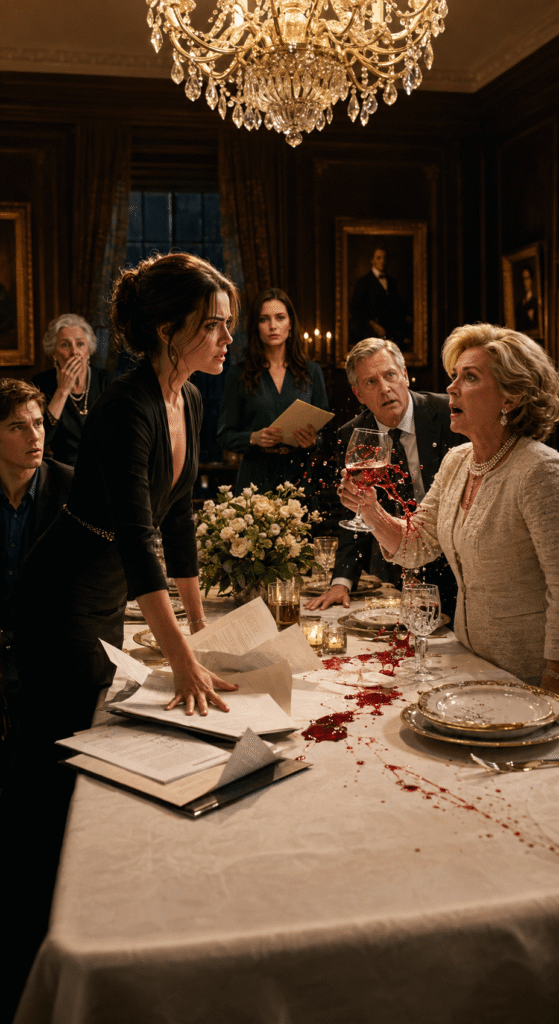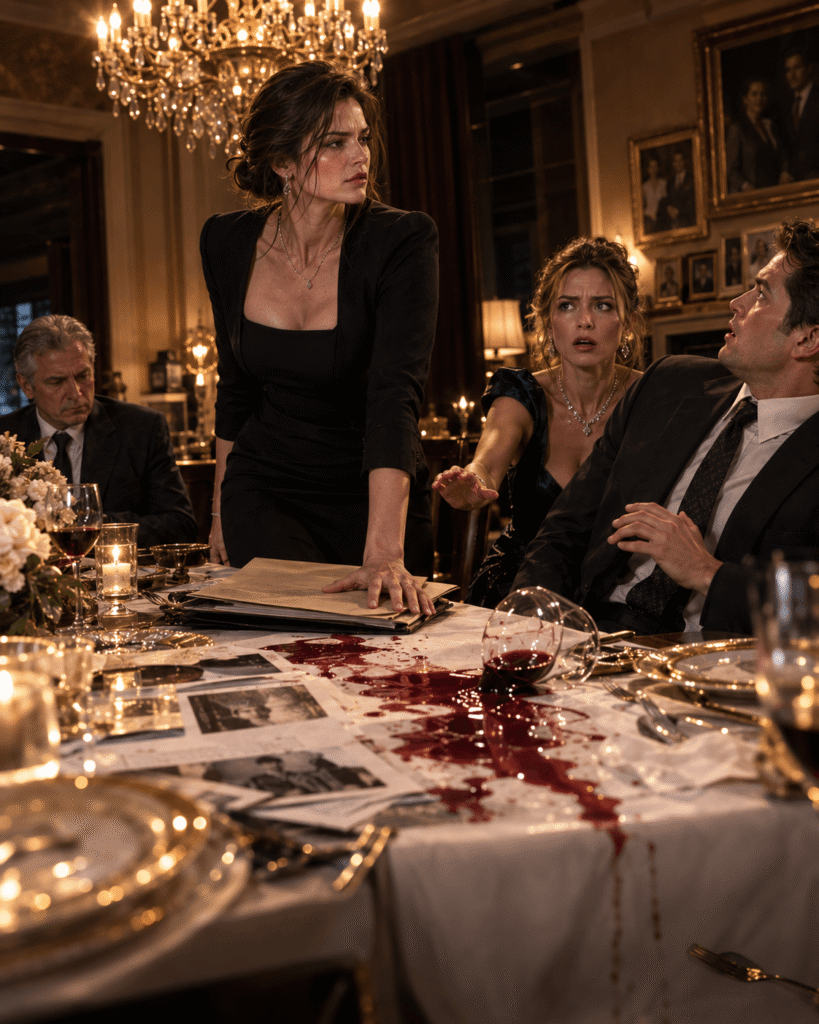
“You’re not even the biggest disappointment in this room.”
She hid his daughter for six years. Now his family wants an heir. A rival wants leverage. And her husband wants a second chance she has no intention of giving.
“You’re not even the biggest disappointment in this room.”
Alina didn’t raise her voice. She didn’t need to. The words landed across the mahogany boardroom table like a thrown gauntlet, and the five faces arrayed opposite her—all Morettis, all male, all wearing variations of the same expensive, inherited scowl—registered the blow with varying degrees of offense.
The youngest, Marco, actually flinched. The patriarch, Salvatore Moretti, did not. He tapped one liver-spotted finger against the polished wood, a metronome counting out her insolence.
“You watch your mouth,” Salvatore said. His voice was gravel dragged over silk. “You are in my house.”
“This is a hotel,” Alina said. “And it’s my boardroom. At least for the next forty-five minutes.” She smoothed the front of her black silk blouse, a gesture she immediately regretted because it revealed the slight tremor in her hand. She balled her fingers into a fist beneath the table. “You summoned me. You have me. Speak.”
She let her gaze sweep the room, cataloging exits and threats with the old, unwelcome instinct that had never quite left her. The Bellwether’s executive boardroom was aggressively masculine: dark wood, leather chairs that cost more than her monthly payroll, a wall of rain-streaked windows overlooking the Pearl District’s glittering, damp streets. December in Portland. The rain never stopped. It just changed its mind about how hard to fall.
Marco shifted in his chair. “We’re not here to fight, Linh An.”
“Alina,” she corrected, the word sharp. “Linh An is for people who knew me before I married into this viper pit.”
“You’re still a Moretti,” Salvatore said.
“On paper. A technicality I’ve been trying to rectify for six years. Your son is the one who keeps stalling the divorce.”
A muscle ticked in Salvatore’s jaw. “Dominic is… reluctant.”
“Dominic is a coward.” The words tasted bitter, familiar. She’d said them to her reflection a thousand times. Saying them to his father felt like finally setting down a heavy weight. “He wants to keep me tethered without actually having to look at me. Classic Dom.”
“He’s outside,” Marco said quietly. “He doesn’t know you’re here.”
Alina’s heart slammed against her ribs. Stupid. Stupid to feel that. She kept her face still, a mask of porcelain indifference. “Then he’s about to have a very bad afternoon. Good. Let him.”
She stood. The meeting was over. She’d said what she came to say—that the shares were hers, that the family’s attempt to pressure her into selling was an exercise in futility, that she would not be summoned like a disobedient daughter-in-law. That she was done.
“We called you here,” Salvatore said, and for the first time, something shifted in his voice. Not anger. Something closer to discomfort. “Because there is a matter that concerns the family. A matter you’ve been keeping from us.”
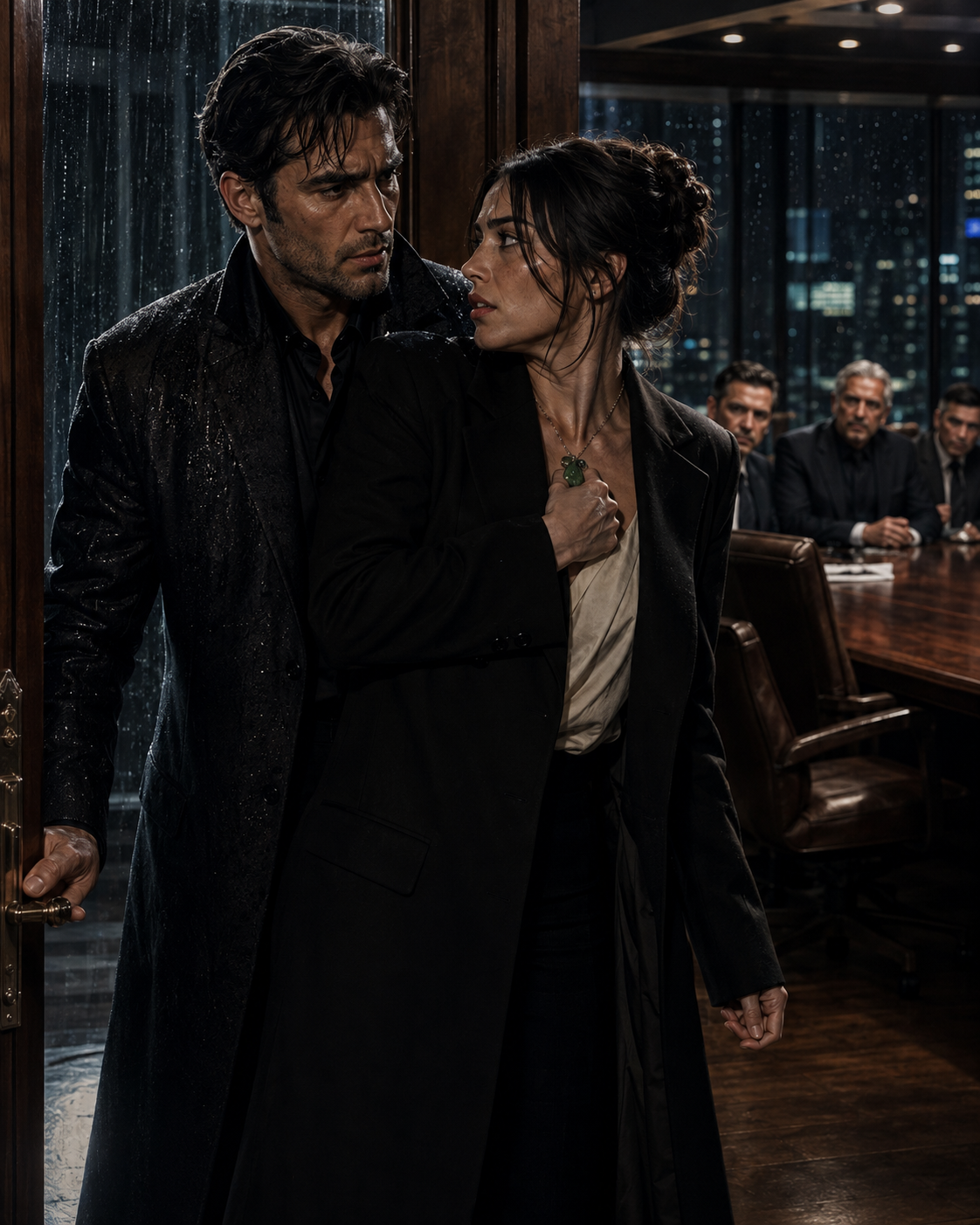
Alina’s blood went cold. Her hand moved, unbidden, to the jade pendant at her throat. She traced the dragon’s carved spine with her thumb.
No. Not yet. I needed more time.
“I don’t know what you’re talking about,” she said.
“Don’t insult me,” Salvatore said. “My son has a child. A daughter. Six years old.” He leaned forward, and the overhead lights caught the deep lines of his face. “And you thought you could hide her from us forever?”
The room tilted. Alina gripped the back of the leather chair, her knuckles whitening. How? How had they found out? She’d been so careful—home-schooling documents, Annie’s school records under her mother’s maiden name, the house in the unincorporated edge of Washington County. No Moretti name anywhere.
But someone found out. Someone told them.
She thought of the missed call from her sister three days ago. The strange car parked across from the restaurant. The lawyer’s email marked URGENT that she’d been avoiding.
The walls of the boardroom seemed to close in.
“She is my daughter,” Alina said, and the ice in her voice could have frosted the windows. “She is not your leverage. Not your heir. Not your anything. You will not speak of her.”
“She is a Moretti,” Marco said. “She should be with her family.”
“She is with her family. I am her family. My mother’s people, my sister, my—she has everything she needs.”
“Except a father,” Salvatore said.
The word hit like a slap.
Alina opened her mouth to retort, but the boardroom door swung open.
And Dominic Moretti walked in.
He was exactly as she remembered, which was the most unforgivable part. Six years had sharpened him—the broad shoulders narrower, the jaw harder, the black hair now threaded with silver at the temples—but the effect was the same: the room contracted around him, the air pressure changed, and Alina’s body responded with a tug of war between fury and something far more dangerous.
Recognition.
He was wearing a charcoal suit, no tie, collar unbuttoned. Rain droplets glistened on his wool overcoat. He hadn’t known she was here. She could tell by the way he stopped dead in the doorway, one hand still on the handle, his dark eyes locking onto her face.
“Alina,” he said.
Not Linh An. Not my wife. Just her name, spoken like a man who’d been holding it in his mouth for years, waiting to exhale.
She found her voice, and it was steady. “Dominic. You look like hell.”
It was true. There were shadows under his eyes that had nothing to do with the dim lighting. A pallor beneath the olive skin. He looked like a man who hadn’t slept in a week, or maybe a year.
But his eyes were clear, and they were fixed on her with an intensity that made her want to step back.
“What are you doing here?” he asked.
“Ask your father,” Alina said. “Apparently, he’s found a new hobby. Interrogating estranged daughters-in-law about their private lives.”
Dominic’s gaze slid to Salvatore. “What is she talking about?”
Salvatore’s lip curled. “She knows. The girl. The child you never told us about.”
The change in Dominic’s face was subtle—a flicker of something behind the eyes, a tightening at the corners of his mouth—but Alina saw it. She’d spent years learning to read that face, and the lessons had stayed, like scars.
He didn’t know.
Oh god. He didn’t know.
The floor dropped out from under her.
She’d assumed—she’d always assumed—that he knew and had simply chosen not to care. That he’d signed the divorce papers without contest because he was done with her, that his silence was rejection. She’d built six years of rage on that foundation.
But the look on his face now was not the look of a man who knew he had a daughter. It was the look of a man realizing he’d been standing on a trapdoor for years, and someone had just pulled the lever.
Dominic turned back to her, and his voice was dangerously quiet. “What child?”
Alina’s throat closed. She could feel the pendant burning against her skin. The dragon, the protector, the one her mother had worn through three countries and two wars. Breathe, she told herself. You have survived worse than this. You have survived him.
“Answer me,” Dominic said, stepping into the room. The door clicked shut behind him. “What child?”
“Minh Anh,” Alina said, and saying her daughter’s name in this room, to these men, felt like a violation. Like handing over a piece of her soul and watching them pass it around, appraising its value. “Her name is Minh Anh. She’s six years old.”
The silence that followed was absolute.
Then Marco let out a low whistle. “Jesus, Dom. You really didn’t know?”
Dominic didn’t look at his brother. He was looking at Alina, and the expression on his face was one she had never seen before. Not anger. Not betrayal. Something more terrifying.
Hope.
“You have a daughter,” he said slowly, like he was learning a new language. “And you didn’t tell me.”
“You didn’t want to know,” Alina said. “You wanted out. You got out. Congratulations.”
“I didn’t—” He stopped, and for the first time, she saw the old Dominic surface—the one who knew he’d made a mistake and couldn’t find the words to admit it. “It wasn’t supposed to be like this,” he said.
The phrase hit her like a physical blow. She hadn’t heard it in six years, but it still landed with the same sick weight, the same hollow excuse.
“No,” she agreed. “It wasn’t. But here we are.”
She grabbed her coat from the back of the chair and pulled it on, her movements sharp and efficient. “This meeting is over. I want the name of whoever told you about my daughter, and then I want all of you to forget she exists. She is not a Moretti. She is not your heir. She is mine, and I will do whatever it takes to keep her away from your world.”
“She is my daughter too,” Dominic said, and there it was—the edge in his voice, the possessive thrum that had once made her feel protected and later made her feel like a possession. “You can’t just walk out of here and pretend this didn’t happen.”
“Watch me.”
She moved toward the door, but Dominic stepped into her path. Not blocking her—he’d never physically blocked her, not even in their worst fights—but close enough that she could smell him: cedar and rain and the faint trace of something she’d spent six years trying to forget.
“Don’t,” she said, her voice low. “Don’t you dare try to keep me here.”
“I’m not trying to keep you,” he said. “I’m trying to understand. Just… explain it to me. Why didn’t you tell me?”
The question hung in the air between them, raw and impossible.
“Because you made it clear,” Alina said, each word precise as a scalpel, “that you wanted nothing to do with me. And I was not going to bring a child into the path of a man who saw me as a mistake he was forced to carry.”
Dominic flinched. It was barely perceptible, but she saw it.
“That’s not—” he started.
“It’s done.” She stepped around him, her shoulder brushing his chest, and the contact sent a jolt through her—of memory, of anger, of something she refused to name. “Don’t contact me. Don’t contact her. If you do, I will make sure every dirty secret this family has ever tried to bury gets handed to the DA’s office. I’ve had six years to collect. Try me.”
She reached the door and yanked it open.
“And Dominic?” she said, not turning around.
“What?”
“The next time your family summons me like a dog to heel, remind them that I own more of this company than they do.” She finally looked back, meeting his eyes for the last time. “Not your call.”
She walked out into the hallway, and the door swung shut behind her, leaving silence and the ghost of her footsteps on the marble floor.
Alina made it to the parking garage before her legs gave out.
She collapsed against the cold concrete pillar, her breath coming in ragged gasps, the edges of her vision gray and pulsing. The pendant was still clutched in her fist, the dragon’s scales digging into her palm.
They know. They know. They know.
She fumbled in her coat pocket for her phone, her fingers numb. She had to call Thuy. She had to get Annie out of the city, out of the state, somewhere the Morettis couldn’t reach. She had to—
Her phone buzzed in her hand.
A text from an unknown number.
Unknown: Pretty little girl you have. Does she know her daddy’s a monster?
Below the text, a photo.
Annie, in her blue raincoat, standing on the steps of Hoa Sen Elementary School, laughing at something out of frame.
The time stamp: forty-two minutes ago.
Alina stared at the photo, her vision narrowing to a single point. The raincoat. The green umbrella with the duck handle. The tiny pink backpack with the unicorn keychain.
No. No no no no no—
She pulled up Annie’s school contact, her thumb shaking so hard she could barely hit the call button.
It rang once. Twice.
“Hello, this is Hoa Sen Elementary, how can I help you?”
“This is Alina Nguyen,” she said, her voice cracking. “I need to speak to someone about my daughter, Minh Anh Nguyen. She’s in Ms. Park’s first-grade class. Please, is she there? Is she okay?”
A pause. The sound of papers shuffling.
“Minh Anh? Let me check. Hold please.”
The line clicked. Alina pressed her forehead against the cold concrete, her eyes squeezed shut, the phone trembling against her ear.
Please. Please. Please.
The hold music clicked off.
“Ms. Nguyen? Your daughter left with the after-school program at 3:15. She should be on the van now.”
Alina’s stomach dropped. “What after-school program? I didn’t sign her up for any after-school program.”
“Let me look at the file…” The secretary’s voice grew uncertain. “It says here she was picked up by her father.”
The world stopped.
“Her father?” Alina whispered.
“Yes, ma’am. A Mr. Dominic Moretti. He signed her out about twenty minutes ago.”
The phone slipped from Alina’s fingers.
It clattered on the concrete, the screen shattering.
But she could still see the photo, burned into her mind: Annie laughing, unaware, with a shadow falling across her from behind.
And the text message, waiting like a blade.
Does she know her daddy’s a monster?
Chapter 2: The Man Who Wasn’t There
Alina’s hand was shaking so violently she couldn’t unlock her car.
She stood in the parking garage, the shattered phone face-down on the concrete, the rain pounding on the roof overhead like a fist against a coffin lid. The school secretary’s words echoed in her skull, a needle skipping on the same groove: picked up by her father… Mr. Dominic Moretti… signed her out twenty minutes ago…
Her father.
The man who had looked at her in the boardroom with hope—the most dangerous emotion a Moretti could feel.
She fumbled for the door handle. The key fob slipped from her fingers, clattered to the ground. She bent to retrieve it, and her vision swam—black spots, the taste of copper in her mouth. Breathe. Breathe. Breathe. The dragon pendant swung against her collarbone, cold and mocking.
A hand closed over hers.
She screamed—a raw, ragged sound torn from some animal place—and spun, her fist already cocked back.
Dominic caught her wrist before it connected. His grip was iron, but not crushing. He was breathing hard, rain plastering his hair to his forehead, his coat soaked through. He must have run from the hotel.
“Alina.” His voice was a low rasp. “What happened? What’s wrong?”
She yanked her hand free, but he didn’t let go of her wrist. “Let go of me,” she hissed. “Let go, or I swear to God I will scream and every cop in this city will come running.”
“Look at me,” he said. “You can barely stand. What happened to Annie?”
The sound of her daughter’s name in his mouth made her want to throw up. It was wrong. It was a violation. It was—
“Someone took her,” Alina said, and the words came out on a sob she hadn’t known was there. “Someone signed her out of school pretending to be you. A man. They let her go with a stranger because he said he was her father. And I got a text—a photo—her in her raincoat, laughing, and a message that said ‘does she know her daddy’s a monster’.”
Dominic went very still.
The kind of still that precedes violence.
“Show me,” he said.
“My phone is broken.” She pointed at the shattered device on the ground. “I dropped it when the school called. I have to go. I have to find her. I have to call the police, I have to call Thuy, I have to call everyone, I have to—“
“Stop.” He released her wrist, but only to cup her face in both hands, forcing her to meet his eyes. It was an intimate gesture, one that would have once made her melt and now made her flinch. But he held her steady, his thumbs brushing the tears she didn’t know she was crying. “Breathe, Alina. Look at me. You’re not alone. I’m going to help you find her. Do you understand?”
“I don’t want your help.”
“Too bad.” His voice was brutal, but his hands were gentle. “She’s my daughter too. And right now, the fastest way to find her is through my people. Unless you have a better plan.”
She didn’t. She had nothing. Her entire world had been reduced to a single, screaming imperative: get to Annie.
Dominic bent down and picked up her phone. He slid it into his pocket, then pulled out his own. “I’m calling my head of security. His name is Rocco. He’s good at this. Trust me.”
“I don’t trust you.”
“I know.” He was already dialing. “But you need me. That’s enough for now.”
He turned away, speaking low and fast into the phone. Alina stood there, rain soaking through her blouse, her arms wrapped around her chest, and watched the man she had once loved more than her own life coordinate a search for the daughter he’d never met.
Not your call, she thought. But it is. God, it is.
Rocco arrived in eleven minutes.
He was a block of granite in a black leather jacket, with a scar cutting through his left eyebrow and a voice like gravel in a blender. He looked at Alina once—a quick, assessing glance that took in her soaked clothes, her shaking hands, the wild look in her eyes—and then he looked at Dominic.
“I got the school’s security footage,” Rocco said, pulling out a tablet. “Whoever took her knew the pickup protocol. Walked in, showed an ID, signed the right name. But it wasn’t you, boss.” He held up the screen. “Facial recognition says it’s a guy named Tommy Bianchi. Low-level muscle, used to run with the DeLuca crew before they got rolled up. Been freelancing since.”
Dominic’s jaw tightened. “Who hired him?”
“Still working on it. But the text your wife got”—he glanced at Alina—“it came from a burner phone bought two days ago in Vancouver. Untraceable.”
“It’s traceable,” Dominic said. “Everything’s traceable.”
“Not this. Not with what we’ve got access to. Not legally.”
There was a long, loaded pause. Dominic stared at the rain, his face unreadable. Then he said, “Rocco, you still have that contact in the Vancouver PD?”
“Yeah.”
“Use it. Call in every favor. I don’t care what it costs. I want to know who bought that phone and where they took my daughter.”
“And if it costs something illegal?”
“Then we deal with it later.” Dominic turned to Alina. “You need to go home. Rest. I’ll call you the second we know anything.”
“No.” Alina shook her head, her voice flat and hard. “I’m not going home. I’m not resting. I’m going to every place I can think of—her school, the park, Thuy’s house, the restaurant—and I’m going to find my daughter.”
“You’ll only get in the way.”
The words landed like a slap. She stepped toward him, her fear transmuting into fury. “Get in the way? She is my daughter. I have raised her alone for six years. I changed every diaper, walked every fever, kissed every scraped knee. I am not getting in the way. I am the only person in this whole godforsaken city who actually loves her, and I am not going to stand here and let you—“
“I’m not letting you do anything.” Dominic’s voice rose, then dropped to a dangerous whisper. “I’m trying to protect you. Both of you. But if you go running around Portland in this state, you’re going to get yourself killed, and then what good are you to her?”
“Don’t you dare tell me what’s good for my daughter.”
“Our daughter,” he corrected, and the word hit her like a physical blow.
She stared at him, her chest heaving. The rain was coming down harder now, a silver curtain between them. Somewhere in the distance, a siren wailed.
“You lost the right to say that,” she said quietly. “When you signed the divorce papers and never looked back.”
“I never signed them.”
The confession stopped her cold.
“What?”
“I never signed the divorce papers,” Dominic repeated. “I couldn’t. I’ve been carrying them around for six years, Alina. Signed, sealed, notarized. But I never filed them. I told your lawyer it was done, but it wasn’t. I couldn’t let you go.”
The ground tilted again. She grabbed the side of the car to steady herself.
“You—you told me it was over. You told me you wanted out. You were the one who—“
“I know what I said.” His voice was hollow. “I was lying. I thought you’d betrayed me. I thought you’d sold me out to the Feds, to my father’s enemies, to anyone who would pay. I thought the only way to survive was to make you hate me enough to leave and never come back.”
“I never betrayed you.”
“I know that now.”
“Then why—“
“Because I was a coward.” He said it simply, without self-pity. “Because I believed the wrong people. Because I let my father’s lies turn me into the kind of man who throws away the only good thing he’s ever had. And by the time I realized the truth, you were gone, and I didn’t know how to find you, and I thought—I thought it was too late.”
The rain dripped off his hair, ran down his face like tears. Alina stared at him, her heart a battleground of rage and grief and something achingly soft that she refused to name.
“It is too late,” she whispered.
“I know,” he said. “But it’s not too late for her.”
He turned back to Rocco. “Find Bianchi. Find the phone. And find my daughter. Now.”
Rocco nodded once and walked off into the rain.
Alina watched him go, then turned to Dominic. “If anything happens to her,” she said, her voice barely audible over the storm, “I will kill you myself.”
“If anything happens to her,” he replied, “I’ll hand you the gun.”
Chapter 3: The Girl with the Duck Umbrella
They found her at a diner off I-5, thirty miles south of Portland.
Tommy Bianchi had taken her to a Shari’s restaurant, ordered her a grilled cheese and a chocolate milk, and then proceeded to panic in the parking lot when he realized he had no idea what to do with a six-year-old who kept asking him if he knew that ducks could sleep with one eye open.
The tip came from a waitress who’d noticed the man in the diner didn’t look old enough to be the father of a child who called him “Mister” and asked to borrow his phone to call her mom because she had to remind her about the science fair project.
When Rocco’s people pulled into the parking lot, Bianchi tried to run. He made it about ten feet before two of Dominic’s men tackled him into a puddle. The girl watched the whole thing from inside the diner, calmly dipping a french fry into ketchup, her duck-handled umbrella propped against the booth beside her.
Alina was the first one through the door.
“Annie!”
The girl looked up, her face breaking into a wide, gap-toothed smile. “Mẹ! You came! I told this man you’d come. He didn’t believe me. He kept saying ‘just wait, just wait,’ but I knew you’d find me because you always find me, even when I hide in the laundry basket and you pretend you can’t see me but I know you can because your shoulders shake.”
Alina crossed the diner in three steps and swept her daughter into her arms, the force of the embrace lifting Annie off the vinyl seat. She buried her face in the girl’s dark hair, inhaling the scent of rain and ketchup and the strawberry shampoo they’d bought at the Vietnamese grocery on Powell.
“I’m here, baby. I’m here. You’re safe. You’re safe.”
“I know,” Annie said, her voice muffled against Alina’s shoulder. “I wasn’t scared. Well, a little scared. But not too much. Because I had my umbrella, and the ducks.” She held up a small plastic bag. “I found a rock outside. I named it after Bà ngoại’s favorite poet. I’ll show you later.”
Alina laughed—a wet, broken sound—and pulled back to look at her daughter’s face. Annie was unharmed. Smiling. Completely, infuriatingly unfazed.
“You are the bravest, strangest, most wonderful child,” Alina said, cupping her daughter’s cheeks. “And we are going to have a very long talk about stranger danger.”
“He wasn’t a stranger,” Annie said matter-of-factly. “He knew my name. And he knew your name. And he said he was my dad, but I told him that wasn’t true because my dad is dead.”
The words hit Alina like a bucket of ice water.
She opened her mouth to respond, but before she could, the diner door swung open and Dominic walked in.
He was soaked to the bone, his black shirt plastered to his chest, his face pale beneath the stubble. He stopped three feet from the booth, his eyes fixed on Annie, and Alina saw something in his face she’d never seen before—not in all their years of marriage, not in the boardroom an hour ago.
Terror. And wonder. And a grief so deep it seemed to swallow the light.
Annie looked up at the tall stranger in the doorway. Then she looked at Alina.
“Is that him?” she asked, in the same tone she used to ask if the moon was made of cheese. “Is that the man who was pretending to be my dad?”
Alina’s throat closed.
Dominic took a step forward, then stopped. He was shaking, Alina realized. The most dangerous man in the Pacific Northwest was shaking like a leaf in a storm.
“No, baby,” Alina said softly, and she heard her own voice break. “That’s not the man who took you. That’s… that’s someone else.”
Annie studied Dominic with the frank, unblinking curiosity of a child who had never been taught to fear the monsters under the bed, because her mother had always been the thing that scared them away.
“He looks sad,” Annie observed. “Like Mr. Henderson’s dog when he got left out in the rain.”
“I am sad,” Dominic said, his voice rough. “I’m very sad.”
“Why?”
“Because I didn’t know about you until today. And now I do, and I’m very happy and very sad at the same time. And I don’t know what to do with that.”
Annie considered this. “Sometimes when I feel two things at once, I draw a picture of both of them and then I rip it in half and tape it back together wrong so it makes a new picture. Maybe you should do that.”
Dominic let out a sound that was half laugh, half sob. “Maybe I should.”
“I have crayons in my backpack,” Annie offered. “But the mean man took my backpack. It had my unicorn keychain on it. And my rocks. I’m very upset about the rocks.”
“I’ll get them back,” Dominic said. “I promise.”
“Okay.” Annie nodded, satisfied. Then she turned back to Alina. “Can I have another grilled cheese? The man didn’t let me finish because he got scared and ran outside and then the big men tackled him. I was saving my french fries for later but they got cold and now I don’t want them.”
Alina let out a shaky breath. “Yes, baby. You can have another grilled cheese.”
“With extra pickles?”
“With extra pickles.”
Annie slid out of the booth and began organizing the salt and pepper shakers on the table, humming a Vietnamese lullaby under her breath. She seemed entirely unaware that she had just detonated a bomb in the center of Alina’s carefully constructed world.
Dominic was still standing there, frozen, his eyes tracing every detail of Annie’s face—the shape of her nose, the curve of her smile, the exact shade of her hair. Alina watched him watch her daughter, and something in her chest cracked open.
He’s not going to walk away from this. Not now.
“Dominic,” she said quietly.
He dragged his gaze away from Annie and met her eyes. For a long moment, neither of them spoke. The diner hummed with the low murmur of other patrons, the clatter of dishes, the hiss of the grill.
“She has your mother’s eyes,” he finally said.
“She has my mother’s stubbornness,” Alina replied. “And your chin. And your complete inability to sit still when she’s thinking.”
Dominic’s lips twitched. It wasn’t quite a smile, but it was close.
“What’s her full name?”
“Minh Anh Nguyen.” Alina hesitated, then added, “I gave her my mother’s maiden name. Nguyen. Not Moretti. I didn’t want your family to find her.”
“But you kept my name,” he said. “Legally.”
“Because I couldn’t change it without revealing I was still married to you. And I didn’t want to answer questions. So I stayed Alina Moretti. It was easier.”
“Easier,” he repeated, and there was a world of pain in the word.
Annie looked up from her salt shaker arrangement. “Are you really my dad?” she asked Dominic, with the bluntness of a guillotine.
Dominic’s breath caught. He looked at Alina, a question in his eyes.
Alina nodded, just once. Tell her the truth. She deserves that much.
Dominic crouched down so he was at eye level with Annie. It was an oddly vulnerable position for a man who normally commanded every room he entered.
“Yes,” he said. “I’m really your dad.”
Annie tilted her head. “Where have you been?”
The question hung in the air, a blade waiting to fall.
“I didn’t know about you,” Dominic said. “And that’s not an excuse. It’s just the truth. Your mom and I—we were having a very hard time, and we weren’t together anymore, and she didn’t tell me about you because she thought I might not be a good dad. And she was probably right.”
“But now you know,” Annie said.
“Now I know.”
“So what are you going to do about it?”
Dominic stared at her, and Alina saw something shift in his face—a slow, tectonic movement, like a mountain deciding to kneel.
“I’m going to try,” he said. “Every day. For the rest of my life. To be someone you can be proud of. Even if it takes a very long time. Even if you never call me Dad. Even if your mom never forgives me. I’m going to try.”
Annie considered this for a long, solemn moment. Then she picked up a french fry—cold, limp, abandoned—and held it out to him.
“You can have my sad fry,” she said. “It’s not very good, but it’s what I have.”
Dominic took the fry. He held it like it was made of gold.
“Thank you,” he said, and his voice cracked.
“You’re welcome,” Annie said. “Now sit down. You’re dripping on my salt shakers.”
Chapter 4: The Terms of Surrender
They spent three days in Dominic’s penthouse.
It wasn’t a choice—it was a necessity. Tommy Bianchi, under the kind of pressure only Dominic’s men knew how to apply, had given up a name: Vincent Caruso, a rival operator who’d been trying to muscle in on Moretti turf for the past two years. Caruso had learned about Annie through a mole in the Moretti household—someone who’d overheard Salvatore’s discovery of the child and sold the information to the highest bidder.
Until Caruso was dealt with, Alina and Annie couldn’t go home. Couldn’t go to school. Couldn’t go anywhere without an armed escort.
So they stayed in the penthouse, a sleek glass-and-steel fortress thirty floors above the city, where the rain streaked the windows like tears and the only sounds were the hum of the security system and the soft click of Annie’s crayons against the marble floor.
Alina hated it. The penthouse was a monument to everything she’d fled—the cold luxury, the constant surveillance, the suffocating weight of the Moretti name. But she stayed, because Annie was safe here, and because every time she thought about leaving, she remembered the photo on her shattered phone.
Does she know her daddy’s a monster?
Dominic stayed too. He cleared his schedule, canceled a business trip to Vegas, and spent his days on the phone with Rocco, coordinating the search for Caruso. But every evening, at six o’clock sharp, he appeared in the living room with a box of takeout and a pile of board games, and he sat on the floor with Annie and played Candyland like it was the most important thing in the world.
On the second night, Annie asked him why he had a broken watch in his desk drawer.
Dominic went still. The watch was lying on the coffee table, where Annie had found it while exploring. She’d opened every drawer in the penthouse, because that was what she did—she was a collector of secrets, a tiny archeologist of other people’s lives.
“That’s a very old watch,” Dominic said carefully. “It doesn’t work anymore.”
“Then why do you keep it?”
He glanced at Alina, who was sitting on the couch pretending to read a book. She felt his gaze and looked up, but didn’t meet his eyes.
“Because it reminds me of a mistake I made,” he said. “A very long time ago.”
“Was it a big mistake?”
“The biggest.”
Annie nodded sagely. “Did you break it?”
“Yes.”
“On purpose?”
“Yes.”
“Did it hurt someone?”
Dominic was silent for a long moment. “Yes,” he finally said. “It hurt someone I loved very much.”
Annie considered the watch, her brow furrowed. “You should fix it,” she said. “Even if it doesn’t work, you should fix it. Then it won’t be a broken mistake anymore. It’ll be a fixed mistake. And maybe the person you hurt will see it and know you tried.”
The book slipped from Alina’s hands.
She caught it before it hit the floor, but not before Dominic saw. Their eyes met across the room, and Alina felt something shift—a crack in the wall she’d built, a sliver of light through the concrete.
“Maybe,” Dominic said quietly. “Maybe I will.”
The next morning, Alina found him in the kitchen at dawn, a toolbox spread out on the counter, the broken Rolex disassembled into a dozen tiny pieces.
He looked up when she walked in, and for a moment, he looked almost sheepish.
“I don’t know what I’m doing,” he admitted. “I can’t fix a watch. I can barely change a tire.”
“Then why are you trying?”
“Because she asked me to.”
Alina stared at him. The morning light was gray and soft, filtering through the rain-streaked windows, and Dominic looked older in that light—tired, worn, but somehow softer around the edges.
“You can’t fix everything with a screwdriver,” she said.
“I know.” He picked up a tiny gear, held it between his thumb and forefinger. “But I have to start somewhere.”
Alina walked to the coffee maker and poured herself a cup. She didn’t offer him one. The silence stretched between them, heavy with everything unsaid.
“I’m not going to forgive you,” she said finally. “Not yet. Maybe not ever.”
Dominic nodded, not looking up from the watch. “I know.”
“And I’m not going to let you have custody. Not unless I decide it’s what’s best for Annie. And right now, I don’t think it is.”
“I know.”
“And if you ever lie to me again—about anything—I will take her and disappear so completely that you’ll spend the rest of your life wondering if she was even real.”
This time, he looked up. His eyes were red-rimmed, but steady. “I know.”
“Good.” She took a sip of coffee, scalding her tongue. “Then we understand each other.”
“Not quite.” He set down the gear and turned to face her fully. “I need you to understand something too. Something I should have told you six years ago, but I was too proud and too stupid and too scared.”
Alina’s grip tightened on the mug. “What?”
“I never stopped loving you,” Dominic said. “Not for a single day. Even when I thought you’d betrayed me. Even when I told myself I hated you. Even when I sat in my car outside your restaurant and watched you laugh with your sister and thought, she’s better off without me. I never stopped.”
The words hung in the air between them, raw and unpolished.
Alina set down her mug. Her hands were shaking again.
“That’s not fair,” she whispered. “You don’t get to say that.”
“I know it’s not fair. And I’m not asking for anything. I’m just telling you the truth, because you deserve to know it. And because if something happens to me—if Caruso comes after me, or this life finally catches up—I want you to know that you were never just a mistake. You were the only thing that ever made me feel like I could be someone worth knowing.”
The wall cracked a little more.
Alina turned away before he could see the tears in her eyes. “I have to take Annie to her virtual doctor’s appointment,” she said, her voice thick. “Don’t wait up.”
She left the kitchen and didn’t look back.
But she heard him pick up the screwdriver again, and the tiny, delicate sound of metal against metal followed her down the hallway like a promise.
Chapter 5: The Mole
On the fourth night, Alina found the custody agreement.
It was in Dominic’s study, tucked beneath a stack of invoices—a thick legal document, stamped with the Moretti family crest, outlining terms for shared custody of Minh Anh Moretti.
Minh Anh Moretti. Not Nguyen. Moretti.
Alina’s blood turned to ice.
She’d gone into the study to borrow a phone charger—Dominic had given her access to the whole penthouse, told her to make herself at home—and there it was, lying in plain sight like a snake in the grass.
She picked it up with numb fingers and flipped through the pages. The legal language blurred, but the key phrases jumped out: primary residence with the father… supervised visitation for the mother… name legally changed to reflect paternal lineage…
A sound escaped her—a choked, animal noise—and she staggered back, the papers scattering across the floor.
He’s trying to take her from me. All of this—the kindness, the watch, the lies—it was all a performance. He was never going to let me keep her.
She stumbled out of the study and down the hall to Annie’s room. The girl was asleep, her duck umbrella propped against the nightstand, her rock collection lined up on the windowsill in careful rows. Alina stood in the doorway, her breath coming in ragged gasps, and watched her daughter sleep.
I won’t let him. I won’t.
She was reaching for her phone—the shattered one, which Dominic had replaced with a new one that morning—when she heard footsteps behind her.
“Alina.”
She spun. Dominic stood at the end of the hall, his face shadowed, his shirt untucked, his hair disheveled. He looked like he hadn’t slept.
“Get away from me,” she hissed. “Get away from her.”
His eyes flicked to the study door, then back to her face. He saw the papers in her hand—she was still clutching them, she realized, crumpled and damp with sweat—and his expression shifted into something like panic.
“It’s not what you think.”
“Really?” Her voice was a knife. “Because what I think is that you’ve been lying to me this whole time. That you’ve been playing the sad, repentant ex-husband while your lawyers drafted a custody agreement that would give you primary residence and reduce me to supervised visitation. What else could it possibly be?”
“It’s a draft,” he said, stepping toward her. “My father’s lawyers sent it to me three days ago. I didn’t sign it. I never intended to sign it. I was going to show it to you tonight and tell you what I planned to do about it.”
“What you planned to do,” she repeated, her voice shaking. “And what was that?”
“I was going to burn it,” Dominic said. “And then I was going to call my father and tell him that if he ever tried to take Annie from you again, I would disown the whole family. I would walk away from the business, the money, the name. Everything. I would choose you and Annie over all of it.”
The words hit her like a wave, but she didn’t let herself believe them. Not yet.
“Prove it,” she said.
“I can’t. Not right now. But I can show you.” He held out his hand. “Come with me.”
She didn’t take it. But she followed him to the study, where he picked up the scattered pages, stacked them neatly, and then—without a word—walked over to the fireplace.
“Wait,” Alina said. “It’s August. We can’t—“
But Dominic had already pulled out a lighter from his pocket. He flicked it once, twice, and the flame caught. He held it to the corner of the custody agreement, and the paper curled and blackened, the legal jargon dissolving into ash.
He dropped the burning document into the empty fireplace, and they stood together and watched it burn.
“There,” he said, when it was done. “Now it doesn’t exist.”
Alina stared at the ashes, her heart pounding. “That was a draft. There will be others.”
“No. There won’t.” He turned to face her, and his eyes were fierce. “Because I’m going to call my father right now, with you standing here, and I’m going to tell him that if he ever sends another custody document, another lawyer, another anything—I’ll cut him out of my life. And I mean it.”
He pulled out his phone and dialed. Alina watched, frozen, as the call connected.
“Dad. It’s Dominic. I’m with Alina. And I need you to listen very carefully, because I’m only going to say this once.”
He didn’t raise his voice. He didn’t threaten. He just spoke, calm and final, like a man laying down a law he had no intention of breaking.
“The girl—Minh Anh—is Alina’s daughter. I’m her father, but I haven’t earned the right to be called that yet. And I won’t earn it by taking her away from the only parent she’s ever known. So if you want to be part of your granddaughter’s life, you will do it on Alina’s terms. Not mine. Not yours. Hers. And if you can’t accept that, then you can consider yourself childless. I’m done being your heir. I’m done being your son. I’m done.”
He hung up before Salvatore could respond.
The silence in the study was absolute.
Then Alina did something that surprised them both. She laughed—a short, broken sound that was half sob.
“You just disowned your father,” she said.
“Yes.”
“Over a custody agreement you never intended to sign.”
“Yes.”
“That’s the dumbest, most dramatic, most—“
“I know,” Dominic said, and for the first time, a real smile broke across his face—tired, rueful, but genuine. “But it was the only thing I could think of that would prove I meant it.”
Alina looked at him, at the ashes in the fireplace, at the phone still clutched in his hand. The wall was crumbling now, faster than she could rebuild it.
“You’re an idiot,” she said.
“I know.”
“And I’m still not forgiving you.”
“I know.”
“But…” She took a shaky breath. “But maybe, someday, if you keep doing things like that—burning drafts and disowning fathers and fixing broken watches—maybe I’ll believe you.”
Dominic’s smile faded into something softer. “That’s all I’m asking for.”
“No,” Alina said. “You’re asking for more. You’re asking for everything. But for now, this is what you get.”
She held out her hand.
After a moment, he took it.
His palm was warm, calloused, familiar. And for the first time in six years, Alina didn’t pull away.
Chapter 6: The Devil’s Bargain
The next morning, Rocco called with news: Caruso had been located. He was holed up in a warehouse on the east side, and he was planning to move Annie—again—unless they acted fast.
“He’s got a buyer,” Rocco said, his voice grim. “Some outfit out of Seattle that deals in… specialized assets. They want a Moretti child. Leverage, ransom, who knows. But if we don’t move now, she’ll be gone by nightfall.”
Dominic listened, his face hard as granite. Alina stood beside him in the kitchen, her coffee growing cold in her hands.
“What’s the plan?” Dominic asked.
“We hit the warehouse. Full team. Ten men, maybe more. But there’s a complication.”
“What kind of complication?”
“Caruso has a hostage. An old friend of yours. Someone he knew would make you hesitate.”
Alina’s blood went cold. “Who?”
Rocco was silent for a moment. Then he said, “Marco.”
Dominic’s face went white. “What?”
“Your brother. Caruso grabbed him last night outside the Bellwether. He’s holding him in the same warehouse. Says if you don’t show up alone—unarmed, no backup—he’ll kill Marco and take the girl anyway.”
The phone slipped from Dominic’s fingers.
He caught it before it hit the floor, but not before Alina saw the terror in his eyes—not for himself, but for Marco, the brother who had once been his closest ally, before the family’s machinations tore them apart.
“He wants to force me to choose,” Dominic said slowly. “My brother or my daughter.”
“No,” Alina said, her voice cutting through the room. “He wants to force you to walk into a trap. And if you do, you lose both of them.”
Dominic turned to her, his expression raw. “I can’t let Marco die. I can’t.”
“And I can’t let Annie die. So we do this together.”
“Alina, this isn’t your—“
“She is my daughter.” Alina stepped toward him, her eyes blazing. “And Marco is my brother-in-law, whether I like it or not. I’m not sitting this one out. Not your call.”
For a long moment, they stared at each other. Then Dominic nodded, once, like a man accepting an inevitable truth.
“Fine,” he said. “But you stay behind me. At all times. And if I tell you to run, you run—with Annie—and you don’t look back.”
“Deal.”
Rocco’s voice came through the phone, tinny but firm. “I’ll rally the team. We’ll have a perimeter in twenty minutes. Dom, we can’t wait for you—if Caruso sees a convoy, he’ll kill everyone and burn the place down. We have to move now.”
“I’m on my way.” Dominic grabbed his coat from the back of the chair. “Alina—“
“I’m coming with you.”
“No. You stay here. I’ll call you the second—“
“I said I’m coming.” Her voice was steel. “Annie is sleeping. Rocco’s men are outside. I’m not going to sit in this penthouse and wait for a phone call that might never come. I’m coming with you, or I’m driving myself. Either way, I’ll be at that warehouse.”
Dominic stared at her for a long, charged moment. Then he let out a breath.
“Fine. But you do exactly what I say. Exactly.”
“Fine.”
They left the penthouse together, the rain swallowing them as they stepped into the elevator, the city blurring past the glass walls. Somewhere below, Rocco’s men were moving into position. Somewhere across the river, a warehouse waited, and inside it, a devil’s bargain.
And in the bedroom at the end of the hall, Annie Moretti slept on, her duck umbrella propped against the nightstand, her rock collection lined up in careful rows, her dreams untroubled by the storm gathering on the horizon.
Chapter 7: The Warehouse
The warehouse rose from the east side like a rusted wound, its corrugated walls bleeding into the gray rain.
Alina crouched behind Dominic in the shadow of a shipping container, the cold metal seeping through her coat. Around them, Rocco’s men moved like ghosts—slipping between stacks of pallets, disappearing into doorways, their footsteps swallowed by the drumming rain.
Rocco’s voice crackled in Dominic’s earpiece. “Two guards at the north entrance. Three on the catwalk. Caruso’s in the office at the back, with Marco and the girl. We’ve got a clear line on the perimeter, but if we breach, he’ll have time to kill one of them before we reach him.”
Dominic’s jaw was set. “What about the buyer? The Seattle outfit?”
“Two vans parked on the south side. Driver’s still in the first one. Second one’s empty—probably inside making the deal.”
“So we’re not just dealing with Caruso. We’re dealing with professionals.”
“Yes.”
Alina’s heart was a wild drum in her chest. She’d seen violence before—she’d grown up in the shadow of it, married into the heart of it—but she’d never been this close to the trigger. The air tasted like rust and rain and fear.
“Let me go in first,” Dominic said quietly. “Alone. Caruso wants me to walk in unarmed. I’ll give him what he wants—me—and buy time for your men to get into position.”
“No.” The word escaped Alina before she could stop it. “That’s suicide.”
“It’s the only way to get close enough to Annie and Marco before the shooting starts.”
“There has to be another way.”
“There isn’t.” Dominic turned to her, and for a moment, the mask slipped. She saw it all—the fear, the guilt, the desperate need to make things right. “I’ve spent six years running from this life. From my family. From you. I’m done running. If I have to die to save our daughter, then that’s a trade I’m willing to make.”
The words hit her like a punch to the chest.
“Don’t,” she whispered. “Don’t you dare make me watch you die.”
“I’m not planning to die.” He reached out, and his fingers brushed her cheek—a feather-light touch that sent a shiver down her spine. “But I need you to trust me. Just this once. Can you do that?”
Alina stared at him. The rain was cold on her face, but his hand was warm. For six years, she’d dreamed of this moment—of him asking for her trust, of her slamming the door in his face. But now, with Annie inside that warehouse and Marco’s life hanging in the balance, she found that the door was already open.
“Don’t make me regret it,” she said.
“I won’t.”
He pulled his hand away and reached for the gun tucked into the back of his waistband. He checked the magazine, then handed it to Rocco.
“No weapons,” he said. “Caruso wants me helpless. I’ll give him helpless.”
Rocco’s face was like stone. “Boss, if this goes south—”
“Then you get Annie out. No matter what. Understood?”
Rocco nodded once, his jaw tight.
Dominic turned back to Alina. “Stay with Rocco. When the shooting starts, you run. Not before. Not after. The second it starts.”
“Dominic—”
“Promise me.”
The word caught in her throat. But she nodded.
“Promise me,” he repeated, his eyes burning into hers.
“I promise.”
He looked at her for one more moment—a long, searching look that seemed to memorize every detail of her face—and then he walked out of the shadows and into the rain.
Alina watched him go, her heart in her throat.
Don’t you dare die. Not now. Not when we’re finally—
She couldn’t finish the thought.
Chapter 8: The Devil’s Bargain
Dominic walked through the warehouse doors with his hands raised.
The interior was dim and cavernous, lit by a few bare bulbs that swayed from the rafters. Rain dripped through holes in the roof, pinging against metal barrels and pooling on the concrete floor. The air stank of oil and mildew and something else—fear.
Vincent Caruso was waiting for him in the center of the floor, flanked by three armed men. He was a thin, angular man with a predator’s smile and eyes that never seemed to blink. Behind him, tied to a chair, was Marco—bruised and bleeding but alive, his eyes wide with terror.
And beside Marco, sitting on an overturned crate, was Annie.
She was holding her duck umbrella. She looked up when Dominic walked in, and her face broke into a gap-toothed smile.
“You came,” she said. “I told the mean man you would. He didn’t believe me, but I told him. You came.”
Dominic’s heart cracked open. “I came,” he said. “I’m here.”
Caruso laughed—a thin, rattling sound. “How touching. The prodigal father returns.” He clapped his hands together. “Dominic Moretti. I was beginning to think you’d let your brother die. But here you are. Unarmed, I assume?”
Dominic held out his arms, letting his coat fall open. “No weapons. No backup. You have my word.”
“Your word.” Caruso’s smile sharpened. “The word of a Moretti. Worth less than the dirt on my shoes.”
“Then check for yourself.”
Caruso gestured, and one of his men approached Dominic, patting him down with rough, efficient hands. The man stepped back and shook his head. “Clean.”
“Good.” Caruso walked over to Annie and crouched down beside her. “She’s a pretty little thing, isn’t she? Smart, too. She asked me if I knew that octopuses have three hearts. I didn’t know that. Did you know that, Moretti?”
Dominic’s hands clenched at his sides. “Let her go.”
“I will. As soon as you sign over the shares. The Bellwether. The distribution routes. The waterfront properties. All of it. Sign it over to me, and I’ll let them both walk.”
“Don’t do it, Dom.” Marco’s voice was raw, desperate. “He’s going to kill us anyway. You know he is.”
Caruso’s smile didn’t waver. “I’m a businessman. I don’t kill children. I don’t kill unarmed men. I just want what’s mine. Your family has been bleeding this city dry for three generations. It’s time for a change.”
“What about the Seattle buyers?” Dominic asked. “You were going to sell my daughter to traffickers. That’s not business. That’s evil.”
Caruso’s eye twitched. “The buyers were a contingency. A way to recoup my losses if you didn’t cooperate. But you’re here now, so—”
“You’re lying.” Annie’s voice cut through the warehouse like a blade. “He told the other man on the phone that he was going to sell me to bad people and then kill you and Uncle Marco and make it look like an accident. He said it would be ‘poetic justice.’ I didn’t know what that meant, so I looked it up in my dictionary. It means when something bad happens to someone and it’s exactly what they deserve.”
The warehouse went very still.
Caruso turned to look at Annie, and for the first time, his smile slipped. “You little—”
“Don’t talk to her.” Dominic’s voice was ice. “Don’t even look at her.”
Caruso stood slowly, his expression darkening. “You’re in no position to make demands, Moretti. I have the gun. I have the girl. I have your brother. All you have is empty hands and a dead man’s pride.”
“You’re wrong.” Dominic took a step forward. “I have something you’ll never have.”
“And what’s that?”
“A reason to live.”
He lunged.
It happened so fast that Alina, watching from the shadows, almost missed it. One moment Dominic was standing still, his hands raised in surrender. The next, he was moving—a blur of motion that closed the distance between him and Caruso in less than a heartbeat.
His shoulder caught Caruso in the chest, driving him backward into the concrete floor. The gun in Caruso’s hand skittered away, spinning across the warehouse floor. Dominic’s fists came down like hammers, once, twice, three times—each blow landing with a sickening crunch.
The guards reacted a second too late.
The first one raised his weapon, but before he could fire, a shot rang out from the catwalk. The guard crumpled, a red bloom spreading across his chest. Rocco’s men had breached the perimeter.
The warehouse erupted into chaos.
Gunfire exploded from every direction. Alina threw herself behind a stack of pallets, her ears ringing, her heart slamming against her ribs. She could see Annie—still on the crate, still clutching the duck umbrella, her eyes wide but her face oddly calm. Marco was shouting something, his voice lost in the roar of gunfire.
And Dominic was still on top of Caruso, still hitting him, his face a mask of pure, feral rage.
“Dominic!” Alina screamed. “Get to Annie!”
He heard her. He looked up, his eyes wild, and for a moment, time seemed to freeze. Then he was moving—scrambling to his feet, running toward Annie, his body a shield between her and the bullets.
One of Caruso’s men swung a rifle toward them.
Alina moved without thinking. She grabbed a fallen pipe—cold, heavy, rusted—and swung with all her strength. The pipe connected with the man’s skull, and he went down like a sack of stones.
The rifle clattered to the floor.
Alina stared at the fallen man, her breath coming in ragged gasps. She’d never hit anyone before. Never hurt anyone. But the adrenaline was a fire in her veins, and all she could think was get to Annie, get to Annie, get to Annie.
She ran.
The warehouse was a nightmare of smoke and noise and bodies. She ducked under a swinging chain, jumped over a fallen guard, and reached the crate just as Dominic pulled Annie into his arms.
“Are you hurt?” he shouted over the gunfire. “Are you hurt?”
“No,” Annie said, her voice small but steady. “I’m okay. The mean man didn’t touch me. He just talked a lot.”
Dominic let out a sound that was half laugh, half sob. He pulled Annie close, pressing his face into her hair, and for a moment, the three of them were a family—huddled together in the wreckage, alive.
Then a voice cut through the chaos.
“Moretti!”
Caruso was on his feet, blood streaming from his nose, a second gun in his hand. His face was a ruin of rage and pain. Behind him, the remaining guards were falling one by one, but he didn’t seem to notice. His eyes were fixed on Dominic with a hatred so pure it seemed to burn.
“You think you’ve won?” he snarled. “You think this changes anything? You’re still a dead man. Your brother’s still a traitor. And that little girl—she’s still going to end up in pieces, just like your family.”
Dominic’s arms tightened around Annie. “Don’t listen to him,” he murmured. “Close your eyes, sweetheart.”
“No,” Annie said, and her voice was clear as a bell. “I want to watch.”
Dominic’s heart stopped.
No. No, no, no—
The gunshot was deafening.
But it wasn’t Caruso’s gun.
Rocco stepped out of the shadows, his pistol smoking, his face like granite. Caruso’s body crumpled to the floor, a perfect hole between his eyes, his expression frozen in disbelief.
The warehouse fell silent.
Rocco lowered his weapon. “Clear,” he said into his earpiece. “Hostile down. All clear.”
Dominic exhaled a breath he didn’t know he was holding. He looked down at Annie, who was still watching Caruso’s body with the unblinking curiosity of a child examining a dead insect.
“Are you okay?” he asked.
Annie nodded. “That was very loud,” she said. “And very messy.” She looked up at him, her dark eyes serious. “Is the mean man dead?”
“Yes,” Dominic said. “He’s dead.”
“Good,” Annie said. “He said he was going to sell me to bad people. I didn’t like him.”
Dominic stared at her, his heart a tangle of fear and relief and wonder. “You’re the bravest person I’ve ever met,” he said.
“I know,” Annie said, and she smiled. “Mẹ says bravery is just doing the thing even when your knees feel like jelly. My knees felt like jelly, but I did the thing anyway.”
Alina’s knees were definitely like jelly. She sank down beside them, her hands shaking, and pulled Annie into her arms. The tears came hot and fast, and she didn’t try to stop them.
“Don’t you ever scare me like that again,” she whispered into her daughter’s hair.
“Okay,” Annie said. “But you have to promise not to get kidnapped either. Then we’ll both be safe.”
The absurdity of it all—the smoke, the bodies, the rain still drumming on the roof—hit Alina like a wave. She laughed, and the laughter turned into sobs, and the sobs turned into something else entirely: relief.
Dominic wrapped his arms around both of them, and they stayed there for a long moment—three people huddled together in the wreckage, alive.
Chapter 9: The Truth Comes Out
They took Marco to a private clinic in Northwest Portland, where a discreet doctor with Moretti ties stitched his wounds and pronounced him lucky. Three cracked ribs, a concussion, and a black eye that would take weeks to fade—but no permanent damage.
Alina and Annie waited in the hallway while Dominic sat with his brother. Through the thin walls, Alina could hear their voices: Marco’s raw and shaking, Dominic’s low and steady.
“…I didn’t know about the girl,” Marco was saying. “I swear, Dom. I didn’t know until Dad told me. And even then, I didn’t know they were going to move on her. I would never—”
“I know,” Dominic said. “I believe you.”
“Dad said she was a liability. A weakness. He said if the other families found out—”
“Marco.” Dominic’s voice was firm. “I said I believe you. Let it go.”
A pause. Then Marco’s voice, smaller: “I’m sorry. For everything. For what Dad did to Alina. For what I didn’t do to stop it. For being a coward.”
“You’re not a coward. You were just as trapped as I was.”
“Doesn’t excuse it.”
“No. But it explains it.” Another pause. “We have a lot to rebuild, Marco. But I’m not going anywhere. And neither are you.”
Alina leaned against the cold hallway wall, her eyes stinging. She’d spent six years hating Marco for his silence, his complicity. But listening to him now—broken and remorseful—she felt something shift.
Forgiveness isn’t the same as forgetting. But maybe it starts with listening.
Annie tugged at her sleeve. “Mẹ, is Uncle Marco going to be okay?”
“Yes, baby. He’s going to be fine.”
“Can I see him?”
“In a little while. Let him rest first.”
Annie nodded, then reached into the pocket of her raincoat and pulled out a small, smooth stone. “I found this in the parking lot,” she said. “It’s for Uncle Marco. To make him feel better. It’s a healing rock. I named it after Bà ngoại’s favorite poet—Hồ Xuân Hương. She wrote poems about being brave when things are hard.”
Alina’s throat tightened. “That’s a beautiful gift, Annie. He’ll love it.”
“He’d better. I looked for twenty minutes.”
A laugh bubbled up from somewhere inside Alina—a soft, broken sound. She pulled Annie close and pressed a kiss to the top of her head. “You are the greatest thing I’ve ever made,” she whispered.
“I know,” Annie said cheerfully.
Later that night, back at the penthouse, Dominic finally told Alina the truth.
Not the abbreviated version—the whole thing. They sat on the floor of the living room, surrounded by the debris of Annie’s coloring books and half-eaten takeout, and he told her everything.
His father’s coercion. The lie about her betrayal—how Salvatore had fabricated evidence that she’d been meeting with federal investigators, selling family secrets to build a case against them. The way Dominic had believed it, because believing it was easier than accepting that the only person he’d ever loved was too good for the world he was born into.
“I found out six months after you left,” he said, his voice hollow. “One of my father’s men got drunk and admitted it. The evidence was fake. The meetings never happened. It was all a setup—my father wanted you gone, and he knew the only way to make me walk away was to make me hate you.”
Alina listened, her heart a cold, hard stone in her chest. “And you didn’t come looking for me.”
“I wanted to. God, I wanted to. But by then, you’d already rebuilt your life. You had the restaurant. You had Thuy. You had…” He trailed off, his eyes flicking toward Annie’s bedroom door. “I didn’t know about her. If I had—”
“You would have done what? Dragged us back into this world? Brought your father’s attention down on us even sooner?” Alina shook her head. “You couldn’t have protected us then. You barely protected yourself.”
“I know.” His voice cracked. “I know.”
“So what makes you think you can protect us now?”
He looked up at her, and his eyes were raw with honesty. “Because now I have something to lose. And I’m done letting my father call the shots. I’m done being afraid of the life I was born into. I’m going to tear it down, piece by piece, until there’s nothing left but what I choose to build. And I choose you. Both of you.”
The words hung in the air between them.
Alina traced the jade pendant at her throat, her thumb finding the dragon’s carved spine. The old habit, the one that once meant I’m scared. But now, as she looked at Dominic—broken, sincere, trying—she realized she wasn’t scared anymore.
She was angry. She was hurt. She was a thousand things. But she wasn’t scared.
“You’re asking me to trust you again,” she said quietly. “After everything.”
“I’m asking for a chance to earn it. Not for forgiveness. Not for a relationship. Just a chance to prove that I’m not the man who broke that watch.”
Alina looked away, her eyes burning. “I don’t know if I can.”
“I know.” He reached out, but didn’t touch her—just let his hand rest on the floor beside hers, close enough that she could feel the warmth of his skin. “And I’ll wait. As long as it takes. For you. For her. For however long you need.”
The silence stretched between them, heavy with everything unsaid.
Then Annie’s door creaked open.
“Mẹ?” A small voice, sleepy and confused. “I had a bad dream. There was a big dog chasing me, and I couldn’t run fast enough.”
Alina’s heart lurched. She started to stand, but Dominic was already moving.
“I’ll go,” he said quietly. “Let me.”
He walked to Annie’s room and knelt beside her bed. Through the half-open door, Alina watched him smooth the blankets, murmur something low and soothing, press a kiss to Annie’s forehead.
“You’re safe,” he said. “The dream can’t hurt you. And if any big dogs come around, I’ll chase them away.”
Annie’s voice was small. “Promise?”
“I promise.”
“Okay.” A yawn. “Goodnight, Daddy.”
The word hit Alina like a freight train.
Dominic went still, his hand frozen on Annie’s blanket. He looked over his shoulder at Alina, his eyes wide and glistening, and she saw the tears he was trying to hide.
“Goodnight, Annie,” he whispered. “Sleep well.”
He closed the door softly and walked back to the living room, his footsteps unsteady. He sank down onto the couch beside Alina, his head in his hands, and she watched his shoulders shake.
She didn’t reach for him. But she didn’t pull away either.
“She called me Daddy,” he said, his voice muffled. “She called me Daddy.”
“You earned it,” Alina said softly. “Tonight, you earned it.”
He looked up, his face streaked with tears, and she saw the man she’d once loved—not the cold, cruel stranger he’d become, but the man who’d held her on their wedding night and promised to protect her from the world.
He’d failed. But he was trying.
And for now, that was enough.
Chapter 10: A New Season
Six weeks later, the rain finally stopped.
Alina stood in the kitchen of Lantern & Leaf, her restaurant, watching the first pale sunlight in what felt like years stream through the windows and pool on the worn wooden floors. The lunch rush had ended an hour ago, leaving behind the quiet hum of the dishwasher and the faint scent of lemongrass and fish sauce that had seeped into the walls over six years of long shifts and late nights.
She traced the jade pendant at her throat, her thumb finding the dragon’s spine—not because she was scared, but because she was still here. Still standing. Still herself.
A lot had changed in six weeks.
Dominic had kept his word. He’d walked away from the family business—not entirely, not yet, but enough. He’d cut ties with Salvatore, moved out of the penthouse and into a modest condo in the Pearl District, and started seeing a therapist, which was so unexpected that Alina had laughed for a solid five minutes when he told her. He’d also, true to his word, taken the broken Rolex to a watchmaker—an old Vietnamese man in a tiny shop on Powell Boulevard—and had it repaired. It didn’t run perfectly, the watchmaker warned. It never would. But it ticked again. It kept time. It moved forward.
That was enough.
Their arrangement was unconventional, but it worked. Annie spent weekdays with Alina at the house in Washington County, and weekends with Dominic at his condo. Every Wednesday night, they had dinner together—the three of them, and often Marco, who had sold his share of the Bellwether and used the money to open a small art gallery in the Alberta Arts District. He’d apologized to Alina, formally and tearfully, and she’d accepted, because holding onto that anger was like drinking poison and expecting Marco to die.
Salvatore Moretti had not apologized. He’d sent a single, terse email: The girl is a Moretti. I will not be shut out forever. Dominic had deleted it without responding.
Alina was still waiting for the other shoe to drop. Some days, she woke up in a cold sweat, certain that Caruso’s people were coming for them, or that Salvatore would try something, or that Dominic would revert to the cold, cruel man she’d fled. But the days passed, and the other shoe didn’t drop. Instead, there were small, ordinary miracles: Annie’s laughter echoing through the restaurant as she helped Thuy fold napkins. Dominic’s voice on the phone, asking Alina about her day with genuine interest. The way he looked at Annie when he thought no one was watching—like she was the sun and he’d been living in the dark for years.
He was trying. Every day. And that, Alina was learning, was the only thing that mattered.
The bell above the restaurant door chimed.
Alina looked up, and there he was—Dominic, standing in the doorway, rain-damp despite the clear sky (some habits, she supposed, were hard to break). He was wearing jeans and a plain gray sweater, no suit, no tie, and he looked younger somehow, lighter.
“Hey,” he said.
“Hey.”
He walked toward her, and she noticed he was holding something behind his back. When he reached the counter, he held it out: a small, potted jade plant, its leaves thick and green and full of life.
“For you,” he said. “For the restaurant. I saw it at the market and thought of you.”
Alina took the plant, her fingers brushing his. The contact sent a small, familiar jolt through her—but it wasn’t fear anymore. It was something warmer.
“You’re bribing me with plants now?” she asked, one eyebrow raised.
“Is it working?”
She set the plant on the counter, considering it. “Maybe.”
Dominic smiled—a real smile, not the tight, controlled thing she remembered from their marriage. This one reached his eyes.
“Annie’s outside,” he said. “She found a rock shaped like a heart. She wants to show you.”
“Of course she does.” Alina untied her apron and hung it on the hook by the kitchen door. “Is Marco with you?”
“He’ll meet us at the park. He’s bringing his new girlfriend.” Dominic paused. “She’s an artist. Very normal. Dad would hate her.”
“Then I already like her.”
They walked out together into the afternoon sun. Annie was waiting on the sidewalk, her duck umbrella tucked under her arm even though there wasn’t a cloud in the sky. She was crouched on the ground, examining a small stone with the intensity of a jeweler appraising a diamond.
“Mẹ! Look!” She held up the rock. “It’s shaped like a heart, but also like a kidney bean. I’m going to name it after that poet who wrote about the moon and the river. Do you know which one?”
“Bà Huyện Thanh Quan?” Alina guessed.
“No, the other one. The one who wrote about the soldier and the moon.”
“Ah. Đặng Trần Côn?”
“That’s the one!” Annie beamed and tucked the rock carefully into her pocket. “I’m making a whole collection of rocks named after Vietnamese poets. Uncle Marco says he’ll display them in his gallery.”
“Uncle Marco is a very smart man,” Dominic said.
Annie nodded solemnly. “He’s smarter than he looks.”
They walked together toward the park, Annie skipping ahead, her umbrella swinging, her rock collection rattling in her pocket. Alina and Dominic walked side by side, not touching, but close enough that their shoulders occasionally brushed.
For a long time, neither of them spoke. The silence was comfortable now, no longer heavy with resentment and old wounds. It was the silence of two people learning to be in each other’s lives again—slowly, carefully, with respect for the boundaries Alina had set and Dominic had honored.
Finally, Dominic broke the quiet.
“I’m not going to ask you to forgive me,” he said, his voice low. “I know that’s not something I can ask for. But I want you to know that I’m grateful. For the chance. For Wednesdays. For letting me be part of her life.”
Alina watched Annie twirl in a patch of sunlight, her laughter bright as bells. “You’ve earned it,” she said. “And I’m not saying I’ll ever be ready for more. But this—this is good. For her. For both of us.”
“I know.” He paused, then added, “It wasn’t supposed to be like this.”
The old phrase, the one that used to cut like a knife. But now, it sounded different. Not an excuse—a acknowledgment. A recognition that the past was broken, but the future was still unwritten.
“No,” Alina agreed. “But it’s not so bad, is it?”
Dominic looked at her, and she saw the answer in his eyes before he spoke.
“No,” he said. “It’s not so bad at all.”
They reached the park, and Annie ran ahead to the playground, her umbrella abandoned on a bench, her rock collection scattered across the grass like tiny promises. Marco was already there, sitting on a blanket with a woman Alina didn’t recognize but immediately liked—she had paint under her fingernails and a warm, genuine laugh.
Alina sat down on the blanket beside them, and Dominic settled next to her, close enough that she could feel the warmth of his body but not so close that she felt crowded.
It wasn’t forgiveness. It wasn’t a second chance. It was something new—a third thing, built from the ashes of the old, fragile but growing.
Annie ran back to them, her face flushed with joy, and threw herself into Dominic’s lap. He caught her, laughing, and spun her around until she shrieked with delight. Then she scrambled over to Alina and planted a sticky kiss on her cheek.
“I’m glad we’re all here,” Annie announced. “Even if it took a long time. Even if there were mean men and bad dreams and sad french fries. I’m glad we’re all here.”
Alina looked at her daughter, then at Dominic, then at the small, strange family they were building together—not the family she’d imagined six years ago, but something better, something earned.
“Me too, baby,” she said. “Me too.”
The afternoon sun warmed their faces, and somewhere in the distance, a duck quacked.